Some knitting projects keep your hands busy. The Poetry Mittens Knitting Kit does something slightly more dramatic: it lets your hands make a story for your hands. That is either wonderfully poetic or the yarn equivalent of a mirror maze. Either way, it is the kind of project that makes knitters pause, lean closer, and say, “Wait, are those words knitted into the mittens?” Yes. Yes, they are.
At its heart, the Poetry Mittens Knitting Kit is a colorwork mitten project inspired by historical mittens from the early nineteenth century. Instead of relying only on snowflakes, diamonds, or classic Nordic-style motifs, these mittens use letters and verse as part of the design. The result is wearable literature: part winter accessory, part textile history lesson, and part quiet bragging rights for anyone who enjoys knitting projects with a little intellectual sparkle.
This is not the fastest “I need mittens by Friday” project. It is more like a slow-cooked stew, except made with yarn, patience, and the occasional muttered conversation with a stitch chart. But for knitters who love meaningful handmade objects, heritage craft, stranded colorwork, and kits that feel more like an experience than a shopping cart impulse, the Poetry Mittens Knitting Kit is genuinely special.
What Is the Poetry Mittens Knitting Kit?
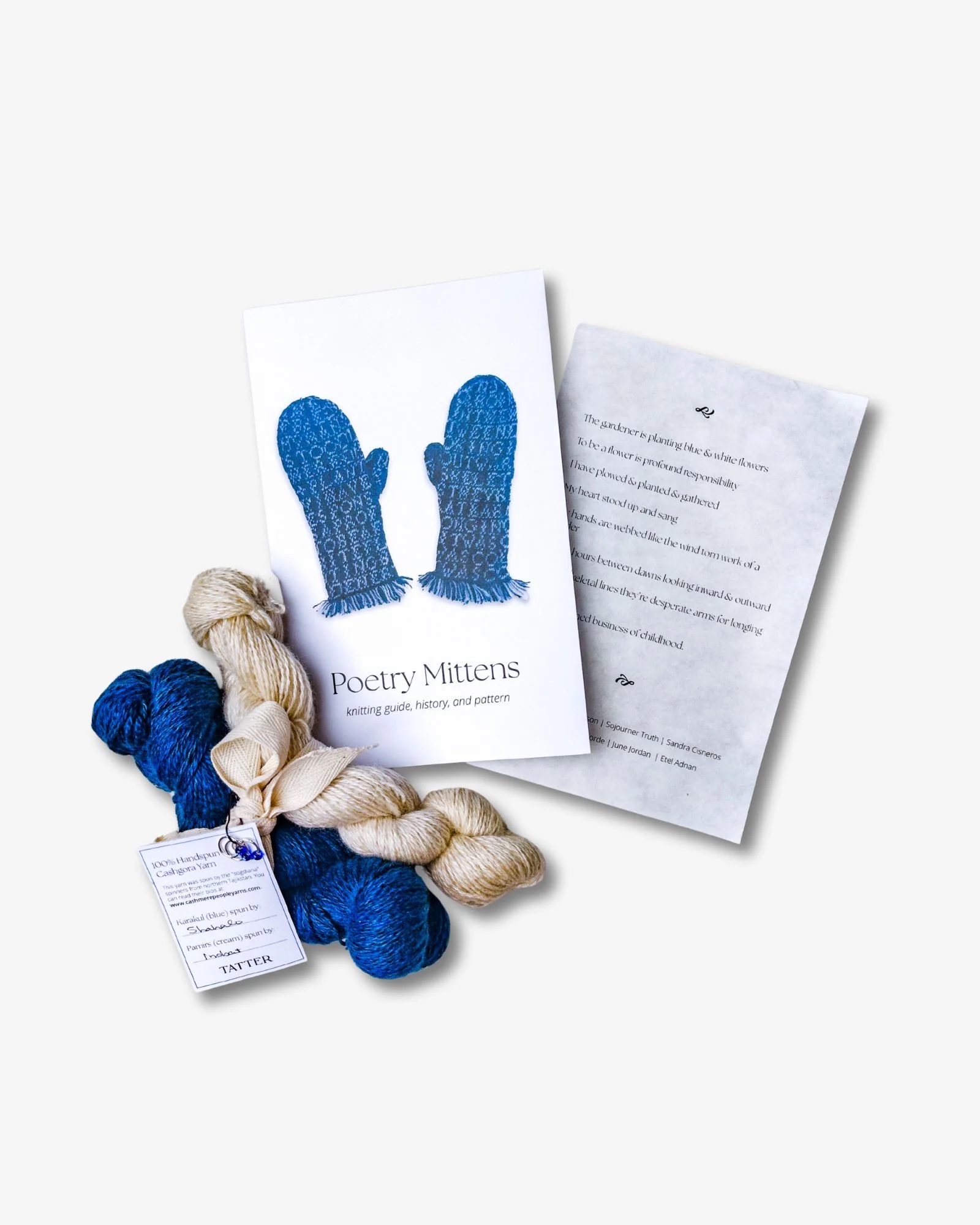
The Poetry Mittens Knitting Kit is a curated knitting kit designed to help makers create a pair of patterned mittens featuring poetic text worked into the fabric. The modern kit is associated with Tatter, a textile-focused organization known for celebrating handwork, textile history, and craft education. The full kit has been offered with a printed booklet, a poem printout, colorwork charts, and handspun cashgora yarn in dyed and natural shades.
In plain English, it gives knitters the materials and guidance needed to create mittens that look like they wandered out of a museum collection, grabbed a cup of tea, and decided to become a modern heirloom. The design is rooted in historic blue-and-white homespun mittens connected to the Smithsonian collection, and that historical influence is what separates this kit from ordinary mitten patterns.
Most mitten kits are built around warmth, color, and fit. This one adds language. The lettering becomes a visual pattern, and the poem becomes part of the structure. Every stitch does double duty: it builds fabric and carries meaning. That makes the finished mittens feel personal even before you slide them on.
Why Poetry Mittens Feel So Different From Regular Mittens
A basic mitten is a practical object. It keeps your fingers from staging a winter protest. A poetry mitten does that too, but it also asks a charming question: what if clothing could speak?
Historically, textiles have often carried messages. Samplers displayed alphabets and moral verses. Quilts preserved family stories. Embroidered linens held initials, dates, and symbols. The Poetry Mittens Knitting Kit belongs to that same tradition of meaningful handwork. Instead of printing a quote on a sweatshirt, you knit letters directly into the surface of the fabric. That is commitment. A screen printer could never.
The lettering also changes the knitting experience. Repeating geometric motifs can become rhythmic and predictable, which is lovely. But knitted text requires more attention. Letters have shapes. Words need spacing. Charts matter. The knitter becomes part maker, part reader, and part very calm detective.
What Usually Comes in the Kit?
Kit contents may vary depending on availability, but the full Poetry Mittens Knitting Kit has been known to include several thoughtful components:
- A printed pattern booklet
- A beautiful printout of the poem
- Colorwork charts for following the lettered design
- Two skeins of handspun cashgora yarn, typically one dyed and one natural
- Color options such as blue-toned or red-toned versions
The pattern has also been available separately in printed or digital form, which is useful for knitters who already own suitable yarn or want to customize the project with their own palette. Still, the full kit has a special appeal because the materials are selected to support the design as intended.
The yarn choice is particularly important. Cashgora, a fiber associated with cashmere-type goats, brings softness, warmth, and a slightly rustic luxury. It feels more refined than basic wool but still suits a heritage-inspired project. When paired with a natural contrast color, it helps the letters stand out clearly without looking too modern or overly polished.
Skill Level: Is This Kit Beginner-Friendly?
The honest answer: not exactly. A fearless beginner could attempt it with enough patience, backup chocolate, and perhaps a trusted knitting friend on speed dial. But the Poetry Mittens Knitting Kit is better suited to intermediate knitters or adventurous advanced beginners who already understand the basics of knitting in the round.
You should be comfortable with:
- Knitting small circumferences in the round
- Reading charts
- Working stranded colorwork
- Maintaining even tension
- Managing floats behind the work
- Finishing mitten thumbs and tips neatly
- Blocking small wool or animal-fiber accessories
The biggest challenge is not necessarily the mitten shape. It is the lettered colorwork. Unlike a repeating snowflake motif, text does not always offer predictable rhythm. One row may feel easy and smooth; the next may require close attention to every square on the chart. That is part of the charm, but it does mean this project is best enjoyed when you are not also watching a complicated murder mystery. Unless you enjoy frogging. Some people do. We do not judge.
Why Gauge Matters So Much
Gauge matters in every knitting project, but with mittens it becomes personal. A sweater that is a little loose can be styled as “relaxed.” A mitten that is too tight becomes a finger prison. A mitten that is too loose becomes a floppy wool windsock. Neither is the goal.
For poetry mittens, gauge also affects the clarity of the lettering. If your stitches are too loose, the letters may look stretched or wobbly. If your stitches are too tight, the fabric may lose elasticity and the text can become compressed. A good gauge swatch helps you confirm that your yarn, needles, and hands are all speaking the same language before the poem begins.
If the pattern uses fingering-weight yarn, smaller needles are typically involved. That creates a dense, warm fabric with crisp detail. Small needles may seem intimidating, but they are excellent for colorwork mittens because they help produce defined stitches and a sturdy surface.
The Beauty of Stranded Colorwork
Stranded colorwork is the technique that allows two colors to appear in the same row. One color is worked while the other is carried behind the fabric, forming small horizontal strands called floats. In the Poetry Mittens Knitting Kit, this technique makes the text and background possible.
The key is tension. Floats should not be so tight that they pucker the fabric, but they should not be so loose that fingers catch on them when the mittens are worn. A practical trick is to spread the stitches out on the right needle before switching colors. This gives the unused yarn enough room to travel across the back without pulling the fabric inward.
Some knitters hold one color in each hand. Others drop and pick up each strand as needed. Both methods can work. The best method is the one that gives you even stitches and does not make you feel like you are wrestling an octopus in a yarn store.
Design Details That Make the Mittens Special
The most obvious design feature is the poem, but several smaller details contribute to the overall effect. The contrast between natural and dyed yarn gives the mittens a historic, hand-hewn quality. The letterforms create texture and movement. The palms, thumbs, cuffs, and tips all become part of the visual story.
These mittens are not loud in the usual way. They do not shout with neon colors or oversized graphics. Instead, they invite closer attention. Someone may first notice the pretty colorwork, then realize it contains words, then ask what the poem says. Congratulations: your mittens are now a conversation starter, and you did not even have to mention the weather.
Who Should Buy a Poetry Mittens Knitting Kit?
This kit is a strong fit for knitters who enjoy projects with meaning. It is especially appealing if you love historical textiles, museum-inspired designs, literary gifts, slow fashion, or heirloom-quality accessories. It also makes a thoughtful gift for someone who already knits and appreciates unusual patterns.
The kit may not be ideal for someone who wants a quick first knitting project. It is also not the best choice for a knitter who dislikes charts or prefers large needles and instant gratification. There is nothing wrong with instant gratification. Bulky yarn exists for a reason. But poetry mittens live in a slower lane.
For the right maker, however, that slowness is exactly the point. This is a project for evenings, winter weekends, fiber retreats, and quiet pockets of time when you want your hands to do something beautiful and slightly ambitious.
How to Prepare Before Casting On
Before beginning, read the entire pattern. Yes, the whole thing. This is the knitting equivalent of checking the map before entering the forest. Look over the charts, identify where the thumb begins, review any special cast-on or edging instructions, and make sure you understand how the poem is distributed across the mitten.
Useful preparation steps include:
- Make a gauge swatch in colorwork, preferably in the round.
- Choose needles that give firm but flexible fabric.
- Mark chart sections with sticky notes or a magnetic board.
- Wind yarn carefully before starting.
- Practice a few rows of stranded lettering if you are nervous.
- Check hand measurements against the pattern size.
A row counter can help, but for this project, chart tracking is even more important. Many knitters prefer to mark each completed row immediately. Do not tell yourself, “I’ll remember where I am.” That sentence has caused more knitting chaos than dropped stitches and curious cats combined.
Choosing Colors for Poetry Mittens
If you buy the full kit, the colors are already curated. That is one of the advantages. The contrast is chosen to make the letters readable and the finished mittens visually balanced. If you buy only the pattern and select your own yarn, prioritize contrast over personal fantasy.
Two colors may look beautiful side by side in skein form but turn muddy when knitted together. A deep navy and charcoal gray may feel sophisticated, but the letters could disappear faster than a tape measure in a craft room. For readable text, choose one light and one dark shade. Natural white with blue, red, brown, forest green, or black can work well.
Fiber matters too. Wool and wool-like animal fibers are usually excellent for colorwork because they have grip and memory. Super-slick yarns can make tension harder to control. Very fuzzy yarns may blur the letter shapes. Save the halo-heavy mohair for another romantic adventure.
Care and Blocking Tips
Once finished, poetry mittens deserve gentle care. Handwashing is usually safest for handspun animal-fiber yarns. Use cool water, a wool-friendly wash, and minimal agitation. Press water out gently with a towel instead of wringing. Wringing handmade mittens is a crime against patience.
Blocking helps even out colorwork and smooth the fabric. You can shape the mittens by hand or use mitten blockers if you have them. The goal is not to stretch them aggressively, but to encourage the stitches to relax into place. After drying fully, the letters often look cleaner and the fabric feels more cohesive.
Why This Kit Makes a Memorable Gift
A Poetry Mittens Knitting Kit makes a wonderful gift because it offers more than materials. It gives the recipient a project with a story. For a knitter, that matters. Yarn is lovely, but yarn with purpose is even better.
It is especially suitable for birthdays, holidays, retirement gifts, winter celebrations, or “you survived another semester” presents for literary people. It also works beautifully for someone who loves museums, poetry, handmade clothing, or historic craft traditions.
If you are giving the kit to a newer knitter, include a small note encouraging them to take their time. Maybe add stitch markers, a row counter, or a nice project bag. If you are giving the finished mittens, prepare yourself: the recipient may become emotionally attached. Handmade gifts have that effect. They sneak past logic and head straight for the heart.
Poetry Mittens vs. Standard Mitten Kits
Compared with a standard mitten kit, the Poetry Mittens Knitting Kit offers a more layered experience. A standard kit may focus on warmth, fit, and a pleasant pattern. This kit adds history, text, symbolism, and a stronger sense of narrative.
That does not automatically make it “better” for everyone. A simple mitten kit may be better for beginners, fast gift knitting, or low-stress travel knitting. But for knitters who want a project that feels rare, artistic, and deeply personal, poetry mittens stand out.
Think of it this way: regular mittens say, “My hands are warm.” Poetry mittens say, “My hands are warm, historically informed, and possibly better read than the rest of me.”
Common Mistakes to Avoid
Skipping the Swatch
This is the classic mistake. The yarn looks right, the needles seem right, and optimism is high. Then the mitten comes out sized for either a toddler or a friendly bear. Swatch first.
Choosing Low-Contrast Colors
Lettered mittens need readable contrast. If the colors are too similar, the poem becomes a secret known only to you and your lamp.
Pulling Floats Too Tight
Tight floats can pucker the fabric and reduce stretch. Keep stitches spread out as you work and check the back of the fabric often.
Losing Your Place in the Chart
Charts for text require attention. Use markers, highlighter tape, or digital chart tools. Future you will be grateful.
Rushing the Finishing
Careful finishing turns a good project into a beautiful one. Weave ends neatly, block gently, and let the mittens dry completely before wearing.
500-Word Experience Section: What It Feels Like to Knit Poetry Mittens
Knitting the Poetry Mittens Knitting Kit feels different from starting an ordinary accessory. The first few rows may seem familiar: cast on, settle into the rhythm, check your tension, admire the yarn, wonder briefly whether you own too much yarn, reject that thought as nonsense. But once the lettering begins, the project changes. You are no longer just making fabric. You are building sentences one stitch at a time.
The experience is slow in the best way. Each charted row asks for attention, and that attention becomes almost meditative. You begin to notice how letters behave as shapes. A curve has to be translated into squares. A line must be suggested through stitches. A word becomes a small architectural problem. It is fascinating, slightly fussy, and deeply satisfying when the text begins to appear.
There is also a pleasant sense of suspense. With ordinary colorwork, you often know exactly what the motif will become. With poetry mittens, a few stitches may not look like much at first. Then suddenly a letter forms, then part of a word, then a phrase. It feels like watching a message surface from snow. That moment is addictive. You may tell yourself you will knit only one more row. This is a known fib in the knitting community.
The project also teaches patience with imperfection. Handmade lettering will not look like machine typography. That is part of its beauty. The slight variations in tension, the softness of the yarn, and the human pace of the stitches all remind you that this is not printed text. It is made text. It has warmth before it even warms your hands.
If you knit in the evening, the project pairs well with quiet music, tea, and a table where the chart can stay visible. It is not ideal for chaotic environments unless you are unusually brave. A barking dog, a dramatic television plot, or a child asking where socks come from can all interrupt chart focus. Keep a pencil nearby. Mark your rows. Protect your concentration like it is the last cookie.
The most rewarding part comes near the end, when the mittens finally look like real objects instead of mysterious tubes with ambition. After blocking, the colorwork relaxes, the letters settle, and the whole piece seems to exhale. The finished mittens feel like something you could wear, gift, display, or quietly admire while pretending to tidy your knitting basket.
For many makers, the Poetry Mittens Knitting Kit becomes more than a project. It becomes a reminder that clothing can carry memory, language, humor, skill, and care. A person could buy mittens anywhere. But knitting a poem into a pair of mittens? That is a small act of devotion, with thumbs.
Conclusion
The Poetry Mittens Knitting Kit is a rare project for knitters who want their handmade accessories to carry history, beauty, and meaning. It combines stranded colorwork, literary charm, fine yarn, and museum-inspired design into a pair of mittens that feel both old-fashioned and refreshingly original. This is not a throwaway weekend craft. It is a slow, thoughtful project that rewards careful hands and curious minds.
For intermediate knitters, poetry lovers, textile history fans, and gift-givers searching for something more memorable than another candle, this kit offers a wonderful blend of challenge and delight. The finished mittens are warm, yes, but their real magic is in the message: handmade things can still speak.
Note: Kit contents, colors, pricing, and availability may change over time. Before publishing or purchasing, verify the latest product details with the seller.