Some art asks us to contemplate the human condition. Some art asks us to admire light, movement, faith, beauty, suffering, war, mythology, and the fragile drama of existence. And then some art asks the most important question of all: “Would this masterpiece be better if a large orange cat were lounging in the middle of it?”
In the case of Fat Cat Art, the answer is a magnificent, whisker-twitching yes.
Artist Svetlana Petrova became known online for digitally inserting her beloved ginger cat, Zarathustra, into famous paintings. The result is a brilliant collision of classical art and internet cat culture: Renaissance angels, Dutch still lifes, moody portraits, mythological monsters, and iconic modern artworks suddenly become funnier, warmer, and far more likely to demand snacks.
The latest collection, often shared under the title “Owner Recreates Famous Art Pieces By Incorporating Her Fat Orange Cat, And The Results Are Hilarious (15 New Pics)”, continues the joke with impressive style. These are not lazy cut-and-paste memes. Petrova’s works show a serious understanding of composition, lighting, art history, and visual humor. The cat is not simply added to a painting; he is staged like he was always there, waiting patiently for humanity to catch up.
What Is Fat Cat Art?
Fat Cat Art is a digital art project built around a wonderfully simple idea: take world-famous masterpieces and “improve” them with a very confident orange cat. The star, Zarathustra, was Petrova’s real cat and creative partner. His round body, theatrical expressions, and natural talent for posing made him the perfect muse for a project that blends parody, affection, and art education.
Petrova has explained in interviews that Zarathustra came into her life after her mother passed away. The cat became more than a pet; he was a living connection to her mother and a source of comfort during grief. That emotional backstory gives the project surprising tenderness. Yes, the images are funny. Yes, the cat often looks like he has conquered Western civilization with one paw. But underneath the humor is a personal tribute to love, memory, and the strange healing power of animals.
The project began in 2011 and grew into a viral art phenomenon. Over time, Petrova created hundreds of images and animations, transforming Zarathustra into a co-author of sorts. He appears as a model, saint, goddess, monster, nobleman, muse, and occasionally the only character in the painting who seems to know exactly what is going on.
Why an Orange Cat Works So Well in Famous Paintings
Orange cats already carry a certain cultural reputation. They are often portrayed online as dramatic, food-motivated, chaotic, affectionate, and operating on one shared brain cell that is sometimes unavailable due to maintenance. Whether fair or not, that reputation makes Zarathustra’s entrance into classical art instantly funny.
But the humor also works because the original artworks are so serious. A grand historical painting expects reverence. A religious scene expects awe. A psychological portrait expects silence. Then Zarathustra appears, large and luminous, and the whole atmosphere changes. Suddenly, the viewer is allowed to laugh. The museum becomes less intimidating. The painting becomes approachable.
This is the secret charm of Fat Cat Art: it does not mock art history; it invites people into it. Someone who has never studied Titian, Botticelli, Munch, or Uccello might click for the cat and stay because they want to know the original painting. That is a clever kind of cultural mischief.
The 15 New Pics: Classic Art, Now With More Cat
The new collection includes a lively mix of paintings from different periods, styles, and themes. Some are instantly recognizable; others may send readers on a delightful art-history treasure hunt. Here are some highlights and why they work so well.
1. “Furry Starry Night Over the Rhone”
Vincent van Gogh’s Starry Night Over the Rhône is already full of shimmering lights and emotional atmosphere. Add Zarathustra, and the night sky becomes less like a poetic meditation and more like the perfect backdrop for a cat who has just discovered that the universe revolves around him. The orange fur contrasts beautifully with Van Gogh’s blues and yellows, making the cat feel like a tiny sun with opinions.
2. “The Cream of Edvard Munch’s Scream”
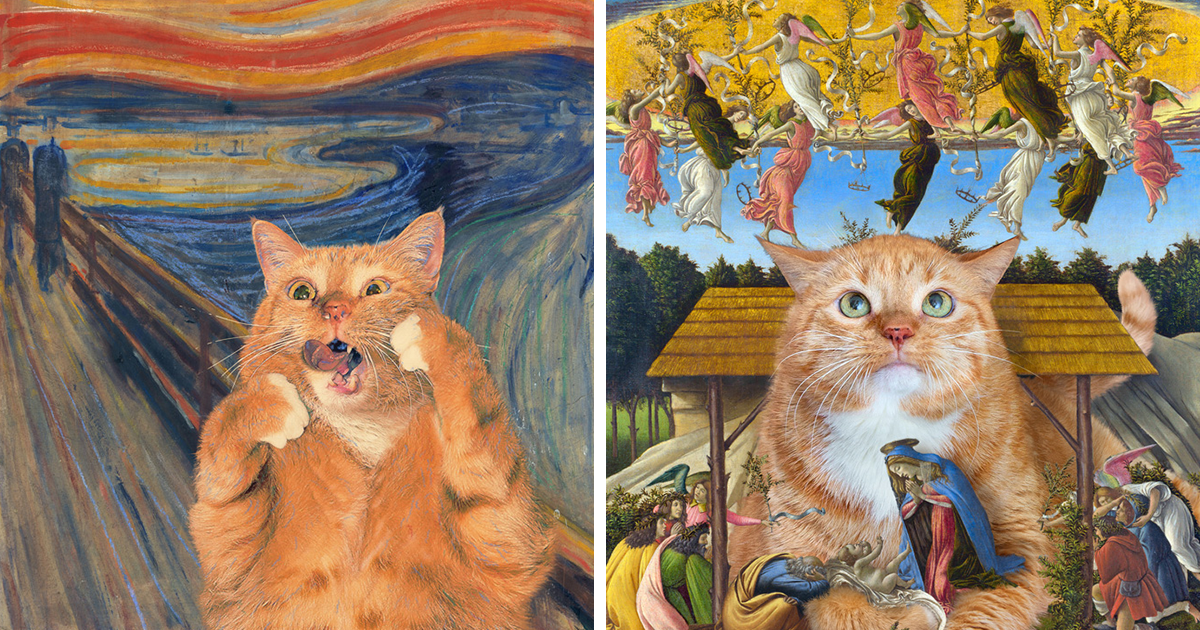
Edvard Munch’s The Scream is one of the most famous images of anxiety in art history. In the Fat Cat Art version, the existential dread is transformed into a very feline crisis. Is the cat screaming because dinner is late? Because the bottom of the food bowl is visible? Because someone closed a door? The parody works because every cat owner knows that household drama can reach operatic levels over absolutely nothing.
3. “The Visit of the Supreme Being”
Inspired by Hieronymus Bosch’s visionary world, this piece places Zarathustra inside a strange, mystical scene that already feels like a dream after eating too much cheese. Bosch’s work is full of bizarre creatures and spiritual drama, so a majestic orange cat does not feel out of place. In fact, he looks like he may be in charge of the afterlife’s snack department.
4. “Napoleon Cat Crossing the Alps”
Jacques-Louis David’s Napoleon Crossing the Alps is all confidence, movement, and heroic propaganda. Replace the military glory with a proud cat, and the joke practically writes itself. Zarathustra does not need an empire. He already owns the sofa, the laundry basket, and at least three forbidden shelves.
5. “Irresistible Temptation”
Salvador Dalí’s dreamlike universe is a natural playground for a cat. In a surrealist painting, long-legged creatures, floating objects, and impossible landscapes already ignore normal rules. Zarathustra fits right in because cats also ignore normal rules, especially gravity, personal space, and the concept of “no.”
6. “Merry Catholic Christmas!”
Based on Melozzo da Forlì’s angelic imagery, this parody leans into the absurdity of sacred art meeting cat appetite. The humor comes from contrast: elegant wings, heavenly music, soft Renaissance beauty, and one orange cat who appears to be thinking about seafood. It is reverent in technique but cheerfully ridiculous in spirit.
7. “This Feeling When Angels Dance on Your Ears”
Botticelli’s Mystic Nativity is filled with symbolism and spiritual movement. Add a cat, and suddenly the angels look less like celestial messengers and more like tiny roommates interrupting an important nap. It is a perfect example of Petrova’s ability to make a grand composition feel intimate and funny without flattening its beauty.
8. “Halloween Cat”
Henry Fuseli’s The Nightmare has always had a theatrical, eerie quality. Inserting a fat orange cat into that world turns gothic terror into household comedy. Any cat owner who has woken up with a pet standing on their chest at 4 a.m. understands that this version may actually be more realistic than the original.
9. “Venus’ Selfie”
Titian’s Venus with a Mirror explores beauty, reflection, and desire. The Fat Cat Art version turns it into a timeless scene of self-admiration. A cat with a mirror needs no mythological explanation. Cats have always known they are beautiful. Humans simply needed several centuries of oil painting to catch up.
10. “The Temptation of the Fat Cat”
Michelangelo’s The Torment of Saint Anthony is full of twisting bodies and demonic energy. With Zarathustra added, the chaos becomes oddly practical. The cat looks less tormented than mildly inconvenienced. This is classic feline comedy: place a cat in a dramatic scene, and the cat will somehow make the drama about comfort.
11. “Dating a Cat”
James Tissot’s stylish social scenes are full of costume, gesture, and polite tension. Add Zarathustra and the dating dynamic becomes instantly clearer. The human may think this is a romantic encounter, but the cat is probably evaluating the chair, the food, and whether anyone is prepared to offer admiration on demand.
12. “The Daughters and the Cats of Edward Darley Boit”
John Singer Sargent’s The Daughters of Edward Darley Boit is famous for its unusual composition and quiet psychological atmosphere. In the cat version, the silence becomes domestic. The large vases, shadowy space, and formal arrangement suddenly feel like the perfect environment for cats to appear, disappear, and stare at invisible spirits in the hallway.
13. “Flower or Turkey Pie?”
Dutch still life paintings often celebrate abundance, texture, and the pleasures of the table. A cat inserted into a feast scene is not just funny; it is inevitable. If there is turkey pie, a cat will arrive. If there are flowers, a cat will inspect them. If there is a carefully balanced composition, a cat will improve it by sitting exactly where it should not.
14. “Being Body Positive”
Fernando Botero’s style is known for round, exaggerated forms, making it a perfect match for Zarathustra’s generous silhouette. This parody is especially clever because the cat does not disrupt the visual language. He belongs there. The result feels joyful, confident, and refreshingly free from the modern internet’s obsession with making every body smaller.
15. “Saint George and the Dragon” Reimagined
Paolo Uccello’s Saint George and the Dragon becomes hilarious when the dragon-like figure takes on feline energy. A cat-dragon is a frightening thought, not because of fire, but because of claws, judgment, and the ability to knock a chalice off a medieval table while maintaining eye contact.
Why These Cat Art Parodies Go Viral
Fat Cat Art succeeds because it sits at the intersection of three powerful internet magnets: cats, recognizable culture, and clever remixing. People love cats because they are expressive and unpredictable. People love famous art because it feels important, even when they do not know every historical detail. Put them together, and you get something both accessible and surprisingly smart.
The images also reward different kinds of viewers. A casual scroller sees a funny orange cat. An art lover notices how carefully the cat is integrated into the color palette and composition. A pet owner recognizes the personality. A museum educator sees a gateway into art history. That layered appeal gives the project staying power beyond a quick laugh.
The Art-History Joke Is Smarter Than It Looks
At first glance, the joke may seem simple: cat plus painting equals funny. But Petrova’s work is more thoughtful than that. The best parodies understand the original source. Zarathustra is placed where he can change the meaning of the scene, not merely decorate it.
In The Scream, the cat exaggerates anxiety. In Napoleon Crossing the Alps, he punctures masculine grandeur. In Dutch still life, he highlights appetite and abundance. In Botticelli, he turns spiritual choreography into a familiar domestic moment. In Sargent, he adds warmth to an enigmatic family portrait. Each image creates a new conversation with the original.
This is why the project can be both silly and sophisticated. It is meme culture with a museum badge. It laughs, but it knows what it is laughing with.
What Cat Owners Understand Immediately
Anyone who has lived with a cat knows that cats already behave like they belong in masterpieces. They arrange themselves in perfect poses, choose dramatic lighting, and stare into the distance as if contemplating the decline of empires. They also ruin laundry, steal chairs, and become boneless when you need to move them.
Zarathustra’s success as a model comes from that natural theatricality. His round form reads beautifully in paintings because it has presence. He does not vanish into the background. He anchors the image. Whether he is lying across a mythological scene or appearing beside a saint, he brings the same expression: calm authority mixed with the possibility of sudden snack-related violence.
Experience Section: What This Topic Teaches About Creativity, Pets, and Online Joy
One of the most enjoyable lessons from Fat Cat Art is that creativity does not always need to begin with a grand theory. Sometimes it begins with a pet doing something funny in your apartment. A cat stretches under a lamp, looks strangely noble, and suddenly you understand why painters spent centuries chasing the perfect pose. The everyday world is full of visual comedy if you are willing to notice it.
For creators, Petrova’s project is a reminder that originality often comes from combining two familiar things in a fresh way. Famous paintings are familiar. Cat photos are familiar. But a ginger cat convincingly inserted into masterpieces creates a new emotional reaction. It turns “I have seen this before” into “Wait, why is this so good?” That little twist is the engine of shareable content.
There is also a practical lesson for digital artists and bloggers. A strong concept matters. Fat Cat Art has a clear identity: famous masterpieces improved by a ginger cat with attitude. That idea is easy to remember, easy to describe, and easy to share. In a crowded online world, clarity is a superpower. People may forget a complicated artist statement, but they will remember the cat in the Mona Lisa.
Pet owners can relate to the project because it captures something true about living with animals. Pets become part of our personal mythology. They appear in our routines, our photos, our jokes, our grief, and our memories. A cat sleeping on a blanket may not look important to the outside world, but to the owner, that moment can hold an entire emotional universe. Petrova transformed that private affection into public art, which is why the work feels warmer than a typical meme.
There is an experience here for readers, too. Looking at these images may encourage people to revisit the original artworks. A person may arrive for Zarathustra and leave knowing the difference between Van Gogh’s Starry Night and Starry Night Over the Rhône. Someone may laugh at the cat-dragon and then look up Uccello. Someone may see the parody of Sargent and become curious about the mysterious quiet of the original portrait. That is a beautiful outcome: humor leading to learning without making learning feel like homework.
For anyone creating content online, this topic also proves that personality matters. The internet rewards information, but it loves character. Zarathustra is not just an orange cat; he is a persona. He looks proud, lazy, imperial, hungry, annoyed, dreamy, and deeply convinced of his own importance. That personality gives the images their spark. It is not only the technical editing that makes people laugh; it is the feeling that this cat truly would interrupt art history if given the chance.
Finally, Fat Cat Art reminds us that joy is worth taking seriously. In a digital landscape often crowded with outrage, speed, and noise, a beautifully edited orange cat in a Renaissance painting offers a tiny vacation. It is harmless, clever, and oddly uplifting. It says that culture does not have to sit behind glass forever. Sometimes it can climb down from the museum wall, curl up in a golden frame, and purr.
Conclusion
“Owner Recreates Famous Art Pieces By Incorporating Her Fat Orange Cat, And The Results Are Hilarious (15 New Pics)” is more than a funny headline. It points to a project that understands both art history and internet humor with rare charm. Svetlana Petrova’s Fat Cat Art gives classic paintings a second life by adding Zarathustra, a fat orange cat whose confidence could humble emperors, saints, angels, and surrealist elephants.
The magic lies in balance. The images are funny without being careless, clever without being cold, and affectionate without becoming overly sweet. They make museums feel more welcoming and remind viewers that art can be playful, personal, and alive. Whether Zarathustra is crossing the Alps, screaming into the void, admiring himself in a mirror, or becoming a dragon, he proves one thing beyond doubt: every masterpiece has room for a cat.
Note: This article is written as an original, web-ready SEO blog post based on verified public information about Fat Cat Art, Svetlana Petrova, Zarathustra, and the famous artworks referenced in the collection.