A surprise birthday party usually involves cake, balloons, excited relatives, and at least one adult quietly wondering whether anyone remembered to bring matches for the candles. In one widely discussed family story, however, a supposedly thoughtful celebration became a lesson in what happens when an adult plans a party for the child she wants instead of the child standing right in front of her.
The conflict centered on a five-year-old girl, identified by the pseudonym “Cleo,” who had consistently said that she disliked the color pink. Her grandfather’s partner, called “Prue” in the public account, apparently regarded that preference less as useful information and more as a technical error she had been personally appointed to correct.
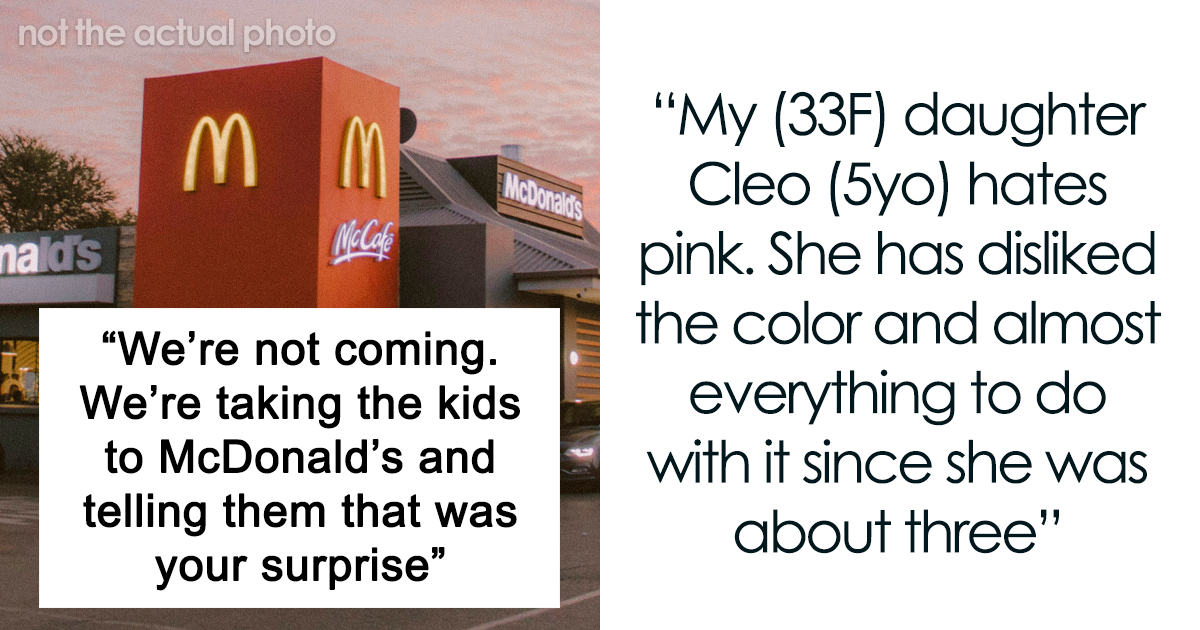
When Cleo’s mother discovered that Prue had arranged an entirely pink surprise party, she refused to take her daughter. Instead, the family went to McDonald’s. The decision triggered accusations of ingratitude, spoiled behavior, parental influence, and poor manners. It also sparked a much larger conversation about child autonomy, gender stereotypes, family boundaries, and the difference between performing generosity and actually being thoughtful.
What Happened With the Pink-Themed Surprise Party?
According to the mother’s public account, Cleo had disliked pink since she was around three years old. This was not a mysterious preference hidden in a locked diary beneath her mattress. She had reportedly expressed it repeatedly, including directly to Prue.
Cleo’s interests were varied. She liked dolls and princesses, but she also enjoyed cars, robots, science, outer space, ballet, and Super Mario Bros. Her favorite colors were yellow and blue. At ballet class, she wore black and had even earned the affectionate nickname “Black Swan.” In other words, she was not rejecting everything traditionally associated with girls. She simply disliked one color.
Prue nevertheless continued giving her pink clothing and toys. When the girl politely asked whether she might receive something yellow in the future, the request apparently failed to penetrate the force field surrounding Prue’s decorating philosophy.
A Dinner Invitation With a Hidden Agenda
The grandfather eventually invited Cleo’s parents and their children to dinner, promising a surprise. Shortly before the family left home, the mother’s younger sister revealed that the “surprise” was actually a birthday party for Cleo, even though the girl’s birthday had passed months earlier.
The timing was strange, but the theme was the real problem. Photographs showed pink tableware, pink balloons, pink banners, pink fringe curtains, and a pink cake. The room had apparently achieved the visual subtlety of a strawberry milkshake exploding inside a gift shop.
Cleo’s parents believed their daughter would immediately realize that the event did not reflect anything she liked. They expected her to become upset rather than feel celebrated. After discussing it, they declined to attend and took their children to McDonald’s instead. The grandfather joined them briefly but was reportedly cold and left early.
Why the Mother Believed the Party Wasn’t Really for Cleo
A gift is not thoughtful merely because it required money, effort, or fifteen rolls of metallic fringe. Thoughtfulness depends on whether the giver considered the recipient.
If someone loves gardening, a set of quality tools may be a meaningful gift. If that person has repeatedly said they hate gardening, the same gift can feel like an assignment. The object has not changed, but the message has. Instead of saying, “I know you,” it says, “I know who you should become.”
That distinction explains why the mother described the party as something that was not truly meant for her daughter. The celebration used Cleo’s name, but it centered Prue’s preferences. The child was expected to supply gratitude, enthusiasm, and perhaps a complete personality rewrite before dessert.
Intentions Do Not Automatically Cancel Impact
Prue may have spent time and money arranging the party. That effort was real. However, good intentions do not erase foreseeable consequences, especially when an adult has already been told that a particular choice upsets a child.
A sincere mistake might involve choosing the wrong shade because nobody knew the child’s preferences. Repeatedly ignoring direct requests is different. Once the intended recipient has clearly said, “I do not like this,” continuing to push it stops looking like a misunderstanding and starts resembling a power struggle.
Was the Mother Teaching Her Daughter to Be Ungrateful?
Critics argued that children should learn to appreciate gifts and tolerate experiences that are not perfectly tailored to them. That principle has value. No child will adore every present, meal, school activity, or relative’s holiday sweater. Learning to respond politely is part of social development.
But politeness does not require pretending that every boundary violation is wonderful. Cleo reportedly thanked Prue for unwanted gifts and sometimes asked respectfully for a different color next time. That is age-appropriate courtesy. It is not reasonable to demand theatrical delight whenever an adult ignores her preferences.
Gratitude means recognizing genuine kindness. It does not mean surrendering all personal taste so the giver can feel successful. Adults understand this distinction instinctively. Few people would call a grown man spoiled for declining a birthday party built around something he openly hates. Children deserve an age-appropriate version of that same respect.
Why Personal Choices Matter at Age Five
Five-year-olds cannot make every decision. They should not determine household finances, bedtime rules, medical care, or whether breakfast consists entirely of marshmallows. Parents remain responsible for safety, health, structure, and long-term judgment.
However, young children can make meaningful low-risk choices about colors, hobbies, clothing options, toys, stories, and party themes. These decisions help them develop agency: the understanding that their thoughts and preferences can influence parts of their world.
Offering children reasonable choices also helps them practice communication. They learn how to express an opinion, hear another person’s preference, compromise when necessary, and accept limits when the issue genuinely matters. A child who says, “I like yellow instead,” is not staging a rebellion against civilization. She is practicing self-expression.
Validation Is Not the Same as Indulgence
Validating a child’s feelings does not mean granting every request. A parent can say, “I understand that you are disappointed, but we still have to leave the playground.” The feeling is accepted even when the decision remains unchanged.
In the party dispute, there was no practical reason Cleo needed to embrace pink. Her dislike was neither dangerous nor harmful. Respecting it did not require the adults to abandon an essential rule. It simply required them to stop treating femininity as a mandatory uniform.
How Gender Stereotypes Turned a Color Into a Family Battle
The argument was never solely about decoration. Prue reportedly objected to several of Cleo’s less traditionally feminine interests, including her preference for blue, her enthusiasm for racing, and her choice of an Elphaba costume rather than a more conventionally glamorous character.
That context suggests the pink party represented a broader expectation: girls should display femininity in a particular way. Pink became symbolic shorthand for the version of girlhood Prue wanted Cleo to perform.
The irony is that modern pink-for-girls and blue-for-boys conventions are relatively recent cultural habits rather than timeless biological laws. During earlier periods, recommendations sometimes reversed the colors, and young children frequently wore similar white clothing regardless of sex. Marketing later helped strengthen the pink-and-blue division.
There is nothing wrong with a girl loving pink, princess dresses, glitter, dolls, or bows. The problem appears when those interests become compulsory. Freedom means allowing a child to adore pink without ridicule and allowing another child to avoid it without being treated like a malfunctioning princess robot.
When Parents Should Set Boundaries With Relatives
Extended family relationships can enrich a child’s life, but grandparents and their partners do not outrank parents. When a relative repeatedly disregards a child’s preferences or undermines parental decisions, clearer boundaries may be necessary.
After the party conflict, Cleo’s parents reportedly established three rules: no surprise parties without parental approval, no more pushing pink gifts, and no insulting the children for disliking something. They also explained that continued violations could reduce the relative’s contact with the family.
Those boundaries were specific, understandable, and connected to consequences. They did not demand that Prue personally dislike pink or abandon her own tastes. They focused on behavior toward the child.
Useful Language for Similar Family Conflicts
- “You do not have to agree with her preference, but you do need to respect it.”
- “Please check with us before planning parties or major surprises.”
- “We are teaching her to be polite, not to pretend she likes everything.”
- “Comments suggesting that certain interests are inappropriate for girls need to stop.”
- “If this continues, we will change how and when visits happen.”
The strongest boundaries are usually calm rather than dramatic. They identify the behavior, explain the expectation, and state what the parents will do if the behavior continues. A boundary is not an attempt to control another adult. It is a decision about what access and behavior the parents will accept.
What Happened After the Original Party Dispute?
In a later public update, the mother said Prue initially stopped pushing pink gifts and avoided openly criticizing Cleo’s preferences. The temporary calm did not last.
As Cleo’s sixth birthday approached, she and a friend reportedly planned a joint Wicked-themed celebration. Cleo wanted to dress as Elphaba while her friend chose Glinda. Prue later sent the mother a lengthy message criticizing Cleo’s less traditionally feminine interests and blaming the parents for encouraging them.
The parents concluded that the underlying problem had not changed. They blocked Prue, limited contact to larger family events, and told the grandfather he could continue seeing the children separately.
The final twist was almost too perfect: Cleo eventually discovered that she liked one deep magenta shade, which she called “purple pink.” That detail demonstrated what the adults should have understood from the beginning. A child’s tastes can evolve naturally when nobody is trying to force them.
Related Experiences: How Similar Conflicts Appear in Real Families
The following are illustrative composite experiences based on common family situations. They are not additional claims about the anonymous family in the original account.
Experience 1: The Sports Party for the Child Who Hates Sports
A parent tells relatives that her eight-year-old wants an art-themed birthday. An uncle decides children need to be “more active” and reserves a soccer facility instead. He then becomes offended when the child looks disappointed. The problem is not that soccer is bad or that children should never try unfamiliar activities. The problem is that a birthday celebration was used to deliver a correction. A better approach would be inviting the child to a casual soccer game on another day, without hijacking an event that was supposed to recognize her interests.
Experience 2: The Haircut That Becomes an Identity Argument
A boy asks for longer hair, while his grandfather repeatedly tells him that boys need short hair to look respectable. The parents allow the longer style as long as it remains clean and manageable. At every visit, the grandfather makes jokes or offers money for a haircut. What sounds like teasing gradually teaches the child that affection may depend on appearance. The parents eventually prohibit comments about his hair. The boundary does not require the grandfather to like the style; it requires him to stop making the child responsible for his discomfort.
Experience 3: The Grandparent Who Always Buys the “Correct” Toys
A girl who loves dinosaurs receives dolls from the same relative every holiday. She thanks the giver, places the dolls aside, and returns to her fossil kits. The relative complains that the parents are encouraging unfeminine behavior. Instead of demanding a particular toy, the parents create a short gift list containing books, puzzles, art supplies, and several dinosaur items. When the relative ignores it again, the parents donate the unused presents without staging a family courtroom drama around the wrapping paper.
Experience 4: The Child Who Changes Her Mind
A six-year-old insists for two years that she hates dresses. Her parents stop buying them and allow comfortable alternatives. One summer, she unexpectedly chooses a bright dress for a family wedding. Nobody announces victory, asks whether she has “finally become a proper girl,” or purchases twelve emergency dresses before sunset. Because her earlier preference was respected, changing her mind does not feel like surrender. Children are more comfortable exploring new interests when adults do not transform every choice into evidence for a larger ideological case.
Experience 5: The Parent Who Mistakes Compliance for Resilience
A relative argues that children must sometimes tolerate disappointment. That is true, but adults should distinguish unavoidable disappointment from deliberately manufactured discomfort. Waiting for a turn, losing a game, or accepting that a toy is too expensive can build patience. Repeatedly presenting a child with something she dislikes to prove that adults are in charge teaches a different lesson: powerful people do not have to listen. Healthy resilience grows when children face manageable challenges while supported by trustworthy adults, not when those adults create unnecessary conflicts and call the result character development.
The Bigger Lesson Behind the Party
The mother’s decision was not really about protecting her daughter from a dangerous color. Pink frosting was not preparing to leap from the cake and attack the guests. The issue was whether Cleo’s clearly communicated preferences deserved basic consideration.
Children need guidance, limits, flexibility, and opportunities to experience disappointment. They also need adults who listen. Those values are not opposites. Parents can teach gratitude without demanding false enthusiasm, encourage experimentation without forcing conformity, and maintain family relationships without sacrificing reasonable boundaries.
A celebration should tell a child, “We see you, and we are glad you are here.” When every detail communicates the opposite, skipping the party may be less rude than attending and expecting the guest of honor to smile through it.