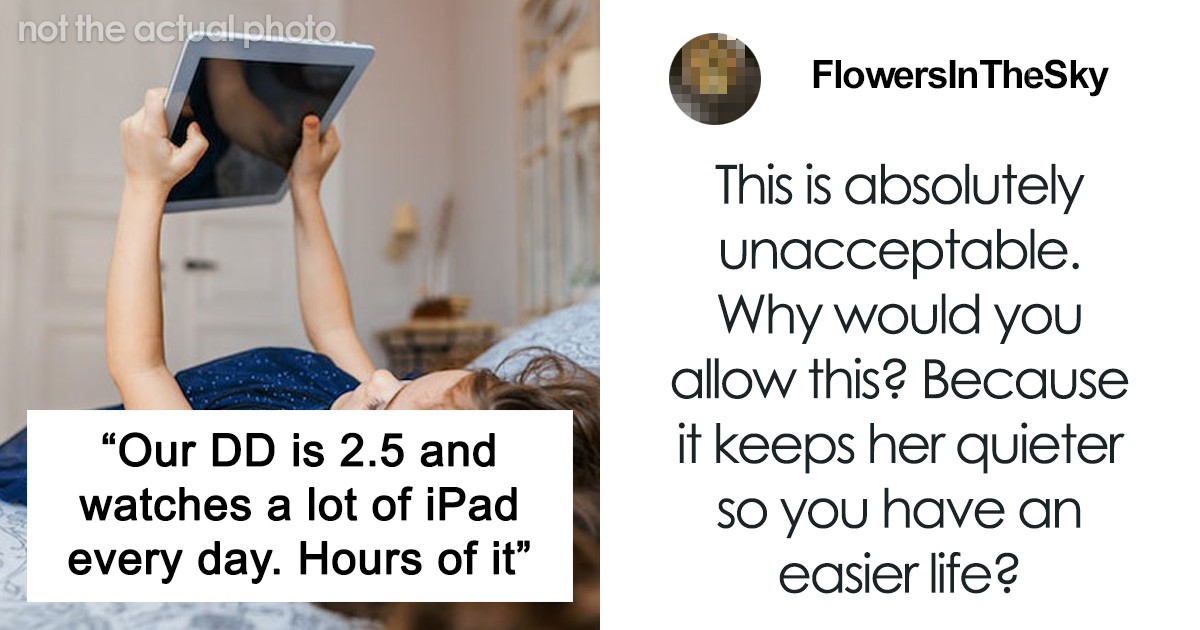
ssure her that hours of daily iPad use were harmless because her toddler appeared academically advanced. Instead, the internet delivered a digital bucket of cold water. The viral discussion exposed a familiar modern parenting conflict: screens can teach letters, colors, and songs, but they can also crowd out conversation, movement, sleep, boredom, and imaginative play. The useful question is not whether one tablet has “ruined” a child. It is whether the family’s current media routine supports the child’s whole developmentand how to change course without turning parental guilt into another full-time job.
The Post That Invited a Parenting Jury
The discussion began when a mother wrote on Mumsnet about her daughter, who was almost two and a half. The child reportedly used an iPad for hours every day, especially while spending time with her father. The mother described both parents as loving and involved, but acknowledged that the tablet had become the father’s default option whenever they were not at a park, museum, class, or other planned activity.
Her defense was familiar to many families. The toddler could identify most letters, count small groups of objects, name several colors in Spanish, and begin typing search terms before choosing the right suggestion. In other words, the iPad appeared to be producing visible results. The mother also said her daughter spent time outdoors, did crafts, and interacted with both parents. She was not describing a child sealed in a dark room with only Wi-Fi and crackers.
Still, commenters focused on the phrase “hours every day.” Some asked whether that meant two hours or something closer to seven. Others argued that early alphabet knowledge did not cancel concerns about attention, emotional regulation, physical activity, sleep, or the habit of expecting instant entertainment. A few defended balance and parental survival, but the general verdict was not the sympathy the mother seemed to expect.
14view0
Why the Internet Reacted So Strongly
Screen-time debates are rarely just about screens. They quickly become arguments about good parenting, exhaustion, child care, household labor, and whether a person has ever tried to cook dinner while a toddler repeatedly attempts to reorganize the recycling bin.
The harshest responses treated the iPad as evidence of laziness. That conclusion is too simple. Research on family media use suggests that parental stress, confidence, routines, available support, and adult screen habits can all influence how much media young children consume. A tablet may be filling a practical gap: a parent needs to work, prepare food, care for another child, recover from illness, or simply sit down long enough to remember their own name.
At the same time, “parenting is hard” cannot answer every developmental question. Compassion for caregivers and sensible limits for children can coexist. A smoke alarm is still useful even when the person who burned the toast is exhausted.
What Current Guidance Says About Toddler Screen Time
For children younger than 18 months, pediatric guidance generally recommends avoiding screen media other than video calls. For children from 18 to 24 months, caregivers who introduce media are encouraged to choose high-quality content and watch with the child. For ages two through five, a commonly cited benchmark is about one hour per day of high-quality programming, ideally with an adult participating.
The World Health Organization similarly emphasizes limiting sedentary screen time in children under five while protecting sleep, movement, and active play. Newer guidance from the American Academy of Pediatrics also warns parents not to obsess over a single stopwatch number. Quality, context, co-use, conversation, and what media displaces all matter.
One hour of a slow, age-appropriate story watched with a parent is not developmentally identical to one hour of frantic autoplay clips consumed alone. That nuance should not be misread as “anything goes.” For a two-year-old, several hours of solo entertainment every day is far beyond what most pediatric and early-childhood organizations consider an ideal routine.
Educational Does Not Automatically Mean Developmentally Complete
An app can teach a toddler to recognize a letter. That is a real skill. It does not prove that unlimited app use is beneficial, just as learning three French words from a cereal box does not turn breakfast into an accredited language program.
Young children learn best when information is connected to responsive human interaction and the physical world. They point, gesture, imitate, test, spill, rebuild, ask the same question 14 times, and watch an adult respond. Harvard’s Center on the Developing Child describes these back-and-forth exchanges as “serve and return.” They help build language, social understanding, and the foundations for later thinking.
Screen-based learning can support development when an adult helps connect the content to real life. A child sees a red truck on-screen, then the parent points out a red truck outside. A counting game becomes counting blueberries at lunch. A song about jumping becomes actual jumping, preferably before the downstairs neighbor files a complaint.
Without that bridge, toddlers may memorize isolated labels without gaining the same depth of understanding they develop through conversation and hands-on play. The problem is not that the child learned letters from YouTube. The problem is assuming those letters compensate for everything else the child might have been doing.
The Biggest Issue May Be What the iPad Replaces
Researchers often discuss screen time as a displacement problem. A day has only so many toddler hours, although parents may reasonably argue that each one lasts six weeks. When several of those hours go to a tablet, they cannot simultaneously go to climbing, drawing, pretending, talking, helping with simple chores, looking at books, or learning how to tolerate a quiet moment.
Conversation and Language
A 2024 cohort study found that more screen time between 12 and 36 months was associated with fewer adult words, fewer child vocalizations, and fewer conversational turns. Other studies and meta-analyses have linked heavier screen exposure with weaker language outcomes, while educational content and co-viewing appear more favorable than passive or background viewing.
This does not mean every extra cartoon causes a missing vocabulary word. Much screen research is observational, so it can identify associations more confidently than direct cause. Families facing stress or developmental concerns may already use more screens. Even so, the repeated connection between heavy use and reduced parent-child talk makes practical sense: a device that occupies both people can interrupt the conversational ping-pong toddlers need.
Development and Problem-Solving
Large cohort studies have found associations between greater early screen exposure and later difficulties in communication, problem-solving, daily living skills, or developmental screening performance. One study reported a dose-response pattern in which more than four daily hours at age one was associated with later delays in communication and problem-solving. Another found that outdoor play may partly reduce some of the developmental risk associated with higher screen use.
These findings should be read as warning lights, not fortune-telling. They do not establish that a specific toddler who watches several hours will experience a delay. They do suggest that “my child knows the alphabet” is too narrow a test of whether the routine is working.
Sleep, Movement, and Vision
Screen use, especially near bedtime, has been associated with later sleep timing, shorter sleep, and poorer sleep quality. Tablets are also close-up activities. The American Academy of Ophthalmology encourages regular breaks and outdoor time, noting that time outside may help reduce the risk or progression of childhood myopia.
Again, the iPad is not a tiny rectangular supervillain. The concern is a pattern: close-up viewing instead of outdoor play, stimulating content before bed, and long sedentary stretches during a stage when bodies and brains are designed to move.
Not All Screen Time Is the Same
Parents can evaluate toddler media with four questions: What is the content? Is an adult involved? What time of day is it used? What is it replacing?
Better Screen Use
- Slow-paced, age-appropriate programming with a clear story or learning goal
- Video calls with relatives who respond to the child
- Short sessions watched or played with a caregiver
- Content that inspires an off-screen activity such as singing, drawing, building, or exploring outdoors
- Media used intentionally rather than running continuously in the background
More Concerning Screen Use
- Hours of unsupervised autoplay or endless short clips
- Fast-paced content filled with ads, rewards, and constant visual changes
- A device used at every meal, car ride, wait, frustration, and bedtime
- Screen use that routinely replaces sleep, movement, conversation, or independent play
- A toddler freely searching an open video platform without strong controls
Being able to type the first letters of a search phrase may look impressive, but it also means a very young child can navigate toward material selected by recommendation systems rather than by a caregiver. At two, digital independence is not the same thing as digital readiness.
How Parents Can Reduce iPad Time Without Starting World War Toddler
A dramatic confiscation may create a dramatic response. Toddlers are not famous for receiving sudden policy changes with the calm professionalism of a municipal planning board. A gradual, predictable reset is usually easier.
1. Measure the Real Amount
For three ordinary days, write down when the device starts and stops. “A little while” has a mysterious ability to become two hours and 17 minutes. Include background television and phones, not only the iPad.
2. Protect the Most Important Times First
Make meals, the hour before bed, and the first part of the morning screen-free. These boundaries protect conversation, appetite cues, transitions, and sleep without requiring the family to reinvent the entire week.
3. Replace the Routine, Not Just the Device
If the tablet usually appears while a parent cooks, prepare a kitchen drawer with safe utensils, reusable stickers, chunky crayons, or a small bin of rotating toys. A toddler can wash vegetables, transfer dry pasta with a scoop, or “help” wipe a cabinet. The cabinet may become wetter than cleaner, but developmental progress is rarely tidy.
4. Teach the Less-Comfortable Parent a Middle Gear
The original post highlighted a useful issue: one parent felt comfortable letting the child potter nearby, while the other seemed to alternate between major outings and the iPad. Many adults need explicit permission to stop performing. Caring for a toddler does not require a museum-quality activity every 12 minutes.
Folding laundry together, watering plants, looking through family photos, building a block tower, or taking a short walk all count. The adult does not have to become a children’s television host with a craft budget.
5. Use Clear Endings
Give a warning, use a timer, finish at a natural stopping point, and state what comes next. “One more episode, then bath” is easier to understand than an abrupt snatch followed by a lecture on neural development.
6. Expect Protest Without Reversing the Rule
A tantrum after the device turns off does not prove the screen has permanently damaged the child. It proves the child preferred the screen. Stay calm, acknowledge the feeling, and hold the limit. Consistency makes the transition less surprising over time.
Parents Need Support, Not a Public Flogging
The mother in the viral thread asked whether the iPad was “rotting” her child’s brain. That phrase is emotionally powerful and scientifically sloppy. Development is not a banana left in a hot car. A family routine can be less than ideal without a child being ruined.
Online commenters were right to challenge the idea that early academic tricks erase the risks of hours of daily tablet use. They were less helpful when they reduced the situation to parental character. Shame tends to make people defensive, secretive, or hopeless. Practical support makes change possible.
A pediatrician can help when screen use is accompanied by language concerns, sleep trouble, extreme distress during transitions, reduced interest in other activities, or worries about vision, hearing, attention, or development. Families should also ask what pressure the screen is solving. Is a caregiver overwhelmed? Is child care unavailable? Is the child difficult to settle? Is a parent unsure how to encourage independent play?
The right intervention may include a media plan, but it may also include respite, developmental support, or simply a better division of household labor.
Related Experiences: What Families Often Learn When They Change the Routine
Many parents discover the screen-time problem gradually. The iPad begins as a tool for a flight, an illness, or one impossible week. Then it becomes the breakfast companion, the grocery-cart negotiator, the restaurant pacifier, and the bedtime bargaining chip. Nobody announces, “Today we shall construct a dependency.” The routine simply grows around the easiest solution.
A common first experience when reducing screen time is that behavior appears to get worse. The child asks repeatedly, cries when the device is unavailable, wanders around declaring boredom in the limited vocabulary of a tiny labor protest, and rejects toys that were perfectly acceptable before. Parents may interpret this as proof that the child “needs” the iPad. More often, the child is reacting to a changed expectation and has not yet rebuilt the skill of entertaining themselves.
The next phase can be surprisingly quiet. After several days of consistent limits, many toddlers begin returning to objects and activities they had ignored. A basket becomes a boat. Sofa cushions become a mountain. A wooden spoon becomes a microphone, a drumstick, and, briefly, a tool for testing the acoustic properties of the dog’s water bowl.
This kind of play looks less educational than an app displaying numbers, but it exercises planning, imagination, language, motor skills, frustration tolerance, and flexible thinking all at once.
Parents also learn that independent play is not the same as leaving a child alone with nothing to do. It develops through practice. An adult might begin by sitting nearby for five minutes while the toddler works with blocks, then gradually shift attention to folding clothes or making coffee. The child checks that the adult is available, returns to play, and slowly builds confidence.
The goal is not constant parental entertainment. It is a secure environment in which the child can explore without requiring nonstop digital stimulation.
Another recurring experience is that adults must change their own habits. A toddler hears “no more screen” while watching a parent scroll through messages, news, recipes, and videos. From the child’s perspective, the rule may look less like health guidance and more like an unfair workplace hierarchy.
Creating a phone basket during meals, keeping devices away during play, or narrating necessary use“I’m checking the bus time, then I’m putting my phone away”makes the family rule visible and credible.
Some families find that planned screen time works better than negotiating every request. A predictable 30-minute window after lunch removes uncertainty. The child knows when media is available, the parent knows when it ends, and the tablet stops functioning as a universal reward for eating peas, putting on shoes, or refraining from licking the shopping cart.
Most importantly, families often learn that improvement does not require perfection. A sick day with movies does not erase a healthy routine. A long trip may involve more screen time than an ordinary Tuesday. A parent can use a tablet to complete an urgent task without submitting a resignation from responsible adulthood.
The useful standard is the overall pattern: Is the child sleeping, moving, talking, playing, connecting, and learning across many kinds of experiences?
The viral mother did not need strangers to certify that hours of daily iPad use were ideal. She needed an honest answer delivered with enough humanity to be usable. Early skills learned from a screen are not meaningless, but they are not a developmental hall pass.
Reduce the hours, improve the content, join the child when possible, protect sleep and play, and help both parents become comfortable with ordinary, unscheduled time. Toddlers do not need every minute optimized. Sometimes they need a cardboard box, a patient adult, and the glorious discovery that boredom is not a medical emergency.
Conclusion
The online response was blunt because several hours of daily iPad use for a two-year-old raises legitimate concerns. Research does not support panic, brain-rotting metaphors, or guarantees of harm. It does support caution, especially when screens replace conversation, outdoor activity, hands-on play, and sleep.
The most useful approach is neither unlimited access nor parental shame. Families can treat media as one small tool among many: chosen carefully, used for a defined purpose, shared with an adult when possible, and turned off before it takes over the day. A toddler may learn letters from a tablet. The rest of childhood still has to happen off-screen.