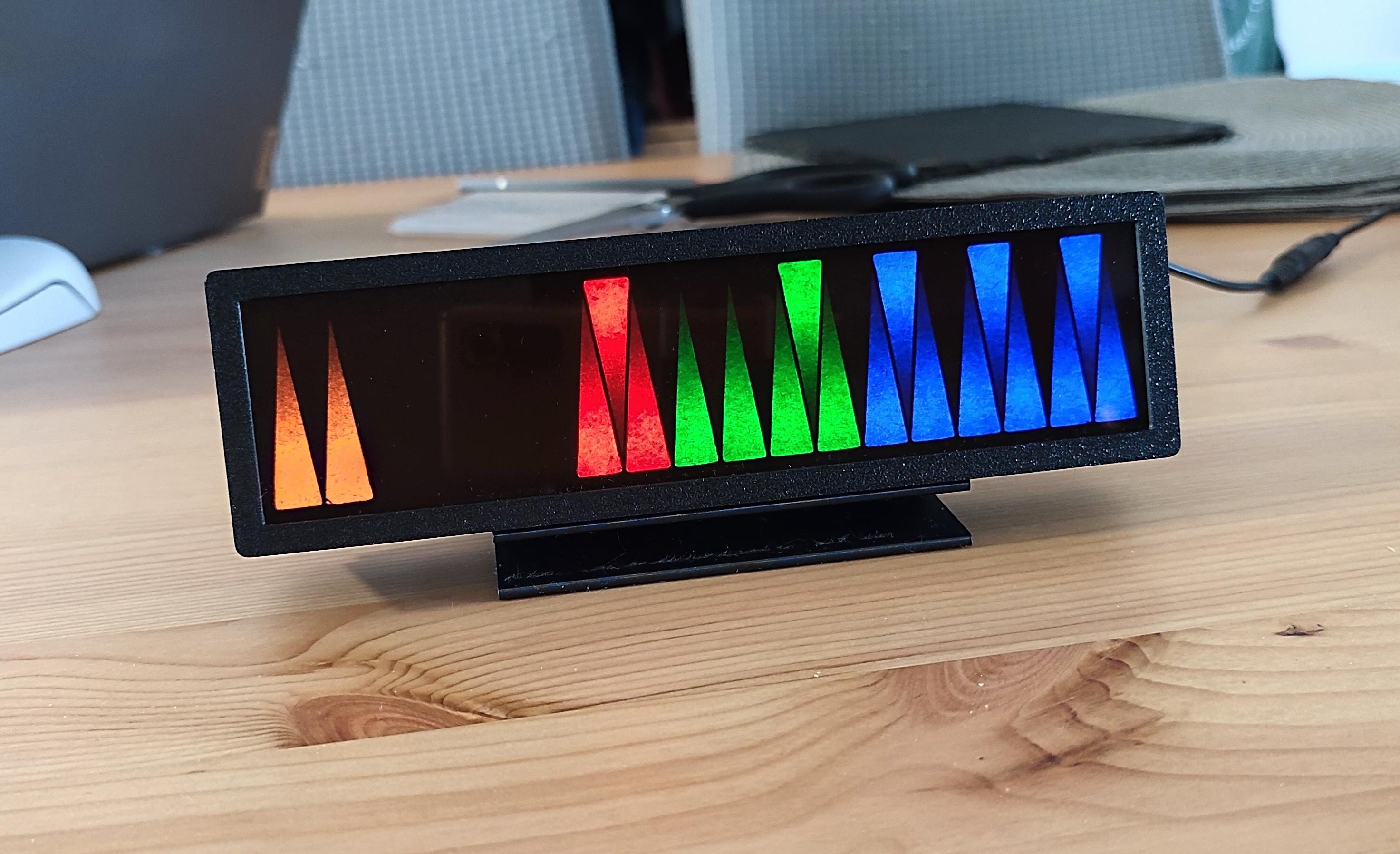
A linear LED clock sounds like something that should belong in a futuristic laboratory, probably next to a talking refrigerator and a suspiciously confident robot vacuum. But the best examples of this maker-friendly timepiece do the opposite: they use modern electronics to create something warm, graphic, and wonderfully retro. The result is a clock that feels less like a gadget shouting from the wall and more like a piece of mid-century wall art quietly keeping everyone honest about being late.
The phrase “linear LED clock” usually describes a clock that does not rely on the familiar four-digit display. Instead of showing time as 12:45 in seven-segment numerals, it maps hours and minutes onto a horizontal arrangement of lights. Some designs use bars, blocks, dots, or color-coded segments. The vintage-looking version that has captured maker attention uses illuminated triangular shapes arranged in a line, giving it a playful geometric look that feels part atomic-age poster, part modern electronics project, and part “yes, I built this myself, please admire it responsibly.”
What makes this kind of clock especially interesting is the contrast. Under the hood, it may use addressable RGB LEDs, a compact Wi-Fi microcontroller such as a Wemos D1 mini, and software that retrieves accurate time from an online server. On the outside, however, it looks like it wandered out of a 1960s design catalog after discovering better soldering techniques. That mix of old visual language and new technology is exactly why the linear LED clock looks decidedly vintageand why it deserves a closer look.
What Is a Linear LED Clock?
A linear LED clock is a time display that arranges lights in a line rather than using traditional clock hands or numeric digits. The time is read by interpreting which LEDs are lit, what colors they use, and how the groups are organized. In many builds, the display is broken into sections for hours, tens of minutes, and single minutes. Instead of reading numbers directly, you read position, color, and pattern.
That may sound complicated at first, but good linear clock design is all about making the pattern learnable. Once the logic clicks, reading the time becomes fast and satisfying. It is a little like learning to read an analog clock as a child, except now the clock has RGB LEDs and may briefly do a startup animation because apparently even clocks deserve a dramatic entrance.
The vintage-style triangular design is especially clever because it avoids the sterile look of a plain LED strip. The triangle shapes give each illuminated point a graphic identity. They soften the technology, turning individual pixels into design elements. This is the difference between “a strip of lights glued to a board” and “a wall clock that makes guests ask where you bought it.”
Why the Design Feels So Vintage
Vintage design is not just about age. It is about visual cues: geometry, color, rhythm, material, and restraint. A linear LED clock can feel vintage because it borrows from several old-school design traditions without copying any one object directly.
Geometric Shapes Create a Mid-Century Mood
Triangles, circles, rectangles, and repeated patterns were common in mid-century graphics, textiles, ceramics, and wall decor. A row of triangular LED windows immediately feels more decorative than a row of naked bulbs. The shape brings a sense of motion and rhythm, even when the clock is just sitting there, silently judging your morning routine.
Mid-century-inspired design often uses simple forms with strong silhouettes. That is why triangles work so well. They are easy to recognize, easy to repeat, and visually interesting from a distance. When grouped in threes, they create a small pattern language: left, center, right; up, down, up; on, off, on. The clock becomes readable but still artistic.
Color Coding Replaces Plain Numbers
Many linear RGB clocks use color to separate time units. One color may represent tens of hours, another the single hour digit, another tens of minutes, and another individual minutes. A vintage-style clock can lean into warm, slightly muted colorsyellows, reds, greens, and bluesthat feel more like classic graphic design than harsh modern lighting.
This matters because color is not only decorative. It is functional. It helps the viewer understand which part of the display belongs to which part of the time. With a smart color system, the clock can avoid clutter while still communicating clearly. It is a tiny user-interface lesson hiding inside a wall ornament.
The Lack of Digits Feels Old and New at Once
Traditional digital clocks are brutally direct. They tell you the time in glowing numbers, no negotiation required. A linear LED clock is more poetic. It asks you to decode the time, but only a little. That decoding process gives it charm.
Ironically, that makes it feel both older and more futuristic. Older, because it recalls mechanical indicators, bar graphs, signal lights, and experimental displays. Futuristic, because the lack of digits makes it feel like an object from a design-conscious science fiction film where everyone owns beautiful furniture and somehow no one has cable clutter.
How the Clock Works Behind the Scenes
The magic of a linear LED clock is mostly software and layout. The electronics are usually straightforward, especially compared with the visual cleverness of the final object. A typical build might include a microcontroller, an addressable RGB LED strip, a power supply, a housing or diffuser, and a time source.
The Microcontroller
A small Wi-Fi-capable board such as a Wemos D1 mini is a popular choice for projects like this because it is compact, affordable, and based on the ESP8266 platform. It can connect to a local Wi-Fi network and retrieve the current time using an internet time server. That means the clock can stay accurate without needing a separate real-time clock module, as long as Wi-Fi is available.
Other builds may use an Arduino Nano, an ESP32, or another microcontroller. If the clock does not connect to Wi-Fi, it may include a real-time clock module such as the DS3231. That module keeps time independently and can continue running from a coin-cell battery when the main power is disconnected. In practical terms, it saves the clock from forgetting the time every time someone unplugs it to vacuum behind the shelf.
The LED Strip
Addressable RGB LEDs such as WS2812-style pixels are common in maker clocks because each LED can be controlled individually. A single data line can tell each pixel what color and brightness to display. This makes it possible to create color-coded time displays, animations, fades, and brightness adjustments with relatively simple wiring.
However, “simple” does not mean “ignore electricity and hope for the best.” LED strips need appropriate power planning. At high brightness, RGB pixels can draw significant current, especially when many are showing white. A reliable build should use a proper power supply, common ground between the controller and LEDs, careful wiring, and sometimes a capacitor or data-line resistor to improve stability. Good clock design is part art, part code, and part not letting the magic smoke escape.
The Diffuser and Housing
The visible personality of the clock comes from its enclosure. A bare LED strip can look harsh and unfinished. A good diffuser spreads the light so each triangle glows evenly instead of showing a bright dot in the center. Acrylic, frosted plastic, 3D-printed parts, laser-cut panels, or layered materials can all create a softer, more polished look.
The enclosure also determines whether the clock feels modern, vintage, industrial, playful, or minimalist. Wood can make it warmer. Black acrylic can make it sleeker. Cream, orange, teal, or walnut tones can push it toward a mid-century mood. The electronics may be the brain, but the case is the haircutand yes, the haircut matters.
Reading the Time on a Linear LED Clock
Every linear LED clock needs a display language. In one vintage-inspired triangular approach, the clock uses four groups of colored triangles. Each group represents part of the time in 24-hour format: tens of hours, single hours, tens of minutes, and single minutes. The triangles light in a repeated order, and the number of illuminated shapes tells the viewer the value.
For example, a clock might use yellow for tens of hours, red for single hours, green for tens of minutes, and blue for single minutes. If the yellow section shows one unit, the red section shows four, the green section shows three, and the blue section shows two, the time would be interpreted as 14:32. The exact reading method depends on the specific build, but the principle is the same: color and position replace standard digits.
This is why a demo video is often helpful for unusual clocks. A written explanation can feel like reading the rules to a board game before coffee. But once you watch the display move through several times of day, the system becomes intuitive. The best linear clocks reward a short learning curve with a display that feels more personal than a mass-produced digital clock.
Why Makers Love Unusual Clock Projects
Clock projects have a special place in electronics culture. They are practical enough to justify building, but flexible enough to invite creativity. A clock can be simple or wildly complicated. It can use LEDs, Nixie tubes, e-paper, servos, flip discs, projection, sound, or even mechanical marbles if someone has enough patience and questionable drawer space.
The linear LED clock sits in a sweet spot. It is approachable for intermediate makers but still leaves room for refinement. The basic concept can be built with common components, but the final result depends heavily on design decisions. How should the time be encoded? Should the brightness change at night? Should the clock show a startup animation? Should it use Wi-Fi time or an RTC module? Should the case be 3D printed, laser cut, CNC milled, or lovingly assembled from whatever survived the last trip to the hardware store?
Those decisions make the project feel personal. Two makers can start with the same concept and end up with clocks that look completely different. One may create a minimalist aluminum bar for a kitchen wall. Another may build a warm wooden version for a living room. Another may go full retro-futurist with smoky acrylic and saturated colors. The time is the same, but the personality is not.
Design Lessons From a Vintage-Looking LED Clock
Make the Display Understandable
An artistic clock still needs to be a clock. If it takes five minutes to read, it has failed at its one job, unless its one job is to start conversations at extremely slow dinner parties. A good linear LED clock should use consistent groupings, clear color separation, and a repeatable pattern. The user should be able to learn the display language quickly and remember it later.
Use Brightness Thoughtfully
LEDs can be intense. A clock that looks beautiful at noon may become a tiny indoor lighthouse at midnight. Brightness control is one of the most important quality-of-life features in any LED clock. Manual brightness buttons are useful, but automatic dimming with a light sensor or scheduled nighttime mode is even better.
A vintage mood also benefits from lower brightness. Soft light feels more like an illuminated object and less like emergency signage. Warm color choices, frosted diffusion, and careful brightness limits can make the clock pleasant in a bedroom, hallway, studio, or kitchen.
Give the Animation a Purpose
Startup animations are fun, and a linear LED clock practically begs for one. A sweep of color across the triangles can show that the device has powered on, connected to Wi-Fi, and loaded the time. But animation should not become annoying. A clock is something people live with every day. If it performs a full Broadway number every hour, the household may eventually vote it off the wall.
Hide the Mess
One reason polished maker clocks stand out is that the wiring disappears. Clean wall mounting, hidden power routing, and a tidy enclosure elevate the project from experiment to object. This is especially important for a design that aims to look vintage. Mid-century-inspired decor tends to value clean lines, and dangling wires are not exactly clean unless the theme is “garage during tax season.”
Linear LED Clock vs. Traditional Digital Clock
A traditional digital clock wins on instant readability. Nobody has to learn anything. Four digits, colon, done. But the linear LED clock wins on character. It turns timekeeping into a small ritual. Instead of glancing at a commodity display, you interact with a custom visual system.
That makes it a better fit for spaces where personality matters: a workshop, creative office, home studio, maker room, kitchen, hallway, or living room. It may not replace the alarm clock beside your bed if you wake up confused and barely human. But as a wall feature, it is far more interesting than a plastic rectangle blinking 12:00 because someone tripped over the power strip.
Build Considerations for a Better Linear LED Clock
If you are planning a similar project, start with the display logic before cutting materials. Decide how many LEDs or shapes you need, how each section maps to time, and whether the clock will use 12-hour or 24-hour format. A 24-hour display can simplify the coding and avoid AM/PM ambiguity, but some users may prefer 12-hour readability.
Next, choose the time source. Wi-Fi time is convenient and accurate, but it depends on network availability. An RTC module is useful for offline reliability. Some builds combine both: Wi-Fi sets the time periodically, while the RTC keeps it running between updates.
Then think about serviceability. Can the controller be reached for firmware updates? Can the LED strip be replaced if a pixel fails? Is the power supply accessible? A clock mounted on the wall should not require archaeological excavation every time a wire needs attention.
Finally, test the display in the room where it will live. LED colors look different in daylight, under warm lamps, and in darkness. A clock that looks subtle on the workbench may look wildly bright on a bedroom wall. Always test before declaring victory and posting beauty shots.
Experience Section: Living With a Linear LED Clock That Looks Decidedly Vintage
The most enjoyable part of a vintage-looking linear LED clock is that it changes the way people notice time. A regular clock disappears into the background because everyone already knows how it works. A linear LED clock, especially one with triangle-shaped light windows, invites a second look. The first reaction is usually curiosity. The second is mild confusion. The third, after a quick explanation, is often delight. That is a pretty good emotional journey for an object whose job is technically just “be accurate.”
In everyday use, the clock works best when it becomes familiar without becoming boring. During the first day, you may need to decode it consciously: color group, triangle count, hour, minute. After a while, the pattern starts to feel natural. You stop translating every part and begin recognizing the overall shape of a time. Morning hours have one kind of rhythm. Late evening hours have another. The clock becomes less like a numeric display and more like a visual landscape of the day.
Guests tend to treat it as a conversation piece. People who enjoy design notice the geometry first. People who enjoy electronics ask what board drives it. People who enjoy neither still usually say, “Wait, how do you read that?” That question is part of the appeal. The clock is interactive without having buttons on the front. It asks for a tiny bit of participation, and in return it makes time feel less boring.
The vintage styling also makes the technology feel friendlier. Many smart devices look cold, glossy, and temporary, as if they were designed to be replaced before the next software update sneezes. A linear LED clock with a retro housing feels more permanent. Add a wooden frame, warm diffusion, and restrained colors, and it starts to resemble decor rather than electronics. It can sit comfortably near bookshelves, record players, houseplants, drafting tables, or that one chair everyone claims they will reupholster someday.
There are practical lessons too. Brightness matters more than expected. At full intensity, addressable LEDs can dominate a room. A good nighttime dimming mode makes the difference between “beautiful ambient timepiece” and “why is the hallway being interrogated?” Diffusion is equally important. Without it, the individual LEDs may look like dots behind shapes. With it, the triangles glow as complete forms, which makes the entire design feel intentional.
Another experience-related detail is startup behavior. A tasteful startup animation gives the clock personality, especially when the lights sweep across the triangles and settle into the current time. But the best animations are brief. The clock should say hello, not deliver a keynote presentation.
Maintenance is usually simple if the build is planned well. Wi-Fi-based clocks may need credentials updated when a router changes. RTC-based clocks may eventually need a coin-cell battery replacement. LED strips are generally reliable, but any long-term project benefits from access panels, removable covers, or at least a design that does not require destroying the enclosure to fix one stubborn pixel.
Overall, the best experience of owning or building a linear LED clock is the blend of usefulness and charm. It tells time, yes, but it also tells a story: about design history, maker creativity, and the pleasure of turning ordinary information into something worth looking at. In a world full of screens, notifications, and rectangles yelling for attention, a quiet line of glowing vintage-style triangles feels refreshingly human.
Conclusion
A linear LED clock looks decidedly vintage because it understands something important: technology does not have to look like technology. With geometric shapes, color-coded time, soft diffusion, and a carefully designed enclosure, a simple LED clock can become a piece of functional wall art. Its components may be modernRGB LEDs, microcontrollers, Wi-Fi timekeeping, and precise codebut its personality belongs to the golden zone where retro design and maker culture shake hands.
For builders, the project offers a rewarding balance of electronics, programming, and physical design. For users, it offers a clock that is useful, unusual, and just mysterious enough to be fun. It is not merely a way to display hours and minutes. It is proof that time can be practical, playful, and stylish all at once. And if a clock can make punctuality look this good, maybe being on time deserves another chance.