SaaStr Europa 2022 was not designed to be another sleepy conference where attendees collected tote bags, nodded politely through presentations, and disappeared before the final coffee break. Scheduled for June 7–8, 2022, in Barcelona, the event promised two energetic days of SaaS education, product discovery, investor conversations, and serious networking near the Mediterranean coast.
For potential sponsors, the timing created both excitement and urgency. SaaStr described the opportunity as a “last-ish chance” to reach approximately 2,500 SaaS and cloud executives in a primarily open-air environment. More importantly, the sponsor expo was planned for the center of the event, between major food, networking, and content areas. In conference geography, that is roughly the equivalent of owning the corner storefront beside the busiest subway station.
Although SaaStr Europa 2022 is now a historical event, its sponsorship model still offers useful lessons for B2B marketers. Here is what the experience was expected to look like, why the opportunity attracted software companies, and how a smart sponsor could turn two days in Barcelona into months of pipeline and brand momentum.
Why SaaStr Europa 2022 Mattered
SaaStr had already developed a large international community of founders, executives, investors, and operators interested in building subscription software businesses. Europa brought that community closer to companies serving European markets, allowing attendees to discuss the realities of regional expansion, hiring, product localization, fundraising, and go-to-market execution.
The 2022 edition also carried additional significance because it represented a large return to international, in-person SaaS networking after years of pandemic disruption. Video meetings had kept businesses operating, but few people wanted another virtual breakout room in which six cameras were off and somebody’s microphone sounded like a helicopter.
Organizers initially expected more than 2,500 attendees and later reported that almost 3,000 SaaS founders, executives, and venture capital professionals participated. The venue was the Centre de Convencions Internacional de Barcelona, commonly known as CCIB, located near the beach and connected to outdoor public spaces.
That combination of scale and focus was appealing to sponsors. The event was large enough to generate meaningful traffic but specialized enough that exhibitors were not explaining what SaaS meant every five minutes. Most people were already part of the cloud software ecosystem and arrived ready to learn, compare tools, meet partners, or evaluate investments.
What the SaaStr Europa 2022 Sponsorship Experience Was Like
An Open-Air Conference Format
One of the event’s defining features was its indoor-outdoor layout. SaaStr planned a primarily open-air experience, following a model it had used for other recent gatherings. Instead of isolating exhibitors in a dim hall that attendees visited only when searching for free espresso, the organizers integrated the expo into the broader event environment.
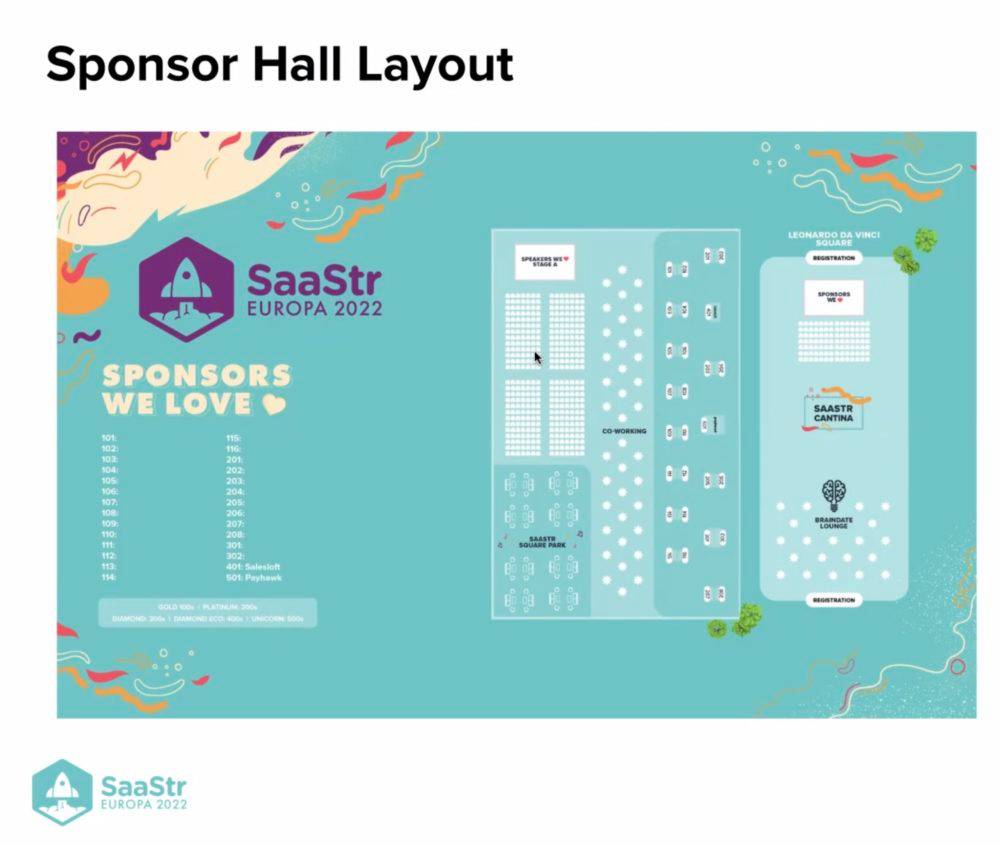
The conference campus included stages, networking zones, workshops, a coworking area, a Cantina, SaaStr Square Park, and spaces for scheduled Braindate conversations. This layout encouraged movement throughout the day and gave attendees several reasons to circulate beyond the session rooms.
For sponsors, an outdoor or semi-outdoor setup could make conversations feel less transactional. A product demonstration conducted near a social area often feels more approachable than one delivered beneath aggressive convention-center lighting while a salesperson guards a bowl of branded candy.
A Sponsor Expo in the Center of Attendee Traffic
Location was perhaps the strongest feature of the SaaStr Europa 2022 sponsor proposition. According to the original sponsorship announcement, the expo sat between the outdoor Cantina, the Braindate Lounge, and the open-air main stage. Attendees moving between food, networking, and headline sessions would naturally pass sponsor activations.
This matters because booth performance is heavily influenced by attendee flow. An impressive display in a remote corner can still resemble an expensive desert island. A modest activation located along a busy route, however, can generate repeated exposure and spontaneous conversations.
Repeated exposure is especially valuable for unfamiliar B2B brands. A founder might pass a company’s booth in the morning, notice a product demonstration after lunch, and finally stop for a conversation before an afternoon session. That journey is more natural than expecting every attendee to begin with an immediate request for a 45-minute sales presentation.
A Concentrated SaaS Audience
SaaStr Europa was built around a specialized community rather than a broad technology audience. The expected attendees included SaaS founders at multiple stages, revenue leaders, product executives, investors, private equity professionals, operators, and cloud enthusiasts.
The event’s promotional materials indicated that founders represented a substantial share of the audience, while investors also had a notable presence. That composition created opportunities for sponsors selling software to startups, scale-ups, and enterprise technology companies. It also created value for service providers supporting fundraising, recruitment, finance, compliance, cloud infrastructure, sales, marketing, and international expansion.
A sponsor did not need to generate thousands of random badge scans to succeed. Ten conversations with well-matched executives could be more valuable than 300 scans from people who came only to win wireless headphones.
Content That Kept Decision-Makers On-Site
The agenda was another important sponsorship advantage. SaaStr announced more than 70 sessions, Super Braindates, and over 100 speakers discussing growth, revenue, recruitment, international expansion, product development, and scaling challenges. Participants came from organizations such as Asana, GitLab, Meta, Notion, Salesloft, G2, and ZoomInfo.
Strong programming helps sponsors because it attracts experienced attendees and keeps them engaged throughout the day. When executives believe the educational content is useful, they are more likely to remain on the campus between sessions rather than answering email from a hotel room.
The sessions also gave sponsor teams easy conversation starters. Instead of opening with the dreaded “So, what does your company do?” a representative could ask what an attendee thought about a presentation on pipeline creation, product-led growth, hiring, or fundraising.
Structured and Informal Networking
SaaStr Europa 2022 combined scheduled networking with informal encounters. Braindate discussions allowed participants to connect around shared interests, while Meet-a-VC programming gave founders access to investors and funds. Workshops, coworking areas, meals, evening activities, and open-air gathering spaces created additional opportunities for conversation.
This environment rewarded sponsors that treated the entire campus as a relationship-building space. The booth was a base, not a prison. Team members could attend sessions, participate in workshops, arrange meetings, join social activities, and bring relevant contacts back to the activation for a demonstration or deeper discussion.
Why a SaaS Company Would Sponsor the Event
Building Brand Recognition in Europe
For a U.S. software company expanding into Europe, SaaStr Europa offered a concentrated way to establish regional visibility. Sponsorship could demonstrate that the company was not merely accepting European customers from a distant headquarters but was actively investing in the market.
This distinction matters. Prospects evaluating a new platform may ask about local support, data requirements, billing currencies, language capabilities, implementation resources, and customer references. A visible presence at a European industry event can help the brand begin those conversations in person.
Generating Qualified Pipeline
Sponsorship was also a lead-generation opportunity, but the most successful approach would focus on qualification rather than raw volume. A useful booth conversation should reveal the attendee’s company size, role, priorities, current tools, buying timeline, and relevant challenges.
Modern event marketing guidance consistently emphasizes that sponsors should define success before the event. A company seeking enterprise opportunities should measure qualified meetings, target-account engagement, pipeline created, and revenue influencednot simply the number of people who accepted a T-shirt.
Gathering Market Intelligence
Not every valuable conversation needs to become a sales opportunity. Events can reveal how prospects describe their problems, which competitors they are considering, what features they expect, and why they hesitate to purchase.
Product leaders can use these discussions to identify gaps in positioning. Marketing teams can collect language for future campaigns. Sales leaders can compare demand across regions. Even a polite rejection may contain more useful information than a dashboard containing 17 colorful charts and no explanation.
Supporting Partnerships and Fundraising
The combination of founders, vendors, and investors created opportunities beyond direct customer acquisition. Sponsors could meet potential technology partners, channel partners, advisors, integration providers, and venture capital firms.
For an early-stage company, a successful event might produce several different outcomes: a pilot customer, an integration discussion, a recruiting lead, and an introduction to an investor. That mixed value is difficult to capture with a single metric, which is why sponsors should document both immediate pipeline and strategic relationships.
How Sponsors Could Make the Most of SaaStr Europa 2022
Start Before Arriving in Barcelona
The strongest event campaigns begin before the doors open. Sponsors should identify priority accounts, invite prospects to meet on-site, announce demonstrations, and give attendees a specific reason to visit.
“Come see us at Booth 42” is technically an invitation, but it is not a compelling one. “See how a revenue team can identify stalled opportunities in three minutes” communicates an outcome. The message should answer the attendee’s silent question: Why should I spend part of my limited conference time with you?
Design an Activation, Not a Storage Area
A booth should make the product or value proposition understandable within seconds. Large blocks of corporate text rarely help. Neither does a wall displaying seven vague promises such as “transform,” “empower,” and “accelerate.” At that point, the wall may be selling software, vitamins, or a motivational cruise.
Effective sponsor activations provide tangible value. Possibilities include a short product diagnostic, a live benchmark, a customized demo, an expert consultation, a useful mini-workshop, or a concise assessment attendees can take home.
Industry guidance recommends creating experiences that connect directly with attendees rather than relying only on logos and signage. Sponsors achieve better results when their activation helps visitors learn, solve a problem, or participate in something memorable.
Prepare the Booth Team Properly
Booth staffing should not be treated as a reward trip for whichever employees happen to own comfortable shoes. Each team member needs a role, a concise opening question, a qualification framework, and a process for recording notes.
A balanced team might include a salesperson, product expert, customer-success representative, and executive. The salesperson qualifies interest, the product expert handles technical questions, the customer-success representative explains implementation, and the executive supports strategic conversations.
Staff members should also know when to stop pitching. If an attendee is clearly not a fit, a friendly two-minute exchange is better than a 20-minute hostage negotiation beside a touchscreen.
Capture Context, Not Just Contact Information
Scanning a badge identifies a person; it does not explain why that person stopped. Sponsors should attach brief notes to every meaningful interaction, including the problem discussed, level of interest, buying stage, requested follow-up, and relevant product area.
Because the event took place in Europe, sponsors also needed to consider consent and privacy requirements. A badge scan or direct sign-up should be handled according to the attendee’s expectations and the company’s compliance process. Receiving an event attendee list does not automatically mean every person has requested marketing email from every sponsor.
Follow Up While the Conversation Is Fresh
The first follow-up should reference the actual discussion. “It was great meeting you at SaaStr Europa” is polite but forgettable. “You mentioned that your team is replacing three disconnected forecasting tools” proves that someone listened.
Leads should be segmented by fit and intent. High-priority prospects may deserve immediate personal outreach, while earlier-stage contacts may benefit from a relevant guide, recorded session, webinar, or product comparison. Event-program best practices recommend preserving engagement status in the CRM and tailoring post-event communication to the person’s activity.
Common Sponsorship Mistakes to Avoid
The first mistake is assuming that paying for visibility automatically creates demand. Sponsorship buys access and positioning; it does not replace strategy.
The second mistake is measuring success only through badge scans. A giant spreadsheet filled with unqualified names may look impressive until the sales team asks what anyone wanted.
The third mistake is overstaffing the booth while ignoring the rest of the event. Team members should participate in networking, workshops, and sessions instead of forming an intimidating semicircle around the reception desk.
The fourth mistake is using identical follow-up for every contact. A founder exploring a future category, an executive evaluating vendors, and an investor researching a market should not receive the same automated message.
Finally, sponsors should not confuse swag popularity with commercial success. A giveaway can start a conversation, but it should not become the entire strategy. People may remember the company that gave them a portable charger. They may also remember only the charger.
Experiences From Sponsoring an Event Like SaaStr Europa
The following field experience is a representative scenario based on the published event layout and common B2B conference practices. It is not presented as a fabricated firsthand account.
The First Morning: Excitement Meets Reality
A sponsor team typically arrives early with a carefully designed plan and immediately discovers that live events have their own personality. A screen needs another cable. A shipment is in the wrong storage area. Someone has forgotten the badge scanner password. The perfectly aligned display looked larger in the design file.
Then the first attendees enter, and the nervous energy changes. At SaaStr Europa’s central expo location, traffic would have increased as people moved between the Cantina, networking spaces, and the main stage. The best teams would resist shouting product pitches into the flow. They would observe which messages attracted attention, test opening questions, and adjust quickly.
By late morning, patterns would emerge. Founders might ask about price and speed of implementation. Revenue leaders might want integrations and reporting. Larger companies might focus on security, governance, procurement, and regional support. The booth team’s original script would become shorter and more useful with every conversation.
The Middle of the Day: Quality Beats Crowds
Lunch traffic can create the illusion that every interaction is valuable. A busy booth feels successful, especially when photographs show a crowd. Yet experienced sponsors learn to distinguish activity from progress.
One ten-minute conversation with a vice president from a target account may be worth more than an hour of distributing merchandise. The goal is not to reject casual visitors; it is to recognize the moments that require deeper attention.
A capable team might invite a qualified prospect to a quieter seating area, schedule a later demonstration, or introduce the person to an executive. Meanwhile, other staff members would continue welcoming new visitors. This handoff prevents a promising discussion from being reduced to a rushed exchange beside a bowl of stickers.
Outside the Booth: The Unexpected Wins
Many of the best conference experiences happen away from the official activation. A sponsor representative may sit beside a future customer during a session, meet a partner while waiting for coffee, or join a conversation that begins with a speaker’s controversial opinion.
The open-air environment at SaaStr Europa was particularly suited to these encounters. Outdoor gathering areas, meals, Braindates, coworking spaces, and evening activities created lower-pressure settings in which people could talk without immediately entering a buyer-and-seller routine.
This is why sponsors benefit from sending curious people, not merely polished presenters. A representative who asks thoughtful questions and understands the industry can build trust before discussing a product. Nobody wants to spend two days avoiding someone who turns every conversationincluding one about the weatherinto a demo request.
The Second Day: Familiarity Creates Momentum
By the second day, attendees begin recognizing brands they passed repeatedly. Someone who was too busy on day one may return with a colleague. A prospect may reference a session that clarified the problem. An investor may introduce a portfolio company. Repetition begins working in the sponsor’s favor.
The second day is also when fatigue tests the team. Energy drops, voices become rough, and the emergency snack supply begins to resemble a strategic corporate asset. Strong teams rotate breaks, share useful notes, and maintain the same attention they gave early visitors.
Before packing up, they verify that important conversations have owners and next steps. A promising lead without a clear owner can disappear faster than the final branded umbrella.
After Barcelona: Where Sponsorship Value Is Won
The most revealing experience comes after the event. A sponsor returns home with scanned contacts, meeting notes, social engagement, photographs, and a heroic collection of charging adapters. Now the organization must convert activity into outcomes.
Marketing cleans and segments the data. Sales prioritizes accounts. Executives follow up on strategic relationships. Product teams review recurring feedback. Customer-success leaders contact expansion opportunities. The event should become a coordinated revenue program rather than a folder labeled “Barcelona Leads Final Version 4.”
A useful post-event review compares results with the original goals: qualified meetings, opportunities created, target accounts engaged, partnerships initiated, content performance, and influenced pipeline. It should also record what failed. Perhaps the giveaway attracted the wrong audience. Perhaps demonstrations were too long. Perhaps pre-booked meetings produced much stronger results than walk-up traffic.
That honest review is the real sponsorship experience. The conference provides concentrated access, but the sponsor’s preparation, team behavior, qualification process, and follow-up determine whether the investment becomes revenue, insight, or merely an attractive set of photographs.
Conclusion: More Than a Logo Beside the Beach
SaaStr Europa 2022 offered sponsors a distinctive combination of focused SaaS attendance, international reach, strong educational programming, and a central expo integrated into an open-air conference campus. The layout encouraged high traffic, while the audience created opportunities for customer acquisition, partnerships, recruiting, fundraising, and European market development.
However, the event’s potential did not eliminate the need for discipline. Sponsors still needed a clear audience, measurable objectives, a compelling activation, trained staff, detailed lead notes, and fast follow-up. A prime booth location could create conversations, but only a strong event strategy could turn those conversations into business results.
The broader lesson remains relevant for any SaaS conference sponsorship: do not purchase space and hope for magic. Build an experience that helps the right people understand your value, and make every interaction easy to continue after the stage lights go dark.