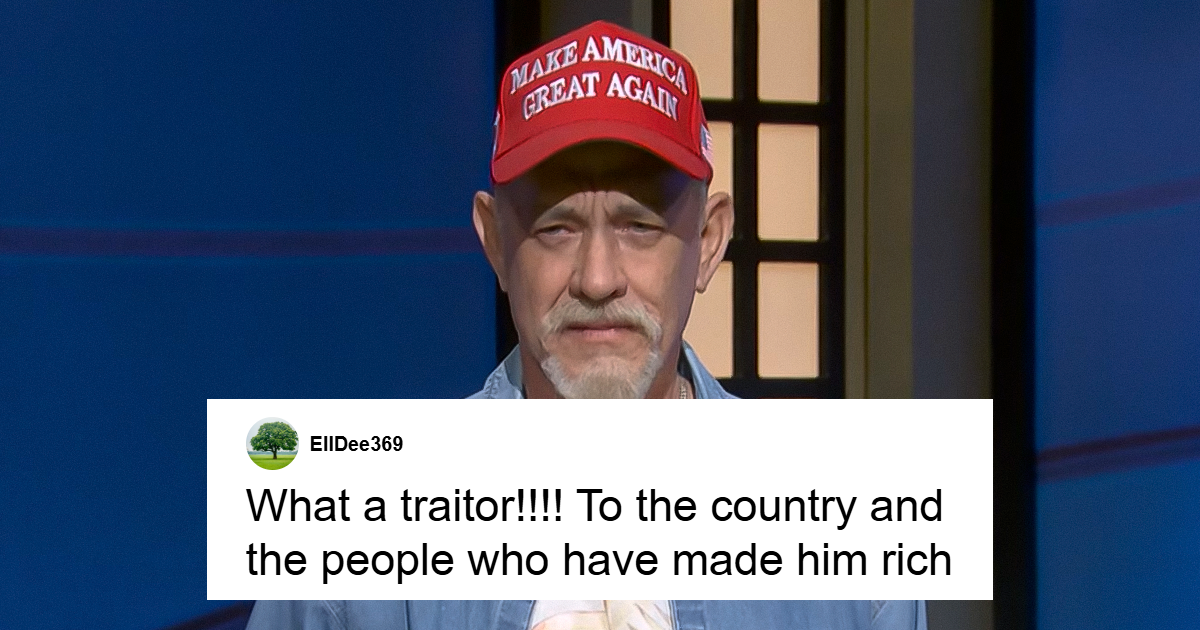
Editorial note: This article discusses public reaction to a comedy sketch. Terms such as “racist,” “disgusting,” and “hate crime” are presented as viewer criticism and online commentary, not as established facts about Tom Hanks or Saturday Night Live.
Tom Hanks has spent decades being America’s cinematic comfort blanket: the guy who can survive on an island with a volleyball, command a spaceship with calm authority, and make a toy cowboy emotionally complicated. So when he appeared on Saturday Night Live’s 50th anniversary special and suddenly became the center of a political firestorm, many viewers did a double take so dramatic it probably needed its own sound effect.
The controversy erupted after Hanks reprised Doug, his MAGA-hat-wearing character from SNL’s recurring sketch “Black Jeopardy.” The original version, which aired in 2016, was widely discussed because it played with expectations. Doug looked like he would be completely out of place on a parody game show built around Black cultural references, but he kept finding surprising common ground with the host and contestants. It was awkward, sharp, oddly warm, and smarter than the average sketch that arrives wearing a trucker hat.
But the 2025 comeback landed differently. During the SNL50 version, Hanks’ Doug again hesitated when host Darnell Hayes, played by Kenan Thompson, moved in for a handshake. The joke was brief, but the internet treated it like a live grenade tossed into the cultural group chat. Some viewers accused the sketch of painting Trump supporters as racist. Others called the bit stale, divisive, and insulting. One viral reaction even claimed, “It feels like a hate crime,” a phrase that quickly became headline fuel across entertainment sites.
What Happened During Tom Hanks’ SNL Appearance?
SNL50 was designed as a victory lap for one of television’s most influential comedy institutions. The special brought back legendary cast members, famous hosts, musical icons, and enough nostalgia to power a small streaming service. “Black Jeopardy” returned as one of the night’s major sketches, featuring Kenan Thompson, Leslie Jones, Tracy Morgan, Eddie Murphy, Chris Rock, and Tom Hanks.
The sketch’s biggest crowd-pleasing moment, for many viewers, was Eddie Murphy impersonating Tracy Morgan while the real Tracy Morgan sat nearby. That is the kind of comedy math only SNL would attempt: one Tracy Morgan, plus Eddie Murphy as Tracy Morgan, equals controlled chaos with premium cable energy.
Then Hanks appeared as Doug. He wore the familiar MAGA hat and American flag-style shirt, spoke with a folksy Southern drawl, and delivered lines that tied him to conservative cultural identity. When Thompson’s host agreed with one of Doug’s answers and approached him warmly, Doug recoiled before eventually accepting the handshake. For critics, that movement was the problem. They saw it as a visual shorthand suggesting that a MAGA supporter would be uncomfortable touching a Black man.
Why Viewers Called The Sketch “Racist”
The anger was not simply about Tom Hanks wearing a red hat on television. The issue was symbolism. Comedy often works in shorthand, and shorthand is dangerous when the subject is race, politics, and identity. A hat, a handshake, a flinch, and a laugh track can become an entire argument before anyone has time to say, “Wait, are we still talking about a fake game show?”
Some conservative viewers argued that the sketch reduced millions of Trump voters to a racist stereotype. They felt SNL was reviving a 2016 joke in a different political landscape and using Hanks’ beloved public image to make the insult sting more. To them, the bit was not satire; it was a broad-brush caricature.
That reaction gained traction because it touched a familiar complaint about late-night comedy: that it often mocks one political tribe more aggressively than the other. Critics said the SNL sketch felt like another example of Hollywood talking down to ordinary Americans. The phrase “Hollywood doesn’t get it” appeared in several reactions, and the backlash moved quickly from “bad joke” to “cultural insult.”
The 2016 “Black Jeopardy” Sketch Had A Different Meaning
To understand why the backlash became so intense, it helps to revisit the original 2016 sketch. Back then, Doug was not just a punchline. The brilliance of the sketch came from the way it set viewers up to expect total failure, then slowly revealed unexpected overlap between Doug and the Black contestants.
Doug understood certain references. He shared skepticism toward institutions. He appreciated practical wisdom. He recognized the social language of working-class communities. The sketch suggested that race and politics were messy, but that cultural common ground existed in places Americans often refuse to look.
That is why the original “Black Jeopardy” with Tom Hanks was often praised as surprisingly nuanced. It did not merely say, “Look at this clueless guy.” It said, “Look how complicated people are when we stop sorting them like laundry.” The handshake hesitation was awkward, yes, but it existed inside a larger structure that made Doug more human than hateful.
The SNL50 callback, however, was shorter and more nostalgic. Without the full arc of the original sketch, the handshake joke felt to some viewers like the only message. In comedy, context is oxygen. Remove too much of it, and even a once-clever joke starts gasping.
Was Tom Hanks Actually Being Racist?
There is a major difference between portraying a character accused of racist behavior and being racist oneself. Hanks was performing a fictional role in a sketch written for satire. The criticism centered on what the character represented, not on evidence that Hanks personally holds racist views.
That distinction matters. Public conversation often collapses performance and performer into one messy pile. An actor plays a villain, and suddenly people act like he arrived on set carrying a notarized confession. But comedy sketches are collaborative. Writers, performers, producers, editors, and the live audience all shape the moment.
Still, viewers are allowed to dislike the creative choice. A sketch can be fictional and still feel unfair. A joke can have satirical intent and still land like a dropped piano. The fair question is not “Is Tom Hanks secretly Doug?” The fair question is “Did this sketch rely on a stereotype that many viewers found lazy or offensive?”
Why SNL Satire Still Creates Big Reactions
Saturday Night Live has always lived in the danger zone between comedy and politics. The show became famous partly because it could turn politicians into pop culture characters. From Chevy Chase’s Gerald Ford to Tina Fey’s Sarah Palin to Alec Baldwin’s Donald Trump, SNL has repeatedly shaped how viewers remember public figures.
That influence makes every political joke heavier than it looks. A sketch is not a policy paper, but it can harden perceptions. A three-second gag can travel farther online than a 3,000-word essay, mostly because nobody has to pretend they read the whole thing.
In the case of Hanks’ SNL appearance, the backlash shows how polarized audiences have become. Some viewers saw a familiar satirical character. Others saw a celebrity mocking them personally. Some laughed. Some groaned. Some opened social media and started typing with the intensity of someone defusing a bomb.
The Role Of Social Media In The Backlash
Without social media, this controversy might have lasted about as long as a commercial break. With social media, it became a rolling argument. Clips circulated on X, Facebook, YouTube, Reddit, and entertainment news sites. Short video excerpts stripped away the full sketch and focused attention on the handshake moment.
That is how modern outrage often works. A clip becomes a symbol. A symbol becomes a team sport. Before long, people who never watched the full special are confidently explaining what it “really means,” because the internet has replaced context with speed and then charged us all a convenience fee.
But social media also revealed that reactions were not one-sided. Some viewers defended Hanks and SNL, arguing that the bit was clearly a callback to a famous sketch and should not be treated as a literal statement about every Trump voter. Others said the original sketch had been clever, but the revival felt unnecessary. A third group mainly wanted to talk about Eddie Murphy’s Tracy Morgan impression, which, frankly, is a very reasonable survival strategy.
Why The Joke Felt Outdated To Some Viewers
One repeated criticism was that the sketch felt like “2016 comedy in 2025.” That complaint is important. Political satire has an expiration date. A joke that feels daring in one election cycle can feel dusty years later, especially when the public conversation has changed.
In 2016, the idea of a MAGA supporter appearing on “Black Jeopardy” carried a specific cultural shock. In 2025, the country had already spent years arguing about Trump, race, media bias, class resentment, and celebrity politics. The surprise was gone. The joke arrived with baggage, and not the cute carry-on kind.
That does not mean SNL had no right to revisit Doug. Anniversary specials are built on callbacks. But callbacks must do more than point at the past and say, “Remember this?” The best nostalgia adds a new layer. The weakest nostalgia simply asks the audience to applaud because something recognizable has entered the room.
What The Backlash Says About Celebrity Culture
Tom Hanks is not just another actor. He is a national brand of decency. That is why this controversy felt bigger than a normal SNL complaint. If a more politically aggressive comedian had performed the same bit, the reaction might have been predictable. With Hanks, the backlash carried a sense of betrayal among some fans.
For years, Hanks has been associated with warmth, sincerity, and civic-minded public appearances. Many viewers see him as Hollywood’s dependable everyman. So when he appeared in a sketch that critics interpreted as mocking conservatives, it clashed with that image. The outrage was partly about the joke and partly about the person delivering it.
This is the celebrity paradox. Audiences want stars to be authentic, but only within approved emotional boundaries. Be charming. Be funny. Be humble. Save the day. Do not accidentally step into a culture-war bear trap while wearing a MAGA hat on live television.
Comedy, Stereotypes, And The Risk Of Broad Brushes
The central issue is not whether satire should avoid offense. Satire without risk is just a greeting card with better lighting. The real issue is whether the joke punches with precision or swings wildly at a crowd.
When comedy targets a powerful politician, audiences often accept exaggeration. When it appears to target ordinary voters, the reaction changes. People who feel mocked as a group do not usually respond by calmly appreciating the structure of the bit. They respond by asking why a television institution thinks they are the joke.
That is why the Hanks backlash became so emotionally charged. Viewers who objected felt the sketch implied that supporting Trump was linked with racial fear or discomfort. Supporters of the sketch argued that satire often exaggerates real social tensions and that Doug was always meant to be a complicated character, not a census report.
A Viewer Experience: Watching The Clip In A Divided Room
Imagine watching the SNL50 “Black Jeopardy” sketch in a living room with people who do not vote the same way, do not consume the same news, and do not agree on whether late-night comedy is still funny. This is not a theoretical room. This is basically Thanksgiving with better snacks and fewer suspicious casseroles.
At first, the sketch feels like familiar SNL territory. Kenan Thompson is steady, the game-show format is comfortable, and the returning cast members create that anniversary-special glow. People laugh at Eddie Murphy doing Tracy Morgan because it is silly, specific, and obviously affectionate. Nobody needs a political science degree to understand the joke.
Then Tom Hanks appears as Doug. One viewer laughs immediately because they remember the 2016 sketch. Another viewer stiffens because they see the MAGA hat and already know where the joke might go. A third person asks, “Wait, is that Tom Hanks?” because somehow Tom Hanks still has the power to surprise people by existing.
When Doug hesitates at the handshake, the room splits. One person sees a callback. Another sees an insult. Someone else sees weak writing. The moment is over in seconds, but the conversation starts instantly. Was the joke saying that all Trump supporters are racist? Was it poking fun at one fictional character? Was the revival missing the warmth that made the original work? Was the audience laughing at Doug, with Doug, or at the people who identify with him?
That kind of viewing experience explains why the controversy grew. The sketch did not land in a neutral country. It landed in an America where entertainment, politics, race, and personal identity are tangled together like earbuds in a backpack. People do not watch a MAGA hat as a costume anymore. They watch it as a statement, a warning, a joke, a badge, or a provocation, depending on their own experiences.
For some viewers, the scene felt like Hollywood confirming their worst suspicion: that mainstream comedy sees conservative Americans as backward, racist, or disposable. For others, the outrage felt exaggerated because SNL has always used stereotypes, discomfort, and political shorthand to create satire. Both reactions can exist at the same time, which is inconvenient for anyone hoping the internet would handle nuance gracefully. Spoiler: it did not.
The experience also shows how comedy changes when watched through clips instead of full sketches. A viewer who sees only the handshake may interpret the bit more harshly than someone who remembers Doug’s original arc. A person who already distrusts SNL may see proof of bias. A longtime fan may see a flawed but recognizable callback. The same seven seconds become completely different stories depending on who is watching.
That is the strange power of the Tom Hanks SNL controversy. It was not just about one joke. It was about how people feel seen, misread, mocked, or defended by popular culture. It was about whether comedy can still build bridges when everyone is checking the bridge for traps. And it was about how even America’s most beloved actor can become a lightning rod when a sketch touches the exposed wires of race and politics.
Conclusion: A Small Sketch With A Big Cultural Echo
Tom Hanks’ SNL appearance became controversial because it sat at the intersection of race, politics, nostalgia, and celebrity trust. The “Black Jeopardy” sketch once worked because it complicated assumptions and found common ground in unexpected places. The SNL50 version, however, revived one of its most uncomfortable beats at a moment when viewers were primed to read every cultural signal as an attack.
Was the backlash too intense? In some corners, yes. Calling a comedy sketch a “hate crime” is obviously extreme language. But was every criticism baseless? Not necessarily. Many viewers objected to what they saw as a lazy stereotype, and that reaction deserves to be understood rather than dismissed.
The lesson is not that comedians should avoid politics, race, or discomfort. The lesson is that satire works best when it is sharp enough to cut through assumptions without flattening people into cardboard villains. SNL has done that brilliantly before. With Tom Hanks’ Doug, it did it in 2016. In 2025, viewers were far less convinced.
And that may be the most honest punchline: sometimes a joke returns wearing the same hat, but the room it walks into has completely changed.