Note: This article is written for educational and editorial purposes. It discusses rocket propulsion technology at a high level and intentionally avoids build instructions, operating procedures, fuel formulas, or test parameters.
When Rocket Science Meets the 3D Printer
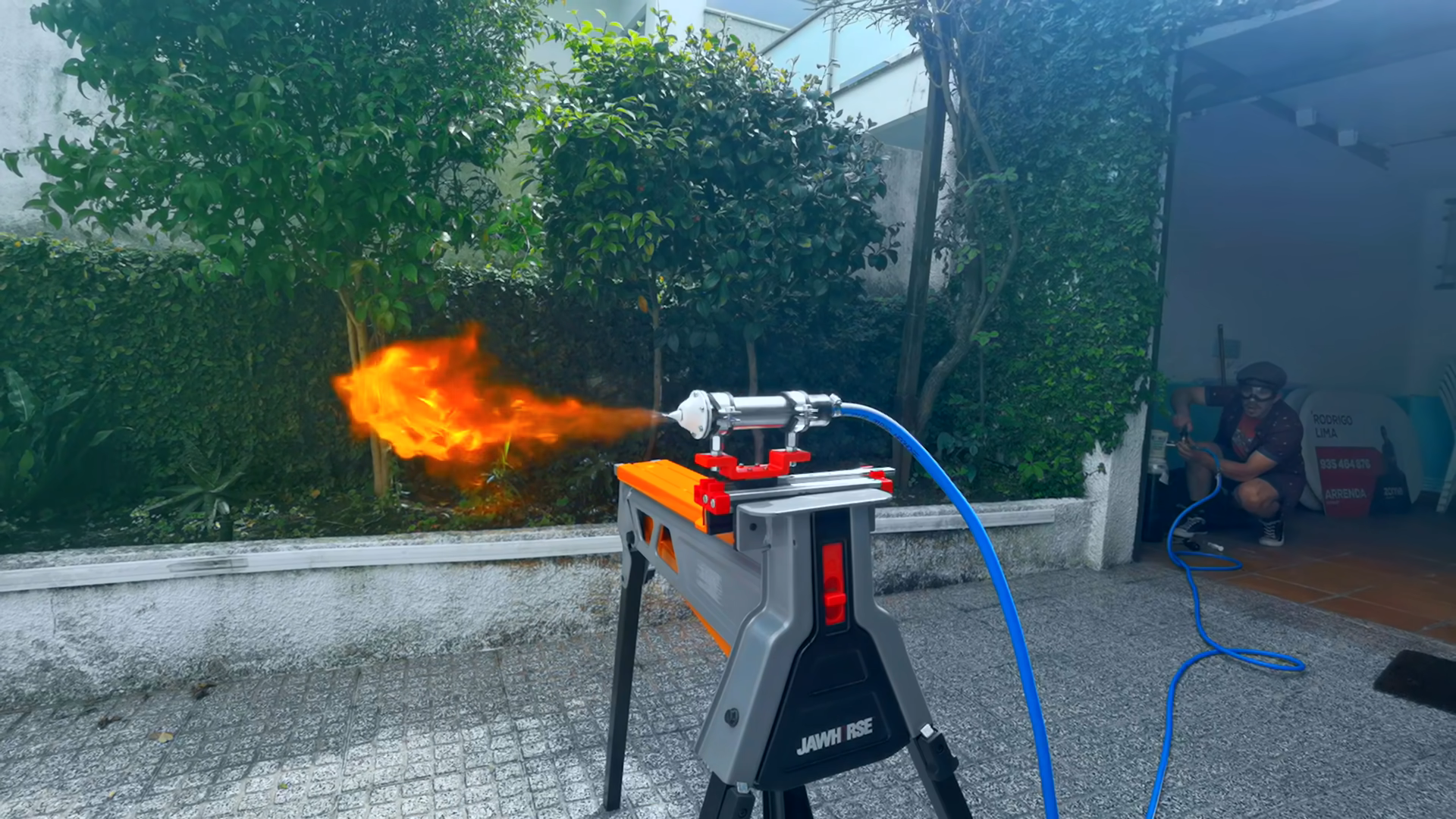
Somewhere between a professional aerospace lab and the kind of garage project that makes insurance companies quietly leave the room, the idea of a hybrid rocket engine with a ceramic aerospike and 3D printed fuel has become a fascinating symbol of modern propulsion experimentation. It sounds like a headline assembled by an overexcited engineering student: hybrid rocket, ceramic nozzle, aerospike geometry, printed fuel grain, and yes, probably a camera rolling in the background.
But behind the futuristic buzzwords is a serious trend. Aerospace teams, research institutions, and advanced hobbyist communities are exploring how additive manufacturing can reshape rocket design. NASA has tested 3D printed engine parts, examined hybrid propulsion for small spacecraft, and supported additive manufacturing research for components that once required complex machining. At the same time, aerospike nozzleslong admired for their altitude-compensating potentialare getting renewed attention because 3D printing makes complex shapes easier to manufacture.
The result is a new kind of propulsion conversation: not simply “Can we make a rocket engine?” but “Can we make one that is lighter, cheaper, more adaptable, and easier to prototype?” That is where the combination of a ceramic aerospike and 3D printed fuel becomes exciting. It joins three ideas that are each powerful on their own: hybrid propulsion, advanced heat-resistant materials, and additive manufacturing.
What Is a Hybrid Rocket Engine?
A hybrid rocket engine uses propellants in two different physical states. In the most common arrangement, the fuel is a solid material while the oxidizer is stored separately as a gas or liquid. This differs from a solid rocket motor, where fuel and oxidizer are mixed together in one solid propellant, and from a liquid rocket engine, where both fuel and oxidizer are usually stored in tanks and fed into a combustion chamber.
The hybrid concept has an obvious appeal: it borrows useful traits from both solid and liquid systems. Like a solid motor, a hybrid can use a relatively simple fuel grain. Like a liquid engine, it can offer more control because combustion depends on oxidizer flow. In broad terms, stop the oxidizer flow and the engine stops producing thrust. That controllability is one reason hybrid systems are often described as safer and more manageable than traditional solid motors.
Of course, rockets are not famous for being easy. Hybrids have their own engineering headaches. One challenge is combustion efficiency. Another is the fuel regression rate, which is the rate at which the solid fuel surface burns away. If the fuel does not burn evenly or quickly enough, performance suffers. Engineers have spent decades trying to improve this behavior through fuel selection, port geometry, oxidizer flow patterns, and manufacturing methods.
Why 3D Printed Fuel Matters
This is where 3D printed rocket fuel enters the chat wearing safety glasses. Additive manufacturing allows designers to create fuel grains with internal shapes that would be difficult or expensive to make with traditional casting or machining. Instead of treating the fuel grain as a simple block with a basic central opening, researchers can explore more complex internal patterns that improve how oxidizer contacts the fuel surface.
In the small-spacecraft world, NASA has highlighted research involving 3D printed ABS fuel grains for hybrid thrusters. The larger lesson is not that one plastic magically solves propulsion, but that printed fuel structures can turn geometry into a design tool. A fuel grain becomes more than stored energy; it becomes an engineered flow environment.
The important caveat is that printing fuel for rocket propulsion is not the same as printing a phone stand or a desk organizer shaped like a dragon. Combustion, heat, pressure, and material consistency matter enormously. In real aerospace development, printed fuel concepts require controlled testing, specialized facilities, and serious safety oversight. Rockets do not care how cool the CAD model looks.
The Aerospike: A Nozzle That Refuses to Be Ordinary
Most people picture a rocket engine nozzle as a bell-shaped cone. That shape is common for a reason: it expands hot gas efficiently and has been proven across decades of spaceflight. But a bell nozzle is optimized for a particular atmospheric pressure. A nozzle that performs beautifully at sea level may be less ideal at high altitude, and a vacuum-optimized nozzle can be awkward close to the ground.
An aerospike nozzle approaches the problem differently. Instead of containing the exhaust flow inside a full bell, it uses a central spike or plug shape. The surrounding atmosphere helps shape the exhaust plume, allowing the nozzle to adapt more naturally across different altitudes. That is why aerospikes are often described as altitude-compensating nozzles.
The idea is not new. NASA’s X-33 program famously planned to use linear aerospike engines as part of a reusable launch vehicle demonstrator. The X-33 was eventually canceled, but the aerospike concept never vanished. It lingered in aerospace conversations like a brilliant band that never got the mainstream tour it deserved.
Why Aerospikes Are Hard to Build
If aerospikes are so clever, why are they not everywhere? The answer is classic engineering: because clever ideas often bring complicated invoices. Aerospike nozzles can be challenging to cool, difficult to manufacture, and tricky to validate across operating conditions. Their shapes are less straightforward than traditional bell nozzles, and the thermal environment can be brutal.
Additive manufacturing changes part of that equation. Complex geometries that once demanded elaborate tooling can now be printed directly in metals, ceramics, or specialized composites. NASA’s recent work with 3D printed nozzles and engine components shows how manufacturing innovation can reopen old design ideas. When a shape is no longer impossibly expensive to produce, engineers can revisit concepts that were once parked in the “beautiful but painful” folder.
Why Use Ceramic for an Aerospike?
Rocket engines are heat machines with an attitude problem. The nozzle region must survive extreme thermal stress, fast-moving exhaust, vibration, and mechanical loading. For small experimental engines, plastic components often fail quickly because ordinary polymers are not designed for such punishing environments.
A ceramic aerospike offers a potential solution because ceramic materials can tolerate high temperatures better than many plastics. In the well-known experimental project that inspired this topic, the aerospike was printed using a ceramic-loaded resin and then processed to create a more heat-resistant part. The point was not merely to make the nozzle look fancy; it was to move beyond the limitations of printed plastic in a high-temperature zone.
Ceramics are not magic, though. They can be brittle, sensitive to thermal shock, and difficult to process reliably. A ceramic part may resist heat but still crack if the design, firing process, or operating environment is wrong. In other words, ceramics are like that one genius friend who can solve impossible math problems but refuses to sit in a normal chair without making it complicated.
Ceramic + 3D Printing = More Design Freedom
The promise of ceramic additive manufacturing is design freedom. Engineers can create shapes that would be painful to machine and nearly impossible to cast at small scale. For aerospike nozzles, this matters because the contour, surface quality, and internal structure can influence performance and durability.
In professional aerospace manufacturing, similar thinking is driving interest in printed metal nozzles, multi-material combustion chambers, and advanced alloys. NASA has tested 3D printed combustion chambers and nozzles, including work involving copper alloys, aluminum alloys, and hybrid manufacturing approaches. These projects show that additive manufacturing is not a novelty act; it is becoming part of the serious propulsion toolbox.
How 3D Printed Fuel Changes Hybrid Rocket Design
In a hybrid engine, the fuel grain is not just a passive chunk of material. Its internal geometry affects how oxidizer flows, how the flame develops, and how the fuel surface recedes during operation. Traditional fuel grains are often limited by manufacturing methods. With 3D printing, the internal shape can be tailored more creatively.
Researchers and aerospace organizations have investigated helical channels, complex ports, and printed structures that increase contact between oxidizer and fuel. The Aerospace Corporation has discussed how 3D printed hybrid motor concepts may improve interaction between oxidizer and solid fuel, helping address one of the long-standing weaknesses of hybrid rockets: slow or inefficient burning.
This is the real advantage of additive manufacturing in rocket propulsion. It does not simply make existing parts cheaper. It allows engineers to ask new questions. What if the fuel grain is also a flow-shaping component? What if the structure of a small spacecraft can partially double as consumable fuel? What if manufacturing time drops from complex tooling cycles to rapid iteration?
The Practical Benefits
The most obvious benefit is rapid prototyping. Designers can revise a fuel grain digitally, print a new version, and evaluate it under controlled conditions. This shortens the learning cycle. Instead of waiting for custom molds or machining setups, a team can explore design variations faster.
Another benefit is integration. In small spacecraft, every gram matters. NASA-supported research has explored the possibility of additively manufactured consumable structures, where printed fuel elements may contribute to both propulsion and spacecraft architecture. That kind of thinking is attractive for CubeSats and other compact platforms where packaging efficiency is everything.
Finally, 3D printing can reduce waste and simplify supply chains. In aerospace, fewer parts, fewer joints, and fewer custom tools can mean lower cost and faster development. Nobody in a propulsion lab has ever said, “You know what this project needs? More procurement delays.”
Why This Combination Feels So Futuristic
A hybrid rocket engine that combines a ceramic aerospike with 3D printed fuel feels futuristic because it attacks several old rocket problems at once. The aerospike tries to improve nozzle efficiency across altitude. The ceramic material addresses heat resistance. The printed fuel grain offers custom geometry and faster iteration. The hybrid architecture adds a degree of operational control compared with a traditional solid motor.
Put together, the concept becomes a compact showcase of where propulsion research is heading: more digital, more material-aware, and more willing to blend disciplines. It is not just mechanical engineering. It is materials science, computational design, thermal analysis, manufacturing technology, safety regulation, and testing discipline all packed into one very loud object.
What It Could Mean for Small Launch and Spacecraft
The most realistic near-term applications are not giant crewed rockets. They are smaller systems: research motors, sounding rockets, university test platforms, CubeSat thrusters, and specialized propulsion demonstrators. These are areas where rapid iteration and compact design can matter more than brute-force scale.
Hybrid systems may be especially attractive for missions that value safety, storability, restart potential, and simpler handling. For small spacecraft, a restartable propulsion system can help with attitude control, orbit adjustment, or deorbiting. For experimental launch vehicles, hybrid motors can provide a middle path between the simplicity of solids and the controllability of liquids.
Still, the road from a clever prototype to a reliable aerospace product is long. A successful demonstration proves that something can work once. Engineering maturity means proving that it can work repeatedly, predictably, safely, and under a wide range of conditions. Rockets are not impressed by viral videos. They prefer data.
The Challenges Nobody Should Ignore
The phrase 3D printed rocket engine can make the technology sound easier than it is. In reality, additive manufacturing introduces its own inspection and quality-control challenges. Printed parts may have porosity, layer defects, residual stress, or inconsistent material properties. Fuel grains may behave differently depending on print parameters and material composition.
Ceramic parts add another layer of complexity. Shrinkage during firing, cracking, surface finish, and thermal cycling all matter. A ceramic aerospike must not only survive heat; it must survive uneven heating, mechanical stress, and the harsh flow environment of a rocket exhaust plume.
Aerospikes also remain difficult to validate. Their performance depends on plume behavior, ambient pressure, base effects, and the interaction of exhaust with the spike contour. That is why modern computational tools, controlled test stands, and careful instrumentation are essential.
Safety and Regulation Matter
Rocket experimentation is regulated for good reason. In the United States, amateur rocket activity falls under FAA rules depending on scale and flight profile. Serious testing requires appropriate facilities, permissions, range safety practices, and experienced supervision. A responsible article about hybrid rockets should say the quiet part loudly: this is not a kitchen-table project.
That does not make the topic less exciting. It makes it more respectable. The future of propulsion belongs not to reckless trial and error, but to disciplined experimentation. The best engineers are not the ones who ignore risk; they are the ones who understand it deeply enough to design around it.
Real-World Examples Behind the Trend
Several real developments help explain why this topic matters. NASA has documented hybrid propulsion concepts for small spacecraft, including a demonstration involving 3D printed ABS fuel and gaseous oxygen in a small hybrid thruster. NASA has also supported work on additively manufactured consumable structures, where printed fuel can become part of the spacecraft’s usable architecture.
In engine hardware, NASA and partners have tested 3D printed combustion chambers, nozzles, and alloy systems. One major lesson from these programs is that additive manufacturing can reduce part count, support complex cooling features, and enable material combinations that are difficult with conventional methods.
Meanwhile, the aerospike idea continues to attract attention. NASA’s X-33 program helped make the linear aerospike famous, even though the vehicle never entered service. More recently, companies and researchers have revisited aerospike engines using modern computational design and 3D printing. The concept has moved from “old aerospace dream” to “maybe we can finally make this practical.”
The ceramic aerospike with 3D printed fuel project belongs to this broader wave. It may not represent a flight-ready commercial engine, but it does represent the spirit of modern propulsion exploration: fast iteration, creative materials, and a willingness to test ideas that once felt out of reach.
Experience Notes: What This Topic Teaches About Innovation
Looking at a hybrid rocket engine that combines ceramic aerospike technology with 3D printed fuel, one lesson stands out immediately: innovation often happens at the borders between fields. A propulsion engineer might focus on combustion. A materials scientist might focus on ceramics. A manufacturing specialist might focus on print quality. A systems engineer worries about how all of it behaves together. The magic, and also the trouble, begins when those worlds collide.
From an editorial perspective, this topic is a perfect example of why modern aerospace is so interesting to follow. The story is not only about thrust. It is about how new tools change old assumptions. For decades, aerospikes were admired but difficult. Ceramic parts were useful but hard to shape. Hybrid rockets were promising but limited by fuel regression and efficiency concerns. Then additive manufacturing arrived and began poking each limitation with a digital stick.
The experience of studying this topic also shows how important it is to separate “possible” from “practical.” A prototype can prove that a concept is physically possible. A useful engine must prove much more: repeatability, durability, manufacturability, inspection quality, safety, and cost-effectiveness. That gap is where engineering lives. It is also where many flashy ideas go to either grow up or quietly retire.
Another takeaway is that materials matter as much as geometry. A beautifully designed aerospike is not helpful if it cannot survive the thermal environment. A clever fuel grain pattern is not useful if it burns unpredictably. A 3D printed component is not automatically advanced just because it came from a printer. In aerospace, the printer is only the beginning. The real work includes material characterization, nondestructive inspection, controlled testing, and honest failure analysis.
There is also a cultural lesson here. The rise of accessible design tools has made aerospace concepts more visible to students, makers, and independent researchers. That visibility can inspire careers, spark university projects, and help the public understand propulsion technology. However, accessibility must be paired with responsibility. Rocket engines operate in dangerous regimes, and safe experimentation requires proper facilities, trained supervision, and regulatory awareness.
For readers, the best way to appreciate this technology is to see it as a window into the future of engineering rather than as a weekend recipe. The interesting part is not “how do I build one?” The better question is “what does this reveal about where propulsion design is going?” It reveals a future where components are more integrated, fuel grains are more carefully shaped, nozzles are revisited with new manufacturing methods, and small teams can test serious ideas faster than before.
In that sense, the ceramic aerospike and 3D printed fuel combination is more than a quirky rocket experiment. It is a miniature case study in modern aerospace innovation. It shows how old concepts can become new again when materials improve, manufacturing changes, and designers get better tools. The rocket may be small, but the idea behind it is anything but tiny.
Conclusion: A Small Engine With a Big Message
The idea of a hybrid rocket engine combining a ceramic aerospike with 3D printed fuel captures the current mood of aerospace technology: bold, experimental, and increasingly shaped by additive manufacturing. It brings together a controllable propulsion architecture, an altitude-compensating nozzle concept, heat-resistant materials, and printed fuel geometry.
It is not a shortcut to easy rocketry. The challenges are real: combustion behavior, ceramic reliability, nozzle validation, inspection, safety, and regulation. But as a technology story, it is powerful. It shows how modern tools can revive older aerospace ideas and push hybrid propulsion into new territory.
The future of rocket engines may not be one single design that replaces everything else. More likely, it will be a collection of specialized solutions: printed chambers, advanced nozzles, hybrid thrusters, reusable engines, and materials designed for extreme environments. In that future, the ceramic aerospike and 3D printed fuel grain deserve attentionnot because they are simple, but because they prove that rocket science still has plenty of room for clever ideas.