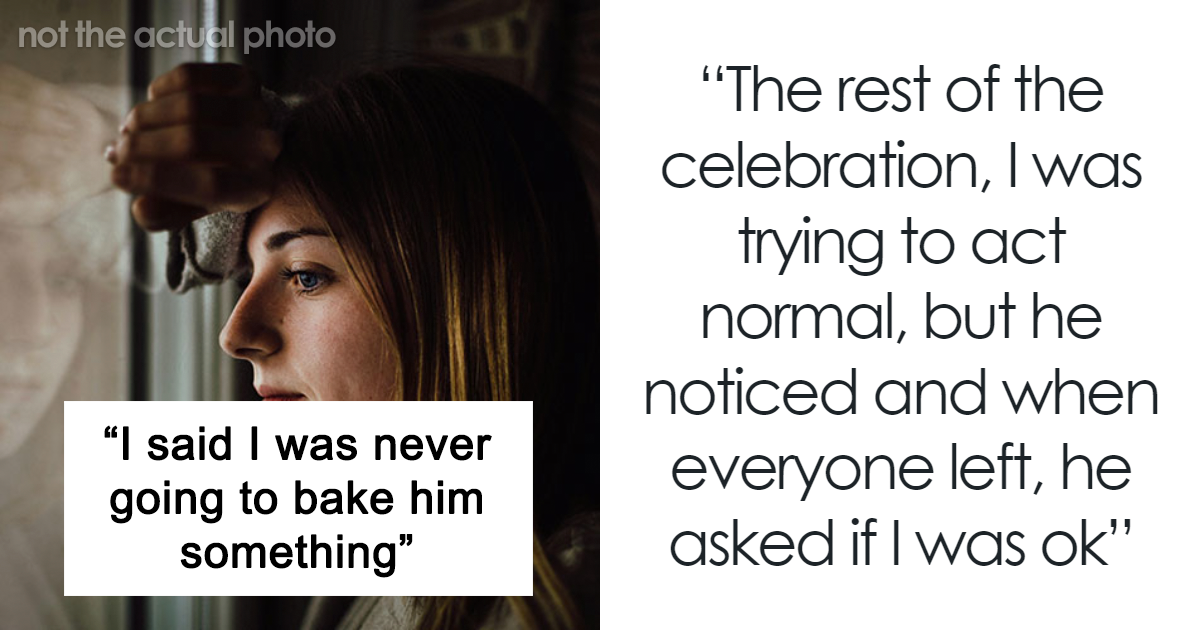
Some birthday disasters involve melted frosting, crooked candles, or that one relative who sings “Happy Birthday” like it is an audition for a Broadway revival. This one was worse. A wife tried to do something thoughtful, personal, and time-consuming for her husband’s birthday: she baked him a cake. Not just any cake, either, but a version adjusted to fit his dietary needs. Then, in front of everyone, he publicly rejected it.
And just like that, the cake stopped being dessert and became evidence. Evidence of effort. Evidence of disrespect. Evidence that in some relationships, the loudest thing in the room is not the party playlist, but the silence after someone says something cruel.
That is why the story “Husband Embarrasses Wife In Front Of Everyone At His Birthday, She Promises To Never Bake Again” has struck such a nerve online. On the surface, it sounds like a cake drama. Underneath, it is really about public humiliation, emotional labor, and what happens when a supposedly funny or casual comment lands like a pie to the soul.
In relationship terms, this is not about bananas, frosting, or whether cake is overrated. It is about being made small in front of an audience. And once that happens, the issue is no longer “Did he like the dessert?” but “Why did he choose to disrespect the person who made it?”
Why This Birthday Cake Story Hit So Hard
People relate to this story because most adults have lived some version of it. Maybe not with cake, but with effort. One partner cooks dinner and gets a sarcastic review. One plans a celebration and gets mocked for being “too much.” One buys a thoughtful gift and watches the other person laugh at it in front of family and friends.
That is what makes public embarrassment in marriage feel so different from an ordinary disagreement. Private conflict is painful enough. Public conflict can feel like betrayal with witnesses. The injured spouse is not only hurt; they are cornered. They have to decide, in real time, whether to defend themselves, cry, laugh it off, or pretend nothing happened while everyone suddenly becomes very interested in their paper plate.
That split-second social pressure is brutal. It turns one rude remark into a memory that loops. Not because the comment was clever, but because it happened at a moment that was supposed to be warm, grateful, and safe.
It Was Never Just About the Cake
Homemade food often carries a meaning store-bought food does not. Baking for someone is not just a task; it is a tiny love letter in edible form. It takes time, planning, ingredients, cleanup, and attention. When a spouse makes something specifically for your birthday, especially with your preferences or dietary restrictions in mind, they are saying, “I thought about you before today arrived.”
So when that effort gets dismissed publicly, the insult hits two targets at once. First, it rejects the cake. Second, and more importantly, it rejects the care behind it. The message becomes, “Your effort was unnecessary, and your judgment was bad.” That is why the wife’s reaction in this story feels so understandable. “I’ll never bake again” is not really about baking. It is about refusing to volunteer for another round of disrespect.
There is also a deeper layer here: many household acts of care are easy to overlook because they are ordinary. Cooking, planning, remembering, shopping, preparing, serving, cleaning, smoothing social situations, and making birthdays feel special are often invisible until someone stops doing them. The labor is real, even when it is wrapped in frosting.
Public Humiliation Changes the Meaning of a Moment
Embarrassment and humiliation are cousins, but they are not twins. Embarrassment can be awkward and temporary. Humiliation feels personal, exposing, and status-lowering. It tells the other person, “You are not just mistaken. You are ridiculous.” That is a very different emotional punch.
In the birthday story, the wife was not simply corrected. She was undercut in front of guests during a celebratory moment. That matters. A harsh comment delivered privately can still be hurtful, but saying it in front of others adds an audience, and audiences change everything. Now the spouse is not merely disappointed; they are socially diminished.
This is one reason contempt is so dangerous in relationships. Contempt is not plain disagreement. It is criticism with a sneer, a laugh, an eye-roll, a mocking tone, or a jab designed to position one partner as smarter, cooler, or more reasonable than the other. It is the verbal version of saying, “I am above you.” And once that pattern starts, affection begins to feel less like comfort and more like a trapdoor.
Why Readers See Red Flags Here
Internet readers are not reacting strongly just because the husband was rude. They are reacting because the scene suggests a larger pattern many people recognize. Publicly belittling a partner is often not an isolated communication oopsie. It can be part of a broader habit of criticism, dismissiveness, or emotional control.
That does not automatically mean every rude spouse is abusive, and one bad moment does not tell the whole story of a marriage. But it does raise fair questions. Does this person often “joke” at their partner’s expense? Do they make thoughtful efforts feel foolish? Do they rewrite reality afterward by claiming the hurt spouse is overreacting? Do they expect care while offering very little gratitude in return?
Those questions matter because the aftermath is often worse than the original comment. If the person who caused the damage later says, “You’re too sensitive,” “You should have known,” or “I was just being honest,” they are not repairing the wound. They are rubbing salt into it and asking why you look uncomfortable.
The Husband’s Biggest Mistake Was Not Disliking Cake
Let us be fair for a second. People are allowed not to like a dessert. They are allowed to have changed tastes. They are allowed to be confused by a recipe, especially if a homemade version tastes different from a bakery one. None of that is the problem.
The problem is how the information was delivered.
A kind partner who genuinely did not want the cake had plenty of better options. He could have thanked her warmly in public and discussed the misunderstanding privately later. He could have taken a polite slice, focused on the gesture, and clarified his preference another day. He could have said, “That was so thoughtful, thank you,” because, frankly, it was.
Instead, he turned her act of care into a moment of correction. That choice changed the emotional meaning of the entire birthday.
What he could have said instead
“Thank you for making this for me.”
“That was thoughtful.”
“You didn’t have to do this, but I appreciate it.”
“Next time, remind me to tell you exactly what kind I want.”
See? No tragedy. No audience participation. No future ban on baking.
Why “I’ll Never Bake Again” Makes Emotional Sense
Some readers may think the wife’s promise sounds dramatic. It is not. It is boundary language disguised as kitchen language. She is saying, “I won’t keep offering intimate acts of care to someone who punishes me for them.”
That is not pettiness. That is self-protection.
When people stop doing thoughtful things after being mocked, they are not suddenly cold. They are adapting. They are trying to reduce the chance of future humiliation. In that sense, “never again” is often less revenge than fatigue.
And honestly, many long-term relationships do not collapse because of giant betrayals. They erode because one person keeps handing over effort while the other keeps handing back attitude. Over time, generosity starts to feel expensive.
Can a Couple Recover After Something Like This?
Yes, but not with a lazy apology and definitely not with “I was just telling the truth.” Recovery requires a real repair. That means the offending partner must understand what the actual injury was. Not “I didn’t like the cake.” Not even “I embarrassed you.” The real injury is: “I made your care look foolish in front of other people.”
A good repair usually has a few ingredients.
1. Clear accountability
The spouse who caused the hurt has to name the behavior plainly. No dodging. No spin. No “if you felt hurt.” A useful sentence sounds like this: “I was rude, and I humiliated you in front of everyone.”
2. Genuine appreciation
The repair should acknowledge the effort, not just the conflict. “You made that cake for me. You spent time on it. You were trying to do something loving, and I treated that badly.”
3. A change in behavior
If the pattern is public mockery, the fix is not poetry. It is stopping the mockery. Respect is a behavior before it is a speech.
4. Space for the hurt partner to stay hurt for a minute
Not every apology earns instant sunshine. Sometimes the injured person needs time. That is not punishment. That is emotional reality.
What This Story Says About Gratitude in Marriage
Gratitude sounds simple, but in long-term relationships it can become strangely rare. Partners may start treating acts of care as automatic, expected, or part of someone’s “job.” That is where resentment loves to move in, unpack its boxes, and label the spice rack.
A healthy marriage does not require standing ovations for unloading the dishwasher. But it does require a culture where care is noticed. Thanking a spouse for something they did for you does not make you weak. It makes the relationship feel less transactional and more human.
That is why this birthday cake incident feels bigger than a dessert disagreement. It exposed a lack of appreciation in a moment that practically begged for gratitude.
When a “Joke” Is Not Really a Joke
Many people defend cruel birthday comments as humor. But humor is not a magic wand that turns disrespect into charm. If the joke punches down, embarrasses your partner, and leaves them swallowing tears while other people stare at their forks, congratulations: that was not banter. That was social humiliation in party clothes.
The fastest way to test whether something was a joke is simple: did both people laugh and feel safe? If not, it may have been mockery wearing a party hat.
What Readers Can Learn From This Viral Marriage Story
The biggest lesson here is not “never bake for an ungrateful man,” though that would fit nicely on a coffee mug. The real lesson is this: how partners handle small vulnerable moments tells you a lot about the health of the relationship.
Birthdays, gifts, meals, introductions, inside jokes, and public compliments all seem minor. But these are the places where respect either shows up or quietly clocks out.
If your partner repeatedly embarrasses you in front of others, dismisses your effort, or makes you feel foolish for caring, the issue is not that you are too sensitive. The issue is that emotional safety is missing. And emotional safety is not some extra decorative feature in a relationship. It is the foundation.
Conclusion
“Husband Embarrasses Wife In Front Of Everyone At His Birthday, She Promises To Never Bake Again” became such a sticky headline because people immediately understood the real story hiding under the frosting. This was not about cake preferences. It was about dignity, appreciation, and whether kindness is safe in a marriage.
The wife baked something thoughtful. The husband responded with public disrespect. Her promise to never bake again reads less like drama and more like a line in the sand. When care is mocked often enough, people stop offering it.
And that may be the saddest part of all. Not that a birthday went sideways, but that one cruel moment can make a generous person think twice before being generous again.
Related Experiences People Commonly Share About Stories Like This
One reason this story spreads so quickly online is that readers do not experience it as random. They recognize pieces of their own lives in it. Someone remembers spending hours cooking a holiday meal only to have a spouse make a face and ask why the potatoes were “weird” in front of the whole family. Someone else remembers planning an anniversary dinner, dressing up, showing up excited, and then getting teased all evening for “making a big deal out of nothing.” Another person thinks of the handmade gift they gave with genuine love, only to watch the recipient laugh and say, “What am I supposed to do with this?” while friends stood nearby pretending the ceiling had suddenly become fascinating.
These experiences stay with people because they create confusion as well as hurt. The person who made the effort often walks away wondering, “Am I overreacting?” That question is common after public embarrassment. The injured partner may replay the scene again and again, trying to calculate whether the comment was merely clumsy or quietly cruel. But the body often knows before the mind catches up. The flushed face, the sinking stomach, the instant urge to disappear, the fake smile that hurts more than the insult itself; those reactions tell the truth.
Many readers also relate to the way domestic effort gets minimized. The work itself may look ordinary from the outside: baking, shopping, wrapping, planning, remembering, decorating, hosting. But these acts are often how love becomes visible in daily life. When that work is mocked, the message can feel like, “Not only do I not value what you did, I do not value the part of you that wanted to make this day special.” That is why seemingly small incidents can trigger such large emotions.
There is also the memory factor. Public embarrassment has a long shelf life. Years later, people may not remember the exact flavor of the cake, the shirt anyone wore, or what songs played in the background. They do remember the sentence that landed like a slap. They remember who looked away, who laughed nervously, and whether anyone stepped in to soften the blow. They remember driving home in silence, cleaning the kitchen alone, or deciding never to volunteer for that kind of care again.
At the same time, some people read this story and remember the opposite: the partner who protected them. The spouse who tasted the lopsided pie and said, “This is great, thank you.” The boyfriend who quietly corrected a rude family member. The wife who noticed a tense moment at the table and redirected the conversation with kindness. Those stories matter too, because they reveal the standard everyone deserves. Not perfection. Not fake enthusiasm. Just basic tenderness, especially in public, especially when someone has tried.
That may be why this headline lingers. It reminds people that love is not proved in grand speeches alone. It shows up in how we handle one another’s vulnerable efforts. A cake can be ugly and still be cherished. A gift can miss the mark and still be received with grace. A misunderstanding can happen and still be discussed privately, respectfully, and without spectacle. In healthy relationships, care is not rewarded with humiliation. It is met with appreciation, honesty, and enough gentleness to make someone want to try again.