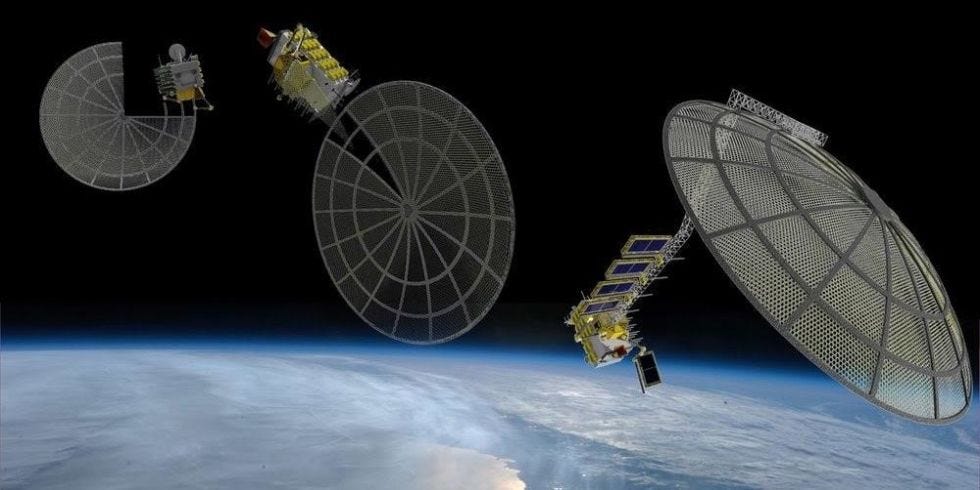
For decades, humanity has built satellites the same way people pack for a budget airline: fold everything tightly, hope it fits, and pray nothing breaks on the way up. That approach has worked remarkably well, but it has also forced spacecraft designers into a weird ritual of compromise. Antennas are folded like origami, solar arrays are squeezed into launch fairings, and engineers spend years trying to make giant ambitions fit inside a rocket-shaped suitcase.
Now a different future is coming into focus. Instead of launching fully finished satellites from Earth, companies and agencies are working toward building satellites in orbit, where robots can assemble structures, add new parts, replace worn systems, and even manufacture components in microgravity. In other words, space may stop being a delivery destination and start becoming a real worksite. That change could reshape communications, Earth observation, national security, science, and even the economics of living and working beyond Earth.
If that sounds dramatic, good. It is dramatic. It is also practical. In-orbit satellite assembly is not just a flashy science-fiction concept designed to impress people who collect telescope posters. It is a logical response to very real limits on launch size, mission cost, hardware lifespan, and orbital congestion. Once satellites can be assembled, repaired, upgraded, and refueled in space, the entire architecture of the space economy starts to look different.
Why We Built Satellites the Old Way for So Long
Traditional satellite manufacturing has always been shaped by gravity, rocket payload limits, and launch stress. A spacecraft built on Earth has to survive transport, vibration, acoustic loads, thermal changes, and a launch environment that treats delicate hardware like a maraca. To survive that journey, engineers have favored compact, rugged, integrated designs. Those designs are impressive, but they also create a problem: once the satellite reaches orbit, it is mostly stuck with the choices made years earlier on the ground.
That model made sense when launches were expensive, satellites were fewer, and servicing in space was more dream than business plan. But the modern orbital economy is changing fast. There are far more spacecraft in operation, far more planned constellations, and far more demand for communications, imaging, navigation, missile warning, weather tracking, and scientific observation. As missions become more ambitious, squeezing everything into a single launch becomes less efficient and, in some cases, unrealistic.
This is where on-orbit servicing, assembly, and manufacturing step in. Instead of sending one giant finished object, future missions can send modules, trusses, tanks, sensors, reflectors, power systems, or robotic tools separately and then combine them in space. Think less “one-time appliance” and more “upgradeable orbital platform.” Suddenly, satellites begin to look less like disposable gadgets and more like infrastructure.
What Building Satellites in Orbit Actually Means
When people hear “building satellites in orbit,” they often imagine astronauts in oversized gloves tightening bolts with the seriousness of a home-improvement show host. In practice, the future is likely to be more robotic, more automated, and a lot more precise. The concept usually includes three connected capabilities: satellite servicing, in-space assembly, and in-space manufacturing.
1. Servicing satellites already in orbit
This includes refueling spacecraft, extending their life, replacing components, moving them to new positions, inspecting damage, and eventually helping with safe retirement. Servicing turns orbit into a place where value can be preserved instead of abandoned.
2. Assembling larger spacecraft in space
This means launching pieces separately and connecting them after arrival. Large antennas, giant solar arrays, telescope mirrors, long booms, and modular payload platforms become much easier to build when they do not need to fit inside a rocket fairing like a very nervous umbrella.
3. Manufacturing parts or materials in orbit
Microgravity and vacuum can enable processes that are difficult or impossible on Earth. That opens the door to producing specialized components, structural parts, advanced materials, semiconductors, optical fibers, or pharmaceutical products in space and then using them there or returning them to Earth.
These three capabilities reinforce one another. A robot that can inspect and dock can also assemble. A platform that manufactures parts can also repair or upgrade. A tug that moves satellites today could become part of a larger orbital construction network tomorrow. This is why the phrase future of space infrastructure matters. We are not talking about one clever robot. We are talking about the early layers of an orbital industrial ecosystem.
How This Changes Satellite Design Forever
The biggest shift may be philosophical. Right now, most satellites are designed as self-contained missions. In the future, many may be designed as platforms that expect support, upgrades, and interaction after launch. That is a huge change. It means designers can stop optimizing every mission for “survive alone forever” and start optimizing for “connect, expand, service, adapt.”
That opens several doors at once. First, spacecraft can become larger and more capable. Bigger radar arrays could improve climate monitoring and disaster response. Larger antennas could strengthen communications for remote regions, aviation, maritime users, and military operations. Larger telescopes could see deeper into space and detect faint objects more clearly. More power generation in orbit could support more demanding sensors and onboard processing.
Second, satellites can become modular. If a power unit degrades, replace it. If a sensor becomes outdated, upgrade it. If a spacecraft runs out of fuel but its payload still works, refuel it instead of throwing the whole machine into orbital retirement like a laptop with a perfectly good screen and one tragic battery.
Third, spacecraft can be built for resilience. Constellations and high-value national security platforms could be repaired or reconfigured after anomalies. Commercial operators could extend asset life instead of eating the cost of total replacement. Scientific missions could gain longer lifetimes and more flexibility. That makes orbital systems not only more capable, but also more economically rational.
The Real-World Progress Already Underway
This future is not purely theoretical. Early forms of orbital servicing are already real. The clearest proof comes from life-extension missions in geostationary orbit, where a servicing vehicle can dock with an aging satellite and provide propulsion and attitude control, effectively giving it more useful years on the job. That has already changed how operators think about end-of-life planning. A satellite once headed for the graveyard can suddenly get a second act. Hollywood loves a comeback story, and apparently so does geostationary orbit.
Meanwhile, newer servicing systems are moving toward robotic operations that go beyond life extension. The next wave aims to inspect, relocate, repair, and install support modules on satellites already in space. Once those services become routine, the industry could shift from emergency intervention to planned orbital maintenance.
Government-backed programs are also pushing the technology forward. Research into autonomous assembly, robotic manipulation, precision structures, and deployable manufacturing is laying the groundwork for building much larger systems in orbit than Earth launch constraints normally allow. That matters because some of the most useful future systems in science and defense may simply be too big, too delicate, or too awkward to launch fully assembled.
Even the manufacturing side is leaving the concept phase. Commercial companies are already experimenting with producing valuable materials in orbit and returning them to Earth. Research aboard the International Space Station has explored fiber optics, crystal growth, pharmaceuticals, and materials science in microgravity. These are early days, but early days are how entire industries begin. Nobody saw the first server rack and thought, “Ah yes, behold the streaming empire.”
Why Building Satellites in Orbit Could Lower Costs
At first glance, building things in space sounds expensive because, well, everything in space sounds expensive. And yes, the upfront investment is significant. Robotics, rendezvous systems, docking interfaces, autonomous guidance, and orbital manufacturing hardware are not exactly bargain-bin items. But the long-term economics can be powerful.
For one thing, servicing and upgrading spacecraft can extract more value from existing satellites. Extending a billion-dollar asset by several years can be far cheaper than building and launching a replacement. For another, modular construction can reduce the need to overbuild satellites for every possible scenario on day one. Instead of launching all capacity upfront, operators may add capability later as demand grows.
There is also the launch equation. If missions can be broken into smaller pieces, they may use multiple launches more efficiently, tap different launch providers, and reduce the engineering gymnastics needed to deploy giant folded systems. Over time, orbital assembly could make large missions more feasible and even cheaper than designing exotic one-piece spacecraft that barely fit inside launch constraints.
Then there is manufacturing. Producing certain high-value products in microgravity could create premium markets that help finance the broader orbital economy. If specialized materials, pharmaceuticals, or semiconductor-related processes prove commercially viable, they could support the development of more orbital infrastructure, which in turn supports spacecraft assembly and servicing. That is how ecosystems form: one profitable capability funds the next one.
What This Means for Everyday Life on Earth
The phrase “future in space” sounds grand, but the real impact will show up in ordinary places on Earth. Better satellites mean better services. More capable communications satellites can improve broadband access and network resilience. Better Earth-observation systems can improve weather forecasting, crop monitoring, wildfire tracking, and disaster response. More adaptable navigation and timing systems strengthen everything from aviation to shipping to financial networks.
In national security, the benefits are just as significant. Satellites that can be inspected, repositioned, upgraded, or repaired are harder to lose and easier to sustain. In a world where space systems are central to defense operations, resilience is not a luxury. It is strategy.
Science stands to gain too. Large assembled telescopes could unlock observations impossible with current launch-limited designs. Distributed sensor networks could be built and maintained more intelligently. Missions to the Moon and beyond could rely on fuel depots, serviced platforms, and reusable in-space systems rather than constantly rebuilding from scratch on Earth.
In short, space manufacturing and orbital construction are not just about fancy hardware above our heads. They are about building better systems for life below them.
The Challenges Nobody Should Pretend Away
Now for the less glamorous but very necessary part: this will not be easy. Building satellites in orbit introduces technical, legal, financial, and security challenges that are very real. Precision robotics in space are hard. Autonomous docking is hard. Coordinating multiple spacecraft in crowded orbital regimes is hard. Standardizing interfaces across manufacturers is hard. Basically, the industry has chosen a future built around doing the hard things on purpose.
There is also debris risk. More operations in orbit mean more rendezvous, more hardware, more potential failure points, and more need for strict traffic management and disposal planning. If orbital construction grows without strong sustainability rules, the industry could end up building a beautiful future inside a dangerous junkyard. That is not a metaphor anyone wants to test at orbital velocity.
Regulation remains another challenge. Satellites that can approach, dock with, move, or modify other spacecraft raise obvious questions about transparency, authorization, liability, and dual-use concerns. A servicing vehicle can be a mechanic, but in the wrong context it can also look uncomfortably like something else. International norms, licensing clarity, and technical standards will matter as much as propulsion and robotics.
And then there is the business risk. Not every ambitious program works out. Some high-profile efforts in this field have faced delays, budget growth, or cancellation. That does not mean the concept is doomed. It means the concept is maturing. Space history is full of technologies that looked clumsy before they looked inevitable.
The Industries Most Likely to Win
Satellite communications
Communications companies may benefit earliest because extending life and adding capability has immediate commercial value. A healthy satellite with empty tanks is basically a luxury car stranded for lack of gas. Servicing fixes that problem.
Earth observation and climate monitoring
Larger sensors and more power can improve imaging resolution, radar coverage, and revisit rates. That means better tools for agriculture, insurance, logistics, emergency management, and environmental science.
Space science
Large telescopes, interferometers, and modular observatories are natural candidates for in-space assembly. The scientific payoff from bigger apertures and longer-lived platforms could be enormous.
Defense and cislunar infrastructure
Resilient, repairable, upgradeable systems are especially attractive in national security and deep-space operations, where replacement may be slow, expensive, or strategically risky.
Advanced manufacturing
If microgravity manufacturing continues to prove useful for niche, high-value products, it could become the quiet financial engine behind wider orbital industrial growth.
What the Next 10 to 20 Years Could Look Like
Over the next decade, the most realistic path is not giant space shipyards appearing overnight with cinematic lighting and suspiciously perfect welds. It is a gradual expansion of capabilities. First, more inspection, docking, relocation, and life-extension services. Then, more robotic installation of add-on modules and replaceable subsystems. Then, larger assembled structures for specialized missions. Then, manufacturing nodes that produce select components or materials in orbit. Piece by piece, the orbital economy becomes less disposable and more permanent.
By the 2030s, it is possible that satellite operators will routinely plan for servicing from the beginning. New spacecraft may launch with standardized ports, robotic access points, modular payload bays, and refueling compatibility. Large government missions may be architected as multi-launch construction projects. Commercial stations and orbital platforms may host inspection robots, depots, and fabrication systems. At that point, asking whether satellites can be built in orbit may sound as outdated as asking whether phones can access the internet.
The deeper change is cultural. Once we stop thinking of space as a place where hardware goes to work alone until it dies, we start thinking of it as a domain where systems can be maintained, expanded, and improved. That is the mindset required for a true space economy. Not one launch at a time, but one layer of infrastructure at a time.
Human Experiences in the Era of Orbital Construction
What will this shift actually feel like for people? That question matters because technology only becomes meaningful when it changes lived experience. For engineers, building satellites in orbit will feel like moving from custom craftsmanship under extreme constraints to something more dynamic and iterative. Instead of designing one sealed masterpiece and waving goodbye at launch, teams will plan missions in phases. They will expect updates, maintenance windows, add-on modules, and in-space troubleshooting. The emotional shift will be huge. Spacecraft will no longer feel like frozen decisions. They will feel alive, revisable, and connected to an ongoing operational story.
For satellite operators, the experience could be even more dramatic. Today, running a spacecraft often means living with the slow anxiety of irreversible problems. A stuck mechanism, a fuel shortfall, or an aging subsystem can push a mission toward a very expensive ending. In the future, operators may have options. They may call for inspection after an anomaly, buy a life-extension package, schedule a robotic upgrade, or relocate a satellite without replacing the whole platform. That changes the emotional texture of mission control. It turns panic into planning and desperation into logistics.
Scientists will experience something equally transformative. Imagine proposing a telescope not limited by fairing size, or an observatory that can receive upgraded instruments after launch. Researchers could begin to think bigger, literally. Questions that once died in the design phase because the hardware was too large or too delicate might come back to life. Space science would become less about one perfect shot and more about building evolving laboratories in orbit. For researchers, that is not just convenient. It is liberating.
Ordinary people on Earth may not watch robotic arms assemble trusses in orbit during breakfast, but they will feel the results. Rural communities could gain more reliable connectivity. Emergency responders could get better real-time imagery during fires, floods, and storms. Pilots, farmers, shippers, and energy operators could rely on stronger data streams from more capable satellites. If orbital manufacturing improves components used in medicine, communications, or computing, some of the benefits may arrive quietly, through better products and services rather than dramatic headlines. The future often sneaks in wearing sensible shoes.
There is also a more human, almost philosophical experience tied to all this. For generations, space has represented distance, isolation, and one-way journeys for machines. Building satellites in orbit changes that story. It suggests continuity. It suggests maintenance, stewardship, and presence. Instead of throwing hardware into the dark and hoping for the best, we begin to care for our tools in space the way mature societies care for infrastructure at home. That may sound poetic, but it also matters practically. Civilizations reveal their priorities by what they maintain.
Even the workforce experience will change. Future jobs in the space sector may blend aerospace engineering with robotics, AI operations, materials science, manufacturing systems, logistics, and orbital traffic coordination. Students who grow up hearing about space construction may not dream only of becoming astronauts. They may want to become orbital mechanics planners, robotic servicing designers, or microgravity manufacturing specialists. That broadens the cultural meaning of participation in space. You do not have to plant a flag to shape the future. Sometimes you just need to build the robot that tightens the bolt.
In the end, the experience of this transformation may be surprisingly familiar. We have seen versions of it before. Transportation networks changed when maintenance and fueling became standardized. Computing changed when systems became modular and upgradeable. Industry changed when production moved closer to where value could be created most efficiently. Space is now approaching a similar turning point. The tools are different, the stakes are higher, and the view is better, but the pattern is recognizably human: first we visit, then we work, then we build.
Conclusion
How building satellites in orbit will change our future in space comes down to one idea: permanence. Once we can assemble, service, upgrade, and manufacture spacecraft beyond Earth, space stops being a place for temporary machines and starts becoming a place for lasting systems. That shift will make missions bigger, satellites smarter, infrastructure more resilient, and the entire space economy more capable.
There will be setbacks, regulatory fights, technical failures, and budget headaches along the way. Space will remain very space about everything. But the direction is clear. The future belongs to orbital infrastructure, not just orbital launches. And when that future arrives, we may look back on the era of one-and-done satellites the way we now look at disposable cameras: impressive for their time, charming in hindsight, and absolutely not the end of the story.