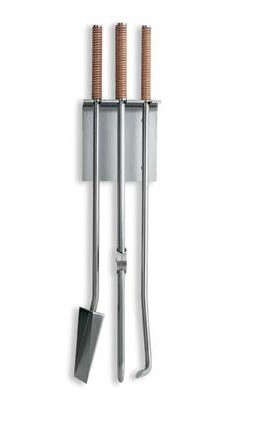
Most fireplace tools suffer from one of two problems: they are either painfully ordinary or aggressively medieval, as if your living room doubles as a small castle with questionable heating efficiency. Fireside Tools by Peter Maly take a very different route. They turn a practical household object into a clean-lined design statement without forgetting the one thing that matters most: these tools still need to work when the logs shift, the ash builds up, and someone has to do the glamorous job of tending the fire.
Designed for Conmoto and introduced in 1997, the Peter Maly fireside set has become one of the company’s defining products. That fact alone says a lot. In a category often treated as an afterthought, this set helped establish a design language for modern fireplace accessories: reduced, precise, elegant, and refreshingly free of decorative fuss. It is one of those rare objects that makes you wonder why fireplace tools ever needed to be clunky, curly, or coated in historical cosplay in the first place.
What makes Fireside Tools by Peter Maly so compelling is not just the look. Yes, the stainless steel frame is sharp and architectural. Yes, the leather-wrapped handles add warmth, texture, and tactile comfort. But the deeper appeal is the balance. This set manages to feel premium without being flashy, minimal without being cold, and timeless without falling into the trap of being boring. That is a difficult trick in furniture design. In fireplace accessories, it is practically wizardry.
Who Is Peter Maly?
To understand the fireside tools, it helps to understand the designer. Peter Maly is a German interior designer and product designer whose career has long been associated with geometric clarity, functional thinking, and a disciplined, enduring modernism. He studied interior architecture in Detmold, worked in editorial and interior-design roles at the German magazine Schöner Wohnen during the 1960s, and opened his own studio in 1970. Over the years, he has worked across furniture, exhibition design, store concepts, and interiors, building a reputation for designs that feel rational, useful, and quietly confident.
Maly’s work is frequently described through words such as clarity, durability, timelessness, and functionality. Those ideas are not abstract branding fluff here; they show up directly in the fireside tools. You can see his preference for elementary geometry in the upright form of the stand, the disciplined vertical lines of the tools, and the absence of ornamental distractions. Nothing is added just to look dramatic. The form is the point, and the form follows the job.
That design philosophy also explains why this piece still feels current. Trends change. Good proportions do not. A lot of home accessories date themselves by chasing whatever is hot that year. Maly’s work tends to avoid that trap. He designs the kind of object that can live next to a minimalist concrete hearth, a warm oak-paneled den, or a highly edited contemporary interior and still look like it belongs.
What Exactly Are the Fireside Tools by Peter Maly?
At its core, the Peter Maly set is a three-piece companion set for fireplace care. The freestanding version includes a poker, a dustpan or ash shovel, and tongs, all stored in a slim stainless steel stand. Conmoto also offers a wall-mounted version built around the same visual language, giving homeowners a second option when floor space is tight or when a more architectural wall presentation makes sense.
The freestanding set is compact but tall, measuring roughly 36 inches high, which gives it enough presence to read as part of the room rather than as a random utility object shoved near the hearth. The official product information emphasizes the premium material mix: stainless steel and high-quality leather. The leather handles are not decorative afterthoughts. They are there for grip, comfort, and heat protection, which is exactly the sort of practical logic that separates serious design from pretty nonsense.
One of the most telling details is the origin story. Peter Maly reportedly developed the idea because he could not find contemporary fireplace accessories that matched his taste. That frustration shows in the final product in the best possible way. The set does not feel like an iteration of old-fashioned fireplace ironwork. It feels like a correction. It asks, “What if fireplace tools were designed for a modern room by someone who actually cares what modern rooms look like?”
Why the Materials Matter
Stainless steel is doing a lot of heavy lifting here, literally and visually. It gives the tools a crisp, refined structure, and it supports the larger design idea of precision. Fireplace tools need toughness, and steel delivers that without apology. But stainless steel alone could have made the set feel too clinical. That is where the leather comes in and saves the whole composition from becoming a shiny robot at the fireside.
The leather-wrapped handles soften the experience in two ways. First, they make the tools nicer to hold. Second, they introduce an organic material that belongs naturally in the world of wood, fire, embers, and warmth. This contrast between metal and leather is one of the reasons the set feels sophisticated instead of sterile. According to product descriptions associated with the design, the leather was chosen not only for heat protection but also for its material beauty. In other words, function and atmosphere shake hands instead of ignoring each other.
That is smart design. Fire is primal. A fireplace should never feel entirely industrial. By combining steel with leather, Maly gives the set a human touch. The tools look precise, but they do not feel emotionally distant. They are polished, but not precious. You can actually use them without feeling like you are handling a sculpture in a gallery while a security guard narrows their eyes.
The Aesthetic: Modern, But Not Showy
Fireside Tools by Peter Maly are often described as minimalist, and that is true, but “minimalist” can be a slippery word. Sometimes it means elegant restraint. Sometimes it means a design has all the personality of unbuttered toast. This set falls firmly into the elegant camp.
The stand is narrow and vertical, which keeps the tools visually tidy. The tools themselves read almost like drawn lines in space. From a distance, the whole arrangement has the rhythm of a small architectural composition. Up close, the materials make it warmer and more tactile. That combination is what keeps the set from becoming overly severe.
In practical interior-design terms, the Peter Maly fireside tools work because they do not compete with the fireplace. They frame it. Traditional fireplace sets often call attention to themselves with scrollwork, blacksmith-style drama, or bulky silhouettes. Maly’s design does the opposite. It supports the hearth visually and functionally while allowing the room to breathe. It is the accessory equivalent of someone with excellent taste who does not need to announce it every six minutes.
Why This Design Still Matters
American design editors and retailers still feature contemporary fireplace accessories as part of broader conversations about modern hearth styling, and that matters. Fireplace tools are no longer viewed only as utility pieces. They are part of the décor story now. Publications focused on design and home living routinely treat hearth accessories as style objects alongside screens, wood storage, and sculptural decor. That shift makes the Peter Maly set feel especially relevant because it anticipated the category’s evolution years ago.
In that sense, the set was ahead of its time. It understood early that fireplace tools do not live in a basement workshop. They live in the room. People see them every day. They contribute to the architecture of the space, whether the fire is lit or not. A thoughtfully designed fireplace tool set can make the hearth feel composed and intentional. A bad one can make the whole area look like it borrowed props from a generic lodge-themed restaurant.
The Peter Maly set survives because it solves both problems at once. It performs the tasks a fireplace owner needs, and it looks like it belongs in a modern home. That might sound obvious, but it is surprisingly rare in home accessories. Too many products choose one lane and forget the other.
How It Compares With Traditional Fireplace Tools
If you grew up around classic iron fireplace sets, the contrast is immediate. Traditional sets often prioritize visual mass. They are dark, heavy, decorative, and designed to blend into a rustic or period setting. That can be beautiful in the right room. But in a modern interior, that same style can feel like a costume change nobody asked for.
Peter Maly’s approach strips away the historical baggage. Instead of ornamental iron curls, you get controlled geometry. Instead of visual heaviness, you get vertical lightness. Instead of a “hearth accessory” that screams its identity from across the room, you get a piece that reads as an integrated design object.
That does not mean it lacks personality. It simply expresses personality through proportion, material, and restraint. This is a more mature kind of drama. It does not wave its arms. It stands there looking composed while the rest of the room catches up.
Best Interiors for the Peter Maly Fireside Tools
This set is an obvious fit for modern, minimalist, and contemporary interiors, but it is more versatile than that. It works beautifully in spaces that mix clean architecture with warm natural materials, such as oak flooring, linen upholstery, stone surrounds, or soft neutral textiles. It also makes sense in Japandi-inspired rooms, where the marriage of simplicity and tactility is essential.
In loft-like spaces with concrete, steel, and glass, the leather helps prevent the tools from feeling too cold. In softer residential spaces, the steel keeps the set from becoming visually mushy. If your fireplace area already includes sleek wood storage, a frameless screen, or other pared-back accessories, the Peter Maly tools will feel especially natural.
Even in more traditional rooms, this set can work if the goal is contrast. A classic mantel with a more modern tool set can create an appealing tension, especially when the rest of the décor is edited and calm. The key is intentionality. These tools are not background clutter. They are part of the composition.
Things to Consider Before Buying
The first question is whether you want the freestanding version or the wall-mounted one. The stand version is ideal if you want the set to read as a sculptural object next to the hearth. The wall-mounted version is great for tighter footprints or for anyone who prefers a cleaner floor area.
The second question is aesthetic commitment. This is not a farmhouse accessory, not a colonial revival detail, and definitely not something that wants to pretend it was forged during a thunderstorm in 1742. It is a modern design piece. If your room leans heavily rustic, you will need to decide whether you want harmony or contrast.
Finally, there is the question of expectations. This is a premium fireside set with designer pedigree, quality materials, and enduring appeal. It is not the bargain-bin route, and it is not trying to be. People buy a piece like this because they want an object that earns its place in the room for years, not because they need the cheapest possible way to poke a log.
Experience: Living With Fireside Tools by Peter Maly
Living with Fireside Tools by Peter Maly is a little different from living with an ordinary fireplace set, and the difference shows up in ways that are both practical and strangely emotional. The practical side comes first. The tools are easy to spot, easy to grab, and easy to return to the stand. That may sound minor, but anyone who has dealt with awkward fireplace tools knows that good storage changes the entire ritual. When the set has a clear place and a clear order, the fireside area stays calmer. The room looks prepared rather than messy, even after a long evening of tending the fire.
Then there is the tactile experience. The leather-wrapped handles matter more than you might expect. They feel warmer in the hand than bare metal, and they make the act of adjusting logs or clearing ash feel less mechanical. Instead of grabbing a generic tool, you feel like you are using an object that was actually thought through from the standpoint of the person holding it. Good design often works this way. It does not scream for attention while you use it; it simply removes irritation from the moment.
There is also a visual pleasure in seeing the set at rest. Many fireplace tools look acceptable only when you are actively using them. The Peter Maly set still contributes to the room when the fire is out, the hearth is cool, and nobody is playing woodland philosopher in front of the flames. Standing quietly beside the fireplace, it reads almost like a small sculpture. It creates a sense of readiness, like the room knows exactly what it is doing.
That is especially important in homes where the fireplace serves as a visual anchor year-round. In many interiors, the hearth is not used every day, but it is seen every day. A badly chosen accessory can make the space feel cluttered for eleven months and useful for one month. Maly’s design avoids that trap. It earns its keep in both active use and visual presence.
There is an understated confidence to the experience too. Guests may not always identify the designer, but they notice the difference. They notice that the tools look intentional. They notice that the set feels integrated instead of improvised. It is one of those rare household details that quietly elevates the room without turning into a conversation hostage. Nobody has to stand there for twenty minutes explaining that it is “a statement piece.” The set simply does its job, and the room benefits from that composure.
Over time, that may be the most appealing part of owning something like this. It turns an everyday ritual into a slightly better version of itself. Bringing in wood, adjusting the fire, clearing away ash, restoring order at the end of the night: none of those tasks become glamorous exactly, but they do become more satisfying. And in a home, those little upgrades matter. They are the difference between mere utility and lived-in pleasure.
So the experience of Peter Maly’s fireside tools is not about extravagance for its own sake. It is about living with an object that respects both the room and the routine. It makes the fireside feel more considered, more grounded, and frankly more adult. Not boring-adult, tax-spreadsheet-adult. Good-adult. The kind of adult who owns decent coffee, folds throws neatly, and knows that even the poker by the fireplace can be beautifully designed.
Final Thoughts
Fireside Tools by Peter Maly succeed because they understand the fireplace as both a functional zone and an emotional center of the home. They are thoughtfully engineered, materially rich, and stylistically disciplined. They bring together stainless steel, leather, geometry, and purpose in a way that still feels fresh decades after the design first appeared.
For homeowners who care about modern interiors, this set is more than a useful accessory. It is an example of how design can elevate even the most ordinary domestic tools. And that may be the real charm here. Peter Maly did not invent the fireplace poker, the tongs, or the ash shovel. He simply gave them a better life story.