Note: This article is an original, rewritten feature prepared for web publication and based on publicly available information about Yaşar Vurdem’s portfolio, creative collaborations, and digital illustration work. Source links are intentionally not displayed in the article body.
Some digital portraits make you pause. Others make you lean toward the screen like a detective examining evidence. Yaşar Vurdem’s celebrity illustrations belong firmly in the second group. The Turkish digital artist has built a recognizable style around glowing color, cinematic lighting, polished realism, and the kind of tiny visual details that make viewers ask the internet’s favorite question: “Wait… is this a painting?”
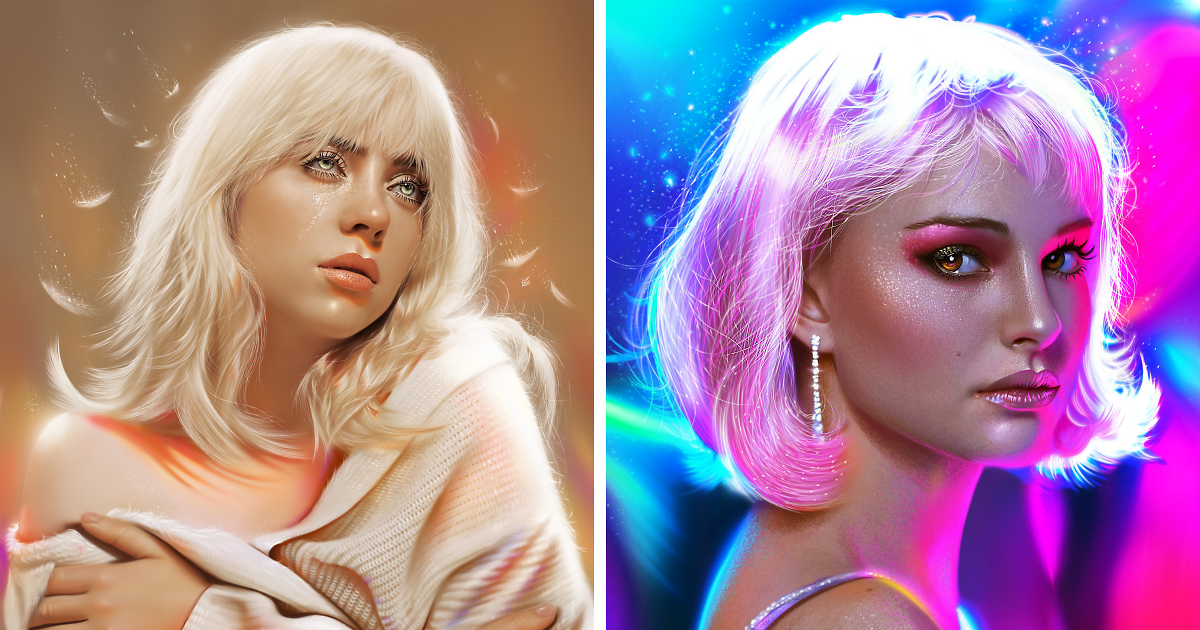
The answer is yes. Vurdem’s work is digital illustration, but it carries the emotional weight of portrait photography and the dramatic finish of movie-poster art. His famous-celebrity portraits often feature performers and characters with huge pop-culture presence, including Billie Eilish, Elizabeth Olsen as Scarlet Witch, Gal Gadot as Wonder Woman, Natalie Portman, Millie Bobby Brown’s Eleven, Simone Simons, and fantasy figures such as Galadriel. The result is not merely fan art; it is fan art that dressed up, learned lighting theory, bought a premium tablet, and walked confidently into a gallery.
In the “9 Pics” collection, Vurdem’s illustrations show why realistic digital art continues to thrive online. People love celebrity portraits because the face is already familiar. The magic happens when an artist reintroduces that face through brushwork, atmosphere, symbols, and mood. Vurdem does exactly that, transforming recognizable icons into images that feel both intimate and larger than life.
Who Is Yaşar Vurdem?
Yaşar Vurdem is a digital artist and freelance illustrator based in Turkey, known for realistic portrait illustration, bold color palettes, and storytelling-driven compositions. Across his online portfolio, he presents himself as an independent illustrator whose work has connected with major entertainment and creative brands. His profile highlights collaborations and client work associated with names such as Adobe, Prime Video, Ubisoft, Wacom, Logitech, XP-Pen, and others.
That client list matters because it tells us something important about the professional level of his work. Vurdem is not simply producing clean celebrity drawings for social media likes, although he certainly knows how to make a scroll-stopping image. His portraits also fit the language of modern entertainment marketing: dramatic, instantly readable, emotionally charged, and polished enough to live on a billboard, poster, streaming campaign, or promotional visual.
One of his best-known milestones is his Billie Eilish illustration connected to Adobe’s Billie Eilish campaign. The artwork appeared in global advertising contexts, including billboards in major U.S. cities such as Las Vegas, Chicago, and New York. That kind of visibility is a dream scenario for digital artists. One day you are painting pixels; the next day your portrait is towering over traffic while pedestrians look up and pretend they are not impressed.
Why His Celebrity Illustrations Feel So Real
The phrase “incredibly realistic illustrations” gets tossed around online so often that it has almost lost its sparkle. In Vurdem’s case, however, the description fits. His portraits do not rely on realism alone. They combine likeness, surface texture, atmosphere, and emotion. That combination is why his work feels alive rather than flat.
1. The Eyes Carry the Portrait
In realistic portrait art, the eyes are the first checkpoint. If they fail, everything fails. A perfectly rendered jacket, hair strand, or necklace cannot rescue a lifeless gaze. Vurdem’s celebrity portraits often succeed because the eyes have direction, moisture, reflected light, and emotional temperature. They do not simply sit on the face; they communicate.
His Billie Eilish portrait, for example, is not only recognizable because of facial structure or hairstyle. The image captures a mood: calm, slightly mysterious, and magnetic. The viewer sees a celebrity, yes, but also a carefully staged emotional moment. That is the difference between drawing a famous person and building a portrait around a presence.
2. Color Does More Than Decorate
Vurdem’s use of color is one of the easiest signatures to notice. Bright tones, glowing highlights, floral accents, fantasy hues, and symbolic color choices appear often in his work. Instead of treating color as a final coat of paint, he uses it as part of the storytelling structure.
In a Scarlet Witch illustration, red is not just red. It suggests chaos magic, power, danger, grief, and cinematic intensity. In a Galadriel-inspired piece, cooler light and ethereal color can make the character feel ancient, noble, and almost unreachable. With Wonder Woman, warm highlights and heroic contrast help emphasize strength and myth. Vurdem’s palette choices are not random confetti. They are more like stage lighting for the soul.
3. Realism Meets Surrealism
Another reason Vurdem’s digital celebrity art stands out is his blend of realism and surrealism. The faces are convincing, but the surrounding worlds are often heightened. Flowers, flames, soft glows, magical symbols, atmospheric smoke, and abstract textures push the portraits beyond ordinary likeness studies.
This balance is especially important in celebrity illustration. If the artwork is too realistic, it may feel like a copied photograph. If it is too stylized, the likeness may disappear. Vurdem walks between those extremes. The viewer recognizes the celebrity or character quickly, then stays longer because the visual setting adds a second layer of meaning.
The 9 Pics: Famous Faces, Characters, and Visual Stories
The “9 Pics” collection associated with Vurdem’s celebrity illustrations includes a mix of musicians, actors, and fictional screen icons. Several pieces are especially memorable because they show how he adapts his visual language to different personalities and genres.
Billie Eilish
Billie Eilish is a natural subject for digital portraiture because her public image already plays with mood, color, fashion, and visual symbolism. Vurdem’s Billie Eilish illustration captures that mix beautifully. The portrait feels polished and luminous without stripping away the quiet intensity that fans associate with her. It is glamorous, but not empty. Stylish, but not stiff.
The Adobe-related exposure of this artwork also shows how celebrity fan art can cross into professional campaign work. For digital artists, this is an encouraging example: personal style and fandom can become part of commercial visual culture when the execution is strong enough.
Galadriel
Galadriel is not merely a face; she is a mythology problem. Any artist painting her has to suggest grace, age, wisdom, danger, and beauty without turning the character into a decorative elf calendar. Vurdem’s interpretation leans into atmosphere and luminous fantasy energy. The portrait works because it respects the character’s iconic elegance while still giving the image a modern cinematic shine.
Scarlet Witch / Elizabeth Olsen
Scarlet Witch gives Vurdem a chance to push color and emotion hard. Elizabeth Olsen’s character carries grief, power, instability, and mystery, and those qualities translate well into a digital painting full of red light and supernatural tension. In this kind of portrait, realism is only half the job. The other half is visual drama, and Vurdem clearly enjoys that assignment.
Eleven / Stranger Things
Millie Bobby Brown’s Eleven is instantly recognizable, but the character is also defined by vulnerability and force. A successful portrait has to hold both. Vurdem’s approach gives Eleven the emotional seriousness she needs while keeping the image visually rich. It is not just a “Stranger Things” reference; it is a character study wrapped in digital polish.
Natalie Portman
Natalie Portman’s features invite a different kind of portrait language: refined, expressive, and subtle. Vurdem’s work with a Portman-inspired portrait shows his ability to step away from explosive fantasy lighting and focus on elegance. This is where the artist’s control of facial softness, shadow, and skin texture becomes especially important.
Wonder Woman / Gal Gadot
Wonder Woman is all about heroic clarity. If Scarlet Witch is emotional fire, Wonder Woman is disciplined power. Vurdem’s Gal Gadot-inspired Wonder Woman illustration uses the familiar cues of armor, strength, and cinematic lighting while maintaining the softness necessary for a portrait. It looks heroic without becoming a stiff action figure. That is not easy. Many artists discover this only after accidentally making a superhero look like a very serious mannequin.
Simone Simons, Fire, and White
The inclusion of Simone Simons adds a music-world dimension beyond Billie Eilish, while works titled “Fire” and “White” show how Vurdem’s portrait style can move between celebrity likeness and more symbolic or conceptual imagery. These pieces help explain why his portfolio is broader than simple famous-face illustration. He is interested in mood, texture, and storytelling even when the subject is not tied to a blockbuster franchise.
Digital Illustration Is Not “Just a Filter”
Whenever realistic digital art goes viral, someone eventually says, “Isn’t that just a photo with effects?” This is the internet’s version of walking into a bakery and asking whether the cake is “just flour.” Digital portrait work can involve references, layers, brushes, color correction, and software tools, but the final image still depends on artistic judgment.
Realistic digital painting requires understanding anatomy, value, edge control, texture, lighting, composition, and expression. The software does not decide where the highlight should fall on a cheekbone. It does not automatically know how much sharpness belongs in the eyelashes or how soft the transition should be under the lower lip. The artist makes those decisions, often hundreds of times in a single piece.
Vurdem’s portraits are especially useful examples because they show both technical discipline and entertainment appeal. The paintings are clean enough to satisfy viewers who love realism, but expressive enough to avoid looking sterile. They have the glossy finish of digital tools, yet still feel touched by a human hand.
What Makes Vurdem’s Style SEO-Worthy and Social-Media Friendly?
From a web publishing perspective, Yaşar Vurdem’s celebrity illustrations perform well because they combine several highly clickable elements: famous faces, realism, fantasy, color, and behind-the-scenes curiosity. Readers are not just asking, “Who is this celebrity?” They are asking, “How did the artist make this?” That question keeps people scrolling.
Search engines also reward content that gives context, not just image dumps. A strong article about Vurdem’s work should explain who he is, why the illustrations matter, which celebrities or characters appear, and what techniques make the portraits compelling. The best version of this topic is not simply “look at these pictures.” It is “look at these pictures, and here is why your brain refuses to believe they are drawings.”
That is the sweet spot for digital art coverage. Readers enjoy the visual surprise, while the written analysis gives them language for what they are seeing. Lighting, brushwork, saturation, likeness, composition, and symbolism all become part of the story.
Why Celebrity Portraits Still Matter in the Age of AI Images
Celebrity illustration has entered a strange new era. AI image tools can generate glossy portraits in seconds, and audiences are becoming more skeptical about what they see online. That makes artists like Vurdem more interesting, not less. His work represents a craft-based approach to digital image-making, where style, portfolio history, process, and personal visual decisions matter.
The value of an artist is not only the final picture. It is the recognizable voice behind the picture. Vurdem’s portraits have a consistent personality: dramatic lighting, carefully rendered faces, saturated color, and a love of fantasy-inflected beauty. That consistency is difficult to fake over a long body of work. It is also what helps viewers recognize an artist without needing a watermark the size of a garage door.
In a crowded digital landscape, style is survival. Vurdem has built a style that feels commercial, cinematic, and emotionally accessible. That is why his images travel well on platforms such as Instagram, Behance, ArtStation, and entertainment blogs. They are easy to admire quickly and rewarding to study slowly.
Lessons Artists Can Learn From Yaşar Vurdem
For emerging digital artists, Vurdem’s work offers several practical lessons. First, realism alone is not enough. A technically accurate face may impress people for a moment, but storytelling makes them remember the image. Second, lighting is not decoration. It controls mood, focus, and drama. Third, a strong portfolio should show range while still feeling recognizable.
His career also shows the importance of presenting work professionally. Online portfolios, social media visibility, tutorials, brushes, and marketplace products all help turn artistic skill into a sustainable creative presence. In today’s illustration world, talent matters, but discoverability matters too. A beautiful painting hidden in a forgotten folder is basically a masterpiece wearing camouflage.
Vurdem’s celebrity portraits demonstrate that digital artists can move between fan culture, personal expression, and professional opportunity. That is one of the most exciting things about the field. A portrait made from admiration can become a portfolio centerpiece. A portfolio centerpiece can become a brand collaboration. A brand collaboration can put the artist’s work in front of millions.
Experiences Related to Yaşar Vurdem’s Realistic Celebrity Illustrations
Looking at Yaşar Vurdem’s work is a familiar experience for anyone who has ever fallen into an art rabbit hole online. You open one image because the celebrity face catches your attention. Then you notice the glow around the hair. Then the skin texture. Then the careful rim light. Then the tiny color accents that seemed decorative at first but are quietly holding the entire composition together. Five minutes later, you are zooming in like a museum curator with Wi-Fi.
That is the special pleasure of high-level digital portraiture. It gives viewers two experiences at once. The first is immediate recognition: “That is Billie Eilish,” or “That is Scarlet Witch,” or “That is Wonder Woman.” The second is discovery: “Look at how the artist painted the lips,” “Look at the flowers,” “Look at that red glow,” “Look at the way the character seems to step out of shadow.” A good celebrity illustration does not stop at likeness. It invites inspection.
For people who create art, Vurdem’s portraits can also be a little dangerousin the best way. They make digital painting look glamorous, but they also reveal how much work sits behind the glamour. Beginners might see the finished image and think the secret is a magic brush pack. More experienced artists know the truth is less mystical and more demanding: strong fundamentals, patient layering, clean edges, controlled values, color harmony, and many hours of refinement.
One relatable experience is trying to paint a famous face and discovering that “almost right” looks completely wrong. Celebrity portraits are unforgiving because viewers know the subject already. Move the eyes a little too far apart, soften the jaw too much, or misjudge the nose shape, and suddenly Billie Eilish becomes “Billie-ish,” which is not a person anyone bought concert tickets to see. Vurdem’s success comes from respecting likeness while still allowing room for style.
Another experience is realizing how emotional color can be. Many viewers respond to Vurdem’s work before they consciously understand why. Warm light can make a portrait feel intimate. Red can make Scarlet Witch feel unstable and powerful. Cool fantasy tones can make Galadriel feel distant and divine. Digital artists who study his work can learn that color is not just the fun part after the drawing is done. Color is storytelling with a volume knob.
There is also a broader experience here for fans. Celebrity culture often gives us polished photographs, red-carpet images, posters, and screenshots. Vurdem’s illustrations remix that familiarity. He gives fans a version of a celebrity or character that feels known but newly imagined. That is why fan art remains powerful. It is not simply copying pop culture; it is participating in it.
Finally, Vurdem’s rise reminds creative people that digital art is not a lesser cousin of traditional art. It is its own language, with its own tools, standards, and possibilities. A stylus can be as expressive as a brush. A digital canvas can hold just as much mood as paper or linen. And a portrait made on a screen can still make viewers stop, stare, and whisper the highest compliment of the modern internet: “Okay, that is insanely good.”
Conclusion
Yaşar Vurdem’s incredibly realistic celebrity illustrations stand out because they do more than imitate famous faces. They interpret them. Through luminous color, dramatic lighting, refined brushwork, and a cinematic sense of mood, Vurdem turns pop-culture icons into digital portraits that feel polished, emotional, and memorable.
The “9 Pics” collection gives readers a compact but powerful introduction to his style. From Billie Eilish and Scarlet Witch to Galadriel, Eleven, Natalie Portman, Wonder Woman, and other striking works, each illustration shows a different side of his creative approach. Some pieces lean into fantasy. Others focus on elegance or atmosphere. Together, they prove that realistic digital portraiture is not just about technical skill. It is about presence, personality, and storytelling.
In a world overflowing with images, Vurdem’s work gives viewers a reason to slow down. That may be the greatest compliment a digital artist can earn.