Flexible seating in elementary school sounds simple at first: trade a few desks for wobble stools, add a cozy rug, maybe toss in a beanbag or two, and suddenly the classroom looks like a children’s library met a tiny coworking space. Lovely, right? Well, almost. Designing flexible seating with elementary school students is not really about trendy furniture. It is about building a classroom where children can make thoughtful choices, move safely, focus better, collaborate naturally, and learn that comfort comes with responsibility.
For elementary students, the learning environment is not background decoration. It is part of the lesson. A room with clear pathways, purposeful seating zones, predictable routines, and student voice can support independence and classroom management. A room with ten yoga balls, no rules, and a teacher silently praying by 9:05 a.m. is not flexible seating. That is furniture-based chaos with a colorful rug.
The best flexible seating classroom balances freedom and structure. Students get options, but those options are taught, practiced, reviewed, and adjusted. The goal is not to make the room look cute on a school tour. The goal is to help real children do real learning in a space that respects their bodies, attention spans, personalities, and developing self-management skills.
What Flexible Seating Really Means
Flexible seating is a classroom design approach that gives students more than one appropriate place or posture for learning. Instead of assigning every child to the same desk-and-chair setup all day, the teacher creates a variety of workspaces: tables for collaboration, floor cushions for reading, standing spots for writing, stools for movement, quiet corners for independent work, and traditional seats for students who prefer them.
That last part matters. Flexible seating does not mean every desk must disappear. Some children love a standard chair and table. Some need a defined personal space to feel organized. Some students want novelty on Monday and predictability by Wednesday. A strong flexible seating plan includes choices without making traditional seating feel like the “boring option.” In a healthy classroom, a regular chair is not a punishment; it is one tool in the learning toolbox.
Why Elementary Students Benefit From Choice
Elementary students are still learning how to manage their attention, bodies, materials, emotions, and friendships. Flexible seating can support those skills when it is designed intentionally. When students choose a workspace, they practice asking, “Where can I do my best work right now?” That question is small, but it builds self-awareness.
Choice can also increase student ownership. A child who helps design the reading nook, names the quiet zone, or votes on seating rules is more likely to treat the room as a shared community instead of a furniture showroom. Students begin to understand that the classroom belongs to everyone, not just the teacher with the label maker.
Flexible seating may also support movement. Many young learners focus better when they can shift, stand, wiggle slightly, or change position during the day. This does not mean every child needs constant motion. It means the room should allow reasonable movement without turning math time into a miniature obstacle course.
Start With Learning Goals, Not Furniture
The most common mistake in designing flexible seating with elementary school students is starting with the shopping list. A teacher sees wobble stools, scoop rockers, lap desks, or soft chairs and thinks, “My classroom needs those.” Maybe it does. Maybe it needs three fewer things and one better traffic pattern.
Begin with learning goals. Ask what students actually do during the day. Do they read independently? Meet in small groups? Build with manipulatives? Use tablets? Write for long stretches? Work with partners? Listen to mini-lessons? Each activity needs a different kind of space.
Questions to Guide the Design
Before adding anything new, consider these questions: Where do students need to collaborate? Where can they work quietly? Where can a student sit close to instruction? Where can a child take a brief sensory or emotional reset without feeling isolated? Where do backpacks, book bins, pencils, headphones, and math tools live? If the room cannot answer these questions clearly, the seating is not flexible yet. It is just movable.
Invite Students Into the Design Process
Elementary students can be surprisingly thoughtful classroom designers. They know which corners feel crowded, which table gets too loud, and which rug spot mysteriously attracts pencil shavings. Involving them does not mean giving them full control over the floor plan. It means giving them authentic voice within teacher-created boundaries.
Try starting with a class discussion: “What helps you focus?” “Where do you like to read?” “What kind of seat makes partner work easier?” “What makes a space distracting?” Chart their ideas. Students might say they need a quiet place away from traffic, a table big enough for group projects, or a spot where they can stand without blocking the board.
Then let students test options. For one week, allow them to rotate through different seating types and reflect on what worked. A simple exit slip can ask, “Where did I work today? Did it help me learn? Why or why not?” Their answers will often be more useful than a catalog description promising “maximum ergonomic engagement,” whatever that means in fourth-grade handwriting.
Create Clear Seating Zones
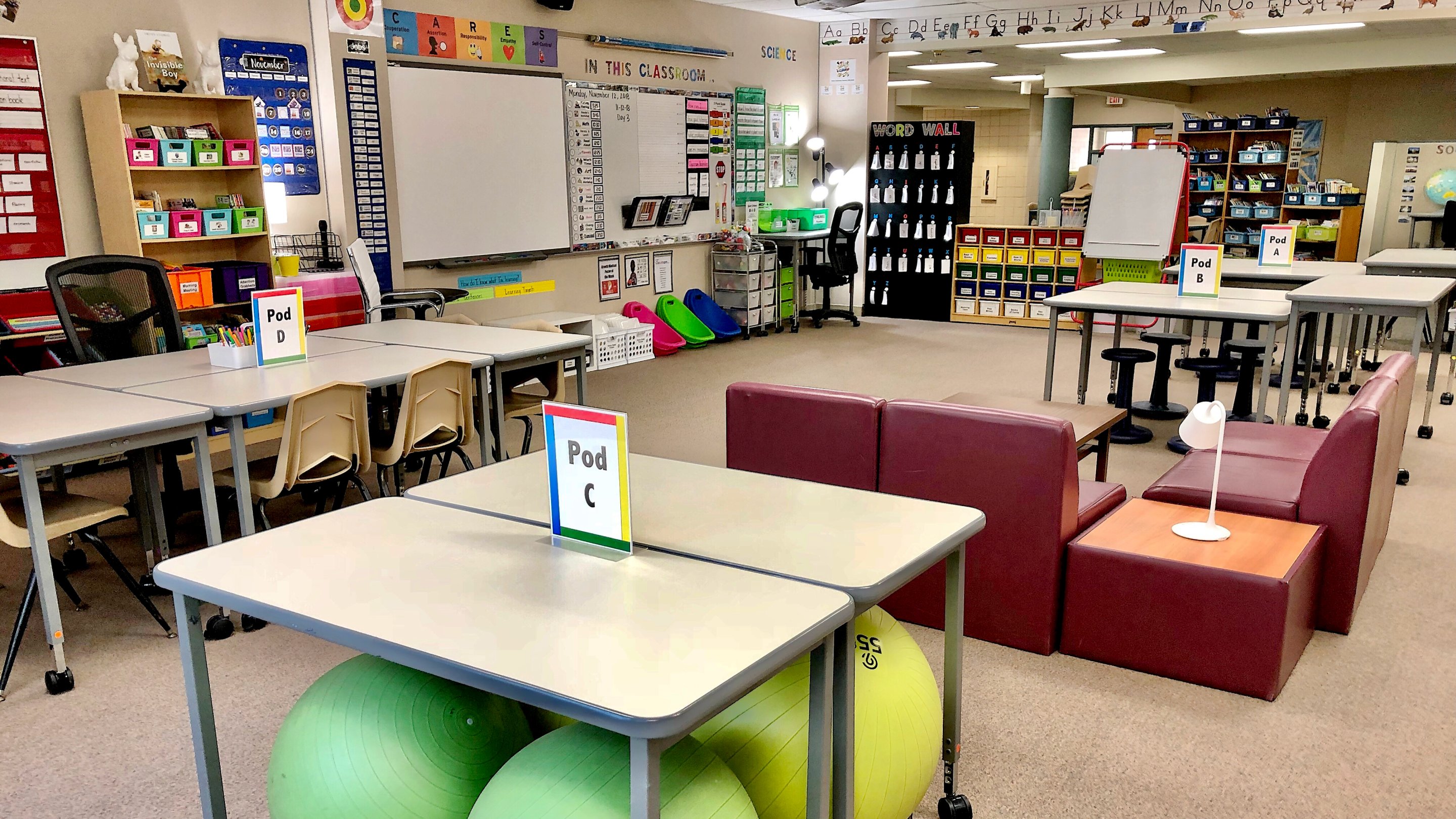
A flexible seating classroom works best when students understand the purpose of each zone. Instead of randomly spreading seats around the room, design areas that match common learning tasks.
The Collaboration Zone
This area is for partner work, small-group projects, STEM challenges, and discussions. Tables, clustered desks, or low work surfaces can help students face one another and share materials. The collaboration zone should be far enough from quiet spaces that normal conversation does not feel like a marching band rehearsal.
The Focus Zone
This is the place for independent reading, writing, assessments, or tasks requiring concentration. It might include individual desks, privacy folders, cushions with lap desks, or a small table facing a wall. The focus zone should feel calm, not banished. Avoid calling it “the quiet punishment corner.” Children are excellent at detecting bad branding.
The Movement-Friendly Zone
Some students benefit from standing desks, wobble stools, chair bands, or floor spaces where they can shift position. These seats should be placed where movement will not bump classmates, block pathways, or distract the whole group. Movement-friendly does not mean anything goes; it means movement is expected, safe, and purposeful.
The Gathering Zone
Elementary classrooms still need a shared meeting space for morning meetings, read-alouds, mini-lessons, and community conversations. A rug, taped floor spots, or assigned meeting locations can help students settle quickly. Young children often feel safer when they know exactly where their bodies belong during group time.
Teach Flexible Seating Like a Procedure
Flexible seating fails when teachers introduce it as a privilege but never teach it as a routine. Students need explicit modeling. Show them how to carry a cushion, how to sit on a wobble stool, how to choose a spot, how to switch seats, how to clean up, and how to know when a seat is not working.
Use interactive modeling: demonstrate the correct behavior, demonstrate a silly non-example, then let students practice. For example, show how to sit on a wobble stool with feet on the floor. Then show the dramatic version: spinning, tipping, and slowly becoming a human helicopter. Students will laugh, and they will remember the rule.
Anchor charts can help. A chart titled “Choose a Seat That Helps You Learn” might include: I can see or hear the lesson; I have enough space; I am safe; I am not distracting others; I can complete the task. Keep the language positive and simple.
Use Student Agreements, Not Endless Rules
Rules are necessary, but too many rules can make flexible seating feel like a legal contract. Instead, create a few student-friendly agreements. For example: “Choose a smart spot,” “Use furniture safely,” “Move if the spot is not helping,” and “Leave the space ready for the next learner.”
These agreements teach responsibility. A student who keeps chatting at the floor table is not “bad at flexible seating.” The seat is not matching the task. The teacher can say, “That spot is not helping your learning right now. Choose a focus spot.” This keeps the conversation practical rather than personal.
Protect Accessibility and Inclusion
Flexible seating should support all students, including children with ADHD, sensory needs, anxiety, physical disabilities, visual needs, hearing needs, or executive function challenges. A flexible classroom is not inclusive if only the fastest, loudest, or most socially confident students get the best spots.
Some students may need preferential seating close to the teacher, away from high-traffic areas, near visual supports, or in a quieter part of the room. Others may need stable chairs, foot support, extra space between work areas, or easy access to materials. Flexible seating should expand access, not create a daily competition for survival.
Consider using “home base” seats. Each student has a predictable assigned place for attendance, direct instruction, testing, or substitute days. During independent or collaborative work, students may choose from approved options. This hybrid model gives students freedom while preserving predictability.
Budget-Friendly Flexible Seating Ideas
Designing flexible seating with elementary school students does not require a luxury furniture budget. In fact, some of the most effective changes cost little or nothing. Rearranging desks into groups, clearing a reading corner, lowering a table, adding clipboards for floor work, or using sturdy cushions can change how students use the room.
Teachers can repurpose existing furniture. A bookshelf can define a quiet area. A small table can become a conference zone. Carpet squares can mark independent reading spots. Plastic crates with cushions can provide storage and seating, as long as they are stable and safe. Clipboards can turn almost any area into a writing space.
Before accepting donations, set standards. Soft furniture should be cleanable. Chairs should be sturdy. Rugs should not create tripping hazards. Anything that squeaks, sheds, tips, smells mysterious, or looks like it survived three garage sales and a raccoon incident should probably not enter the classroom.
Classroom Management Tips for Flexible Seating
Strong management makes flexible seating possible. Without routines, students may treat seating choice like recess with pencils. With routines, flexible seating can actually reduce conflict because expectations are clear.
Use a Slow Rollout
Do not open every seating option on the first day. Introduce one or two choices, teach them well, and add more as students show readiness. For example, start with table choices and floor spots. Later introduce wobble stools, standing areas, or a calm corner.
Limit Popular Seats
If everyone wants the blue beanbag, create a fair system. Use rotation cards, sign-ups, table teams, or task-based seating. Students can learn that not getting the beanbag today is not a human rights crisis. It is Tuesday.
Match Seats to Tasks
Not every seat fits every activity. Floor cushions may work for reading but not for cutting paper. Standing desks may help during writing but not during a detailed art project. Teach students to choose based on the task, not just comfort.
Keep Materials Easy to Reach
Flexible seating becomes frustrating when students constantly wander for pencils, books, chargers, or math tools. Use labeled bins, supply stations, personal folders, and clear storage systems. The room should say, “You can be independent,” not “Good luck finding a glue stick.”
Safety Comes First
Flexible seating must be safe. Keep walkways clear. Make sure students can exit quickly during drills. Avoid blocking doors, sinks, emergency materials, windows, or teacher access to students. Furniture should be stable and age-appropriate. If a seat encourages tipping, rolling, launching, or acrobatics, it needs a procedure or a new home.
Also consider hygiene. Soft seating should be easy to clean, and shared items may need regular sanitation. Floor seating should be placed away from messy supply areas, trash cans, and high-traffic paths. A beautiful reading pillow is less magical when it lives under the pencil sharpener.
How to Know If Flexible Seating Is Working
A classroom may look flexible but still not function well. Measure success by student behavior, engagement, independence, and learningnot by how many seating types appear in the room.
Look for signs: Are students choosing appropriate spots more quickly? Are transitions smoother? Are fewer students interrupting instruction because they are uncomfortable? Are students able to explain why a seat helps them learn? Is collaboration improving? Are quiet spaces respected? Are you spending less time managing furniture and more time teaching?
Collect student feedback regularly. Ask, “Which spaces help you learn?” “Which spaces need new rules?” “What seating choice is distracting?” “What should we change next month?” The design should evolve as students grow. A seating plan that works in September may need a refresh by January, when everyone is taller, louder, and weirdly attached to one particular stool.
Specific Examples for Elementary Classrooms
In a second-grade classroom, a teacher might create four seating options: regular desks, a rug with clipboards, a standing table, and a quiet reading corner. Students begin with assigned seats during whole-group lessons, then choose a work spot for independent reading. The teacher uses a timer and a reflection question: “Did my spot help me read?” After two weeks, students help revise the seating chart and agreements.
In a fourth-grade classroom, students might use flexible seating for project-based learning. The collaboration table is used for planning, the floor area is used for sorting materials, and individual desks are used for final writing. Students choose spaces according to project stage. This teaches that flexible seating is not just about comfort; it is about matching environment to purpose.
In a mixed-ability classroom, a teacher might reserve a few seats for specific needs while still offering general choice. For example, one student may need a low-distraction desk near the teacher, while another may use a wobble stool during writing. The class does not need to know private reasons. The teacher can simply say, “In our room, everyone gets what helps them learn.”
Common Flexible Seating Mistakes to Avoid
The first mistake is removing too much structure too quickly. Elementary students need choice, but they also need predictable routines. The second mistake is buying furniture before observing students. Watch how children use the room first. Their behavior will tell you what the space needs.
The third mistake is treating flexible seating as a reward. If only “well-behaved” students get comfortable seats, the classroom can become unfair and stressful. Instead, teach seating as a learning strategy. Students may lose a choice temporarily if it is unsafe or distracting, but the goal is always to help them regain independence.
The fourth mistake is ignoring teacher needs. The teacher must be able to see students, confer easily, move around the room, access materials, and teach without stepping over six cushions and a water bottle village. A room that works for children but exhausts the adult is not sustainable.
Experiences From Designing Flexible Seating With Elementary Students
One of the most valuable lessons from designing flexible seating with elementary school students is that children often understand their learning needs better than adults expect. When asked where they focus best, students rarely say, “Wherever the most expensive chair is located.” They say things like, “I need to be away from my friends during writing,” “I like standing because I get sleepy,” or “The rug is good for reading but not math because my paper gets messy.” Those comments are classroom design gold.
A practical experience many teachers share is the importance of testing before committing. For example, a class may be excited about floor seating until students realize that writing neatly on the floor is harder than it looks. Another class may love wobble stools, but only when there are clear expectations about feet, spacing, and noise. A standing table may become the most productive spot in the room for some students and a social headquarters for others. The teacher’s job is not to declare one option good or bad forever, but to notice patterns and adjust.
Student co-design also builds community. When children help decide where the quiet area should go, they are more likely to protect it. When they help create the rule “Leave the spot ready for the next learner,” they begin to see the classroom as a shared environment. This is especially powerful in elementary school because students are learning civic habits in miniature: fairness, responsibility, compromise, and respect for common spaces.
Another experience worth noting is that flexible seating can reveal hidden needs. A student who constantly chooses a seat near the teacher may not be clingy; they may need proximity to stay organized. A student who prefers the floor may need more physical grounding. A student who avoids group tables may be overwhelmed by noise. Seating choices can become informal data, helping teachers understand students beyond test scores and hand-raising habits.
Teachers also learn that the best flexible seating systems are simple. A complicated checkout board with twelve seat categories, color-coded passes, and a rotating spreadsheet may look impressive, but it can collapse by Thursday. Elementary students need systems they can understand quickly. A few labeled zones, a fair rotation for popular seats, and a short reflection routine often work better than a seating plan that requires air traffic control.
Finally, flexible seating teaches patience. The first week may include reminders, wobbly experiments, and one child who believes a cushion is also a hat. That does not mean the plan failed. It means students are learning a new classroom routine. With modeling, feedback, and consistency, flexible seating can become less about furniture and more about independence. The room slowly shifts from “Where do I want to sit?” to “Where can I do my best work?” That is the real win.
Conclusion
Designing flexible seating with elementary school students is not about chasing classroom trends or creating a picture-perfect space. It is about designing a room that helps children learn how to choose, focus, collaborate, move safely, and take responsibility for their environment. The strongest flexible seating classrooms are organized, inclusive, predictable, and responsive to student feedback.
Start small. Observe your students. Create purposeful zones. Teach routines explicitly. Keep safety and accessibility at the center. Invite students into the process, but guide them with clear expectations. When flexible seating is done well, the classroom becomes more than a place to sit. It becomes a place where students practice becoming thoughtful, independent learnersone smart seating choice at a time.