Editor’s note: The headline uses the viral shorthand that circulated online. This article distinguishes between verified reporting, public criticism, and the campaign’s response. The people in the footage were real supporters, not digitally created characters, and the campaign denied trying to present them as the candidate’s own family.
Political campaigns have always been part policy proposal, part theater production, and part carefully selected B-roll of someone nodding beside a flag. But every so often, a campaign image lands with the subtlety of a marching band entering a library.
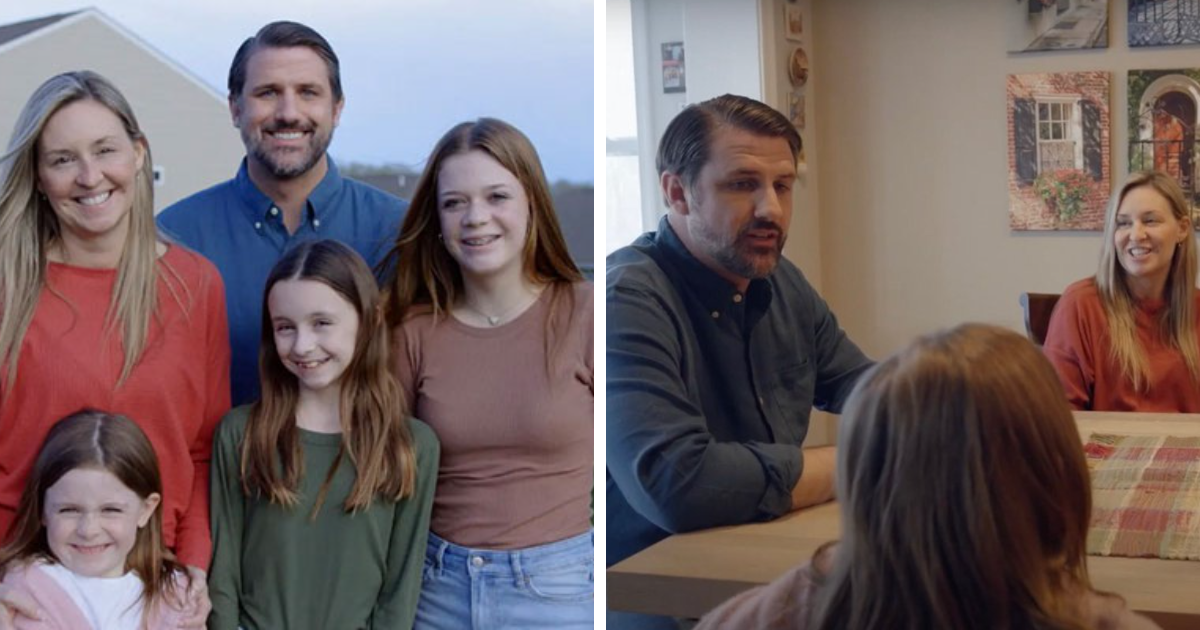
That happened in 2024 when Virginia congressional candidate Derrick Anderson appeared in campaign-related footage with a woman and three girls. The video looked, at first glance, like a polished slice of family life: smiles, a kitchen table, warm conversation, and the sort of visual rhythm usually reserved for holiday cards, insurance commercials, or the opening scene of a sitcom where everyone somehow owns a spotless farmhouse.
The problem, according to reporting that quickly spread across national outlets, was that the woman and children were not Anderson’s wife and daughters. They were the wife and children of a longtime friend. Anderson’s campaign said the footage simply showed him with female supporters and their children, while critics argued that the framing seemed designed to create a family-man impression.
The result was a campaign optics story with all the ingredients the internet loves: politics, visual ambiguity, outrage, jokes, and a family photo that launched a thousand “rent-a-family” comments.
What Happened in the Viral Campaign Video?
Anderson, a Republican candidate in Virginia’s competitive 7th Congressional District race, appeared in photos and video with a woman and three young girls in scenes that resembled family-life imagery. The visuals included a posed group photograph and a dining-table moment, both of which made the footage look less like a standard campaign stop and more like a family-centered lifestyle advertisement.
News coverage identified the woman and children as the family of one of Anderson’s longtime friends. At the time, Anderson did not have children and had publicly announced that he was engaged. His campaign pushed back against the idea that the footage was deceptive, arguing that candidates are regularly photographed with supporters, families, and community members.
That defense is not completely irrational. Candidates do, in fact, appear with voters constantly. They shake hands at diners, hug veterans, tour schools, pose with business owners, and stand beside enough babies to make one wonder whether every campaign office includes a tiny waiting room full of future constituents.
But critics said this situation felt different because of the staging. A quick handshake outside a grocery store carries one message. A warm domestic tableau with a woman and children at a dining table carries another. Images do not need captions to communicate. They have their own grammar.
Why the Image Created Such a Strong Reaction
The controversy was not really about whether a candidate is allowed to stand next to supporters. It was about what viewers were likely to infer from the composition of the video.
Campaigns rely on visual shortcuts because voters are busy. A hard hat can suggest jobs. A classroom can suggest education. A diner can suggest local roots. A candidate holding a clipboard can suggest competence, even if the clipboard contains nothing more exciting than a lunch order and three reminders to call donors.
Likewise, a candidate seated with a woman and children in a family-style setting can suggest stability, relatability, and personal investment in family issues. None of those messages need to be spoken aloud. The image does the work quietly.
That is why the footage became a larger conversation about political authenticity. Viewers were not merely asking, “Who are these people?” They were asking, “What was this image supposed to make me believe?”
Family Imagery Is a Powerful Political Shortcut
For decades, American campaigns have used family imagery to communicate character. Candidates are often shown with spouses, children, parents, pets, neighbors, and small-business owners because these images make political figures appear grounded in ordinary life.
There is nothing inherently wrong with that. Voters naturally want to know whether a candidate understands the pressures of daily life: paying bills, caring for relatives, dealing with schools, navigating health care, and figuring out why the dishwasher suddenly makes a noise like a small helicopter.
Still, family imagery can become misleading when it appears to tell a personal story that is not actually true. The issue is not whether a politician must be married or have children. The issue is whether campaign materials invite voters to assume a relationship that does not exist.
Political marketing works best when the candidate’s real story is compelling enough to stand on its own. A veteran does not need a borrowed dining room. A business owner does not need borrowed employees. A childless candidate does not need borrowed children to demonstrate concern for families.
Childless Politicians Do Not Need a Family Photo to Be Qualified
One uncomfortable part of this story is the assumption that a candidate without children needs to compensate for that fact. Parenthood can shape a person’s perspective, but it is not a job requirement for public service.
Childless adults pay taxes, care for aging parents, volunteer in their communities, mentor younger people, run businesses, serve in the military, teach, practice medicine, and support relatives. They also vote on schools, housing, transportation, public safety, health care, and every other issue that affects families.
A politician does not need to have personally experienced every life circumstance in order to represent people who have. By that standard, no one could govern anyone. A mayor who has never owned a farm can still support farmers. A senator who has never driven a school bus can still improve school transportation. A representative without children can still fight for affordable child care, strong schools, safer neighborhoods, and better health coverage.
The real test is not family status. It is whether a candidate understands constituents, listens to them, and can explain how their policies would improve daily life.
The Legal Question Is Different From the Ethical Question
Political advertising in the United States does not operate under the same truth-in-advertising system that applies to ordinary consumer marketing. Federal campaign rules focus heavily on disclosure, including identifying who paid for a communication. That is important because voters should know who is trying to influence their vote.
However, a disclaimer saying “paid for by” does not answer every question about context, implication, or presentation. It tells viewers who sponsored the message. It does not necessarily explain whether a photo is meant to show a spouse, a supporter, a neighbor, or someone who happened to be standing nearby when the camera started rolling.
That gap leaves plenty of room for political spin. A campaign may avoid making a literally false statement while still creating an impression that viewers later discover was incomplete or misleading. In politics, the most effective message is often not a direct claim. It is a carefully arranged suggestion.
A Real Photograph Can Still Create a Misleading Impression
The Anderson controversy did not involve an artificial family generated by software. It involved real people in a real setting. Yet authenticity is about more than whether pixels are genuine.
A photo can be technically accurate while still encouraging an inaccurate conclusion. A candidate standing near a factory does not necessarily work there. A candidate eating pancakes at a diner does not necessarily know the waitress. A candidate sitting at a family dinner table does not necessarily belong to that family.
That is why campaign context matters. The difference between an honest community image and a confusing political prop can be as small as a caption, a few seconds of video, or a clear statement explaining who is in the frame.
What Campaigns Can Learn From the “Borrowed Family” Backlash
The first lesson is simple: do not make voters do detective work on your lifestyle footage. If people in a campaign video are supporters, say they are supporters. If they are local parents, say they are local parents. If they are volunteers, say they are volunteers.
Clear labeling does not weaken a campaign message. In many cases, it strengthens it. A candidate who says, “These are parents in our community who are worried about school costs,” sounds more credible than a candidate who appears to be quietly borrowing someone else’s family brand.
The second lesson is that authenticity has become a political asset. Social media users are quick to notice stock-photo energy, staged interactions, awkward props, and suspiciously perfect kitchen counters. Campaign consultants may believe they are creating warmth, but voters can smell manufactured relatability from several zip codes away.
The third lesson is that humor travels faster than clarification. Once an image becomes a meme, the campaign no longer controls the story. A carefully planned visual can become an unplanned symbol of inauthenticity in a matter of hours.
How Voters Can Read Campaign Images More Carefully
Voters do not need to become professional investigators every time they see a candidate near a casserole dish. But a few simple questions can help.
- Who is actually shown in the image?
- What relationship does the campaign imply without directly stating?
- Does the visual match the candidate’s public biography?
- Is the message focused on policy, or mainly on personal branding?
- Would the campaign benefit from explaining the scene more clearly?
These questions apply to candidates from every party. Political branding is not a partisan invention. Every campaign wants to look relatable, trustworthy, competent, and normal enough to share a barbecue with. The challenge is making sure “normal” does not become a costume department.
Why This Story Matters in the Age of AI and Political Media
The borrowed-family controversy arrived at a time when voters are increasingly concerned about manipulated political media. Deepfakes, edited clips, synthetic voices, and misleading captions have made people more skeptical of what they see online.
That makes old-fashioned staging more risky than ever. A campaign does not need artificial intelligence to damage trust. Sometimes a perfectly real image, placed in the wrong context, can do the job all by itself.
In a media environment filled with suspicious content, campaigns should aim for radical clarity. Show real supporters. Use real stories. Explain who people are. Let candidates speak honestly about their own lives. The public is far more forgiving of an imperfect biography than of a biography that appears to have been decorated with borrowed accessories.
Conclusion: A Campaign Photo Is Never Just a Campaign Photo
The viral image of a childless politician posing with a friend’s wife and children became memorable because it exposed something larger about modern political communication. Campaigns are not only selling policies. They are selling narratives about character, belonging, and everyday life.
Anderson’s campaign denied that the footage was meant to mislead, and it is important to acknowledge that response. But the public reaction showed how easily staged domestic imagery can create assumptions that campaigns may not be able to control later.
The better political strategy is not to borrow the appearance of a life voters expect. It is to explain honestly how a candidate’s real life, record, values, and policy agenda make them ready to serve. Voters deserve more than a nice frame. They deserve the full picture.
Experience-Based Takeaways: What This Teaches About Campaign Authenticity
Anyone who has worked around campaigns, local politics, public relations, or even a school fundraiser knows that photos can become more important than the event itself. One candidate gives a detailed answer about housing costs, but the social post that performs best is a picture of them holding a baby next to a food truck. Politics can be strange that way. The policy memo may be 30 pages long, but the internet remembers the baby, the taco, and occasionally the borrowed family.
The most useful lesson from this controversy is that audiences are smarter than many political consultants assume. People may not read every policy paper, but they recognize visual cues. They know what a family portrait looks like. They know what a casual volunteer photo looks like. And they can usually tell when a campaign has arranged a scene so carefully that it begins to feel less like real life and more like a streaming-service thumbnail called Congressman Next Door.
Campaign teams often make the mistake of trying to create a version of the candidate that checks every emotional box. The candidate must look tough but gentle, experienced but fresh, patriotic but neighborly, serious but fun, and somehow equally comfortable in a factory, a classroom, a church basement, and a kitchen with perfectly arranged fruit. That is an impossible standard, and efforts to meet it can become awkward fast.
A better experience is to let the candidate’s actual community speak. A veteran can meet with fellow veterans. A small-business owner can talk with local workers. A teacher can visit schools. A caregiver can discuss elder care. A candidate without children can meet with parents and listen to their concerns without pretending to be part of their family photo.
That approach has another advantage: it creates more useful political content. Instead of a vague image of togetherness, voters see a candidate engaging with real people about real problems. The footage becomes harder to mock because it is grounded in something concrete. A conversation about bus routes, prescription costs, flood insurance, or classroom staffing may not look as glossy as a staged dinner table, but it gives voters a reason to trust the message.
There is also a broader personal lesson here. People are often tempted to present an upgraded version of themselves online. They borrow backgrounds, filters, phrases, routines, and sometimes entire personalities. Politics simply puts that instinct on a giant billboard. But authenticity usually wins in the long run because it is easier to maintain. You never have to remember the details of a real story.
For campaign professionals, the practical rule is simple: do not put anything on screen that would require a five-paragraph explanation after it goes viral. For voters, the rule is equally simple: enjoy the memes, but keep asking what the image is trying to say. The answer may reveal more about a campaign than the slogan ever could.