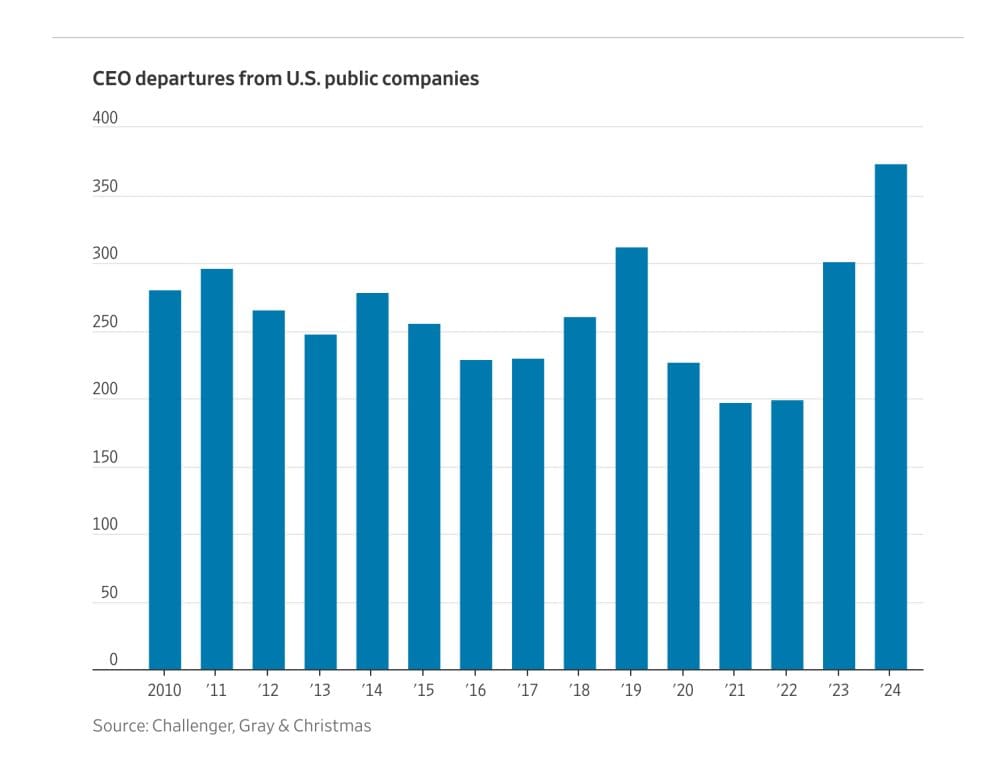
Here is the part nobody puts on the glossy investor deck: the corner office has started to feel less like a throne and more like a folding chair at a very tense board meeting. The headline number is startling for a reason. CEO departures at U.S. public companies jumped 24% in 2024, hitting a record high. More broadly, CEO exits across U.S. organizations surged to levels not seen since tracking began in 2002. That is not a blip. That is a signal flare.
And no, this is not just another dramatic business headline wearing expensive loafers. The rise in CEO resignations reflects something deeper happening inside corporate America: boards are less patient, investors are louder, technology is moving faster, and the CEO role itself has become a mash-up of strategist, therapist, crisis manager, AI translator, and part-time lightning rod. For some leaders, the job has simply become too punishing. For others, performance pressure got there first.
This wave of turnover matters because CEO exits are rarely just personal career decisions. They shape hiring plans, morale, budgets, acquisitions, product bets, and Wall Street narratives. One resignation can reset an entire company’s tone overnight. So when resignations rise this sharply, the smarter question is not “Who quit?” It is “What kind of corporate environment makes this many CEOs want out, or get shown the door?”
The Number Is Big. The Message Behind It Is Bigger.
The simplest explanation is that the job got harder. But that is only half the story. The fuller truth is that the margin for error got smaller at the exact moment the demands of the role exploded. CEOs are now expected to manage AI disruption, geopolitical uncertainty, inflation hangovers, activist investors, political polarization, labor concerns, cyber risk, and a market that wants better numbers yesterday. It is like being asked to pilot a plane, rebuild the engine, and reassure the passengers while the turbulence is trending on social media.
That pressure shows up differently depending on the company. In some cases, departures are clearly performance-driven. In others, they are framed as retirements, planned transitions, or “new opportunities.” And sometimes “stepping down to spend more time with family” translates, in practical corporate dialect, to “the board would like to see if someone else can stop the bleeding.”
Still, it would be too easy to paint every exit as a boardroom execution scene. Many transitions are orderly. Plenty are part of succession plans. In fact, one of the most important developments in recent CEO research is that a large share of departures are still classified as planned. That means the surge in exits is not only a story about failure. It is also a story about fragility in leadership pipelines, rising role fatigue, and companies trying to adapt faster than they used to.
Why More CEOs Are Leaving
1. Boards Are Less Patient With Underperformance
Boards have always cared about results. What has changed is how quickly they are willing to act when those results do not materialize. When shareholder returns slip into the bottom tier of an industry, tolerance tends to disappear. Stronger markets can make weak leadership stand out even more. If peers are finding a growth story, a margin story, or at least a believable turnaround story, the CEO who cannot deliver suddenly looks very replaceable.
That dynamic helps explain why high-profile departures have clustered around companies facing visible strategic or operational trouble. Boeing’s leadership shake-up came amid a deepening safety crisis and public trust problem. Intel’s CEO exit reflected mounting frustration that a costly turnaround was not moving fast enough in a market suddenly obsessed with artificial intelligence. These were not soft landings. They were reminders that when a company’s challenges become impossible to explain away, the CEO often becomes the explanation.
2. The CEO Job Has Become Brutally Complex
Even leaders who are not failing are dealing with a radically expanded brief. A modern CEO is expected to understand AI strategy without sounding like they learned the phrase “large language model” five minutes before earnings. They must reassure investors about margins while spending heavily on transformation. They have to manage culture, succession, regulation, supply-chain resilience, public reputation, and long-range bets that may not pay off during their own tenure.
That is exhausting. It also helps explain why burnout has become a real subtext in leadership turnover. The position still pays well, of course. But money does not automatically make a role sustainable. More executives are openly questioning whether the trade-off is worth it, especially when the scrutiny is constant and the average tenure in major companies has been drifting down. Put differently: the title still looks glamorous from the outside, but the operating conditions are increasingly medieval.
3. Activist Pressure And Investor Scrutiny Are Changing The Clock
Another reason CEO turnover is rising is that investors are not waiting as long as they used to. Activist campaigns, public pressure, and relentless benchmarking have sped up the timeline. A CEO no longer gets the same generous runway to say, “Give the strategy more time.” If the market does not believe the plan, or if rivals appear to be adapting faster, the board may decide that time is exactly what the company no longer has.
This is one reason the increase in departures should not be read only as a workforce trend. It is also a governance trend. Boards are making sharper judgments, faster. In many cases, they are being pushed to do so by shareholders who want accountability now, not after three more investor presentations and a podcast tour about transformation.
This Is Also A Succession Story
Interim CEOs Are Having A Moment
One of the most revealing side effects of the turnover wave is the rise of interim leaders. Companies are using temporary CEOs more often because uncertainty makes flexibility valuable. An interim appointment gives the board breathing room. It reduces the pressure to rush a permanent pick. It also lets directors test whether an internal leader can steady the ship without committing to a long marriage after one impressive first date.
There is a practical logic here. If the environment is unstable, boards may prefer an executive who can manage the next six to twelve months while the company decides what kind of leader it really needs. The downside is obvious: employees, customers, and investors can interpret interim leadership as hesitation. When the company looks unsure about who should run it, the market does not usually reward the suspense.
Insiders Still Matter, But Outsiders Are Back In Fashion
For years, boards leaned heavily on insiders, especially at the largest companies. That instinct still makes sense. Internal candidates know the business, understand the culture, and can usually move faster with less disruption. But the recent shift in CEO hiring suggests a growing appetite for experienced outsiders, particularly when the company needs a visible reset.
That makes the current moment especially interesting. On one hand, boards still like insiders because they lower transition risk. On the other hand, the surge in external appointments shows that many companies now want fresh eyes, proven scars, and leaders who have already sat in the hottest seat in the building. When change is urgent, “knows the culture” can lose out to “has done this before under fire.”
What The Biggest Exits Reveal
Look across the most talked-about departures and a pattern emerges. The reasons differ, but the themes repeat.
Boeing became a case study in how operational failures can become leadership failures. Once trust erodes, leadership change becomes part of the repair strategy. The CEO is no longer just running the company; the CEO becomes a symbol of whether the company truly understands the crisis.
Intel showed how technological inflection points can accelerate executive risk. Falling behind in a moment defined by AI urgency is not like missing an ordinary product cycle. It invites questions about judgment, speed, and whether the company has the right leader for the next era, not the last one.
Other public-company transitions across consumer, industrial, transportation, and technology sectors tell a similar story: boards are increasingly willing to make a leadership change when strategy looks stale, execution looks uneven, or the narrative simply stops working. Sometimes the CEO leaves because the company needs a different playbook. Sometimes the CEO leaves because the board decides the company needs a different face to sell the same playbook. Either way, the clock is ticking faster.
What Rising CEO Turnover Means For Companies
For Employees
For employees, a CEO exit usually means one thing first: uncertainty. Projects get re-labeled. Budgets go into witness protection. Words like “realignment,” “review,” and “strategic prioritization” begin appearing in emails like pigeons in a public square. Even when the transition is clean, people inside the business start asking practical questions. Will the culture change? Will the new boss cut headcount? Are we doubling down on AI, retail, international expansion, or just PowerPoint?
The emotional effect is real. A CEO change can produce relief, anxiety, or both. If the outgoing leader was unpopular, the mood may improve overnight. If the company respected the former CEO, morale can wobble while people wait to see what comes next.
For Boards
For boards, the lesson is clear: succession planning can no longer be treated like emergency glass hidden in a hallway. It has to be a living process. Companies that wait until the resignation happens are usually the same companies that end up scrambling, overpaying, or settling for a temporary answer that becomes longer than intended.
A good succession plan does not just identify names. It tests scenarios. What if the CEO leaves after an activist campaign? What if a misconduct issue forces a sudden exit? What if the company needs a builder instead of an operator, or an operator instead of a charismatic storyteller? The board that answers those questions early is far less likely to look panicked later.
For Investors
Investors often cheer CEO changes when they believe leadership was the bottleneck. But transitions are not automatically bullish. A new CEO inherits the same market realities, the same talent gaps, and sometimes the same overconfident slide deck. A smart leadership change can create momentum. A vague one can create drift. The market knows the difference faster than companies wish it did.
So, Is This A Crisis Or A Correction?
It is a bit of both. Rising CEO resignations are a warning sign because they suggest the role has become harder to sustain and because many companies are still not as prepared for succession as they should be. But the trend is also a correction. Boards are acting faster. Investors are demanding more. Companies are becoming more willing to admit that the leader who was right for one chapter may be wrong for the next.
That does not mean every departure is healthy. Some are clearly reactive. Some happen too late. Some may happen for the wrong reasons. But the broader shift suggests that leadership is being judged in a more unforgiving, more accelerated environment than at any point in recent memory.
The age of the untouchable CEO is fading. In its place is a more exposed, more scrutinized, more transitional version of corporate leadership. The pay may still be enormous. The influence may still be massive. But the job security? That part seems to have quietly left through the side door.
Conclusion
The surge in CEO resignations is not just a story about executives cashing out early or boards losing their temper. It is a reflection of how radically the leadership environment has changed. Performance expectations are sharper. Transformation pressure is heavier. Investor patience is thinner. And succession planning is no longer a nice governance talking point; it is a competitive necessity.
That is why the 24% jump matters. It tells us corporate America is not merely swapping names at the top. It is renegotiating what the CEO job actually is. The new reality is simple: leaders are expected to move faster, explain better, adapt sooner, and fail less publicly. Companies that prepare for that reality will navigate turnover better. Companies that do not will keep discovering that replacing a CEO is much easier than replacing confidence.
Related Experiences: What A Wave Of CEO Resignations Feels Like Inside A Company
From the inside, a CEO departure rarely feels as tidy as the press release. Public statements are polished, upbeat, and usually sprinkled with words like “transition,” “opportunity,” and “next chapter.” Inside the company, though, the mood is usually more mixed. The first reaction is often curiosity. The second is interpretation. Employees immediately start reading the move like a weather system. Was this planned? Was it a board decision? Is the business in trouble? Are layoffs coming? Even before the answers arrive, the organizational temperature changes.
One common experience is a sudden pause in decision-making. Teams that were moving quickly on hiring, product launches, expansion plans, or vendor commitments often slow down because nobody wants to make a major call just before a new leader arrives. It is not always official. Sometimes it is just corporate instinct. Managers become more cautious. Big proposals are delayed. People start saying, “Let’s wait until the new CEO weighs in,” which is executive-transition code for “No one wants to be the last person to champion a project that gets canceled next month.”
Another familiar experience is message overload. The company sends emails, town hall invites, FAQ documents, and manager talking points, all designed to reassure people that everything is under control. Sometimes that works. Sometimes it has the exact opposite effect. The more often leadership says “business as usual,” the more employees suspect it is absolutely not business as usual. Informal channels light up. Slack messages multiply. Recruiters suddenly get more replies. Not because everyone is panicking, but because uncertainty has a way of making even stable people quietly update their resume.
There is also the strange experience of symbolic reset. New CEOs do not just inherit strategy; they inherit mood. That means their earliest moves are watched obsessively. Which executives stay? Which projects get mentioned? Which phrases keep appearing? People notice everything. If the new CEO talks about discipline, employees expect cuts. If the new CEO talks about innovation, teams expect reorganization. If the new CEO talks about culture, everyone assumes culture was worse than leadership admitted. In that sense, the earliest weeks of a transition are less about policy and more about interpretation.
For senior leaders, the experience is even more intense. A CEO resignation can instantly reorder internal power. Executives who seemed central last week can look exposed this week. Others suddenly become indispensable because they offer continuity. Ambition, caution, and politics all rise together. That is one reason CEO turnover often triggers secondary turnover. Once the top role changes, other departures tend to follow, not always because the business is collapsing, but because the ecosystem around the CEO is changing too.
And yet, not every CEO exit feels negative. In some companies, the change creates relief. Employees who felt stuck under slow decision-making, murky priorities, or declining performance may see a resignation as the first honest sign that the organization is willing to change. A fresh leader can restore energy, sharpen accountability, and make people believe the company is not sleepwalking anymore. That is the paradox of CEO turnover: it creates disruption, but it can also create momentum. The experience inside a company depends less on the resignation itself and more on whether people believe the transition has a purpose.