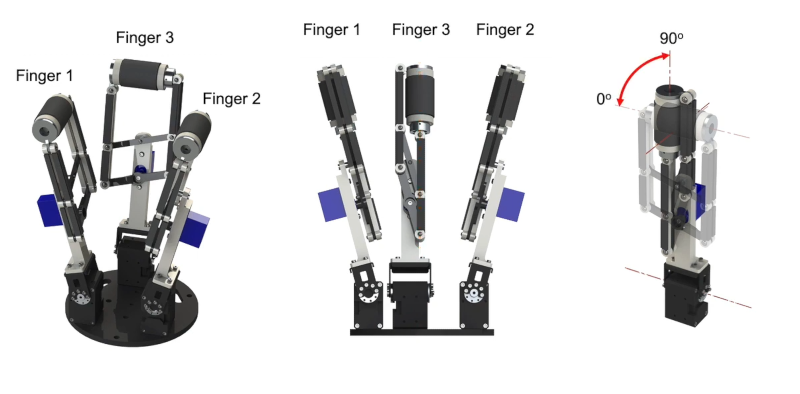
Robot hands have spent decades trying to copy the human hand, which is a noble goal until you remember that human hands also drop keys into couch cushions, spill coffee during video calls, and somehow forget how to open produce bags at the grocery store. Roller-based robot hand grasps take a different path. Instead of building a mechanical hand that only imitates fingers, these designs add active rolling surfaces at the fingertips or contact points, allowing a robot to move an object while still holding it.
That small change is a big deal. A traditional gripper usually grabs an object, moves the whole arm, releases, adjusts, and tries again. A roller-based robot hand can grasp, rotate, translate, reorient, and reposition objects inside the hand. In other words, the hand does not merely hold the object; it can “work” the object the way a person rolls a pen between fingers or turns a screw before tightening it.
For industries that depend on automation, robotic grasping, robotic manipulation, warehouse picking, assembly, food handling, medical robotics, and service robots, roller-based robot hand grasps offer a fascinating promise: more dexterity with fewer awkward regrasping steps. It is not magic. It is mechanics, control theory, tactile sensing, friction, and a healthy amount of engineering patience. But when it works, it looks a little like the robot hand has learned the ancient art of not dropping the thing.
What Are Roller-Based Robot Hand Grasps?
Roller-based robot hand grasps use powered rollers, wheels, belts, or spherical rolling fingertips as active contact surfaces. Instead of treating the fingertip as a fixed rubber pad, the fingertip becomes a controllable surface. Once the object is captured between fingers, the rollers can move the object relative to the palm without forcing the robot to open its grasp.
Imagine holding a small ball between two fingers. If your fingertips could spin like tiny motorized wheels, you could roll the ball forward, backward, sideways, or around its own axis without changing your arm position. That is the core idea behind roller-based robotic hands. The robot uses friction at the contact points to create controlled motion. The object stays trapped, but it is not frozen.
This matters because real-world tasks rarely end after the first grasp. A robot may need to pick up a screwdriver, rotate it into a usable orientation, slide a small part into an assembly, turn a knob, align a plug, separate one item from a pile, or reposition a delicate object. A simple parallel-jaw gripper can be excellent at grabbing, but it often struggles when the object must be adjusted after contact. Roller-based grasping aims to close that gap.
Why Robotic Grasping Is Harder Than It Looks
Humans make grasping look easy because our brains, hands, eyes, skin, muscles, and lifelong experience work together without asking for a software update. Robots do not get that luxury. A robot hand must deal with uncertain object shapes, changing friction, uneven surfaces, poor lighting, occlusion, sensor noise, and the terrifying possibility that a shiny metal part will behave like a tiny banana peel.
Traditional robotic grasping often focuses on stable capture. The robot identifies an object, chooses a grasp pose, closes the gripper, and lifts. That is already difficult. But dexterous robotic manipulation adds another challenge: changing the object’s pose after it has been grasped. This is called in-hand manipulation, and it includes rolling, sliding, pivoting, spinning, and regrasping. For a robot, each of those actions can break contact or cause the object to slip.
Roller-based robot hand grasps are appealing because they can reduce the need for finger gaiting, which is the process of lifting and replacing fingers on the object while other fingers maintain stability. Finger gaiting is impressive, but it is mechanically and computationally complex. Active rollers can keep the contact alive while moving the object, which is like editing a document without closing the file every three seconds.
How Roller-Based Robot Hands Work
Active Fingertip Surfaces
The most important feature is the active surface. In a roller-based robotic hand, the contact patch can move under motor control. This can be done with spherical rolling fingertips, wheel-like rollers, conveyor-style belts, or wearable roller modules. The active surface applies tangential motion to the object. If the normal force is high enough and friction is properly managed, the object moves with the roller instead of slipping away randomly.
Steering and Rolling
Some advanced roller graspers combine rolling with steering. Rolling moves the object along the surface direction. Steering changes the direction of that surface motion. Together, these degrees of freedom can produce complex object motion. The hand can rotate a sphere, shift a cylinder, or reorient an irregular object while maintaining a grasp. That is why roller-based grippers are often described as non-anthropomorphic: they do not need to look like a human hand to be dexterous.
Contact, Friction, and Force Control
Roller-based grasping lives or dies by contact mechanics. Too little grip force, and the object slips. Too much force, and the robot may crush, jam, or overconstrain the object. The best systems balance normal force, roller speed, contact location, and object geometry. This balance is especially important when handling fragile items, polished parts, cables, fruit, lab samples, or small manufacturing components.
Tactile Sensing
Tactile sensing makes roller-based manipulation much more practical. Cameras can lose sight of an object once the hand closes around it. Tactile sensors can detect pressure, deformation, contact location, shear force, slip, and sometimes texture. With tactile feedback, a robot can adjust roller speed, grip strength, and motion direction in real time. Without tactile feedback, the robot is basically trying to do a magic trick while wearing oven mitts.
Key Advantages of Roller-Based Robot Hand Grasps
1. Better In-Hand Manipulation
The biggest advantage is the ability to manipulate an object after grasping. Roller-based robot hands can rotate, translate, or reposition items without repeatedly releasing them. This is useful for assembly tasks, tool handling, bin picking, packaging, and any job where the first grasp is not the final pose.
2. Fewer Regrasping Steps
Every release-and-regrasp cycle creates risk. The object may fall, shift, collide with nearby parts, or end up in a worse orientation. Active rollers reduce the need for those cycles. By moving the object within the hand, the robot can correct its grip more smoothly.
3. Compact Dexterity
Roller-based grippers can create dexterity without requiring a full five-fingered humanoid hand. That is important because humanoid hands are expensive, complex, and difficult to control. A two- or three-finger roller grasper may perform useful manipulation with fewer joints and a smaller control problem.
4. Useful for Irregular Objects
Real objects are rude. They have weird corners, slippery coatings, labels, seams, flexible edges, and mystery dust. Roller-based systems can adapt by changing contact motion rather than depending on one perfect grasp. This makes them promising for logistics, recycling, agriculture, and household robotics.
5. Reduced Arm Motion
If the hand can adjust the object locally, the robot arm does not need to perform every correction. That can save time, reduce collision risk, and make motion planning simpler. In tight spaces, the ability to manipulate within the hand is especially valuable.
Where Roller-Based Robot Grasps Can Be Used
Warehouse Picking and Sorting
Warehouses contain objects of different shapes, weights, textures, and packaging styles. A roller-based gripper could pick an item from a bin, rotate it so a barcode faces a scanner, or shift it into a stable placement pose. Instead of dropping the item onto a table and trying again, the robot can correct the pose while holding it.
Manufacturing and Assembly
Assembly tasks often require precise orientation. Screws, connectors, clips, washers, small brackets, and electronic parts must be aligned before insertion. Roller-based robot hand grasps can help orient these parts in-hand, making automated assembly more flexible.
Food Handling
Food automation is difficult because food is inconsistent. A strawberry, dinner roll, or cucumber slice does not always behave like a machined part. A roller-based hand with compliant contact and tactile sensing could gently reposition food without excessive squeezing.
Medical and Laboratory Robotics
Robots in labs may need to handle tubes, vials, swabs, caps, syringes, or delicate samples. Roller-based manipulation could help rotate or align cylindrical objects while reducing the need for large arm movements. In medical robotics, careful in-hand adjustment could support safer tool handling.
Home and Service Robots
For a household robot, grasping is not enough. It must pick up a remote, turn it around, press a button, hold a mug by the handle, straighten a utensil, or retrieve a small object from a cluttered drawer. Roller-based robot hand grasps could give service robots more practical dexterity in messy human environments.
Roller-Based Hands vs. Traditional Robot Grippers
A traditional parallel gripper is simple, strong, and reliable. It is the pickup truck of robotic end-effectors: not fancy, but usually ready to work. Roller-based grippers are more specialized. They add motors, control complexity, and moving parts, but they also add the ability to manipulate objects after grasping.
Compared with suction cups, roller-based hands can handle objects that are porous, uneven, dusty, or unsuitable for vacuum gripping. Compared with soft grippers, they can provide active in-hand motion rather than passive compliance alone. Compared with humanoid hands, they may achieve useful dexterity with fewer fingers and fewer joints.
The best choice depends on the job. If a robot only needs to pick identical boxes from a conveyor, rollers may be unnecessary. If a robot must pick a random object, rotate it, inspect it, align it, and place it precisely, roller-based manipulation becomes much more attractive.
Challenges Holding Roller-Based Robot Hands Back
Mechanical Complexity
Adding rollers means adding motors, bearings, belts, wiring, seals, and control electronics. These parts must survive repeated contact, dust, impact, and wear. A roller fingertip that works beautifully in a lab still has to prove it can survive factory life, where machines are expected to perform for thousands of hours without becoming expensive confetti.
Control Difficulty
Moving an object with rollers requires accurate models of friction, contact geometry, and object motion. Unfortunately, friction is famously difficult to predict. The same object may behave differently depending on surface wear, humidity, dust, temperature, or tiny changes in grip force.
Slip Detection
Robots need to know when the object is slipping, sticking, or rolling as intended. Tactile sensors can help, but they add cost and integration challenges. Vision can help too, but the object may be hidden by the fingers. The most robust systems will likely combine tactile sensing, proprioception, force control, and vision.
Object Diversity
A roller-based hand may perform well with spheres, cylinders, and smooth objects but struggle with soft, jagged, flexible, or highly irregular items. The more diverse the object set, the more adaptable the control policy must be.
Cost and Maintenance
Industrial adoption depends on value. A roller-based hand must not only be clever; it must be worth its price. If it improves cycle time, reduces failures, handles more products, or replaces multiple end-effectors, it can earn its place. If it requires constant tuning, managers will give it the same look people give a printer that says “PC load letter.”
The Role of AI and Machine Learning
Roller-based robot hand grasps become more powerful when paired with machine learning. Reinforcement learning can teach policies for object reorientation. Imitation learning can use human demonstrations or scripted control examples. Simulation can generate thousands or millions of attempts before the robot ever touches a real object.
However, simulation is not reality. Real rollers have backlash, friction, compliance, motor limits, sensor delay, and wear. Objects have unpredictable surfaces. The famous sim-to-real gap still matters. Modern approaches often use domain randomization, tactile feedback, and adaptive control to make learned policies more robust.
AI can also help classify object states during manipulation. For example, tactile signals may reveal whether a part is slipping, whether a cable is seated correctly, or whether a small item has rotated into the desired orientation. In roller-based grasping, the hand needs this information because the object is constantly moving inside the grasp.
Why Active Surfaces Are So Interesting
The phrase “active surface” sounds like something from a futuristic kitchen countertop, but in robotics it means a contact surface that can intentionally move the object. This is a major shift in design thinking. Instead of building more joints to move fingers around the object, engineers can move the contact itself.
Active surfaces can appear as rollers, belts, wheels, or modular attachments. Some experimental systems even explore wearable roller modules that can be mounted on robot or human fingers. The concept is flexible: if the contact patch can be driven, it can potentially manipulate the object.
This opens the door to robot hands that are less biologically inspired and more task inspired. Nature gave humans excellent hands, but robots are not required to follow the same blueprint. A robot hand can use wheels where humans use skin. It can roll an object continuously without finger fatigue. It can rotate a part in ways that would make a human hand file a complaint with the wrist department.
Design Principles for Better Roller-Based Robot Grasps
Use Compliance Wisely
Rigid rollers can transmit force precisely, but compliance helps maintain contact with uneven objects. A smart design may combine firm actuation with soft outer materials, giving the robot both control and forgiveness.
Prioritize Reliable Contact
The roller is only useful if the object stays in controlled contact. Finger geometry, surface texture, contact spacing, and grip force all matter. A good roller grasper should guide the object naturally rather than depend on perfect control at every instant.
Integrate Tactile Feedback Early
Tactile sensing should not be an afterthought. If the hand needs to detect slip, pressure, and contact location, the sensor layout must be designed with the mechanics. Bolting sensors on later can create bulky, fragile, or poorly placed fingertips.
Match the Hand to the Task
A roller-based hand for warehouse boxes does not need the same design as one for surgical tools. The best robotic grasping solution is task-specific enough to be efficient but flexible enough to handle variation.
Experience Notes: What Working With Roller-Based Robot Hand Grasps Teaches You
Anyone who studies roller-based robot hand grasps quickly learns that the glamorous part is the video demo, and the real story is everything that happened before the demo worked. The first lesson is that contact is never “just contact.” A fingertip touches an object, but the quality of that touch depends on surface material, pressure, speed, alignment, dust, wear, and even tiny manufacturing differences. In a roller system, those details become even more important because the contact is expected to move the object, not merely hold it.
A second lesson is that rollers make robots look more intelligent than they sometimes are. A well-designed active fingertip can create smooth object motion with relatively simple commands. Watching a robot rotate a sphere inside its grasp feels almost biological, but the intelligence is distributed across mechanical design, friction, geometry, and feedback control. Good hardware reduces the burden on software. Bad hardware makes even brilliant algorithms look like they need a nap.
Testing also reveals how important object selection is. Smooth cylinders and balls are friendly training partners. Lightweight boxes, rubber tools, caps, and knobs are manageable with careful control. Soft pouches, tangled cables, crinkled packaging, and oddly shaped household objects are more chaotic. They deform, twist, snag, and shift their center of mass. These are the objects that teach engineers humility. They are also the objects that make roller-based grasping worth improving, because real environments are full of them.
Another practical experience is that speed must be earned. It is tempting to spin the rollers quickly and celebrate fast manipulation, but fast motion increases slip risk and makes sensing harder. Many successful experiments start slowly, with conservative force and careful feedback. Once the system understands the object’s behavior, speed can increase. In production, this balance matters. A robot that works slowly but reliably may be more valuable than a faster robot that occasionally launches parts into low Earth orbit.
Maintenance is also part of the experience. Rollers collect dust. Soft surfaces wear. Belts stretch. Bearings loosen. Calibration changes. A prototype can survive a conference demo, but an industrial robot hand must survive boring, repetitive work. That means designers need easy replacement parts, sealed components, robust wiring, and diagnostics that tell operators when performance is drifting.
The most exciting experience, however, is seeing how roller-based grasps change the way people think about robotic hands. Instead of asking, “How do we copy the human hand?” engineers start asking, “What does the object need?” Sometimes the answer is a thumb. Sometimes it is a soft pad. Sometimes it is a tiny motorized roller that can spin a part into place while the rest of the robot stays still. That shift is powerful. It suggests the future of robotic manipulation may not be a perfect metal copy of the human hand. It may be stranger, simpler, and better at certain jobs.
Roller-based robot hand grasps are not a universal solution, but they are one of the most creative answers to a stubborn robotics problem. They offer a practical middle ground between simple grippers and highly complex humanoid hands. With better tactile sensing, smarter learning algorithms, improved materials, and rugged mechanical design, these hands could become common in factories, warehouses, laboratories, farms, hospitals, and homes.
Conclusion
Roller-based robot hand grasps represent a clever leap in robotic manipulation. By turning passive fingertips into active surfaces, engineers give robot hands the ability to reposition objects without constantly releasing and regrasping them. This improves dexterity, reduces unnecessary arm motion, and opens new possibilities for assembly, logistics, food handling, lab automation, and service robotics.
The technology still faces challenges. Contact control is difficult, tactile sensing must be reliable, and the hardware must survive real-world use. But the direction is promising. Instead of forcing robots to imitate human hands in every detail, roller-based designs ask a better question: how can a robot move the object most effectively? Sometimes the smartest hand is not the one that looks most human. Sometimes it is the one with tiny powered rollers doing the quiet, useful work of keeping the object exactly where it needs to be.
Note: This article is written in original language for web publication and is based on synthesized information from real robotics research on roller graspers, active-surface manipulation, tactile robot hands, and dexterous in-hand manipulation.