Note: This is original editorial content written for web publication, based on publicly reported mission details and official background information. No source links are embedded in the article body.
Blue Origin landed the same rocket for the fourth time, and yes, that sentence still sounds like something a science fiction editor would have circled in red twenty years ago. On June 19, 2016, the company’s New Shepard vehicle lifted off from West Texas, crossed the edge of space, separated its crew capsule, and then brought its booster back for another controlled vertical landing. The mission was not just another “rocket goes up, rocket comes down” video for space fans to replay during lunch. It was a practical demonstration that reusable rockets were moving from bold promise to repeatable engineering.
At the center of the achievement was New Shepard, Blue Origin’s suborbital launch system named after Alan Shepard, the first American in space. Unlike massive orbital rockets designed to place satellites or spacecraft into long-duration trajectories around Earth, New Shepard was built for shorter suborbital flights. It sends a capsule above the Kármán line, gives passengers or research payloads a few minutes of weightlessness, and returns both capsule and booster safely to Earth. The fourth landing of the same booster showed that the machine was not a one-hit wonder. It was more like a very expensive, very vertical pickup truck: launch, land, inspect, repeat.
What Actually Happened During the Fourth Landing?
The fourth reusable flight followed a clean and dramatic sequence. New Shepard launched from Blue Origin’s West Texas test site, powered upward by its BE-3 engine, and climbed to roughly 331,500 feet, or about 101 kilometers. That altitude placed the vehicle just beyond the internationally recognized boundary of space. After engine cutoff, the crew capsule separated from the booster, allowing the two parts of the system to follow different paths home.
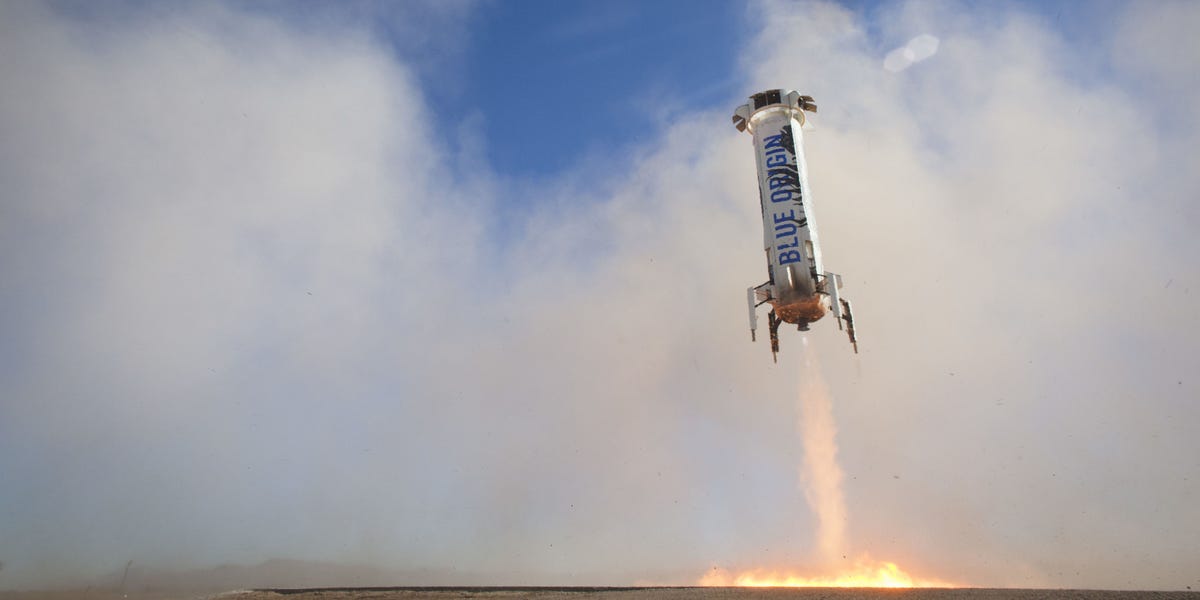
The booster returned first. As it descended, it used aerodynamic control surfaces and reignited its engine to slow itself before touchdown. Its landing legs deployed shortly before it reached the pad, and the rocket settled back onto the ground in a controlled vertical landing. For a vehicle that had already survived three previous trips, this fourth landing strengthened the argument that reusable rocketry could become a normal part of space operations rather than a spectacular exception.
The capsule had its own assignment. Blue Origin intentionally tested a parachute-failure scenario by allowing the capsule to descend under two main parachutes instead of three. That was not a mistake. It was the whole point. The company wanted to prove that the capsule could still bring future passengers down safely even if one main parachute did not deploy. Near the ground, retro-rockets fired to cushion the landing, adding another layer of protection. In other words, the mission tested both showmanship and seriousness: the rocket landed like a movie scene, while the capsule practiced for a bad day.
Why the Fourth Landing Mattered
The phrase “landed the same rocket for the fourth time” matters because rockets have traditionally been disposable. For decades, the standard launch model was brutally simple: build an enormously complex machine, launch it once, drop most of it into the ocean, and then build another one. That approach worked, but it was expensive. Imagine buying a new airplane for every flight from New York to Los Angeles and then throwing it away somewhere over Nevada. That is not a perfect comparison, but it captures the financial headache.
Reusable rockets aim to change that equation. If a booster can fly again and again, the cost of each mission can potentially fall. Engineers also gain real-world data from repeated flights, which helps them understand wear, thermal stress, engine performance, guidance accuracy, and refurbishment needs. A rocket that lands once is impressive. A rocket that lands multiple times starts looking like a transportation system.
Blue Origin’s fourth New Shepard landing was especially important because it demonstrated operational consistency. The company had already proven that the booster could cross the boundary of space and return. The fourth flight suggested that the vehicle could do so repeatedly with the same core hardware. For space tourism, microgravity research, and commercial suborbital missions, reliability is not a bonus feature. It is the product.
New Shepard: A Short-Hop Rocket With Big Ambitions
New Shepard is not designed to compete directly with orbital heavy-lift rockets. It is a suborbital system, which means it travels above the edge of space but does not accelerate fast enough to remain in orbit. That distinction matters. Orbital launch is far more demanding because a vehicle must reach extremely high horizontal velocity. Suborbital flight is shorter and less energy-intensive, but it still delivers a powerful experience: a view of Earth’s curvature, several minutes of weightlessness, and a fast return through the atmosphere.
The system consists of two major parts: a reusable booster and a crew capsule. The booster handles powered ascent and vertical landing. The capsule separates near the top of the flight path, coasts through microgravity, and returns under parachutes. New Shepard is also fully autonomous, meaning there are no pilots onboard. For future passengers, that means the spacecraft itself handles the ride. For researchers, it means a standardized platform for experiments that need brief access to microgravity.
This combination made New Shepard a useful testbed. It could carry scientific payloads, test safety systems, and eventually fly paying passengers. The fourth landing helped prove that the hardware could survive repeated real flights, not just simulations or carefully polished animation videos. In the aerospace world, PowerPoint is nice, but scorch marks on a rocket that still works are much more persuasive.
The Parachute Test Was Just as Important as the Landing
The booster landing grabbed the headlines, but the capsule test may have been the quieter star of the mission. By intentionally flying the capsule with only two of its three main parachutes, Blue Origin tested redundancy under realistic conditions. Redundancy is a core principle in human spaceflight. If one system fails, another system should be ready to take over. If that second system is also having a rough morning, a third layer may be needed.
During the June 2016 flight, the capsule descended faster than it would under three healthy parachutes, but the landing system still functioned successfully. That kind of test is uncomfortable by design. Space companies do not prove safety by assuming every component will behave perfectly. They prove safety by asking, “What happens when something goes wrong?” Then they test the answer before people are onboard.
For a vehicle intended to carry humans, this was more than a technical checkbox. It was a message to regulators, future customers, researchers, and the public: Blue Origin was not only trying to make rockets reusable; it was trying to make the passenger experience survivable under off-nominal conditions. That may sound less glamorous than a clean landing, but in real aerospace engineering, boring safety margins are beautiful.
How Blue Origin’s Reusability Strategy Compared With SpaceX
Any discussion of reusable rockets eventually invites comparison with SpaceX. The two companies approached the challenge from different directions. SpaceX focused heavily on orbital launch, using Falcon 9 boosters to send satellites, cargo, and eventually astronauts into orbit while recovering first stages on land and drone ships. Blue Origin’s New Shepard, by contrast, focused on suborbital flights, vertical landings, research payloads, and space tourism.
That difference is important. New Shepard’s mission profile is shorter and less demanding than an orbital Falcon 9 launch. The booster does not need to reach orbital-class speeds, and it returns closer to its launch site. However, New Shepard’s repeated landings still contributed to the broader reusable-rocket revolution. It proved that controlled vertical landing, rapid learning, and hardware reuse were not just theoretical talking points. They were becoming normal engineering goals across the industry.
Blue Origin also followed a slower, quieter public style in those years. While SpaceX often turned launches into high-energy global livestream events, Blue Origin was initially more reserved. The fourth New Shepard flight was notable because the company streamed the test live, giving the public a front-row seat to a mission that previously might have been summarized after the fact. For space enthusiasts, it was like being invited into the garage after years of hearing mysterious engine noises from next door.
What Reusable Rockets Mean for Space Tourism
Reusable rockets are central to the business case for space tourism. A company cannot realistically build a broad commercial passenger service if every vehicle is treated like a disposable firework. Reuse helps create a pathway toward more frequent flights, better hardware familiarity, lower long-term operating costs, and improved customer confidence.
New Shepard’s design fits the space-tourism model well. The flight is short, dramatic, and focused on the emotional highlights: launch acceleration, weightlessness, views of Earth, and a parachute landing. Passengers do not need to train like professional astronauts for months. The capsule is autonomous, the mission is brief, and the experience is designed to be accessible to private citizens who can afford the ticket.
The fourth landing did not instantly create a mass market for space tourism. Tickets were not suddenly priced like a weekend theme park pass. But the mission helped build the technical foundation. Before companies can sell regular trips to the edge of space, they must show that vehicles can fly, return, and fly again. The fourth New Shepard landing was one more brick in that foundation.
Why Microgravity Researchers Care About New Shepard
New Shepard is not only about wealthy passengers looking for the ultimate vacation selfie. The vehicle also serves researchers who need access to microgravity. During a suborbital flight, experiments can experience a few minutes of weightlessness, which is valuable for studying fluids, combustion, materials, biological samples, sensors, and spaceflight hardware.
For many teams, especially university labs and early-stage technology groups, a suborbital flight can be more accessible than sending hardware to the International Space Station or booking space on an orbital mission. The flight is shorter, the payload may be recovered quickly, and researchers can iterate faster. That makes New Shepard useful as a bridge between laboratory testing and more complex space missions.
The fourth flight reinforced confidence in that model. A reusable suborbital rocket that can fly repeatedly creates more opportunities for scientific scheduling. Researchers do not want a platform that works once and then becomes a museum piece. They want something that can fly again, gather data again, and support the next round of questions. Science loves repeatability almost as much as it loves coffee.
The Engineering Lesson: Reuse Is Not Just Landing
Landing a rocket is only one part of reusability. The harder long-term challenge is learning what happens after the landing. How much inspection is required? Which parts wear out first? How quickly can the vehicle be prepared for another flight? Does repeated exposure to vibration, heat, pressure changes, and landing loads create hidden problems? These questions determine whether reuse is economically powerful or merely visually impressive.
Blue Origin’s fourth New Shepard landing helped answer some of those questions. Each flight gave engineers data about the booster’s structure, engine, avionics, landing systems, software, and refurbishment needs. The more often a vehicle flies, the more engineers can move from theory to pattern recognition. They can see what changes, what stays stable, and what needs redesign.
That is why repeated flights are so valuable. A single success can hide weaknesses. Multiple successes under changing conditions build confidence. New Shepard’s fourth landing showed that the vehicle was not only capable of a dramatic return but also durable enough to keep participating in the test program.
Public Perception: The Moment Reusable Rockets Started Feeling Normal
One of the most interesting parts of the fourth landing was psychological. The first time a rocket lands vertically, people gasp. The second time, they cheer. By the fourth time, something subtle changes: people begin to expect it. That expectation is powerful. It means reusable rockets are no longer a strange stunt. They are becoming part of how the public understands modern spaceflight.
Blue Origin’s live broadcast helped accelerate that shift. Viewers could watch the launch, separation, descent, and landing unfold in real time. There was no need to wait for a polished recap video. The event had tension, timing, and a satisfying touchdown. It made aerospace engineering feel immediate.
For the broader commercial space industry, that visibility mattered. Public confidence does not come only from technical papers or executive statements. It comes from repeated demonstrations that people can see and understand. A rocket landing upright is simple visual storytelling: it left, it returned, and it is ready to try again.
What the Fourth Landing Did Not Mean
It is also important not to exaggerate the milestone. New Shepard’s fourth landing did not mean Blue Origin had solved all reusable spaceflight challenges. It did not prove orbital reusability, replace heavy-lift launch systems, or make space travel cheap overnight. Suborbital reuse and orbital reuse are different engineering mountains.
Still, dismissing the achievement would be a mistake. Aerospace progress often comes through focused demonstrations. New Shepard showed that one specific kind of reusable vehicle could cross the edge of space and return repeatedly. That was meaningful, especially for a company building toward human suborbital flight.
The mission belongs in the larger story of reusable rockets because it captured a turning point. The industry was no longer asking whether rockets could land. It was beginning to ask how often they could land, how quickly they could fly again, and how much money reuse could actually save. Those are better questions, and better questions usually mean the technology is maturing.
Experiences and Reflections: Watching a Rocket Become a Routine Machine
There is something oddly emotional about watching a rocket land itself. Rockets are supposed to be wild things. They roar, shake the ground, burn huge amounts of propellant, and vanish into the sky like they have no intention of apologizing to gravity. Then New Shepard comes back, slows itself down, extends its legs, and lands with the calm confidence of someone parallel parking in an empty lot. The fourth landing made that experience even stranger because it was not the rocket’s first performance. It was a repeat act.
For viewers, the experience was a mixture of excitement and disbelief. Even when you know the physics, a vertical rocket landing still feels slightly illegal. The booster is tall, narrow, and falling from the sky. Your brain expects it to tip, tumble, or explode into an expensive cloud of regret. Instead, the engine relights, the vehicle steadies itself, and the landing pad becomes the finish line. By the fourth success, the surprise begins to turn into trust.
That trust is one of the most valuable outcomes of repeated testing. The public does not become comfortable with new transportation systems because a company says, “Relax, we did the math.” People become comfortable when they see a system work again and again. Airplanes, elevators, trains, and even everyday cars earned public trust through repetition. Reusable rockets must do the same. The fourth New Shepard landing was one of those moments where a futuristic idea became a little more ordinary.
From a writer’s perspective, the mission is also a great reminder that technology stories are not only about hardware. They are about habits changing. The first vertical landing is a headline. The fourth landing is a pattern. Patterns are what industries are built on. A rocket that can return repeatedly changes how engineers plan missions, how investors think about space companies, how researchers schedule experiments, and how future passengers imagine their own trip beyond the atmosphere.
The parachute test added another layer to the experience. It showed that Blue Origin was not simply trying to produce a perfect-looking flight. The company intentionally introduced a failure condition and tested the capsule’s response. That is the kind of detail that makes aerospace both thrilling and deeply practical. The glamorous part is seeing Earth from space. The serious part is making sure the capsule can still land if one parachute decides to take the day off.
For people following the commercial space race, the fourth landing also offered a lesson in patience. Blue Origin’s motto, “Gradatim Ferociter,” is often translated as “step by step, ferociously.” The fourth New Shepard landing fit that philosophy neatly. It was not the biggest rocket, the fastest mission, or the most dramatic payload. But it was another step, and in aerospace, steps matter. A safe test leads to a better design. A better design leads to more confidence. More confidence leads to humans onboard. Eventually, a once-weird idea becomes a service people can book.
Imagine being a student watching that livestream in 2016. You might have seen a rocket rise into the sky, separate, and return to Earth like a controlled science experiment. Years later, that same kind of system would carry private passengers, researchers, cultural figures, and historic aviation pioneers above the edge of space. The fourth landing was not the end of the story. It was a chapter that made later chapters more believable.
That is why “Blue Origin landed the same rocket for the fourth time” remains a compelling topic. It is not just about a booster touching down in Texas. It is about the slow normalization of reusable spaceflight. It is about testing failure before humans are onboard. It is about turning rockets from single-use machines into vehicles with flight histories. And yes, it is also about the joy of watching a giant tube of engineering return from space and politely stand itself back up.
Conclusion
Blue Origin’s fourth landing of the same New Shepard booster was a milestone in the development of reusable suborbital spaceflight. The June 2016 mission proved more than booster recovery. It demonstrated repeatability, tested capsule safety under a parachute-failure scenario, and helped shape public understanding of reusable rockets as practical vehicles rather than spectacular experiments.
The achievement did not solve every challenge in commercial spaceflight, but it showed that careful, repeated testing could turn ambitious ideas into working systems. For space tourism, microgravity research, and the larger reusable rocket movement, the fourth New Shepard landing was a strong signal: the future of spaceflight would not be built only by reaching space, but by coming back safely and doing it again.