Note: This article focuses on respectful, public-facing images that honor law enforcement officers and their families while also recognizing the importance of privacy, community trust, and thoughtful storytelling.
Some images speak before anyone reads the caption. A police officer hugging a child before a night shift. A spouse straightening a badge before a promotion ceremony. A family standing quietly at a memorial wall. A retired officer smiling beside three generations in uniform. These are the kinds of images often connected with the phrase Blue Lives Matter, and they carry a lot more weight than a bumper sticker, a flag, or a hashtag.
At its heart, Blue Lives Matter is commonly used to express support for police officers and the risks they face. The phrase became widely known in the United States in the 2010s and has often appeared alongside the thin blue line symbol, memorial tributes, police appreciation events, and family-centered photo essays. But like many public symbols, it can mean different things to different people. For some families, it is a message of love and gratitude. For some critics, it can feel politically charged, especially when used in conversations about race, policing, and accountability.
That is why images of officers and their family members deserve more care than a quick social media post. The best ones are not about shouting the loudest. They are about showing the human side of service: the early mornings, the missed birthdays, the pride, the worry, the humor, the ordinary kitchen-table moments, and the quiet courage that rarely makes the news.
What Blue Lives Matter Means In Family-Centered Images
When people search for Blue Lives Matter images, they are often looking for visual content that communicates support for law enforcement. That may include portraits of officers in uniform, family photos at police ceremonies, memorial graphics, thin blue line artwork, badge tributes, or candid moments from community events. But the most meaningful images usually go beyond symbols. They show relationships.
A badge by itself can look formal. A badge held by a child who is waiting for a parent to come home tells a different story. A patrol car can represent authority. A patrol car parked outside a youth event can also represent presence, service, and neighborhood connection. A uniform can look tough. A uniform with a toddler’s handprint on the sleeve? That is the internet’s way of saying, “Yes, officers are human, and yes, laundry detergent deserves hazard pay.”
The Thin Blue Line And Its Visual Role
The thin blue line is one of the most recognizable symbols associated with support for police. In many Blue Lives Matter images, the color blue represents law enforcement, while the “line” suggests officers standing between public order and chaos. Families may use the symbol on memorial photos, tribute banners, shirts, bracelets, decals, or framed portraits.
Still, context matters. A thin blue line image posted for a fallen officer’s memorial may be received very differently from the same symbol used in a heated political debate. Good visual storytelling understands that symbols do not float in a vacuum. They arrive with history, emotion, and public interpretation. A respectful article, gallery, or social media post should make room for that complexity without losing sight of the families involved.
Why Images Of Officers And Families Matter
Law enforcement is a public profession, but police family life is deeply personal. Officers work holidays, overnight shifts, emergency calls, court days, training days, and overtime. Their family members often live with uncertainty that is hard to explain to people outside the profession. A simple image can make that emotional reality visible.
Family-centered police images matter because they help audiences see officers as whole people. They are not just uniforms, patrol cars, body cameras, or headlines. They are parents, siblings, spouses, sons, daughters, coaches, neighbors, mentors, and the person who still has to remember to buy milk after a twelve-hour shift. Spoiler: they do not always remember the milk.
These images also matter for survivors. Organizations that support families after line-of-duty deaths often emphasize remembrance, community, and peer support. Photographs become part of that remembrance. They preserve birthdays, graduations, academy ceremonies, family vacations, last holidays, and ordinary afternoons that later become priceless.
Common Types Of Blue Lives Matter Images
1. Officer Portraits With Family Members
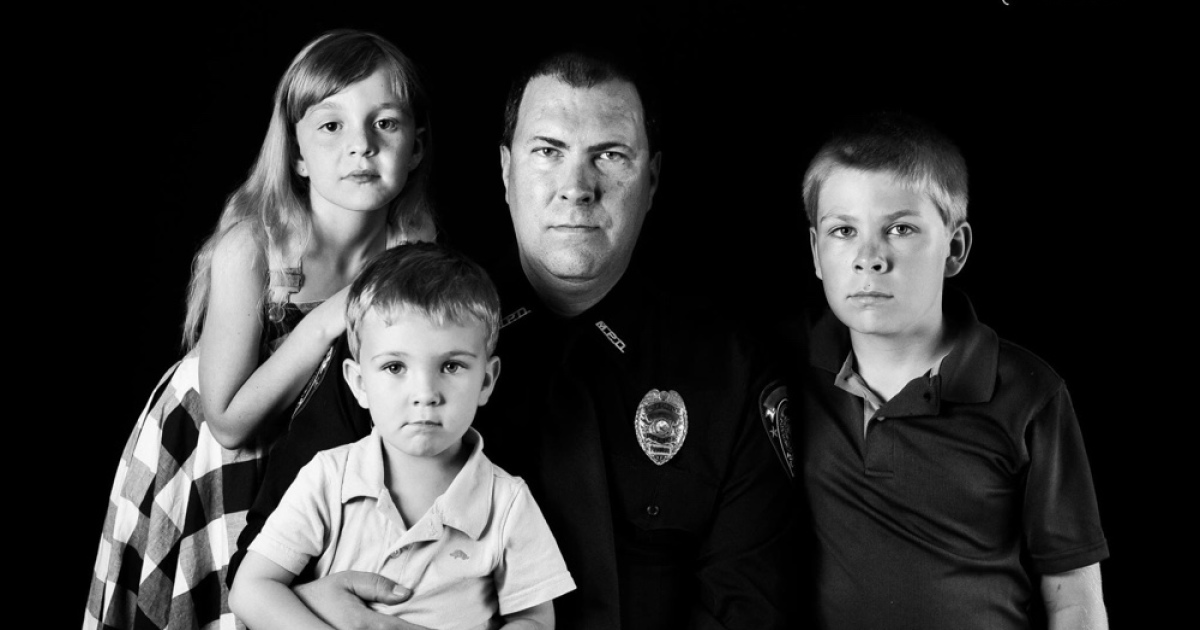
One of the most popular categories is the formal or semi-formal family portrait. These images may show an officer in uniform standing with a spouse, children, parents, or siblings. Sometimes the background is a station, courthouse, flag display, memorial wall, or family home. The goal is usually simple: honor the person behind the badge and the people standing behind that person.
Strong family portraits do not need to look like a movie poster. In fact, the most touching ones often feel natural. A child leaning against a parent’s leg. A spouse laughing at the exact moment the photographer says, “Just one more,” for the ninth time. A retired officer holding a framed badge while surrounded by grandchildren who are mostly interested in snacks. Real beats perfect almost every time.
2. Promotion, Graduation, And Swearing-In Photos
Police academy graduations, swearing-in ceremonies, and promotions are emotional milestones. Families attend because they know the journey was not easy. There were long study nights, physical training, missed weekends, background checks, interviews, and enough paperwork to make a printer question its life choices.
Images from these events often show family members pinning a badge, holding certificates, or standing beside an officer in a new rank. These photos are powerful because they capture pride at the exact moment service becomes official. They also show that a badge is rarely earned alone. Behind many officers is a support system that handled stress, schedules, childcare, meals, encouragement, and occasional uniform lint emergencies.
3. Memorial And National Police Week Images
Memorial images are among the most solemn Blue Lives Matter-related visuals. During National Police Week and local remembrance events, families, departments, and communities honor officers who died in the line of duty. Images may include candlelight vigils, folded flags, memorial walls, wreaths, white gloves, honor guards, and family members gathered in remembrance.
These images should be handled with special care. They are not decorative content. They represent grief, public service, and private loss. Captions should avoid sensational language and focus on dignity. If family members are shown, publishers should consider whether the image is public, whether consent is appropriate, and whether the moment is being used respectfully.
4. Everyday Life Images
Not every meaningful image involves a ceremony. Some of the strongest officer-family photos show everyday life: breakfast before a shift, a child waving from the porch, a family dog sitting beside duty boots, or an officer reading homework at the kitchen table between calls. These images remind viewers that law enforcement families live in two worlds at once: ordinary family life and the unpredictable rhythm of public service.
Everyday images can also soften the overly serious tone that sometimes surrounds police content. A photo of an officer trying to eat dinner while a toddler steals fries is not just funny; it is relatable. It says, “This family also negotiates with tiny snack criminals.” No sirens required.
5. Community Event Photos
Images from community events can show officers and families participating in charity runs, school visits, neighborhood cookouts, youth sports, holiday drives, and public safety fairs. These photos work well for SEO articles because they connect Blue Lives Matter themes with broader keywords like police family support, law enforcement community, officer appreciation, and police memorial images.
Community images are especially valuable when they show relationship-building rather than staged publicity. A genuine conversation between an officer and a resident often says more than a perfectly arranged group photo. Trust is not built by one image, but images can document the small moments that help it grow.
How To Create Respectful Blue Lives Matter Images
Whether you are building a blog gallery, designing a tribute page, posting on social media, or creating a family keepsake, the best Blue Lives Matter images follow a few simple principles: dignity, consent, accuracy, and context.
Protect Family Privacy
Police families may be proud, but they may also be cautious. Avoid posting children’s full names, school details, home addresses, license plates, schedules, or anything that reveals daily routines. A touching image can quickly become unsafe if it overshares. When in doubt, crop wider, blur identifying details, or keep the post private.
Use Captions That Add Meaning
A strong caption explains the moment without turning it into a slogan parade. Instead of writing only “Blue Lives Matter,” add context: “Officer Ramirez celebrates promotion day with his family after eight years of service,” or “A daughter waits with flowers after her mother’s academy graduation.” Specific details make images more memorable and more search-friendly.
Avoid Turning Grief Into Clickbait
Memorial photos should never feel like traffic bait. If an image includes surviving family members, write with care. Avoid dramatic exaggeration, intrusive speculation, or emotional manipulation. Respectful content can still perform well in search because readers value sincerity. Google is smart enough to understand quality, and readers are smart enough to smell fake emotion from three browser tabs away.
Balance Support With Accountability
Supporting officers and their families does not require ignoring public concerns about policing. In fact, the strongest content often recognizes that community trust, fairness, professionalism, and officer wellness are connected. Families want their loved ones to come home safely. Communities want fair and effective policing. Those goals should not be enemies.
SEO Ideas For A Blue Lives Matter Image Article
If this article is being published online, it can rank better by targeting related search terms naturally. Use the main phrase Blue Lives Matter images in the title, introduction, one subheading, and conclusion. Then use secondary phrases throughout the article, such as images of police officers and families, law enforcement family photos, thin blue line tribute, police officer memorial images, and officer appreciation photos.
For image SEO, use descriptive alt text. Instead of “police photo,” try “police officer standing with family at promotion ceremony” or “thin blue line tribute image honoring law enforcement family.” Keep it clear, not stuffed. Search engines appreciate precision; readers appreciate not being attacked by a keyword salad.
File names matter too. A photo named IMG_7731.jpg tells search engines nothing. A better file name might be police-officer-family-promotion-ceremony.jpg. For galleries, group images by theme: family portraits, memorial tributes, academy graduation, community events, and everyday officer life.
What Makes These Images Powerful?
The power of Blue Lives Matter images comes from contrast. The uniform suggests duty; the family suggests vulnerability. The patrol car suggests public service; the child’s drawing taped inside a locker suggests home. The memorial candle suggests loss; the gathered community suggests remembrance. These contrasts create emotional depth.
Good images also remind viewers that public service affects more than one person. When an officer puts on a uniform, the family often adjusts too. Dinners shift. Holidays move. Sleep schedules become creative. Phone calls matter. Doorbells can make people jump. Pride and worry sometimes sit at the same table, passing the mashed potatoes back and forth like awkward relatives at Thanksgiving.
That is why family images should not be treated as background decoration. They are part of the story. A spouse at a ceremony, a parent at a memorial, a child at a charity event, or a sibling at graduation can reveal what official statistics cannot: service has a household echo.
Experiences Related To Blue Lives Matter Images Of Officers And Their Family Members
One common experience behind these images is the “before shift” moment. It may look ordinary from the outside: an officer tying boots, checking a radio, grabbing keys, and saying goodbye. But for family members, that small goodbye can carry a lot. A photo taken in that moment may show a hug, a wave, or a sleepy child wrapped around a parent’s leg like a tiny emotional backpack. The image is not dramatic, but it is honest. It captures the daily rhythm of service better than any polished slogan.
Another experience is the pride of public recognition. At a promotion ceremony, families often sit through speeches, applause, and formal traditions, but their eyes are fixed on one person. When a spouse pins a badge or a parent stands for a photo, the image becomes a record of shared effort. It says, “We made it here together.” That matters because police careers are demanding not only for officers but also for the people who support them behind the scenes.
There is also the experience of community appreciation. Some families remember school events, charity breakfasts, toy drives, or neighborhood safety days where residents thanked officers and included their spouses and children. These images often feel warm because they show connection rather than distance. A child handing a handmade card to an officer, a family posing at a fundraiser, or neighbors gathering around a memorial table can help turn a public role into a personal relationship.
For surviving families, the experience is much deeper. A memorial photo may be painful and comforting at the same time. Seeing a loved one’s name honored, a candle lit, or a department standing in formation can remind families that their loss has not been forgotten. These images should be shared with sensitivity because they belong first to the people who are grieving. When handled well, they preserve memory. When handled poorly, they can feel intrusive. The difference is respect.
Many officer families also experience humor as a survival tool. Behind the serious portraits are funny realities: uniforms that attract pet hair like magnets, kids who think handcuffs are toys until they are definitely not toys, and family calendars that look like they were designed by a caffeinated air traffic controller. Photos that include gentle humor can make an article more relatable. They show that law enforcement families are not frozen in ceremonial poses. They laugh, improvise, forget lunchboxes, burn dinner, and try again tomorrow.
Finally, there is the experience of being seen. For many families, a thoughtful image says, “Your support matters too.” It recognizes the spouse who waits, the parent who worries, the child who adapts, the sibling who attends every ceremony, and the community that shows up when it counts. That is the deeper meaning behind the best Blue Lives Matter images. They are not just pictures of uniforms. They are pictures of love, service, sacrifice, memory, and the complicated but very human lives connected to the badge.
Conclusion
Blue Lives Matter: Images Of Officers And Their Family Members is not just a topic about flags, slogans, or formal portraits. It is about visual storytelling that honors law enforcement families with care. The most effective images show the human side of police service: the proud ceremony, the quiet goodbye, the family hug, the memorial candle, the community event, and the everyday moments that make public service personal.
For publishers, bloggers, photographers, and families, the key is balance. Support can be heartfelt without being careless. Images can be emotional without becoming exploitative. A gallery can honor officers while respecting privacy and acknowledging the broader conversation around policing in America. When done thoughtfully, these images do more than decorate a page. They help readers pause, reflect, and remember that behind every badge is a person, and behind many of those people is a family carrying part of the weight.