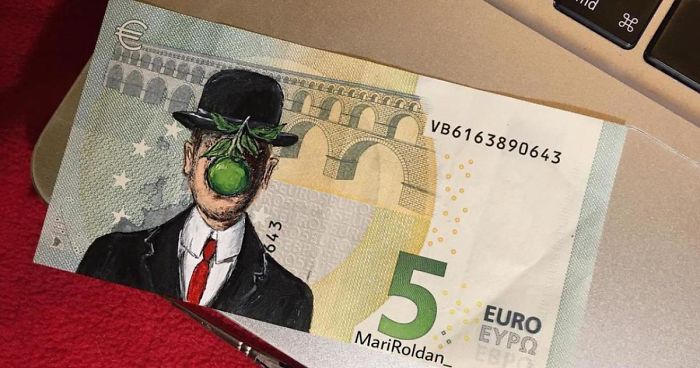
Money usually has one job: leave your wallet dramatically, then reappear in someone else’s cash drawer with the confidence of a tiny paper celebrity. But Spanish artist Mari Roldán looked at a euro banknote and saw something most of us miss while buying coffee: a miniature canvas waiting for a masterpiece.
Instead of treating currency as a dull everyday object, Roldán turns euro bills into small, portable tributes to art history. Her work recreates famous paintings on money, borrowing the visual language of Van Gogh, Botticelli, Hokusai, Magritte, Picasso, and other instantly recognizable artists. The result is a clever collision between two systems of value: the financial value printed on the bill and the cultural value painted across it.
That is why the idea is so irresistible. A painting on canvas already asks, “What is beauty worth?” A painting on money asks the same question while smirking like it just paid for lunch.
Who Is Mari Roldán?
Mari Roldán is a self-taught artist from Málaga, Spain, who gained attention online for painting and drawing on euro banknotes. Her work spread widely through social media because it is immediately understandable, visually surprising, and just mischievous enough to make people stop scrolling.
Roldán’s idea reportedly began when she drew Michelangelo’s The Creation of Adam on a ten-euro note with a ballpoint pen. Like any sensible person holding a hand-decorated bill, she wondered whether anyone would still accept it as payment. The note was used to buy coffee, which may be one of the most charming origin stories in modern small-scale art. Some artists wait for a gallery opening; Roldán’s first test audience may have been a barista.
From there, she began personalizing more banknotes. Her goal was not simply to decorate money, but to let her art travel. A bill can move through cities, pockets, shops, train stations, restaurants, and countries. A canvas typically waits on a wall. A banknote has travel plans.
Why Money Makes Such a Fascinating Canvas
At first glance, painting on money feels like a novelty. Look closer, and it becomes surprisingly layered. Currency is already designed with portraits, symbols, architecture, numbers, security patterns, and national or regional identity. It is one of the most common pieces of public design in the world. We touch it, fold it, lose it, count it, worry about it, and occasionally find it in old jacket pockets like a tiny miracle.
By painting famous artworks onto banknotes, Roldán does not erase the original purpose of the money. She interrupts it. The viewer can still recognize the bill, but now the eye is pulled toward a second image. A euro note becomes both payment and painting, both object and commentary.
This is what makes money art so powerful: it turns the everyday into a question. What gives something value? Is it the number printed in the corner? The labor behind the artwork? The cultural memory of the painting being recreated? The rarity of the object? Or the strange joy of seeing Van Gogh’s swirling sky land on something you could technically use to buy snacks?
Famous Paintings Reimagined on Banknotes
Roldán’s work often references paintings that are already deeply embedded in popular culture. This matters because the viewer does not need an art history degree, a velvet blazer, or the ability to pronounce “chiaroscuro” at dinner. Many people instantly recognize the mood, shape, color, or composition of the originals.
Van Gogh’s Emotional Sky
Vincent van Gogh’s The Starry Night is one of the most recognizable paintings in modern art. Its swirling blues and yellows feel almost alive, as if the night sky had too much espresso and decided to dance. When translated onto a banknote, that emotional movement becomes even more striking because the rigid geometry of currency contrasts with Van Gogh’s expressive energy.
A banknote is built for order: numbers, borders, patterns, serial codes. Van Gogh’s style is built for feeling. That tension is exactly what makes the recreation work. The bill becomes a tiny stage where control and emotion wrestle politely in public.
Magritte and the Surreal Euro
René Magritte’s surrealist imagery is another natural fit for Roldán’s concept. Surrealism thrives on making familiar objects behave strangely, and money is one of the most familiar objects on Earth. Placing a Magritte-inspired image on currency turns the banknote into a philosophical joke with excellent composition.
Money already has a surreal quality. A piece of paper can become dinner, rent, opportunity, stress, comfort, or power depending on where it goes. Magritte would probably appreciate the absurdity. The euro does not need a bowler hat to be mysterious, but it certainly would not hurt.
Hokusai’s Great Wave in Miniature
Katsushika Hokusai’s The Great Wave is famous for its dramatic curve, crisp lines, and sense of unstoppable motion. On a banknote, the wave becomes a compact force. It seems to crash against the printed structures of the bill, as if nature has decided to audit the economy.
This is one of the pleasures of Roldán’s money art: famous images do not merely sit on top of the note. They interact with it. The existing colors and patterns of the currency become part of the composition, creating a visual conversation between the original masterpiece and the modern object.
Botticelli, Beauty, and the Price Tag Problem
Sandro Botticelli’s The Birth of Venus is associated with beauty, myth, and graceful movement. When a detail inspired by Venus appears on money, the contrast is delicious. One image represents idealized beauty; the other represents practical exchange. Together, they ask whether beauty can be priced, packaged, and passed from hand to hand.
Of course, the art market has been trying to answer that question for centuries, usually by adding more zeros. Roldán’s banknotes make the question small enough to hold between two fingers.
The Art of Working Small
Painting on a banknote is not like painting on a stretched canvas. There is no generous field of white space, no forgiving surface, and no room for grand theatrical gestures. The artist must work around printed details, texture, folds, borders, and security features. Every mark has to earn its place.
This kind of small-format art requires patience and control. A single line can shift a face. A tiny mistake can throw off the likeness. The challenge is not only to recreate a famous painting, but to compress its identity into a limited space without reducing it to a flat copy.
That is why Roldán’s work feels more like translation than reproduction. She is translating large artworks into the language of currency. Like any good translation, the goal is not to copy every word. The goal is to preserve the spirit.
Is Painting on Money Legal?
The legality of altering currency depends on the country, the type of currency, and the intention behind the alteration. This article is not legal advice, and nobody should treat a paintbrush like a courtroom strategy. However, the general issue is important because money is not ordinary paper. It is a legal instrument, and governments tend to have feelings about people cutting, burning, falsifying, or intentionally damaging it.
In the United States, laws around mutilating coins and currency focus heavily on fraudulent intent, counterfeiting risk, and whether the money is made unfit for circulation. The Bureau of Engraving and Printing also handles mutilated currency redemption when notes are so damaged that their value is questionable. In Europe, euro banknote reproduction rules are designed to prevent confusion between images and real banknotes.
Roldán’s work is centered on euro bills, and her public comments have emphasized keeping key identifiers visible. Still, anyone inspired by this art should check local regulations before turning rent money into a tiny museum. Artistic enthusiasm is wonderful; accidental legal trouble is less adorable.
Why the Internet Loved It
Money art is perfect for the internet because it delivers a strong idea instantly. A viewer sees a banknote, then sees a famous painting, then realizes both are occupying the same small object. That three-step surprise happens in seconds, which is basically the attention span Olympics.
But the appeal goes beyond novelty. Roldán’s work is also shareable because it feels optimistic. It suggests that creativity can appear anywhere, even on the most practical objects in daily life. A bill is not glamorous. It is handled, folded, counted, and forgotten. By painting on it, Roldán gives it a second life.
There is also a democratic charm to the medium. Museums can feel intimidating to some people. Money does not. Everyone understands it. By placing art history on currency, Roldán brings famous paintings out of the marble hall and into the everyday world. It is like the Louvre got tired of standing still and hopped into a wallet.
Money, Value, and the Bigger Art Conversation
Artists have used money as a subject and material for decades. American artist Mark Wagner, for example, is known for intricate collages made from deconstructed U.S. dollar bills, exploring wealth, power, value, and American identity. Other artists have drawn currency, sculpted with coins, shredded bills, or used money as a performance object.
Roldán’s work belongs to this broader conversation but has its own personality. It is less aggressive than some conceptual money art and more intimate than large installations. Her banknotes feel personal, almost like visual postcards from art history. They are clever without becoming cold.
The strongest part of the concept is that it refuses to separate beauty from economics. In real life, art and money are always connected. Artists need materials, time, space, buyers, collectors, commissions, and audiences. Museums need funding. Galleries need sales. Viewers may love art spiritually while still checking the gift-shop price tag. Roldán simply places that relationship in your hand.
Why Recreating Masterpieces Still Feels Fresh
Some people assume recreating famous paintings is less original than inventing completely new images. That is a narrow view. Artists have studied, copied, remixed, quoted, and reinterpreted earlier works for centuries. The question is not, “Has anyone painted this image before?” The better question is, “What happens when this image appears in a new context?”
When a classic painting is recreated on money, the context changes completely. The masterpiece becomes smaller, more portable, more vulnerable, and more ironic. It is no longer only an artwork in a museum. It becomes a conversation about circulation, ownership, public design, and attention.
This is why Roldán’s art feels current. We live in a remix culture. Memes remix images. Fashion remixes eras. Music samples older tracks. Designers revive vintage styles and call them fresh with a straight face. Roldán’s banknote paintings fit that cultural rhythm, but with a handmade touch that keeps them from feeling disposable.
The Beauty of Letting Art Travel
One of the most poetic ideas behind Roldán’s project is movement. A traditional artwork is often tied to one place. Visitors travel to see it. A painted banknote reverses that relationship. The artwork travels to the viewer.
Imagine receiving change and discovering a tiny painted tribute to a famous work. For a second, the transaction becomes an encounter. The buyer and seller are no longer just exchanging value; they are passing along a small surprise. That is a lovely thought in a world where payments increasingly happen through silent taps and invisible digital transfers.
Of course, many decorated notes may be kept rather than spent. That also makes sense. A hand-painted banknote carries the intimacy of an artist’s touch. It turns an object of exchange into an object of attention. The bill stops being money and becomes a keepsake.
Lessons Artists Can Learn From Roldán’s Money Canvas
Roldán’s rise shows that a strong artistic idea does not always require enormous scale or expensive materials. Sometimes the right concept is already sitting in your pocket, quietly waiting to become interesting.
For emerging artists, her work offers several useful lessons. First, constraints can be powerful. A small surface forces sharper decisions. Second, familiar materials can help audiences connect quickly. Third, social media rewards visual clarity, but lasting attention still depends on craft. A clever idea gets the first look; skill earns the second.
Most importantly, Roldán’s project reminds artists to pay attention to ordinary objects. Creativity often begins with a simple shift in perception. A banknote is money. Then suddenly, it is a canvas. A receipt is trash. Then suddenly, it is collage material. A coffee stain is annoying. Then suddenly, it is the beginning of a portrait, assuming you are brave and under-caffeinated.
Experiences Related to “Artist Recreates Famous Paintings Using Money As Her Canvas”
There is something strangely memorable about seeing art placed where it “doesn’t belong.” A famous painting in a museum is expected. A famous painting on a banknote feels like discovering a violin solo in an elevator. The surprise changes the experience.
Think about the emotional difference between viewing The Starry Night on a museum wall and seeing a miniature version painted on money. In the museum, the painting has space, silence, guards, labels, and a crowd pretending not to block one another’s photos. On a banknote, the image becomes private and close. You hold it. You tilt it toward the light. You notice the texture of the paper and the way the artwork adjusts to the printed design underneath.
That physical closeness matters. Many people experience famous paintings through screens, posters, books, mugs, tote bags, phone cases, and classroom slides. Roldán’s work adds another layer to that experience. The painting becomes part of an object associated with labor, spending, saving, and survival. Suddenly, art history feels less distant. It has entered the daily economy.
For viewers, this can create a small but real moment of reflection. A ten-euro note might normally disappear without ceremony. You hand it over, receive change, and move on. But if that note carries a painted detail inspired by Botticelli or Hokusai, the transaction slows down. The object asks to be noticed. It becomes difficult to treat it as ordinary.
For artists, the experience is also instructive. Working on money requires respect for limitation. You cannot simply dominate the surface. You have to collaborate with what already exists. The printed architecture of the note, the color palette, the security marks, the size, and the folds all become part of the artwork. That is a useful creative exercise because it teaches adaptation. Not every canvas begins blank, and not every project gives the artist total control.
For collectors or casual fans, painted banknotes offer a different kind of intimacy than large artworks. They feel personal, almost secretive. A framed painting announces itself across a room. A decorated bill waits to be discovered. It has the charm of a message tucked inside a book.
There is also a broader cultural experience here: the joy of seeing value rearranged. Money is supposed to measure worth, but art complicates that measurement. A five-euro note is worth five euros until an artist transforms it. Then its value becomes emotional, cultural, aesthetic, and possibly collectible. The number printed on the bill suddenly feels like the least interesting thing about it.
That is why this topic resonates so strongly. It is not only about painting on money. It is about seeing possibility in everyday objects. It is about giving beauty a passport. It is about asking whether value is fixed or imagined. And, yes, it is also about the delightful weirdness of a banknote becoming too pretty to spend.
Conclusion
Mari Roldán’s banknote paintings prove that art does not need a grand entrance to make an impact. Sometimes it can arrive folded in a pocket, tucked into a wallet, or passed across a café counter. By recreating famous paintings on euro bills, she transforms money from a symbol of exchange into a symbol of imagination.
Her work stands at the crossroads of art history, public design, social media, and everyday life. It is clever enough to make viewers smile, detailed enough to reward close looking, and thoughtful enough to raise bigger questions about value. That is a rare combination. Plenty of art asks us to look. Roldán’s money art asks us to look again at something we thought we already understood.
In the end, the charm of this project is simple: it makes money feel less like an ending and more like a beginning. A bill can buy coffee, yes. But in the right hands, it can also carry Van Gogh’s sky, Hokusai’s wave, Botticelli’s beauty, or Magritte’s mystery. Not bad for something that usually spends its life being crumpled next to old receipts.