Paper is supposed to be humble. It carries grocery lists, wraps sandwiches, survives awkward printer jams, and occasionally becomes a paper airplane that immediately nose-dives into a coffee mug. Then the members of the Paper Artist Collective get involved, and suddenly that same everyday material turns into birds, beasts, florals, miniature worlds, layered landscapes, glowing color studies, and sculptures so detailed they make tweezers look like heavy construction equipment.
The Paper Artist Collective is a global community of artists who work with paper as their primary language. Their work proves that paper art is not a cute side hobby hiding in the craft drawer. It is design, sculpture, illustration, storytelling, engineering, patience, and a tiny bit of wizardry. From hand-cut wildlife to painted-paper collage, from bold commercial installations to delicate personal pieces, the collective shows how far a simple sheet can travel when imagination takes the wheel.
What Is The Paper Artist Collective?
The Paper Artist Collective is an international community built around one shared obsession: transforming paper into art that feels alive. Its members come from different countries, creative backgrounds, and specialties, but they are connected by the same core idea. Paper may be flat when it arrives, but it does not have to stay that way.
The collective has highlighted artists such as Lisa Lloyd, Anaïs Herd-Smith, Sarah Suplina, Samantha Quinn, and many others whose work ranges from sculptural animals and mythical creatures to botanical collages, editorial pieces, set design, window installations, and color-driven experiments. Some members cut with surgical precision. Others paint, fold, curl, score, layer, twist, and assemble. The result is a wildly varied paper-art ecosystem where one artist may build a delicate bird feather by feather while another creates a monster that looks like it just wandered out of a neon dream.
One of the most memorable Paper Artist Collective projects challenged artists to create paper artwork using only one color. The rules were delightfully strict: artists received sheets of Colorplan paper and had to make a piece that fit inside a small three-dimensional space. That kind of limitation is not a creative punishment; it is a creative trampoline. With only one color, artists had to rely on shadow, texture, depth, rhythm, shape, and structure. No rainbow rescue mission. No glittery escape hatch. Just paper, patience, and a brave little blade.
Why Paper Art Feels So Surprisingly Powerful
Paper art works because it lives in a beautiful contradiction. Paper is delicate, but paper sculpture can feel strong. Paper is inexpensive, yet finished work can look luxurious. Paper is familiar, but in the right hands it becomes strange, theatrical, and almost impossible to categorize.
That tension is part of the magic. A viewer knows, deep down, that the artwork began as sheets. That knowledge makes the finished piece more impressive. When Lisa Lloyd creates large-scale paper wildlife inspired by nature, the viewer can sense both the fragility of the material and the strength of the subject. When Sarah Suplina builds textured birds, florals, and landscapes from snippets of painted paper, the final image has the softness of watercolor and the physical presence of relief sculpture. When Anaïs Herd-Smith constructs colorful paper creatures and mythological beasts, the medium becomes playful, sculptural, and wonderfully odd.
Paper also has a built-in memory. Fold it, and it remembers the fold. Score it, and it bends with intention. Cut it, and negative space becomes part of the image. Layer it, and shadows begin doing unpaid acting work. This is why paper artists often think like sculptors, illustrators, designers, and engineers all at once. They are not merely decorating a surface. They are negotiating with gravity, thickness, grain, light, and time.
The Techniques Behind Incredible Paper Art
Cutting: The Drama Of The Blade
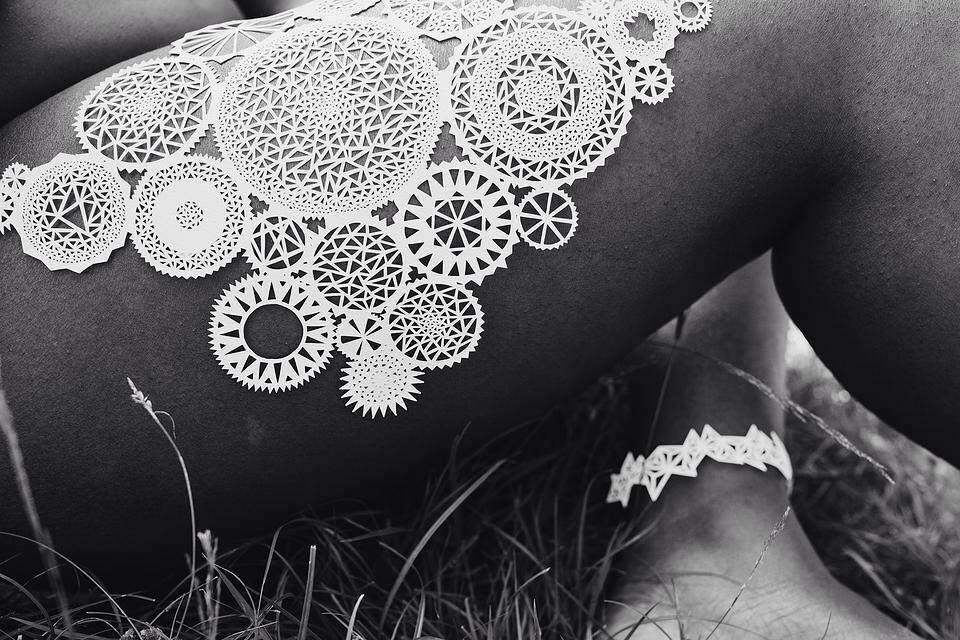
Paper cutting is one of the most recognizable techniques in contemporary paper art. It can be done with scissors, craft knives, scalpels, laser cutters, or a mix of hand and machine processes. The hand-cut approach has a special charm because every curve reveals the artist’s control. One wrong move and the paper says, “Congratulations, you now have modern abstract art.”
Artists like Samantha Quinn demonstrate how cutting can create intricate silhouettes, decorative patterns, layered scenes, and commercial visuals. The blade becomes a drawing tool. Instead of making a line with ink, the artist makes a line by removing material. That subtraction is powerful. It turns absence into design.
Layering: Flat Sheets, Deep Worlds
Layering is where paper art starts to feel architectural. By stacking cut shapes, artists create depth, shadow, and dimension. A flower petal can lift away from the background. A bird can gain feathers. A landscape can stretch into the distance. Even a monochrome piece can feel rich if layers are used well.
Layering also slows the viewer down. Instead of seeing the whole image at once, the eye travels from edge to edge, discovering small decisions: a lifted wing, a hidden shadow, a slight curl, a textured center, a tiny color shift. It is the visual equivalent of finding extra fries at the bottom of the bag, except more elegant and less salty.
Scoring, Folding, And Curling
Scoring allows paper to bend cleanly without cracking. Folding creates structure. Curling adds movement. These techniques may sound simple, but in professional paper sculpture, simple does not mean easy. A single curve can change the attitude of an entire piece. Curl a petal too much and it looks wilted. Curl it just enough and it looks like it has been kissed by sunlight.
Paper artists use these methods to give life to leaves, feathers, waves, ribbons, insects, garments, props, and abstract forms. In educational settings, folding, curling, twisting, and scoring are often introduced as beginner-friendly techniques. In the hands of an expert, however, they become the foundation for sophisticated sculptural work.
Painting And Collage
Some paper artists do not rely on commercially colored paper alone. They paint their own sheets, creating custom gradients, textures, and surprises before cutting them into smaller components. Sarah Suplina’s work is a strong example of this approach. By using painted paper snippets, she creates natural subjects with lively surfaces. The color does not sit flat; it shifts and breathes through the layers.
This approach gives collage a sculptural personality. Instead of simply placing pieces side by side, the artist builds form through overlapping, trimming, and composing. The final work feels handmade in the best possible way: precise, warm, and full of tiny decisions.
Specific Artists Who Show The Range Of The Collective
Lisa Lloyd: Nature With Wings, Teeth, And Texture
Lisa Lloyd is known for three-dimensional paper sculptures inspired by nature. Her animals and imagined creatures often combine delicacy with drama. The viewer may notice feathers, fins, scales, petals, or armor-like details, all made from paper. Her work shows how the medium can capture movement and organic structure without needing stone, metal, or clay.
What makes this kind of paper sculpture so compelling is the relationship between subject and material. Nature is full of repeated patterns: scales, cells, seed pods, wings, coral, flowers, and shells. Paper is ideal for echoing those patterns because it can be cut into repeated units and assembled into complex surfaces. The result feels both scientific and poetic.
Anaïs Herd-Smith: Paper Creatures From A Bright Otherworld
Anaïs Herd-Smith works in a colorful universe of paper sculpture, often exploring creatures, chimeras, and mythological forms. Her pieces feel playful but not careless. They are carefully constructed, boldly colored, and full of personality. If some paper art whispers, her work grins at you from across the room and politely asks whether you believe in monsters.
This kind of paper sculpture reminds viewers that art does not have to choose between craft and imagination. It can be technically demanding and still joyful. It can be precise and still a little weird. In fact, the weirdness is often where the charm lives.
Sarah Suplina: Painted Paper, Nature, And Texture
Sarah Suplina, a paper artist and art educator in the United States, creates layered pieces often inspired by birds, flowers, seasons, and the natural world. Her painted-paper technique gives her work a distinct texture. Instead of using paper as a neutral support, she makes paper the main event.
Her work is especially useful for understanding why paper collage remains so popular. It offers color, texture, and dimension without losing the intimacy of handwork. Every small piece matters. A wing is not a wing because one shape says so; it becomes a wing because dozens of small choices gather into one convincing form.
Samantha Quinn: Paper Cutting With Design Precision
Samantha Quinn brings a graphic designer’s eye to paper cutting and paper-based commercial work. Her practice includes illustration, branding, set design, prop design, window installations, packaging, and private commissions. That range matters because it shows that paper art is not limited to gallery walls. It can live in retail displays, editorial campaigns, book covers, events, and brand storytelling.
Paper has a warmth that digital images often lack. In commercial design, a hand-cut or hand-built paper piece can make a campaign feel tactile and memorable. It says, “A human made this,” which is still a pretty excellent marketing strategy in a world where everything is trying to look frictionless.
The One-Color Challenge: A Tiny Box Full Of Big Ideas
The Paper Artist Collective’s one-color challenge is a perfect example of how constraints can make creativity sharper. Artists received paper in a single shade and had to create work within a compact size limit. Participants included artists associated with colors such as turquoise, pistachio, Tabriz blue, Mars green, mid green, azure blue, candy pink, and mandarin.
Why is that interesting? Because color usually does a lot of emotional heavy lifting. Red shouts. Blue calms. Yellow performs jazz hands. But when an artist has only one color, the work must depend on form. Light and shadow become the palette. Edges become accents. Repetition becomes rhythm. Texture becomes contrast.
A monochrome paper sculpture also photographs beautifully when constructed well. Shadows reveal every raised layer, every fold, every cut line. The viewer starts to notice the architecture of the piece rather than simply reacting to color. That is a powerful lesson for artists, designers, and anyone who has ever tried to make a school project look “minimalist” because they ran out of markers.
Paper Art As A Bridge Between Fine Art, Craft, And Design
One reason paper art continues to grow in popularity is that it refuses to stay in one category. It belongs to fine art because it can be conceptual, expressive, and museum-worthy. It belongs to craft because it celebrates hand skill, material knowledge, and tradition. It belongs to design because it solves visual problems for brands, books, spaces, and experiences.
Museums and cultural institutions have long treated works on paper as serious artistic objects. Drawings, prints, studies, collages, and paper sculptures all hold a major place in art history. Contemporary paper sculpture adds another layer to that history by pushing the material into three-dimensional and installation-based forms.
Paper art also connects to traditions such as origami, kirigami, paper cutting, pop-up books, paper engineering, book arts, and paper architecture. Each tradition has its own rules and history, but contemporary artists freely borrow, bend, remix, and reinvent. That is why today’s paper art can look like a botanical specimen, a fashion editorial, a stage set, a scientific model, or a fantasy creature having the best hair day of its life.
Why Viewers Love Paper Art Online
Paper art performs extremely well online because it has instant visual appeal and a built-in “How did they do that?” factor. A finished paper sculpture can stop the scroll because viewers understand the material immediately. They know what paper is. They have touched it. They have folded it. They have accidentally crumpled it during stressful phone calls. So when they see it transformed into something extraordinary, the reaction is immediate.
This makes paper art perfect for platforms that reward process. Time-lapse videos, behind-the-scenes reels, progress photos, and detail shots can be just as engaging as the final artwork. Watching a paper artist build a sculpture layer by layer is satisfying because the transformation is visible. The mystery remains, but the labor is honored.
For SEO and web publishing, this topic also has strong evergreen value. Searchers may look for paper art ideas, paper sculpture techniques, Paper Artist Collective members, cut paper artists, paper collage inspiration, paper craft design, contemporary paper artists, or handmade paper artwork. The subject is visual, educational, and emotionally appealing. In other words, it has the rare ability to attract artists, teachers, collectors, designers, parents, students, and people who just enjoy saying, “Wait, that is paper?”
The Hidden Difficulty Behind The Beauty
Paper art looks charming from a distance, but up close it is a serious test of discipline. Paper has opinions. It can warp with moisture, fade in direct light, tear under pressure, buckle under glue, and betray dull blades with fuzzy edges. It is forgiving in some ways and brutally honest in others.
Professional paper artists must understand paper weight, grain direction, adhesive behavior, humidity, cutting pressure, and display conditions. They must plan how pieces will be photographed, transported, framed, mounted, or preserved. A sculpture that looks effortless may involve sketches, prototypes, color tests, failed attempts, and hours of repetitive cutting.
That labor is part of the value. Paper art rewards patience. It asks the artist to slow down and build carefully. In a culture obsessed with instant results, there is something deeply refreshing about an artwork that says, “Nope, this took forever, and that is the point.”
What Beginners Can Learn From The Paper Artist Collective
You do not need a professional studio to learn from the Paper Artist Collective’s approach. Beginners can start with simple materials: heavyweight paper, a craft knife, scissors, glue, a cutting mat, a ruler, and a pencil. The bigger lesson is not about buying fancy tools. It is about learning how to see paper as a material with possibilities.
Start by experimenting with basic techniques. Cut strips and curl them. Score a line and fold it. Layer small shapes to create a feather, petal, or scale. Build a simple monochrome piece to understand shadow. Try a tiny botanical study using only three paper colors. Make mistakes. Paper is not judging you. Well, maybe a little, but only when you use too much glue.
The collective’s work also teaches the value of creative community. Artists grow faster when they share challenges, prompts, collaborations, and feedback. A group project can push each person into new territory. The one-color challenge is a perfect model: clear rules, shared materials, individual interpretation, and a final collection that celebrates difference.
Experiences Related To Paper Art: What It Feels Like To Make Something From Almost Nothing
There is a special kind of surprise that happens when someone tries paper art for the first time. At the beginning, the materials look almost too ordinary. A stack of paper sits on the table, flat and quiet. The tools are simple. The idea may seem manageable. Then the first cut happens, and the artist realizes that paper has a personality. It bends one way more happily than another. It accepts a sharp blade but punishes a lazy one. It loves clean hands. It does not enjoy being drowned in glue. Paper is polite, but it has boundaries.
A beginner might start by cutting a flower. The first petal looks stiff. The second one tears. The third is too large. By the seventh petal, something changes. The hand relaxes. The curve becomes smoother. The artist begins to understand that paper art is less about forcing the material and more about cooperating with it. That moment is addictive. Suddenly, a flat sheet is not a flat sheet anymore. It is a future leaf, wing, shell, cloud, mask, city, bird, or tiny dragon with excellent posture.
One of the most useful experiences in paper art is working with a limited palette. Using only white paper, for example, teaches the importance of shadow. Without color to distract the eye, every fold and raised edge matters. A white-on-white paper sculpture can look plain under weak lighting and breathtaking under strong side lighting. The artwork changes as the light moves, which makes it feel alive. It is a quiet reminder that paper art is not just about the paper; it is also about air, space, and illumination.
Another memorable experience is realizing how much planning hides behind a finished piece. A small bird may require separate parts for the body, wings, tail, eye, beak, and dozens of feathers. Each piece has to be cut, shaped, and placed in the right order. Glue becomes strategy. Tweezers become an extension of the hand. The artist starts making strange bargains with time: “Just five more feathers,” which somehow becomes midnight.
Paper art also changes the way people look at everyday objects. A cereal box becomes useful cardboard. Wrapping paper becomes texture. Old magazines become color libraries. A paper bag becomes an experiment in surface and strength. Once someone starts thinking like a paper artist, recycling bins become treasure chests. This does not mean every scrap must be saved forever, though many artists learn this lesson the hard way after creating a “useful paper pile” that slowly becomes a roommate.
The best experience, however, is watching someone else react to the finished work. Viewers often lean closer. They ask whether it is really made of paper. They notice details the artist nearly forgot creating. That reaction is deeply satisfying because paper art invites wonder without needing explanation. It turns a familiar material into a small event. The Paper Artist Collective captures that feeling again and again: the shock of transformation, the joy of detail, and the reminder that creativity does not always need expensive materials. Sometimes it just needs a sheet of paper, a sharp tool, and an artist patient enough to listen.
Conclusion: Paper Is Not BoringIt Was Just Waiting For Better PR
The members of the Paper Artist Collective prove that paper can be elegant, strange, funny, detailed, emotional, architectural, and wildly expressive. Their work transforms a simple material into sculptures, collages, installations, creatures, florals, and visual stories that feel both handmade and astonishingly refined.
What makes the collective so exciting is not just technical skill, although there is plenty of that. It is the sense of possibility. A single sheet can become a feather. A stack can become a creature. A color challenge can become an international showcase. A familiar material can become a reminder that art is often hiding in plain sight, waiting for someone brave enough to cut, fold, curl, layer, and glue it into a new life.
Note: This article is an original, rewritten synthesis based on public information about the Paper Artist Collective, contemporary paper-art practices, paper sculpture techniques, works-on-paper conservation, and real artists associated with the paper-art community.