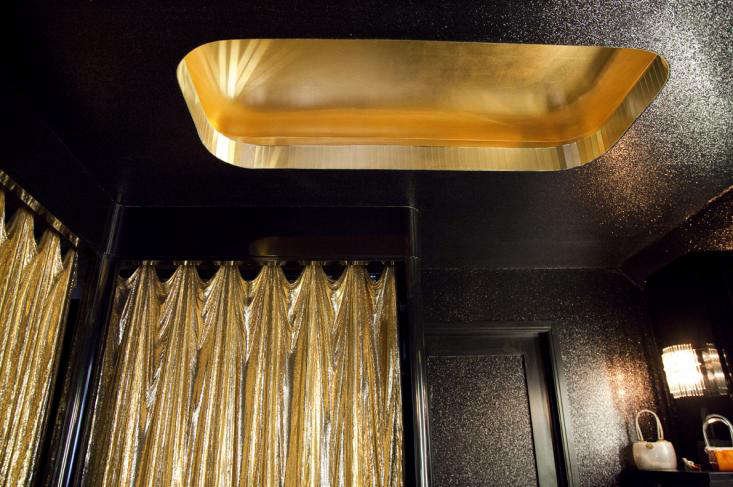
Some rooms whisper. Some rooms politely clear their throat. And then there is the glamorous Hollywood dressing room from Alexandra Loew, a space that sweeps into the house wearing black glitter, gold metal mesh, Art Deco confidence, and the calm assurance of a movie star who knows the lighting is already perfect.
Designed as part of Loew’s “The Silver Screen” project, this dressing room is not merely a place to hang jackets or debate which pair of shoes looks most responsible. It is a private fantasy built around old Hollywood glamour, masculine Art Deco lines, sultry materials, and a witty disco twist. The project was created for a client who collected gelatin prints by Golden Age portrait photographer George Hurrell, whose luminous images helped define the visual language of classic Hollywood glamour. Loew translated that cinematic inspiration into architecture, using material, shape, reflection, and shadow to create a room that feels like a backstage moment before the close-up.
The result is a dressing room with black glitter wall covering, liquid metal mesh panels, gold-leafed and mirrored coves, and a theatrical sense of enclosure. It is glamorous, yes, but not in the lazy “add a chandelier and hope for the best” way. It is glamorous because every surface knows its role. The room acts like a set, a jewel box, a functional closet, and a mood all at once.
Who Is Alexandra Loew?
Alexandra Loew is a Los Angeles-based interior architect and designer known for spaces that combine architecture, design history, fashion, cinema, and client psychology. Her studio describes her process as cinematic, narrative-rich, and deeply connected to the spirit of the client. Before interior design, Loew’s early career included filmmaking, and that background shows clearly in the way her projects handle atmosphere, composition, and reveal.
Rather than relying on a single repeatable signature style, Loew builds worlds. In one project, that world might look like modernist clarity inspired by Le Corbusier. In another, it may feel like a collector’s private screening room in architectural form. Her interiors often balance discipline and rebellion: historically informed, but never stiff; polished, but never predictable; luxurious, but rarely boring enough to behave at a dinner party.
That balance is what makes this Hollywood dressing room so memorable. It is rooted in Art Deco and classic cinema, yet it avoids becoming a costume. The room does not say, “Welcome to a theme restaurant where the waiter is required to call you ‘doll.’” Instead, it says, “Here is a private interior with a story, a silhouette, and just enough glitter to make your blazer feel underdressed.”
The Design Concept: Old Hollywood Meets Art Deco and Disco
The dressing room belongs to Loew’s “The Silver Screen” project, which reimagined a bedroom suite as a dramatic private environment. The renovation opened up walls and ceilings to create a strong sequence: bedroom, enclosed dressing room, and en suite bath. The design brief drew from a client’s love of George Hurrell portraits, which are famous for sharp lighting, sculptural faces, luminous skin, and a sense of mythic celebrity.
Loew’s genius was to avoid copying a film set literally. Instead, she extracted the emotional ingredients of old Hollywood: mystery, contrast, shine, shadow, and controlled drama. Then she mixed them with the geometry of Art Deco and the sheen of disco. That may sound risky, like inviting Fred Astaire and Studio 54 to share a taxi, but the result works because the design is disciplined.
The room’s black glitter wall covering becomes the night sky. The gold mesh panels create movement and shimmer. Mirrored coves bounce light, helping the compact space feel expanded and more atmospheric. Circular and square forms add structure, giving the room a visual rhythm that feels architectural rather than decorative. It is a place for getting dressed, but also a place for stepping into character.
Why the Dressing Room Feels Cinematic
A cinematic room is not only about dramatic color. It is about sequencing. In film, a director controls how the viewer sees a scene: the frame, the light, the cut, the reveal. Loew applies similar thinking to interiors. The dressing room is enclosed, intimate, and theatrical. It asks you to enter, pause, and notice the way light moves across surfaces.
The materials also perform like actors. Metal mesh does not sit flat and silent; it ripples, reflects, and changes depending on where you stand. Black glitter wall covering is similarly active. It catches light in tiny points, creating depth without demanding a loud pattern. Mirror, gold leaf, and dark surfaces build a push-pull between opacity and reflection. This is the room’s real luxury: not just expensive finishes, but the orchestration of visual experience.
That is why the space feels more sophisticated than a typical “glam dressing room.” Many glam interiors rely on obvious symbols: oversized mirrors, tufted stools, crystal lighting, and high-gloss everything. Loew’s room has glamour, but it also has tension. The black walls add mood. The gold adds warmth. The mirrored elements add illusion. The result is sensual, tailored, and intelligent.
Key Materials That Define the Look
Black Glitter Wall Covering
The black glitter wall covering is the room’s atmosphere-maker. It creates the impression of a night sky, a velvet curtain, or the dark edge of a theater before the spotlight comes up. In a dressing room, this kind of wall treatment can be incredibly effective because it turns a small enclosed space into an event. Instead of trying to make the room disappear, it makes the room unforgettable.
Black walls are often misunderstood as heavy or gloomy, but the shimmer changes the equation. The glitter catches light, breaking up the darkness and making the surface feel alive. It also creates a flattering backdrop for clothing, metallic accessories, perfume bottles, and mirrors. In practical terms, black can hide visual clutter better than pale walls, which is helpful in a dressing area where life tends to include scarves, hangers, and the occasional missing earring.
Liquid Metal Mesh Panels
The use of liquid metal mesh is one of the room’s most distinctive gestures. Whiting & Davis, long associated with metal mesh in fashion and architectural applications, has produced flexible mesh materials that can be used as drapery, dividers, or decorative surfaces. In Loew’s dressing room, this material brings a fashion-world sensibility into the architecture.
Metal mesh is glamorous because it sits between fabric and jewelry. It folds like cloth but gleams like metal. It suggests evening bags, stage curtains, armor, and couture all at once. In a Hollywood dressing room, that ambiguity is perfect. It gives the space a dressed-up quality before any actual clothes enter the room.
Gold-Leafed and Mirrored Coves
Gold and mirror can go wrong quickly. Use too much, and a room starts looking like it is trying to sell perfume at an airport. Loew uses them with architectural control. The coves are not random sparkle; they help shape the room, catch light, and create depth. Gold adds warmth to the black palette, while mirror expands the space and gives it that classic dressing-room association with performance and transformation.
The mirrored elements also connect to the psychology of a dressing room. This is a space where identity is assembled. You look, adjust, reconsider, edit, and finally decide who you are going to be for the evening. Mirror is functional, but in Loew’s hands it also becomes narrative.
Art Deco Without the Costume Party
The dressing room leans into Art Deco through geometry, rich materials, and cinematic polish. Art Deco has always loved contrast: black and gold, hard lines and soft glamour, modern machine-age confidence and decorative luxury. It is a natural fit for a Hollywood-inspired interior because the style shaped many theaters, hotels, and film-era fantasies of the early twentieth century.
Yet Loew’s room is not a museum reproduction. The disco reference loosens the formality. The glitter adds a seventies edge. The metal mesh introduces a slightly futuristic shimmer. This is important because rooms based too closely on historical styles can become frozen. Loew keeps the room alive by letting different periods talk to one another.
That layered approach is one reason the design feels current. Today’s best luxury interiors rarely follow one style with perfect obedience. They mix references, but they do so with intention. In this dressing room, the Art Deco structure gives the space backbone, while the disco glamour gives it a pulse.
Hollywood Regency Influence: Glamour with a Wink
Hollywood Regency design is known for theatricality, shine, contrast, and a confident sense of play. It grew from the glamour of Golden Age cinema and the homes of movie stars, where rooms often had dramatic silhouettes, lacquered finishes, mirrored furniture, bold colors, and luxurious fabrics. The style was never shy. It believed a room could wear jewelry.
Loew’s dressing room shares that spirit, but it is moodier and more architectural than typical Hollywood Regency. Instead of leaning on bright color or ornate furniture, the room uses black, gold, mirror, and mesh to create glamour through surface and light. It is less “starlet’s sitting room” and more “private chamber behind the velvet rope.”
This makes the design useful as inspiration even for modern homes. You do not need a mansion or a film-star budget to borrow the lesson. The key is not to copy every element. The key is to choose a strong palette, introduce one or two reflective materials, use lighting carefully, and give the dressing area a sense of occasion.
How to Bring the Look Home Without Overdoing It
Most of us do not have a dressing room that deserves its own theme music. Still, Loew’s design offers practical ideas for anyone trying to make a closet, vanity nook, bedroom corner, or dressing area feel more special.
Start with a Dark, Dramatic Base
A deep wall color can make a small dressing space feel intentional rather than cramped. Black, charcoal, midnight blue, oxblood, or deep aubergine can create a cocoon effect. If glitter wall covering feels too bold, consider grasscloth with sheen, lacquered paint, or a subtle metallic wallpaper. The goal is depth, not darkness for darkness’s sake.
Add Reflection Strategically
A dressing room needs a mirror, but the mirror does not have to be boring. Consider an arched mirror, a smoked mirror panel, mirrored cabinet fronts, or a small reflective cove behind shelves. Reflection should multiply light and create atmosphere, not turn the room into a funhouse where you accidentally make eye contact with yourself from six directions.
Use One Fashion-Inspired Material
Loew’s metal mesh panels work because they connect clothing and architecture. At home, you might use a chain curtain, a brass rail, a lacquered tray, a velvet stool, a mohair cushion, or a satin shade. One fashion-inspired texture can make a dressing area feel designed instead of merely organized.
Choose Lighting Like a Cinematographer
Lighting is the difference between “Hollywood glamour” and “I found this sweater in a cave.” Use layered light: flattering front-facing light near the mirror, soft ambient light overhead, and accent lighting for shelves or architectural details. Warm bulbs can help metallic finishes glow, while dimmers allow the space to shift from practical morning routine to evening drama.
Why This Dressing Room Still Feels Fresh
The reason Alexandra Loew’s Hollywood dressing room still feels compelling is that it is not trend-dependent. Glitter may trend. Gold may trend. Art Deco may come back every few years wearing a new hat. But the core idea is timeless: a private room can tell a story about its owner.
This is especially powerful in a dressing room because clothing is already a form of storytelling. A closet holds the uniforms of work, celebration, travel, comfort, reinvention, and occasional questionable online shopping decisions. When the room itself has a point of view, getting dressed becomes less mechanical and more expressive.
Loew’s room respects that ritual. It does not treat storage as a dull necessity. It treats dressing as a performance of self. The room says that beauty can be useful, that function can have drama, and that a closet deserves more than fluorescent lighting and a plastic laundry basket quietly giving up in the corner.
Design Analysis: The Power of Controlled Excess
One of the most interesting lessons from this project is the idea of controlled excess. The materials are bold, but the palette is tight. The references are glamorous, but the architecture is disciplined. The room is theatrical, but it is still functional. That balance is difficult to achieve.
In weaker interiors, glamour often becomes clutter. Designers add shine, then more shine, then perhaps a shiny thing to hold the shine. Loew avoids that trap by making every dramatic element serve the room’s central concept. The black glitter wall covering supports the silver-screen mood. The metal mesh supports the fashion and performance narrative. The mirrored coves support light and spatial illusion. Nothing feels accidental.
This is why the room can handle such rich materials. It has a clear story. Without that story, black glitter and gold mesh might feel chaotic. With the story, they feel inevitable.
Experience Section: Living with a Hollywood-Inspired Dressing Room
Imagine beginning your day in a dressing room inspired by Alexandra Loew’s Hollywood fantasy. You walk in half-awake, possibly negotiating with your alarm clock like it owes you money, and the room immediately changes the tone. The dark walls soften the outside world. The mirror catches a warm glow. A metallic panel flickers slightly as you move. Suddenly, choosing a shirt feels less like a chore and more like a tiny act of stage direction.
The experience of this kind of space is not only visual. It changes behavior. In an ordinary closet, people tend to rush. They grab what is visible, ignore what is wrinkled, and promise themselves they will organize everything “this weekend,” a mythical time period that has defeated many civilizations. In a glamorous dressing room, the ritual slows down. You notice texture. You compare silhouettes. You remember the jacket you bought because it made you feel like you had excellent plans, even if those plans were just dinner and parking validation.
A Hollywood-inspired dressing room also makes personal style easier to understand. When clothing is surrounded by thoughtful lighting, reflective surfaces, and a strong palette, each piece looks more intentional. A black dress becomes sculptural. A white blouse becomes crisp. A vintage bag becomes a character. Shoes look less like clutter and more like a supporting cast.
There is also a psychological pleasure in having a private space that feels slightly theatrical. Not every room in a home needs to be calm, beige, and ready for a wellness retreat. Some rooms should make you grin. Some rooms should remind you that ordinary routines can be upgraded with imagination. A dressing room is one of the best places for that kind of design because it is intimate and personal. Guests may never see it, which makes it even more luxurious. It exists for the person using it.
In practical terms, the best version of this experience combines drama with order. Drawers should glide smoothly. Jewelry should be visible but protected. Shoes should be easy to reach. Hanging space should be arranged by type, color, or frequency of use. A stool or small chair makes the room more comfortable. A tray for keys, watches, perfume, or lipstick prevents the daily migration of tiny objects into mysterious alternate dimensions.
The lighting should flatter but also tell the truth. A dressing room that makes every outfit look perfect until you step outside is not a dressing room; it is a charming liar. The ideal setup includes soft, even light near the face, enough brightness to distinguish navy from black, and warm accent light for atmosphere. Dimmers are the unsung heroes of glamour. They allow the room to be practical at 8 a.m. and cinematic at 8 p.m.
Materials matter, too. Loew’s room shows how a strong material story can make a small room feel important. At home, this could mean black lacquered shelves, brass hardware, a smoked mirror, velvet seating, a metallic curtain, or wallpaper with a subtle shimmer. The trick is restraint. Choose the drama carefully. Let one or two elements be the star, and make the rest of the room the excellent supporting cast.
The biggest takeaway from living with a glamorous dressing room is that luxury is not only about cost. It is about attention. It is about designing a daily ritual so it feels considered, flattering, and a little more fun. Alexandra Loew’s Hollywood dressing room captures that idea beautifully. It turns storage into story, surfaces into atmosphere, and getting dressed into a moment worth enjoying.
Conclusion
A glamorous Hollywood dressing room from Alexandra Loew is more than a beautiful interior; it is a master class in narrative design. By combining old Hollywood glamour, Art Deco geometry, disco shimmer, and architectural discipline, Loew created a room that feels cinematic without becoming theatrical in the wrong way. The black glitter wall covering, liquid metal mesh, gold-leafed coves, and mirrored details work together to form a private silver-screen fantasy.
For homeowners, designers, and style lovers, the lesson is clear: a dressing room does not have to be an afterthought. It can be intimate, functional, dramatic, and deeply personal. Whether you borrow the dark palette, the reflective accents, the fashion-inspired materials, or simply the idea of making daily routines feel more beautiful, Loew’s design proves that glamour is at its best when it has a story to tell.
Note: This article is written for web publication in original language and structure, based on real design information and broader interior design context.