Most people pass utility poles every day without giving them much thought. They are background furniture: tall, brown, slightly crooked, and usually decorated with enough wires to make a bowl of spaghetti look well organized.
Look closer, though, and a North American utility pole becomes a compact piece of infrastructure storytelling. Its wires reveal how electricity moves through a neighborhood. Its transformers hint at the customers being served. Its cables tell the history of telephone, cable television, fiber internet, and sometimes several generations of technology that apparently agreed never to move out.
This field guide explains how to read a typical utility pole from top to bottom, what the major components do, why poles look different from one street to another, and what their construction can tell you about the electric grid. The first rule, however, is simple: this is a guide for observation, not interaction. Utility poles and overhead lines can carry dangerous voltages. Admire them from the ground. Do not climb, touch, move, cut, or experiment with anything attached to them.
What Is a Utility Pole, Really?
A utility pole is an engineered support structure for electric power, communications equipment, or both. In many North American communities, poles form the visible final stage of an enormous energy network that begins at generating facilities, passes through high-voltage transmission systems and substations, and eventually reaches local distribution lines.
Transmission structures are generally the giants of the grid: tall towers or large poles carrying high-voltage lines over significant distances. The familiar pole along a residential street is more often part of the distribution system, where electricity has already been stepped down from transmission levels and is being routed toward homes and businesses.
Wood remains the classic utility-pole material, but steel, concrete, and composite structures are also used. The right choice depends on engineering requirements, local conditions, utility practices, loading, weather exposure, maintenance strategy, and cost. A pole that works nicely on a calm suburban street may not be the pole an engineer chooses for a hurricane-prone coast or a heavily loaded urban corridor.
How to Read a Utility Pole From Top to Bottom
There is no single universal layout for every North American utility pole. Voltage, local codes, utility standards, road geometry, age, available space, and joint-use agreements all affect construction. Still, many distribution poles follow a recognizable vertical hierarchy.
1. The Primary Distribution Conductors
Near the top of many electric distribution poles are the primary conductors. These carry higher-voltage electricity through the local distribution network before transformers reduce the voltage for customer use.
You may see one, two, or three primary conductors depending on the circuit configuration. Three conductors arranged across a crossarm often indicate a three-phase circuit, while a single-phase lateral may branch away to serve a smaller residential area. Real-world construction varies, however, so counting wires from a sidewalk should be treated as informed observation rather than a substitute for engineering drawings.
The top of the pole is premium real estate because energized supply conductors require carefully engineered clearances from other facilities. As a general visual rule, the most electrically serious-looking equipment tends to occupy the upper portion of a joint-use pole. That is not a technical measurement standard, merely a good reminder not to assume a lower-looking wire is harmless.
2. Crossarms and Insulators
A crossarm is the horizontal member that gives many utility poles their instantly recognizable capital-T silhouette. It supports conductors at designed spacing and may be made of wood or other engineered materials.
Insulators separate energized conductors from the supporting structure. Depending on the system and construction style, they may appear as compact posts, larger ridged components, or suspended assemblies. Their job is not decorative, despite their occasional resemblance to unusually serious ceramic cupcakes.
Some modern distribution designs use fewer visible crossarms, with conductors mounted on brackets or line-post insulators. That is why two neighboring circuits can perform similar jobs while looking surprisingly different.
3. Transformers: The Familiar Gray Cans
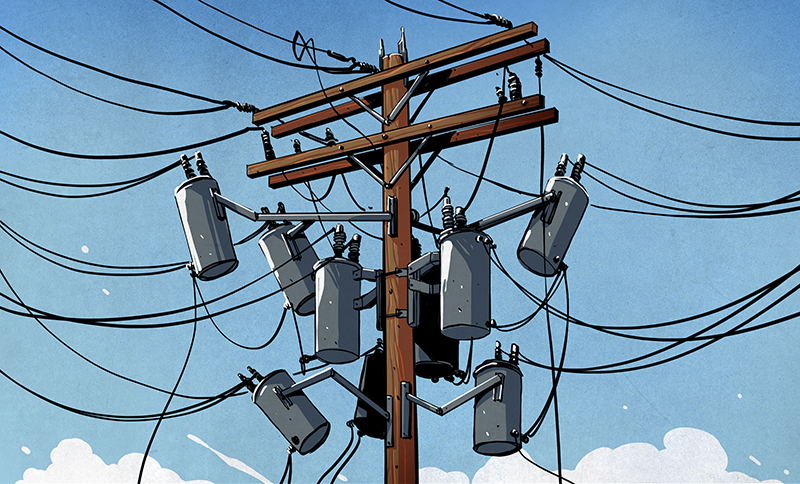
One of the easiest pieces of equipment to recognize is the pole-mounted distribution transformer. Often shaped like a gray metal cylinder, it reduces the voltage supplied by the distribution circuit to a level suitable for the customers connected downstream.
A single transformer may serve several nearby homes. Larger loads or three-phase customers may require multiple transformers arranged as a bank. Commercial streets, apartment complexes, workshops, and other substantial loads can produce far more elaborate pole configurations than a quiet residential cul-de-sac.
Not every neighborhood uses pole-mounted transformers. In areas with underground distribution, transformers are commonly housed in ground-level enclosures. That green or gray cabinet on a lawn may be doing a job similar to the metal can hanging on a pole a few blocks away.
4. Fuses, Cutouts, Arresters, and Switches
A utility pole may also carry protective and switching equipment. A fuse cutout can disconnect part of a circuit when excessive current occurs. Surge arresters help protect equipment from voltage surges. Switches allow sections of a distribution system to be isolated or reconfigured.
More advanced circuits may include reclosers, capacitor banks, voltage-regulating equipment, sensors, communications devices, or remotely controlled switches. In other words, the modern utility pole is no longer always a passive stick holding wires. Some poles have become small outposts of an increasingly automated electric grid.
5. The Neutral and Secondary Conductors
Below or near the primary portion of a typical distribution structure, you may see neutral and secondary conductors. The exact arrangement varies significantly.
Secondary conductors carry electricity after it has passed through a distribution transformer. From there, a service drop may run toward a home or building. Follow the line visually and you can often see the point where the public distribution network makes its final aerial approach toward a customer.
Again, visual identification has limits. Covered conductors are not necessarily safe to touch, and a line that appears insulated may still be dangerous. The useful field-guide principle is simply that electrical distribution equipment generally occupies the upper working zones of a joint-use pole.
6. The Communications Space
Lower on many joint-use poles are communications cables. These may support telephone service, cable television, broadband, or fiber-optic networks. Communications facilities are commonly positioned below electric supply facilities with required separation between working spaces.
This lower area can become crowded, particularly on older urban and suburban routes. One provider arrives. Then another. Then fiber arrives. Then somebody upgrades a network but leaves part of the old one in place. Eventually the pole begins to look as though it has been collecting cables since the invention of the telegraph.
That crowded appearance reflects a serious infrastructure issue. Adding new communications equipment is not as simple as throwing another cable onto the pole. Pole owners and attachers may need surveys, engineering review, rearrangement of existing facilities, and other “make-ready” work before new attachments can be installed safely.
The Supporting Cast: Equipment People Often Miss
Guy Wires and Anchors
Conductors pull on poles. At a straight section of line, forces may be relatively balanced. At corners, dead ends, and other high-tension locations, the pole may need additional support.
That is where guy wires enter the scene. A guy wire runs diagonally from the pole toward an anchor in the ground, helping resist the mechanical forces acting on the structure. Some assemblies include an insulating component. Other designs use different bracing strategies depending on the situation.
If a pole at a sharp road corner looks dramatically more muscular than its neighbors, the reason is usually physics, not vanity.
Pole Grounds
Grounding conductors may run vertically along a pole and connect parts of the system to a grounding system. Grounding and bonding are fundamental elements of electrical safety and system protection, although much of the important work is not visually obvious to a casual observer.
Risers and Underground Transitions
Sometimes a cable or conductor runs down the side of a pole inside protective covering and disappears underground. This is commonly called a riser arrangement and may mark a transition between overhead and underground facilities.
These transition poles are especially interesting because they show that “overhead versus underground” is not always an either-or choice. A distribution route may combine both systems, using overhead construction in one section and underground cables in another.
Double Poles and the Mysterious Pole Beside the Pole
Occasionally you will see a newer pole standing beside an older one. This often means a pole replacement or transfer process is underway. Electric facilities may have been moved while communications attachments remain on the old structure, or various owners may still need to complete their portion of the transfer.
To the untrained eye, it can look like the utility accidentally installed a spare. Infrastructure coordination is usually the less exciting, but more accurate, explanation.
Wood Poles Are More Engineered Than They Look
A wood utility pole may begin as a tree, but it does not enter service as a random trunk selected by someone who said, “That one seems tall enough.” Wood poles are manufactured and selected according to defined dimensions, species characteristics, strength classes, quality requirements, and engineering needs.
ANSI standards classify wood poles by dimensions and structural capacity. Standard lengths span a broad range, from relatively short poles to structures well over 100 feet long. The required pole depends on the loads it must support, including conductors, equipment, wind, ice, line tension, and other forces.
The pole is also only partly visible. A significant portion is embedded in the ground, meaning the apparent height above the street does not equal the pole’s full manufactured length.
Why the Wood Is Treated
A utility pole may remain exposed to rain, soil moisture, insects, fungi, temperature changes, and decades of weather. Preservative treatment helps protect wood against biological deterioration and extend service life.
Several preservative systems have been used in North America, and the choice can depend on wood species, utility specifications, region, and era. Standards organizations govern treatment requirements, while the U.S. Environmental Protection Agency regulates wood-preservative pesticides. Pentachlorophenol, historically associated with many utility poles, is being phased out under an EPA cancellation decision, while older treated poles can remain part of the existing system.
Utilities also inspect poles and may repair, reinforce, remedially treat, or replace them based on condition. Decay near the ground line is an obvious concern, but inspectors also look for structural damage, deterioration, loose equipment, and other conditions that can affect reliability.
What Pole Markings Can Tell You
Look closely from a safe public location and you may notice metal tags, numbers, brands, stencils, inspection marks, or small plates. These can identify the pole, track ownership, record inspections, indicate manufacturing information, or support utility asset-management systems.
There is no single marking system that every utility uses. A number that looks like a secret government code may simply be an asset identifier that helps a crew locate the correct pole in a database.
For field observers, the most useful lesson is that poles are managed assets. They are inventoried, inspected, engineered, and maintained as part of a larger network.
How to Read the Story of a Neighborhood Through Its Poles
Older Neighborhoods Often Show Layers of Technology
A mature urban pole line may contain equipment from several eras. Old copper telephone infrastructure may share space with coaxial cable and newer fiber. Electric hardware may have been upgraded in stages rather than replaced all at once.
The result is a kind of technological archaeology. You are not merely looking at wires; you are looking at decades of investment decisions stacked vertically.
Large Transformer Banks Suggest Larger Loads
Several transformers grouped together can indicate a three-phase service arrangement or a substantial local load. Commercial and industrial customers often have power requirements that differ significantly from those of a typical house.
Heavy Guying Usually Means Heavy Mechanical Forces
Poles at corners, line terminations, and major direction changes frequently have more visible support hardware. The shape of the route itself creates forces that engineers must manage.
A Pole With a Riser May Mark a Change in Construction
When overhead conductors descend toward underground facilities, you may be looking at the boundary between two styles of distribution. Newer developments often use more underground infrastructure, while older main roads or feeder routes may remain overhead.
More Electronic Equipment Can Signal a Smarter Grid
Sensors, communications antennas, automated switches, and other control equipment are increasingly part of distribution modernization. Not every box is easy to identify from the ground, but a pole carrying more electronics than its neighbors may perform monitoring, protection, switching, or communications functions.
Why Utility Poles Still Matter in the Age of Underground Infrastructure
Overhead lines are often criticized for their exposure to trees, wind, ice, vehicles, and severe weather. Underground systems can reduce exposure to some of those hazards and improve neighborhood appearance.
But underground construction has its own engineering, maintenance, access, and cost considerations. Real grids are therefore mixtures. Utilities may underground selected circuits, harden overhead lines, install stronger poles, improve vegetation management, automate switching, or combine several approaches.
Utility poles also support more than electricity. Broadband deployment frequently depends on access to existing pole routes. A single line of poles may therefore support two essential modern systems at once: electric power and digital communications.
Utility Pole Safety: The Part of the Field Guide That Is Not Optional
Observing utility infrastructure can be fascinating. Approaching it can be dangerous.
Never climb a utility pole. Never touch wires, cables, guy wires, equipment cabinets, or objects contacting electrical lines. Do not assume a wire is harmless because it is low on the pole, appears insulated, or is lying on the ground.
Keep ladders, antennas, long tools, drones, and other equipment away from overhead power lines. If you encounter a downed line, stay well away, keep other people and pets back, and contact emergency services or the responsible utility according to local guidance. A downed conductor should be treated as energized.
One of the most dangerous mistakes is trying to identify electrical safety by appearance alone. Electricity does not care how confident you feel about your wire-recognition skills.
A Simple Utility Pole Spotting Checklist
When observing from a safe distance, try asking these questions:
- Is the structure wood, steel, concrete, or another material?
- How many primary conductors appear near the top?
- Are the conductors mounted on crossarms or compact brackets?
- Is there a pole-mounted transformer?
- Can you see switches, cutouts, arresters, or other protective equipment?
- Are communications cables attached lower on the pole?
- Does a guy wire brace the structure?
- Is there a visible riser transitioning facilities underground?
- Are there identification tags or inspection markings?
- Does the pole look like part of an older layered network or a newer standardized build?
After a few walks, you may notice that poles you once considered identical are anything but.
Field Notes: What You Experience Once You Start Paying Attention
The first experience most new utility-pole watchers have is mild embarrassment. You have probably lived near these structures for years, yet the moment you consciously inspect one, you realize you have no idea what half the equipment does. A gray transformer that was once merely “the bucket thing” suddenly has a purpose. The diagonal cable you ignored becomes a guy wire. The apparent chaos begins developing a grammar.
The second experience is discovering that neighborhoods have different infrastructure personalities. Walk through an older business district and the poles may be packed with layers of communications cable, transformers, service drops, and equipment added over decades. Move into a newer subdivision and much of the distribution system may vanish underground, leaving only occasional transition points and cabinets at ground level.
Rural roads offer another experience entirely. Long pole lines make the geometry of distribution easier to see. You can watch a main route continue straight while smaller laterals branch away. A heavily guyed pole marks a change in direction. A transformer appears near a cluster of customers. The physical logic of the network becomes more obvious because there are fewer buildings, signs, and parked vehicles competing for attention.
One of the most interesting exercises is to follow a distribution route visually while walking or riding as a passenger. Without touching anything or entering restricted property, you can observe how the line changes from a larger corridor to smaller branches. Three-phase construction may continue along a commercial road before a less complex lateral heads into a residential street. Transformers appear where local voltage conversion is needed. Service drops make the final connection toward buildings.
Then there are the poles that refuse to be understood in five seconds. They carry extra boxes, antennas, loops of cable, unusual brackets, or multiple communications lines. These are a good cure for overconfidence. A field guide can teach patterns, but utility construction is shaped by local engineering standards, circuit history, joint-use arrangements, repairs, upgrades, and special applications. Sometimes the most accurate field identification is simply, “That is specialized equipment, and I should not pretend otherwise.”
Weather adds another layer to the experience. After a major storm, the importance of ordinary-looking poles becomes obvious. A tree limb can damage conductors. A vehicle can strike a structure. High winds and ice can impose severe mechanical loads. Crews then have to assess the system, make conditions safe, replace damaged structures and equipment, and coordinate the restoration of services. What looked like roadside scenery the day before suddenly becomes critical public infrastructure.
You also begin noticing the invisible work behind a pole. Someone selected its class and length. Someone calculated loads. Someone planned conductor clearances. Someone arranged access rights and attachments. Someone tracks its location. Someone inspects it. Someone eventually decides whether it should be repaired, reinforced, transferred, or replaced.
Perhaps the biggest change in perspective is realizing that a utility pole is not one object. It is a platform. Electricity, telephone service, cable, fiber, grounding systems, protection devices, mechanical supports, and identification systems can all converge on the same vertical structure. The pole itself may be visually simple, but the network attached to it is anything but simple.
After that, walking down an ordinary street becomes slightly more interesting. You start noticing crossarms, transformer banks, risers, double poles, and fiber routes. Friends may stop inviting you on walks because you keep pointing upward and saying things like, “Now that is an interesting dead-end structure.” This is the occupational hazard of learning how infrastructure works.
Conclusion: The Most Familiar Infrastructure You Never Really Saw
The North American utility pole is easy to overlook precisely because it is so common. Yet each pole is a small engineered node in a much larger system. Its upper equipment may distribute electricity. Its transformers adapt voltage for local customers. Its lower attachments may carry telephone, cable, and broadband networks. Its guy wires resist mechanical forces. Its markings help utilities manage the asset throughout its service life.
Learning to read utility poles changes the streetscape. A row of wooden structures becomes a map of energy flow, communications history, engineering decisions, and neighborhood growth. You begin to see where circuits branch, where overhead systems become underground, where loads increase, and where decades of technology share the same piece of sky.
Just remember the essential rule of utility-pole field observation: look, learn, and keep your hands to yourself. The best field guide is the one that leaves both the infrastructure and the observer exactly where they started.
Note: Utility-pole configurations, voltages, clearances, equipment, markings, and ownership practices vary by utility and jurisdiction. Visual observations should never be used to determine whether a wire or piece of equipment is safe to approach or touch.