There are few sounds in television history more comforting than Dr. Frasier Crane clearing his throat, arranging his dignity like a silk pocket square, and preparing to say something gloriously overeducated. For 11 seasons on NBC, Frasier turned snobbery into music. It made sherry, opera, psychiatry, Seattle rain, sibling rivalry, and a tiny dog named Eddie feel like the ingredients of one of the sharpest American sitcoms ever made. Then came the reboot. Then came the Amazon commercial. And suddenly, the tossed salads were not merely scrambled; they were microwaved in a warehouse fulfillment center.
The title may sound dramatic: Frasier Crane’s Amazon Commercial Is Even Worse Than the Reboot. But sometimes drama is simply accuracy wearing a cashmere blazer. Prime Video’s promotional video, commonly described as an Amazon commercial, puts Kelsey Grammer back into the role of Frasier Crane and asks the famously verbose psychiatrist to answer “burning Gen Z questions.” On paper, that sounds like a harmless bit of nostalgia marketing. In practice, it feels like watching a grand piano get used as a folding table at a clearance sale.
The 2023 Frasier reboot had problems, certainly. It struggled without Niles, Martin, Daphne, and Roz in their original orbit. It often felt like a sitcom revival trying to remember the password to its own apartment. But at least it attempted to be a television show. The Amazon spot, by contrast, turns Frasier into a brand-safe reaction machine, tossing him into jokes about ghosting, emojis, artificial intelligence, oat milk, goat milk, and youth slang with the subtlety of a forklift entering a wine tasting.
Why the Original Frasier Worked So Well
To understand why the Prime Video promo feels so off, we have to remember what made the original Frasier special. It was not just “smart people saying smart things.” That would have been unbearable, and also possibly a public radio pledge drive. The show worked because Frasier and Niles were ridiculous. Their taste was expensive, their vocabulary was ornamental, and their emotional intelligence often vanished the moment they left the radio booth.
Frasier Crane was a psychiatrist who could solve a caller’s crisis in three elegant sentences and then spend an entire evening destroying his own life over a dinner party seating arrangement. His genius was always balanced by vanity. His refinement was always undercut by insecurity. His best jokes came not from making him modern, but from making him human.
The original cast also gave the show a perfect pressure system. Martin Crane, played by the late John Mahoney, grounded Frasier’s pretension with blue-collar bluntness. David Hyde Pierce’s Niles turned sibling rivalry into ballet. Peri Gilpin’s Roz delivered reality checks like a professional archer. Jane Leeves’ Daphne added warmth, weirdness, and a different kind of comic rhythm. The show’s writing understood that Frasier was funniest when he was not the coolest person in the room. In fact, he was often the least cool person in the room, which is exactly why he was delightful.
The Reboot Had a Difficult Job
The Frasier reboot, which premiered on Paramount+ in 2023, brought Frasier back to Boston, the city where the character first appeared on Cheers. This time, he was older, wealthier, and trying to reconnect with his grown son Freddy, now a firefighter. The idea had potential. A father-son reversal could mirror the original show’s dynamic with Martin, and Kelsey Grammer remained impressively capable of slipping back into Frasier’s theatrical rhythm.
Still, the revival faced a nearly impossible assignment. It had to satisfy longtime fans, attract new viewers, explain the absence of major beloved characters, honor the original, and justify its own existence in a streaming landscape already crowded with reboots. That is not a sitcom premise; that is a graduate-level obstacle course.
Some critics found charm in the reboot’s old-school format. Others saw a show that felt too safe, too hollow, or too dependent on memories of better episodes. The absence of Niles was especially painful. Frasier without Niles is like a wine tasting without glasses: technically possible, but socially alarming.
Even so, the reboot had structure. It had scenes, characters, conflicts, and the occasional reminder that Grammer still understands the man he has played for decades. It may not have reached the original’s heights, but it did attempt to build a “third act” for Frasier Crane. The Amazon commercial does something more depressing: it turns that third act into a marketing sketch.
What Happens in the Amazon Commercial?
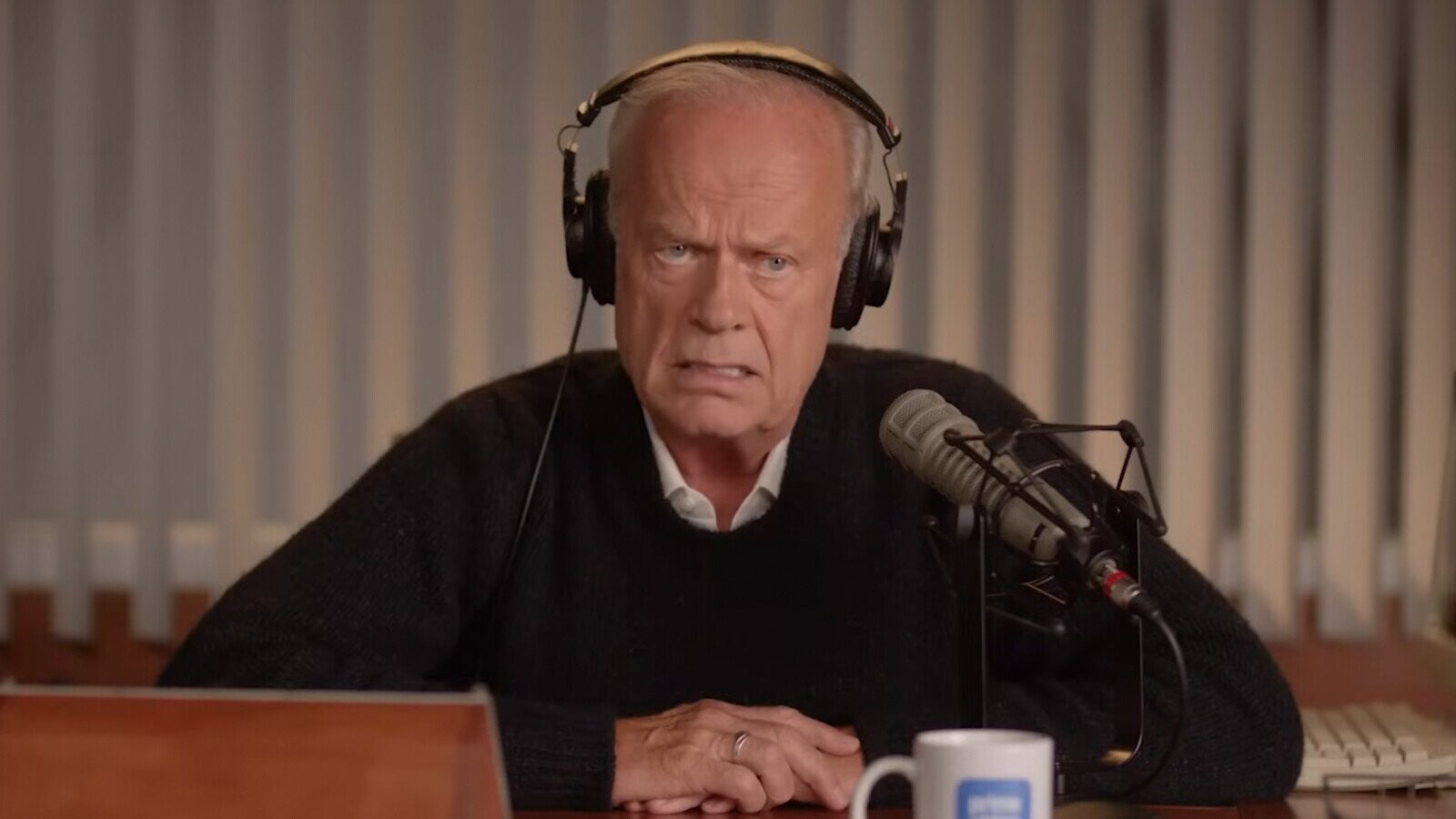
The Prime Video video places Grammer in a recreated radio-style setting and has him perform as Dr. Frasier Crane answering questions from younger callers. The questions are designed around trendy Gen Z concerns: ghosting, artificial intelligence, polycules, emoji misunderstandings, and the general social confusion of modern digital life. The joke is supposed to be simple: old-school Frasier meets new-school problems.
There is nothing inherently wrong with that setup. In fact, a well-written version could work beautifully. Imagine Frasier trying to interpret a passive-aggressive text thread with the seriousness of a Viennese case study. Imagine him diagnosing a group chat as “a salon without manners.” Imagine him misunderstanding TikTok not because he is old, but because he is offended by its lack of curation. That is a funny premise.
The problem is execution. The commercial often sounds less like Frasier Crane and more like someone fed a list of internet buzzwords into a nostalgia blender. The responses are broad, awkward, and strangely detached from the character’s established voice. Frasier was never just “an older man confused by young people.” He was a particular kind of older man: educated, fussy, dramatic, romantic, self-important, and desperate to appear civilized even while behaving like a raccoon trapped in a tuxedo.
Why It Feels Less Like Frasier and More Like Content
The most painful thing about the Amazon promo is not that it is silly. Frasier was often silly. This is a show that could turn a missing chair, a bad date, or a misunderstood party theme into full theatrical chaos. The pain comes from watching a character built on precision become vague “content.”
Modern nostalgia marketing often treats beloved characters like reusable stickers. Put the familiar face in a familiar room. Add current slang. Let the internet do the rest. But Frasier Crane is not a sticker. He is a mechanism. His comedy depends on timing, vocabulary, posture, contradiction, and social context. Remove those pieces, and you are left with Kelsey Grammer in a set saying lines that point at Frasier rather than embody him.
The commercial’s Gen Z angle also feels forced. Frasier was always capable of being out of touch, but the original series made that flaw specific. He was not confused by youth culture because he was merely old. He was confused by anything that failed to recognize his preferred hierarchy of taste. He could be equally baffled by sports fans, casual dining, bad wine, a loud shirt, or a chair that violated his entire design philosophy.
That is why jokes about “Gen Z questions” can feel thin. They flatten the character into an easy generational contrast. Old man meets internet. Sophisticated doctor meets emoji. Psychiatrist meets ghosting. The setup announces the joke before the joke has a chance to breathe. Frasier deserves better than being used as a pop-culture translator who accidentally wandered into a sponsored post.
The Commercial Is Worse Than the Reboot Because It Shrinks the Character
The reboot may have disappointed viewers, but it at least respected Frasier as a character with history. It gave him family tension, professional reinvention, grief, vanity, loneliness, and a new social circle. Not all of it worked, but the ambition was recognizable. The Amazon commercial shrinks him down to a reaction format.
That is the key difference. A flawed reboot can still be part of a character’s story. A bad commercial feels like a costume party where the guest of honor has been replaced by a cardboard cutout holding a QR code.
Frasier Crane was never funny because he knew what was trending. He was funny because he cared too much about the wrong things, then accidentally revealed the right things about himself. His failures were emotional, not algorithmic. When he embarrassed himself, it usually came from longing: longing to be loved, respected, admired, desired, or recognized as the most cultured man within a 12-foot radius. The Amazon promo has little of that emotional engine. It has references, not stakes.
Kelsey Grammer Is Still Not the Problem
It is tempting to blame Kelsey Grammer, because he is the face on screen. But that would be too easy. Grammer has played Frasier Crane across Cheers, Frasier, and the revival with remarkable durability. Few actors have carried a sitcom character across so many decades without losing the basic silhouette. He still has the voice, the eyebrows, the operatic indignation, and that marvelous ability to look wounded by ordinary reality.
The issue is not that Grammer cannot play Frasier anymore. The issue is that the commercial gives him a version of Frasier that barely has room to exist. A great Frasier scene needs escalation. It needs another person who refuses to validate him. It needs a social trap. It needs the slow collapse of dignity. A quick promotional Q&A rarely offers that architecture.
In the original series, even a simple radio call could reveal Frasier’s contradictions. He wanted to help people, but he also wanted to sound brilliant helping them. He could be compassionate and pompous in the same breath. The Amazon video mostly asks him to react, and reaction is a smaller comic instrument than character.
The Streaming Era Loves Nostalgia, But Nostalgia Is Not Enough
The commercial is also a symptom of a larger entertainment problem. Streaming platforms are hungry for library titles, recognizable brands, and quick promotional hooks. Classic sitcoms have become valuable not only as shows, but as identity objects. People rewatch them for comfort, quote them online, buy themed merchandise, and treat them like cultural furniture. That makes them perfect targets for campaigns designed to say, “Remember this? It is available here.”
But nostalgia is a delicate ingredient. Use a little, and it adds warmth. Use too much, and the whole dish tastes like a scented candle called Childhood Apartment. The Amazon commercial leans heavily on recognition without capturing the elegance that made the recognition valuable in the first place.
This is especially risky with Frasier, because its fans are not just attached to catchphrases. They are attached to tone. They remember the farce episodes, the verbal fencing, the dinner disasters, the opera jokes, the sibling pettiness, and the emotional softness hiding underneath the snobbery. A lazy tribute stands out because the original was so carefully constructed.
What a Better Frasier Commercial Could Have Done
A sharper commercial would have let Frasier be Frasier, not a mascot for generational confusion. Instead of asking him to decode internet slang, put him in a situation where his own flaws create the comedy. Let him host a livestream and become obsessed with the lighting. Let him review Amazon purchases and spiral over the ethics of buying a suspiciously affordable espresso machine. Let him discover that someone left a one-star review on his memoir and treat it like a personal assassination.
Better yet, pair him with Roz. Give him a foil. Frasier is funniest when someone punctures the balloon. A solo Frasier monologue can work, but only if the writing gives him a staircase to climb and fall down. The Prime Video spot gives him a treadmill: motion without destination.
The commercial could also have played with his real relationship to radio. A modern advice podcast would be a natural fit. Frasier would absolutely claim to despise podcasts while secretly launching one with a twelve-word Latin subtitle. He would insist on high production values, reject every sponsor except a boutique olive oil brand, and then accidentally become popular among people who listen ironically. That is a Frasier premise. That has comic blood in it.
Why Fans React So Strongly
Fans do not object because Frasier must remain frozen in 1997. Many viewers are open to seeing the character age, fail, adapt, and embarrass himself in new ways. The problem is that fans can sense when a character is being updated from the inside versus decorated from the outside.
The reboot at least tried to update Frasier from the inside. It asked what an older, wealthier, lonely Frasier might do after losing family, leaving one career behind, and trying to rebuild a relationship with his son. The answers were uneven, but the question was valid. The Amazon commercial updates him from the outside. It tapes modern references onto his blazer and hopes the contrast will count as comedy.
That is why the commercial can feel worse than the reboot. A weak episode disappoints you for half an hour. A weak promotional sketch can make you worry that the people handling the character do not understand why anyone loved him in the first place.
My Experience Watching the Commercial After the Reboot
Watching the Amazon commercial after sampling the reboot felt like going from a mildly under-seasoned restaurant meal to a vending machine sandwich labeled “artisan.” The reboot had flaws, but at least I could see the kitchen. I could see the effort, the ingredients, the occasional good idea trying to escape the plastic wrap. The commercial felt more like a marketing department had discovered a familiar name and asked, “Can he say something about emojis?”
As a longtime sitcom viewer, I have a soft spot for revivals, even when they stumble. There is something comforting about seeing an old character walk back into frame. You know the rhythm. You know the voice. You know the emotional furniture. When Frasier returns, part of you expects the room to rearrange itself around him: a chair too ugly for his taste, a brother too competitive for his ego, a father too honest for his comfort, a producer too sharp for his nonsense. The reboot lacked much of that furniture, but it still occasionally remembered the room.
The commercial did not feel like a room. It felt like a backdrop. That distinction matters. A sitcom scene creates a place where behavior has consequences. A promo creates a surface where references bounce around until the logo arrives. Frasier Crane, of all characters, needs consequences. He needs to be embarrassed by his own sophistication. He needs someone to misinterpret him. He needs a small social problem to become a five-act opera.
The Gen Z theme also triggered a familiar fatigue. Every few months, another brand discovers that young people have slang and older people do not always understand it. This can be funny, but only if the joke has a second layer. Otherwise, it becomes the comedy equivalent of a parent saying “rizz” at Thanksgiving and waiting for applause. Frasier Crane should never be reduced to that. He is not funny because he is old. He is funny because he is Frasier: a man who could turn ordering coffee into a referendum on civilization.
What bothered me most was the missed opportunity. A Prime Video promotion for the original Frasier could have been genuinely clever. It could have reminded viewers why the series remains so rewatchable: the elegant farce, the sibling chemistry, the perfect contrast between high culture and low impulse. It could have used Frasier’s voice to celebrate the absurdity of streaming itself. Imagine him overwhelmed by menus, watchlists, autoplay, subtitles, and the indignity of being recommended his own show. That would have been funny because it would have put Frasier’s personality into conflict with modern technology.
Instead, the commercial mostly asks us to laugh because Frasier is near modern words. That is not enough. A character this specific deserves jokes this specific. Nostalgia should feel like opening a good bottle you saved for years, not like finding the label glued to a soda can. The reboot may have been an imperfect revival, but the Amazon commercial is a smaller, sadder thing: proof that even great characters can be flattened when the goal is not comedy, but content. And somewhere, Niles Crane is probably fainting into an antique settee.
Conclusion: Frasier Deserved Better Than a Buzzword Booth
Frasier remains one of television’s great comedies because it understood the difference between intelligence and wisdom, taste and kindness, confidence and insecurity. Frasier Crane was never merely a pompous psychiatrist. He was a walking contradiction: brilliant, needy, generous, vain, cultured, foolish, and deeply funny when the world refused to arrange itself according to his preferences.
The reboot did not always recapture that magic, but it had the dignity of trying to tell a story. The Amazon commercial has the hollow brightness of a brand activation. It places Frasier beside modern topics but rarely lets him respond with the layered absurdity that made him iconic. That is why it lands worse than the reboot. Not because it is longer, louder, or more consequential, but because it misunderstands the scale of the character. Frasier Crane should not be used as a nostalgia puppet for internet slang. He should be allowed to be what he has always been: a magnificently flawed man trying to sound composed while reality ruins his evening.
Note: This article is an editorial analysis based on publicly available information about Prime Video’s Frasier promotional video, the original NBC sitcom, the Paramount+ revival, and major entertainment coverage of the franchise.