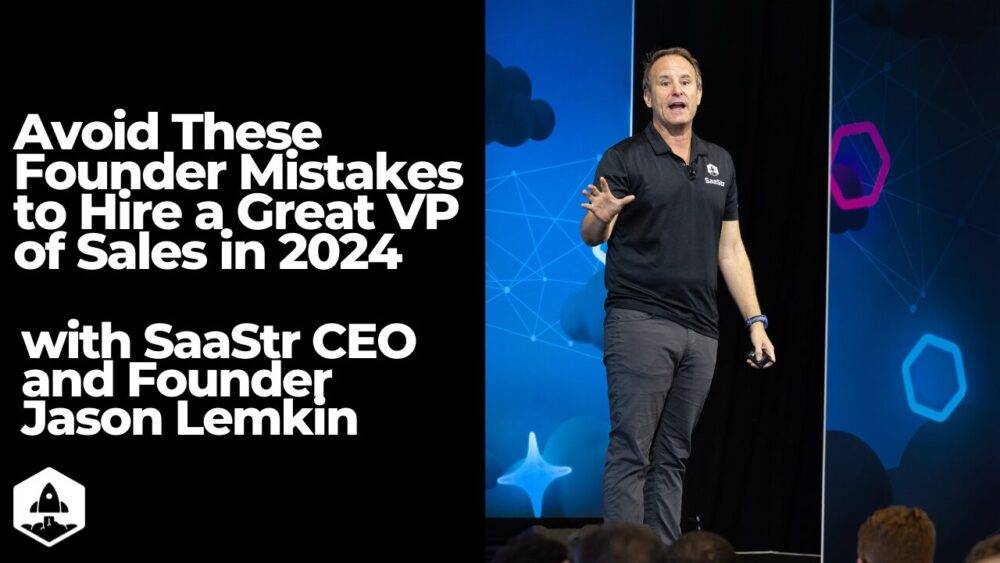
Hiring a great VP of Sales sounds simple until you actually try it. Then it starts to feel like assembling IKEA furniture with no manual, three missing screws, and a board member asking why revenue is not already up 40%.
Jason Lemkin, founder of SaaStr and one of the loudest, clearest voices in SaaS growth, has been warning founders about this hire for years. In the newer “Video + Pod” edition of his VP of Sales guidance, the message is sharper than ever: your first VP of Sales can change the company’s trajectory, but only if you hire the right person at the right stage for the right job.
The bad news? Many first VP of Sales hires fail. The good news? Most of those failures are predictable. And predictable mistakes are the best kind, because you can stop making them before they turn your sales forecast into modern art.
Why the VP of Sales Hire Matters So Much
A VP of Sales is not just “the person who runs sales.” In a growing SaaS company, this leader becomes the builder of the revenue machine. They recruit account executives, define sales process, improve forecasting, coach managers, help refine positioning, create accountability, and translate founder-led sales into something repeatable.
That is why this hire is so dangerous when done too early or too casually. A great VP of Sales can turn a few promising reps into a real team. A poor fit can burn cash, confuse the market, chase the wrong customers, demoralize the team, and leave the founder muttering, “Maybe I should have opened a coffee shop.”
Jason Lemkin’s core idea is refreshingly practical: do not hire a VP of Sales to invent sales from nothing. Hire one to scale what is already beginning to work. The distinction is small on a slide deck and enormous in real life.
The Biggest Misunderstanding: A VP of Sales Is Not a Magician
Founders often imagine a VP of Sales arriving like a superhero in a Patagonia vest. The new executive will fix pipeline, close enterprise accounts, hire ten reps, install the perfect CRM dashboard, and somehow make churn feel better by Tuesday.
That is not the job.
A strong VP of Sales scales a working motion. They take the lessons from founder-led sales and early rep success, then convert those lessons into hiring profiles, onboarding, qualification rules, sales stages, coaching systems, and performance management. They do not magically create demand where there is none. They do not repair a weak product-market fit by smiling harder. They do not turn vague buyer interest into predictable revenue just because their LinkedIn headline contains “revenue architect.”
Before hiring, founders should ask one brutally honest question: Do we have something repeatable enough to scale? If two reps are consistently closing, customers understand the value, the sales cycle is not a complete mystery, and the founder can explain why deals are won or lost, the company may be ready. If every deal still requires divine intervention and a founder-led custom demo, wait.
When Should You Hire Your First VP of Sales?
The usual SaaS answer is “around $1 million in ARR,” but that benchmark is only useful if the revenue is real, repeatable, and not held together by duct tape and founder charisma. A better readiness checklist looks like this:
- You have at least two sales reps who can close without the founder carrying every step.
- You know your ideal customer profile well enough to reject bad-fit prospects.
- You understand your average contract value, sales cycle, win rate, and common objections.
- You have enough pipeline or demand to support more sales capacity.
- You can explain what a successful rep does differently from an unsuccessful one.
If those ingredients are missing, the founder probably needs a Head of Sales, a senior seller, or a player-coach rather than a true VP of Sales. Titles are cheap. Mis-hires are not.
The wrong timing creates a classic startup tragedy: a talented sales executive joins, discovers there is no repeatable process, spends six months “building foundation,” misses targets, frustrates the founder, and exits with both sides feeling vaguely betrayed. Nobody wins. Except maybe the recruiter.
The Candidate Must Match Your Stage
One of Lemkin’s most useful frameworks is that there are many types of VP of Sales. The person who scales from $30 million to $150 million in ARR is not always the person who can take you from $1 million to $10 million. In fact, they may be exactly wrong.
At an early stage, you need someone who can still sell, recruit, listen to customers, coach reps directly, and tolerate messiness without calling three consultants. At a later stage, you may need a leader who can manage managers, design territories, coordinate revenue operations, and align with marketing, customer success, finance, and product.
The “big logo trap” is especially dangerous. A candidate from Salesforce, Oracle, Microsoft, or another massive company may be impressive, but big-company success often comes with big-company infrastructure. Brand awareness, enablement teams, inbound demand, mature systems, and established procurement paths can make a sales leader look like a wizard. Drop that same person into a 25-person startup with three case studies and a CRM full of duplicate contacts, and the magic may disappear.
Great hiring is not about finding the most famous resume. It is about finding the most relevant operator.
The Number One Skill: Recruiting
A VP of Sales who cannot recruit is like a chef who refuses to cook. Recruiting is not a side quest. It is the main game.
The first VP of Sales must attract, assess, close, and retain high-performing reps. They should know who they want to hire, why those people succeed, how to interview them, how to onboard them, and how to remove the ones who are not working. If a candidate inherited a team but never built one, be careful. Managing people is not the same as recruiting them.
Founders should ask direct questions:
- Who are the best reps you personally recruited?
- How many quota-carrying reps have you hired from scratch?
- How did you source them?
- What percentage hit quota?
- Who would follow you to this company?
A great candidate will have names, stories, patterns, and scars. A weak candidate will speak in fog: “I believe in building world-class teams through a culture of excellence.” Lovely. Also useless.
Do Not Let the Founder Disappear
One of the sharpest points in Lemkin’s newer guidance is that founders often make a fatal move right after hiring a VP of Sales: they leave sales. They assume the new executive owns revenue now, so the founder can return to product, fundraising, strategy, or staring meaningfully at dashboards.
That is usually a mistake.
The founder is still one of the strongest sales assets in an early-stage company. Prospects want to hear the vision from the person building the company. Customers want reassurance. The sales team needs product context. The new VP of Sales needs to learn what works, what does not, and where the bodies are buried. Ideally there are no bodies, but this is startup life, so bring a shovel.
The founder’s role should change, not disappear. Instead of chasing every follow-up email, the founder should support strategic deals, help with executive relationships, join important discovery calls, explain product direction, and stay deeply involved in sales hiring. That is how the VP of Sales gets leverage instead of being abandoned on Revenue Island with a laptop and a quota.
Interview for Reality, Not Theater
Executive sales interviews can become dangerously performative. Sales leaders are, by profession, good at selling. Some are so good they can sell you on their ability to sell while not actually being right for your sale. Very meta. Very expensive.
Use practical interview questions that force specificity:
- What would you do in your first 30, 60, and 120 days?
- What would you need to believe to accept this role?
- What is broken in our current sales motion?
- What would you not change at first?
- What type of rep would you hire first?
- What would our revenue look like after one quarter?
- Where have you failed as a sales leader?
The best candidates are confident but not delusional. They will not promise miracles in 90 days. They will talk about learning the customer, tightening qualification, inspecting pipeline, improving rep quality, and identifying the repeatable motion. They will probably say something you do not want to hear. That is good. You are not hiring a motivational poster.
What a Great VP of Sales Does in the First 90 Days
A strong VP of Sales does not begin by rearranging the CRM fields into a monument to personal preference. They begin by listening, diagnosing, and building trust.
First 30 Days: Learn the Truth
The first month should be heavy on customer calls, deal reviews, rep shadowing, pipeline inspection, product education, and founder alignment. The VP should meet customers, study closed-won and closed-lost deals, and identify which sales behaviors are actually producing revenue.
Days 31–60: Raise the Bar
Next comes clearer qualification, stronger deal hygiene, better forecasting, early coaching, and a sharper hiring plan. The VP should know which reps are scalable, which need help, and which are unlikely to make it. This stage can be uncomfortable, because accountability often arrives wearing boots.
Days 61–90: Build the Machine
By the third month, the VP should be recruiting actively, improving onboarding, creating repeatable playbooks, tightening sales stages, and helping leadership understand what is realistic. The company should feel more focused, not merely busier.
Modern Sales Leadership: AI, Hybrid Buyers, and the New VP Profile
The VP of Sales role has changed. Buyers research more before talking to sales. Many prefer digital self-service for parts of the journey but still need human expertise for complex decisions. AI tools can automate prospecting, summarize calls, enrich accounts, analyze pipeline, and improve productivity. But tools do not replace judgment.
The modern VP of Sales must be both human-centered and systems-minded. They need to understand buyer behavior, data quality, AI-assisted workflows, sales enablement, and cross-functional alignment. They must work closely with marketing to create demand, with customer success to improve retention and expansion, and with product to communicate what the market is really saying.
This is where older sales leadership habits can fail. A VP who believes sales is only about “more calls” may miss the modern buyer. A VP who believes AI will solve everything may build a shiny machine that sends polished nonsense at scale. The right leader uses technology to make good reps better, not to hide a broken strategy under automation confetti.
Red Flags Founders Should Not Ignore
Some warning signs appear quickly. Do not wait six months to admit what you saw in week three.
- The candidate cannot name strong reps they personally recruited.
- They blame every past failure on marketing, product, pricing, or “the board.”
- They are vague about metrics, quotas, conversion rates, and sales cycles.
- They want to hire a large team before understanding the current motion.
- They avoid customer calls.
- They cannot sell your product back to you in a clear, simple way.
- They promise a hockey-stick forecast without evidence.
The best VP of Sales candidates bring clarity. They make the business feel more understandable. If every conversation leaves you impressed but confused, keep interviewing.
How to Close the Right VP of Sales
Great sales leaders are evaluating you as much as you are evaluating them. They want to know whether the product works, whether customers care, whether the founder is realistic, whether the board is sane, and whether the company has enough demand to justify the role.
To close a great candidate, founders need to sell the opportunity honestly. Share the real numbers. Explain the product vision. Introduce them to customers. Let them inspect the pipeline. Invite them to challenge assumptions. A strong VP of Sales does not need a fantasy. They need a real chance to build something meaningful.
Compensation matters, of course. But great candidates also care about trust, autonomy, market potential, founder commitment, and whether they can recruit the team required to win. If your pitch is “come fix our sales problem while we disappear,” do not be surprised when the best people politely vanish.
Experiences and Practical Lessons from Hiring a VP of Sales
In real startup life, hiring a VP of Sales rarely follows a clean checklist. It is messy, emotional, and full of judgment calls. The founder is often tired from carrying sales personally. The board wants predictable growth. The first reps want leadership. Marketing wants cleaner feedback. Finance wants a forecast that does not look like it was written during a thunderstorm. Into this pressure cooker walks the VP of Sales candidate, smiling confidently and saying all the right things.
The first practical lesson is to separate relief from readiness. Many founders hire because they are exhausted, not because the business is ready. Exhaustion is understandable, but it is not a hiring strategy. If the founder is still the only person who can close, the company may need better documentation, stronger positioning, or one or two more successful reps before hiring a true VP. Hiring too early often creates a painful mismatch: the founder expects rescue, while the VP expects something scalable.
The second lesson is to involve the candidate in real work before making the offer. Have them review anonymized pipeline. Ask them to diagnose a lost deal. Let them interview one of your reps. Ask them how they would improve onboarding. Give them your current sales deck and ask what is missing. This reveals far more than another polished conversation about leadership philosophy. Anyone can say they are data-driven. Fewer can look at your messy pipeline and calmly explain what matters.
The third lesson is that references should be specific and slightly uncomfortable. Do not only ask, “Were they good?” Ask what kind of stage they are best suited for. Ask whether they recruited well. Ask how they handled underperformers. Ask whether the forecast improved under their leadership. Ask what support they needed from the CEO. Backchannel references are especially useful, but they should be handled professionally and respectfully. The goal is not gossip. The goal is pattern recognition.
The fourth lesson is to define success before day one. A VP of Sales should not begin with a vague mandate like “grow revenue.” That is not a plan; that is a bumper sticker. Instead, agree on first-quarter goals: customer learning, pipeline hygiene, hiring plan, forecast accuracy, rep assessment, sales process improvements, and specific revenue targets where appropriate. Early success should include both numbers and operating improvements, because the revenue impact may lag behind the quality of the foundation.
The fifth lesson is to protect the relationship between the founder and the VP. This partnership can become tense because sales exposes every weakness in the business: product gaps, pricing confusion, weak messaging, poor lead quality, slow implementation, and customer anxiety. A strong VP will surface these issues. A strong founder will not punish them for telling the truth. Weekly one-on-ones, deal reviews, customer debriefs, and honest forecast discussions create trust. Avoid turning every missed number into a courtroom drama.
The sixth lesson is that culture changes when a real sales leader arrives. Some early reps may feel threatened. Some may thrive. Some may discover that the startup’s charming chaos is being replaced by expectations, metrics, and accountability. That is normal. The goal is not to preserve every habit from the founder-led era. The goal is to keep what works, remove what does not, and build a team that can win without heroics every Friday afternoon.
Finally, remember that hiring a great VP of Sales is not the end of founder-led responsibility. It is the beginning of a new operating rhythm. The founder still sells the vision. The VP builds the system. Together, they turn raw demand into a revenue engine. When that partnership works, the company feels different: calmer, sharper, more honest, and much harder to knock off course.
Conclusion: Hire for the Company You Actually Are
Hiring a great VP of Sales is one of the highest-leverage decisions a SaaS founder can make. It is also one of the easiest to get wrong when ego, urgency, famous logos, or wishful thinking enter the room.
The lesson from Jason Lemkin’s latest guidance is not complicated, but it is demanding: hire at the right time, hire for the right stage, prioritize recruiting ability, test for realism, stay involved as founder, and never confuse a confident talker with a proven builder.
A great VP of Sales will not save a company that has not found a market. But once the market is responding, the right leader can help turn scattered wins into a repeatable, scalable, durable revenue machine. That is when sales stops feeling like a heroic sprint and starts becoming a company capability.
And yes, the search may take longer than you want. Keep going. The right VP of Sales is out there. Just do not hire the wrong one because you are tired. Tired hiring is how startups accidentally buy themselves a very expensive lesson with a calendar invite.