Not long ago, the unofficial soundtrack of a neighborhood afternoon was a basketball bouncing in a driveway, bike tires hissing down the sidewalk, and somebody yelling, “Base is the mailbox!” Today, many streets are quieter. The kids are still around, of course. They have not been abducted by aliens, though a few parents may suspect the Wi-Fi router has negotiated custody. But childhood has changed, and so has the outdoor world around it.
The question “Why don’t we see kids playing outside as often as we used to?” sounds simple, but the answer is not just “screens.” Screens matter, yes. But so do busier family schedules, car-centered neighborhoods, shrinking independent mobility, safety concerns, organized activities, fewer nearby play spaces, and a culture that often treats unsupervised childhood like a suspicious activity. In other words, kids did not simply abandon the outdoors. A lot of the outdoors became harder to reach, harder to trust, and harder to fit into modern life.
This article looks at the real reasons behind the decline in outdoor play, why it matters for children’s health and development, and what families and communities can do to bring back more fresh air, scraped knees, sidewalk chalk, and the ancient childhood art of inventing a game with three rocks and a stick.
The Big Shift: Childhood Moved Indoors
For many adults, outdoor play was once the default setting of childhood. After school, you changed clothes, grabbed a snack, and disappeared into the neighborhood until dinner. The rules were simple: do not go too far, do not break anything expensive, and come home when the streetlights came on. That model depended on several things: nearby friends, walkable streets, available time, and a shared belief that kids could handle small risks.
Today, those conditions are less common. Many families live in neighborhoods where walking or biking feels unsafe. Many children attend schools farther from home. Parents often work long or irregular hours. Afternoons fill up with homework, tutoring, sports, clubs, and transportation logistics. Then, when a child finally has free time, a screen offers instant entertainment, social connection, games, videos, and an algorithm that never says, “Go outside and climb something.”
Outdoor play has not disappeared everywhere. Parks, playgrounds, sports fields, and bike paths are still full in many communities. But the spontaneous, loosely supervised, neighborhood-based play that once defined American childhood has become less visible. The front yard has lost market share to the living room, the car seat, and the group chat.
Reason 1: Screens Became the New Playground
The most obvious reason kids spend less time outside is that indoor entertainment has become incredibly powerful. Television was one thing. Today’s children have streaming platforms, video games, tablets, smartphones, short-form videos, messaging apps, and digital worlds designed to hold attention for as long as possible.
This does not mean technology is evil. A video call with grandparents is wonderful. Educational apps can help some children learn. Online games can build teamwork and problem-solving. But screens are convenient in a way outdoor play is not. A tablet does not require sunscreen, shoes, transportation, or a parent standing at the edge of a playground wondering whether that slide is “fun” or “a lawsuit with stairs.”
The challenge is that screen time often competes directly with active play. When kids spend large chunks of leisure time sitting, they have fewer chances to run, jump, build forts, negotiate rules, get bored, solve problems, and discover that a cardboard box can be a spaceship, restaurant, castle, or questionable hat.
The goal is not to create a screen-free fantasy household where everyone churns butter and reads poetry by candlelight. The goal is balance. Children need digital skills, but they also need physical confidence, social practice, and unstructured time away from glowing rectangles.
Reason 2: Parents Are More Worried About Safety
Parents today often feel pressure from every direction. If they let children roam, someone may judge them as careless. If they keep children close, someone may say they are overprotective. It is the modern parenting Olympics, and everyone forgot to bring medals.
Safety concerns are real. Traffic is a major barrier in many neighborhoods. Busy roads, missing sidewalks, fast drivers, poor lighting, and unsafe intersections make outdoor independence difficult. Even when crime rates are lower than people assume, fear can still shape behavior. Parents may worry about strangers, bullying, injuries, weather, dogs, or simply not knowing exactly where their child is at every moment.
The result is a smaller childhood map. A previous generation might have walked to a friend’s house, the corner store, school, or a vacant lot. Today, many children are driven from home to school to practice to home again. Their world is bigger in digital terms but smaller in physical freedom.
Perceived Risk vs. Developmental Risk
There is also a quieter risk: children who never practice independence may struggle to build confidence. Outdoor play teaches judgment. Kids learn how high feels too high, how fast is too fast, how to solve a disagreement, how to ask another child to join, and how to recover when a plan fails. These lessons are hard to download.
Reasonable risk is not the same as danger. A child climbing a low tree, balancing on a log, or racing a bike on a safe path is learning about limits. Adults can reduce serious hazards while still allowing children to experience challenge. In fact, one of the best gifts adults can offer is not a perfectly padded world, but a reasonably safe world where kids can test themselves.
Reason 3: Neighborhoods Became Less Kid-Friendly
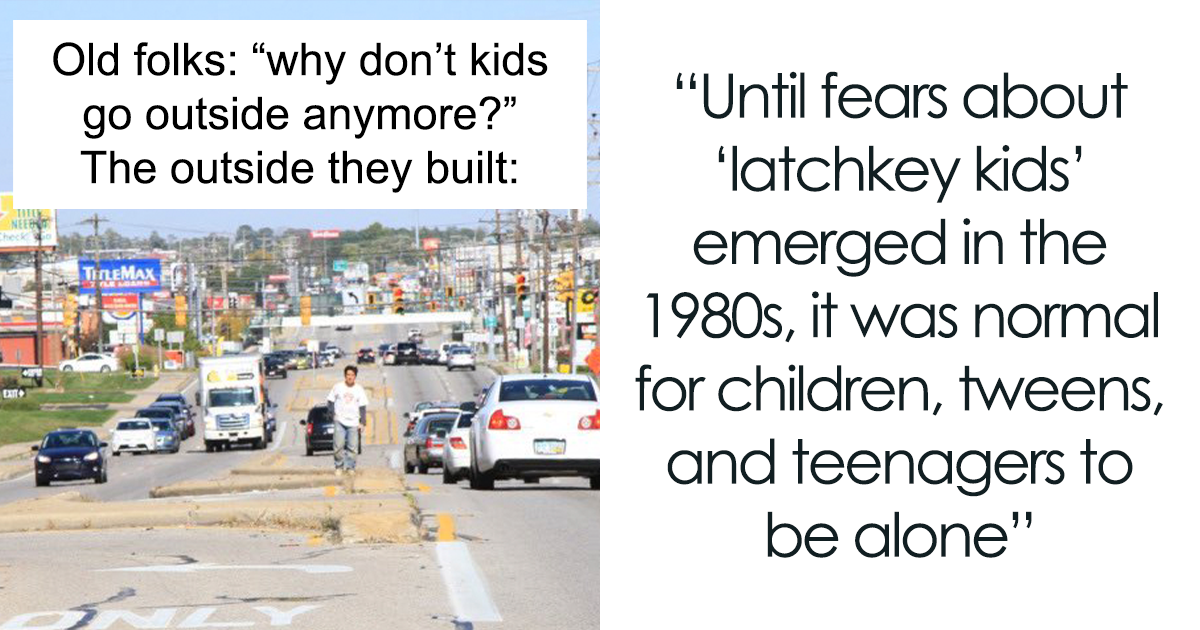
Outdoor play depends heavily on design. Children are more likely to play outside when they have sidewalks, safe crossings, nearby parks, shade, playgrounds, bike routes, open lawns, basketball hoops, and other kids within easy reach. When a neighborhood is built mainly around cars, childhood independence shrinks.
In many American communities, schools are farther from homes than they used to be. Shopping areas are separated from residential streets. Parks may require a drive. Subdivisions may have winding roads but few useful walking routes. Apartment complexes may have limited outdoor space. In some neighborhoods, the nearest “playground” is a patch of grass next to a parking lot that looks like it was designed by someone who has never met a child.
Access also varies by income and geography. Some families have safe yards, shaded parks, recreation programs, and quiet streets. Others face broken sidewalks, traffic, crime concerns, poor lighting, or no nearby green space. When outdoor play requires transportation, supervision, and planning, it stops being a daily habit and becomes a weekend project.
Reason 4: The Walk or Bike to School Almost Vanished
One of the biggest changes in children’s daily movement is school travel. Decades ago, many children walked or biked to school. That trip gave kids daily exercise, independence, neighborhood familiarity, and social time. It also created visible clusters of children outdoors every morning and afternoon.
Today, fewer students walk or bike. Many live too far from school. Others face unsafe routes, heavy traffic, or parents’ understandable concerns. School consolidation, zoning patterns, and car-dependent development have all played a role. The school commute has become another adult-managed activity, often involving a car line long enough to make a coffee shop jealous.
This matters because outdoor play is not only about playground time. It is also about everyday movement. Walking to school, biking to a friend’s house, shooting hoops after class, or stopping at a park on the way home all add up. When those small pieces disappear, childhood becomes more sedentary without anyone making a dramatic decision.
Reason 5: Kids’ Schedules Are Packed
Another reason we see fewer kids playing outside is that many children are busy. Very busy. Calendar-app busy. Some kids move from school to homework to music lessons to travel sports to tutoring to dinner to bed, with a brief pause for asking where their cleats are.
Organized activities can be great. Sports, arts, clubs, and academic programs help children develop skills and friendships. But structured time is not the same as free play. In adult-led activities, children follow rules created by adults. In outdoor free play, children create the rules, adjust them, argue about them, change them, and eventually invent a new game because nobody can agree whether the driveway is lava.
Unstructured play builds creativity, decision-making, negotiation, and emotional regulation. It gives kids ownership of their time. A soccer practice may build athletic skill, but a pickup game in the yard teaches children how to include a younger sibling, settle a dispute, balance teams, and keep playing after someone dramatically claims the ball was “totally out.”
Reason 6: Parents Are Tired and Time Is Tight
Modern outdoor play often requires adult effort. For younger children, someone may need to supervise. For older children, someone may need to drive them to a park, arrange a playdate, check safety, or coordinate with other families. That is not always easy when parents are working, commuting, cooking, helping with homework, managing bills, and trying to remember whether laundry can legally remain in the dryer for three days.
In the past, neighborhood play sometimes functioned as a shared system. Kids played together outside while adults were nearby but not constantly directing the action. Today, if fewer kids are outside, each family has less reason to send its own children out. It becomes a cycle: no one plays outside because no one is outside.
Breaking that cycle often requires one family to start. A regular driveway hangout, a weekly park meet-up, a “bike around the block” routine, or a simple after-dinner walk can make outdoor time feel normal again. Children are more likely to go outside when outside is where the fun is already happening.
Reason 7: Outdoor Play Has a Public Relations Problem
Outdoor play can look messy. Kids get dirty. They yell. They run in unpredictable zigzags like tiny caffeinated squirrels. They may build forts from sticks, dig holes, invent strange rules, or come home with grass stains that look like evidence from a nature-themed crime scene.
Because modern parenting culture often emphasizes achievement, safety, and enrichment, free play can seem less valuable than organized learning. But play is not wasted time. It is how children practice being human. Through play, they test ideas, manage emotions, form friendships, build strength, and learn how the world works.
Adults sometimes underestimate the value of boredom. A bored child may complain for ten minutes, then invent something. That invention may be silly, loud, and mildly inconvenient, but it is also creativity in motion. Constant entertainment can make children passive. Outdoor play asks them to participate.
Why Outdoor Play Still Matters
Outdoor play supports children in ways that are difficult to replace indoors. Physically, it encourages running, climbing, balancing, throwing, jumping, and endurance. These movements build coordination, strength, cardiovascular health, and motor skills. Children often move more vigorously outside because the environment invites it. A hallway says, “Please walk.” A field says, “Race me.”
Mentally, outdoor play gives the brain room to reset. Natural light, open space, movement, and imaginative play can support mood and attention. Socially, outdoor play lets children practice cooperation without an adult scripting every moment. They learn how to join a group, handle rejection, take turns, lead, follow, apologize, and try again.
Outdoor play also helps children build resilience. A game does not always go their way. A tower falls. A friend changes the rules. A jump feels scary. A plan fails. These tiny frustrations are not disasters; they are practice rounds for life. The outdoors gives children a low-stakes laboratory for courage, patience, creativity, and problem-solving.
How Families Can Bring Outdoor Play Back
Start Small and Make It Routine
Families do not need to move to a cabin in the woods or enroll in extreme wilderness training. Start with 20 to 30 minutes outside after school, after dinner, or before homework. A short daily routine is often more realistic than a grand weekend plan involving matching hiking boots and a child who suddenly hates trees.
Make Outdoor Time Social
Children are more likely to play outside when other children are there. Invite neighbors for a driveway chalk session, meet another family at the park, or organize a casual block play hour. The goal is not perfection. The goal is momentum.
Use Screens as Tools, Not Default Babysitters
Some families use timers, charging stations, screen-free windows, or “outside first” rules. For example, a child might play outside before gaming, or the family might take a walk before streaming a show. The point is not punishment. The point is making outdoor time part of the rhythm.
Choose Safe Independence
Independence can grow gradually. A younger child may play in the yard while a parent checks in. An older child may walk to a nearby friend’s house, bike around a safe loop, or visit a park with agreed boundaries. Kids build responsibility by practicing responsibility.
Advocate for Better Places to Play
Families can also support safer streets, sidewalks, traffic calming, parks, playground maintenance, shade, school recess, and afterschool programs. Outdoor play is not only a private family choice. It is a community design issue. If a town wants kids outside, it has to build places where kids can actually be outside.
What Schools and Communities Can Do
Schools can protect recess, encourage active transportation, open playgrounds after hours where feasible, and treat movement as part of learning rather than a break from learning. Communities can invest in parks, sidewalks, bike lanes, crosswalks, lighting, trees, and recreation programs. Local leaders can ask a simple question before approving plans: “Would a 10-year-old be able to move safely and happily here?”
Neighborhoods can also rebuild trust. When adults know one another, children gain more freedom. A block where parents exchange numbers, greet each other, and keep an eye out becomes a more welcoming place to play. Childhood independence is easier when community is strong.
Experiences: What It Feels Like to Bring Outdoor Play Back
The first time a family tries to revive outdoor play, it may feel awkward. A parent opens the door and says, “Go play outside,” and the child looks around as if the yard is a mysterious historical exhibit. There may be complaints. It may be too hot, too cold, too boring, too leafy, or too full of “bugs with attitudes.” That is normal. Outdoor play is a habit, and habits need repetition.
One common experience is the slow warm-up. At first, children may not know what to do without a screen or a scheduled activity. They wander. They ask for snacks. They inspect a stick with the seriousness of a scientist reviewing moon rocks. Then, after a few minutes, something changes. A ball appears. A race begins. A cardboard box becomes a store. A puddle becomes a construction site. A patch of dirt becomes a kingdom with suspiciously complicated laws.
Parents often notice that outdoor play works best when they resist the urge to manage every detail. The adult role is to create a safe boundary, not become the entertainment director of North America. If children argue over rules, give them a chance to solve it. If they get bored, let boredom do its job. If they get dirty, remember that washing machines were invented for exactly this reason.
Another real-world experience is the neighborhood effect. One child outside can attract another. Two children can attract three. Soon the quiet sidewalk has scooters, chalk drawings, jump ropes, and a game nobody fully understands but everyone seems committed to defending. This is how outdoor culture returns: not through one heroic speech, but through repeated small invitations.
Families also discover that outdoor play does not have to be fancy. Some of the best moments happen with almost no equipment. A walk after dinner can turn into a leaf hunt. A driveway can become a basketball court. A park bench can become home base. A backyard can host a bug safari, obstacle course, picnic, or dramatic squirrel-watching expedition. Children do not need a perfect outdoor environment. They need permission, time, and enough space to start.
There is also a noticeable emotional shift. After outdoor play, many kids come inside calmer, hungrier, sweatier, and somehow both exhausted and proud. They may sleep better. They may talk more. They may describe a game in such confusing detail that no adult can follow it, which is usually a sign that real childhood happened. Parents may feel it too: the relief of seeing children active, laughing, negotiating, exploring, and briefly forgetting that the tablet exists.
Of course, outdoor play will not look exactly like it did decades ago. The world has changed. Families still need safety plans, weather awareness, sunscreen, hydration, and age-appropriate boundaries. But the spirit can return. Kids still love movement, freedom, friendship, challenge, and discovery. The outdoors still offers all of that, without a subscription fee or software update.
Bringing kids back outside is not about nostalgia for a perfect past. The past had problems too, including less awareness of many safety and accessibility needs. The better goal is a modern version of outdoor childhood: safer streets, inclusive parks, reasonable independence, balanced technology, and communities that welcome children as active participants rather than tiny indoor residents who occasionally visit sunlight.
Conclusion: The Kids Are Still Ready for the Outdoors
We do not see kids playing outside as often as we used to because childhood has been reshaped by technology, traffic, fear, schedules, neighborhood design, and family stress. But this shift is not permanent. Children have not lost their need for fresh air, movement, friendship, imagination, and freedom. They have simply inherited a world that often makes those things less convenient.
The solution is not to shame parents or blame children. It is to make outdoor play easier, safer, more social, and more normal again. Families can start with small routines. Schools can protect recess and movement. Communities can build parks, sidewalks, bike routes, and safe crossings. Neighbors can create a culture where kids playing outside is not unusual, but expected.
The next great childhood adventure does not need to be expensive or complicated. It might begin with a ball, a bike, a patch of grass, a friend at the door, and an adult brave enough to say, “Go outside for a bit.” The kids may grumble at first. Give them ten minutes. Childhood has a funny way of remembering what to do.