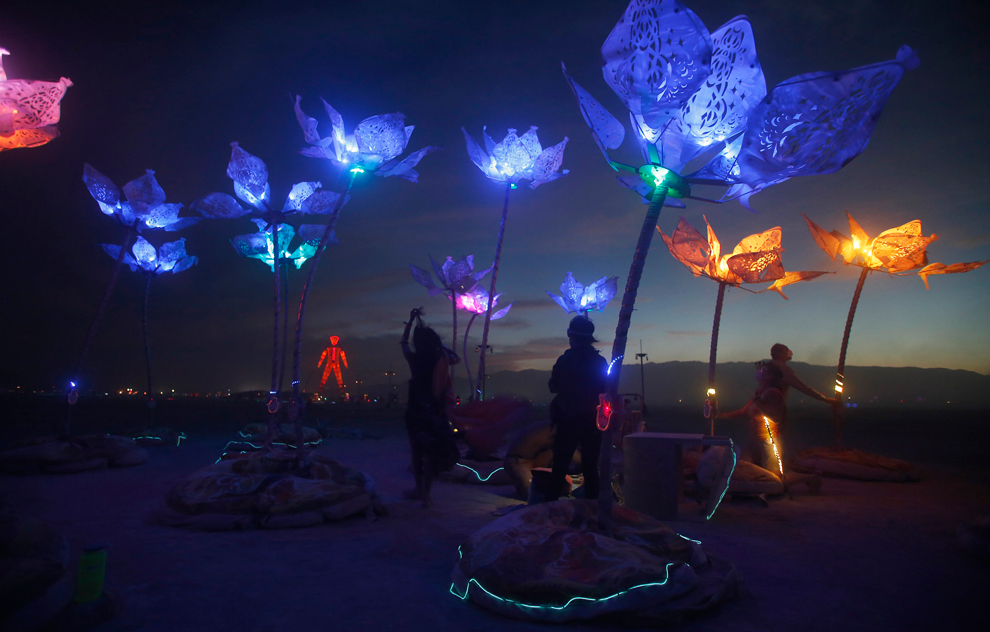
In a place famous for fire-breathing sculptures, dust storms, mutant vehicles, and people sincerely debating whether a bicycle needs more LED lights, biofeedback flowers at Burning Man still managed to feel unusually poetic. The best-known example is Pulse & Bloom, an interactive lotus installation created for Burning Man 2014 that turned human heartbeats into glowing waves of light. In other words, it made your pulse visiblewithout requiring a smartwatch, a hospital monitor, or your aunt asking why you look tired.
The project sat at the sweet spot between art, engineering, meditation, and desert survival. Participants approached towering lotus flowers, placed their hands on pulse sensors, and watched as LEDs traveled upward through the stems and petals in rhythm with their own heartbeat. The result was both futuristic and deeply human: technology acting less like a screen and more like a mirror.
This article explores how the installation worked, why it mattered, what it says about interactive art at Burning Man, and why a field of illuminated biofeedback flowers can feel more emotionally powerful than a thousand passive light shows.
What Were the Biofeedback Flowers at Burning Man?
The phrase Biofeedback Flowers At Burning Man most commonly refers to Pulse & Bloom, a large-scale interactive art installation made of lotus-shaped sculptures. The work was developed by a collaborative team including artists, designers, engineers, and makers, with names such as Saba Ghole, Shilo Shiv Suleman, Rohan Dixit, Heather Stewart, Luke Iseman, and Samuel Clay associated with the project’s creation and documentation.
The installation was designed around a simple but beautiful idea: when people touch the flowers, the flowers respond with light based on their heartbeat. Each lotus acted like a glowing biofeedback instrument. Instead of showing numbers on a display, it translated pulse data into motion, color, and rhythm. That small shiftfrom clinical data to public artchanged everything.
Reports from the build process described a group of 20 interactive lotus flowers, while later project descriptions often refer to 25 lotuses in the final installation. The difference is less important than the achievement: the team created a field of giant flowers, many standing between 8 and 18 feet tall, built from durable materials such as steel and translucent plastic suitable for the harsh conditions of the Black Rock Desert.
How Biofeedback Turns a Heartbeat Into Art
Biofeedback is the process of measuring signals from the body and returning that information in a form people can perceive. In health and wellness settings, it might involve heart rate, breathing, muscle tension, or skin conductivity. At Burning Man, it became a glowing lotus that politely said, “Congratulations, you are alive, and frankly, your cardiovascular system has excellent stage presence.”
In Pulse & Bloom, participants interacted with pulse sensors built into the flowers. When a heartbeat was detected, custom electronics triggered LEDs that moved from the base of the stem upward toward the petals. The visual effect made the body’s invisible rhythm visible to the participant and to everyone nearby.
This is what made the installation more than a gadget. A heart rate monitor usually belongs to one person. Pulse & Bloom turned that private signal into a shared visual experience. The participant could see their own rhythm. Nearby people could see it too. When several flowers were active at once, the entire field became a living pattern of different human tempos.
Why Burning Man Was the Perfect Home for Pulse & Bloom
Burning Man is not a typical arts festival where visitors quietly observe polished objects from behind a rope. Its culture favors participation, experimentation, collaboration, and temporary community. Art in Black Rock City often invites people to climb, touch, activate, listen, build, repair, and occasionally wonder whether the thing in front of them is a sculpture, a vehicle, a philosophy, or all three wearing goggles.
That environment made interactive biofeedback art a natural fit. The flowers needed people to complete the work. Without participants, they were beautiful sculptures. With participants, they became responsive organisms. The art did not simply exist in the desert; it listened.
This aligns closely with Burning Man’s broader principles, especially radical self-expression, communal effort, participation, and gifting. The installation gave participants an experience rather than a product. It invited them to pause, touch, breathe, and notice themselves in the middle of an overstimulating landscape. In a city that can feel like a carnival designed by engineers who own welding masks, that pause mattered.
The Design: Lotus Flowers, Steel, LEDs, and Desert Reality
The lotus was not a random choice. Across cultures, lotus imagery often suggests awakening, resilience, beauty, and emergence from difficult conditions. That symbolism worked well in the Black Rock Desert, where delicate-looking art must survive wind, dust, heat, cold, transportation stress, and thousands of curious humans.
The flowers were large enough to create an immersive environment. Their scale turned individual interaction into landscape design. Walking among them at night could feel like entering a garden from a dream, except the dream had custom circuit boards and probably needed a generator schedule.
The build combined sculptural fabrication and practical electronics. The flowers used steel structures for strength and translucent material for glowing surfaces. High-power LEDs provided the visual pulse. Custom circuits and sensors translated physical touch into light. Portable battery systems powered the work through the night, an important detail because art on the playa cannot depend on convenient wall outlets hiding behind the nearest cactus.
The Emotional Power of Seeing Your Own Pulse
One reason Pulse & Bloom remains memorable is that it transformed an ordinary biological fact into a moment of wonder. Everyone has a heartbeat, but most people rarely think about it unless they are exercising, nervous, or watching their phone fall screen-first onto concrete.
When a glowing flower responds to your heartbeat, the body suddenly feels present. You are reminded that your inner life has rhythm. The experience can be playful, calming, intimate, or surprisingly moving. It is not just “look at the pretty lights.” It is “the pretty lights are you.”
That distinction is essential. Many light installations dazzle the eyes. Biofeedback installations create a loop between person and environment. The participant affects the artwork, and the artwork affects the participant in return. Seeing your heartbeat displayed outside your body can make you breathe differently, stand still longer, smile awkwardly, or suddenly become very aware of the espresso you should not have accepted at midnight.
Technology Without the Coldness
Biofeedback technology can sound clinical. Sensors, circuits, LEDs, voltage regulation, data signalsuseful words, but not exactly poetry at first glance. Pulse & Bloom succeeded because it softened the technology through form and metaphor. The flower became the interface.
This matters for user experience. People do not need to understand the electronics to enjoy the installation. They only need to touch, observe, and feel. The technology disappears into the interaction, which is usually the sign of thoughtful design. If a visitor can walk away saying, “That flower knew my heartbeat,” the system has done its job beautifully.
The project also demonstrated how maker culture can support emotionally rich art. Open-source tools, custom boards, sensors, LEDs, microcontrollers, battery planning, and fabrication techniques all played a role. But the final result was not a tech demo. It was a communal garden of light.
Why the Installation Still Feels Relevant
More than a decade after Burning Man 2014, the idea behind biofeedback flowers feels even more relevant. Modern life is saturated with data. Watches track heart rate. Apps monitor sleep. Fitness platforms score performance. Dashboards are everywhere, silently judging us in cheerful fonts.
Pulse & Bloom offered a different relationship with data. It did not rank participants. It did not tell them to optimize themselves. It did not announce, “Your readiness score is mediocre; please become a better mammal.” Instead, it turned biometric information into beauty. The heartbeat was not a metric to improve. It was a signal to share.
That is an important lesson for designers, artists, and technologists. Data does not always need to become a chart. Sometimes it can become a flower. Sometimes the most powerful interface is not the one that gives more information, but the one that helps people feel something they already carry.
Biofeedback Flowers and the Future of Interactive Art
The success of projects like Pulse & Bloom points toward a future where interactive art becomes more personal, embodied, and responsive. Instead of pushing buttons or waving hands in front of motion sensors, participants may increasingly interact through breath, pulse, voice, posture, temperature, or emotional state.
This opens exciting creative possibilities. A public sculpture could glow more softly as a group slows its breathing together. A room could respond to collective heart rhythms during meditation. A garden could change color based on the calmness or excitement of its visitors. A memorial could translate touch into light. A festival installation could invite strangers to notice that their bodies are different, yet connected through rhythm.
Of course, biofeedback art also raises thoughtful questions. Artists must consider consent, privacy, and the emotional meaning of physiological data. A heartbeat may seem simple, but it is still personal. The best projects handle that information with care, using it for immediate experience rather than surveillance or storage. In this way, Pulse & Bloom remains a strong model: the heartbeat became a temporary gift of light, not a permanent data profile.
Specific Lessons From Pulse & Bloom
1. Make the interaction obvious
The best interactive art does not require a manual the size of a toaster oven warranty. With the biofeedback flowers, the action was intuitive: touch the sensor, watch the flower respond. The body understood the interface before the brain could overcomplicate it.
2. Use scale to create wonder
A single glowing flower would have been charming. A field of towering lotuses became immersive. Scale turned a personal heartbeat into a landscape experience.
3. Let technology serve emotion
The electronics were impressive, but they were not the headline. The emotional experience was. This is why the project appealed beyond engineers and makers. It spoke to anyone who has ever felt awe, curiosity, or the sudden need to take a dramatic desert selfie.
4. Build for the environment
Burning Man art must survive brutal conditions. Dust gets everywhere. Heat and cold create stress. People interact enthusiastically. A successful installation needs beauty, but it also needs structural planning, maintenance access, reliable power, and components that do not panic at the first sign of alkaline dust.
The Human Side of a Glowing Desert Garden
At its core, Pulse & Bloom was not just about heartbeats. It was about connection. A person’s pulse became visible, then joined the pulses of others across the installation. The flowers created a kind of social mirror, showing that every participant brought a different rhythm into the shared space.
This is what separates meaningful interactive art from novelty. Novelty says, “Touch this and something happens.” Meaningful interaction says, “Touch this and you may notice yourself differently.” The biofeedback flowers did the second thing.
They also created a rare type of public intimacy. Heartbeats are private, but the installation made them visible in a gentle, abstract way. It did not expose people; it represented them. That balance made the experience feel safe, poetic, and communal.
Experiences Related to Biofeedback Flowers At Burning Man
Imagine walking across the playa at night after hours of dust, sound, movement, and visual overload. Your shoes are coated in a pale layer of desert powder. Your bike has acquired a mysterious squeak that was not there yesterday. Somewhere in the distance, a glowing art car shaped like an aquatic creature rolls by, because apparently even imaginary sea life enjoys dry lake beds.
Then you see the flowers.
They rise out of the darkness like a garden that forgot it was supposed to obey botany. Their stems are tall, their petals luminous, and their presence strangely calm compared with the surrounding carnival of flame and bass. You approach one, curious at first, then slower. Someone nearby is touching a sensor, and the flower answers with a pulse of light traveling upward. It does not flash randomly. It beats.
When you place your own hand on the sensor, the experience changes from observation to participation. At first, you may wonder whether it is working. Then a glow begins near the base. It climbs. It repeats. The rhythm is yours. Not a generic animation. Not a programmed loop. Yours.
That is the quiet magic of biofeedback art. It makes the invisible visible without making it awkward. You are not being examined. You are being translated. Your heartbeat becomes light, and the flower becomes a temporary extension of your body.
People often describe Burning Man as overwhelming, and that is fair. It can be loud, dusty, strange, beautiful, exhausting, and occasionally confusing in ways that require snacks and a nap. An installation like Pulse & Bloom offers a different rhythm. It asks participants to slow down long enough to notice something subtle. It does not demand performance. It rewards stillness.
Standing among the flowers, you might become aware of the people around you in a new way. Each person has a different pulse. Some lights move quickly. Others appear slower and steadier. When several flowers glow at once, the installation feels like a conversation without words. No one needs to explain themselves. The garden speaks in rhythm.
The experience can also create a surprising sense of vulnerability. A heartbeat is basic, but it is also intimate. Seeing it outside your body can remind you that you are not just a brain carrying a water bottle through an art festival. You are a living system, constantly adjusting, reacting, feeling, recovering, and continuing. That realization can be funny, grounding, or even emotional.
For artists and designers, the lesson is powerful: interaction does not need to be complicated to be profound. A sensor, a light sequence, and a meaningful form can create an experience people remember for years. The flower shape matters. The scale matters. The public setting matters. But the real material is attention.
For visitors, the lesson is simpler: sometimes the best part of a giant desert festival is not the loudest sculpture or the biggest flame. Sometimes it is a flower that waits for your hand, listens to your pulse, and glows back as if to say, “Yes, you are here.”
Conclusion
Biofeedback Flowers At Burning Man represents one of the most elegant examples of interactive festival art: human data transformed into shared wonder. Through Pulse & Bloom, heartbeats became light, technology became soft, and a desert became a temporary garden of living rhythm.
The installation worked because it combined strong engineering with emotional intelligence. It did not use technology for spectacle alone. It used technology to deepen awareness, invite connection, and remind participants that the body itself can be a creative signal. In a world increasingly obsessed with measuring human performance, Pulse & Bloom offered something gentler: a chance to see your heartbeat not as a statistic, but as art.
Note: This article is based on publicly available information from reputable U.S. and project-related sources about Burning Man art, Pulse & Bloom, interactive biofeedback installations, maker documentation, and large-scale festival design. Source links are intentionally not inserted to keep the article clean for web publishing.