Editor’s note: This article preserves the original launch-eve excitement of the OSIRIS-REx mission while also using what we now know about its historic success: launch in 2016, asteroid sample collection in 2020, sample return in 2023, and the spacecraft’s extended mission as OSIRIS-APEX.
Tomorrow, NASA is sending a spacecraft on a cosmic errand that sounds simple only if you say it very fast: fly to an asteroid, map it, touch it, grab a sample, store the sample without making a mess, fly back to Earth, drop the capsule in the Utah desert, and then continue onward like a very expensive overachiever. The spacecraft is called OSIRIS-REx, short for Origins, Spectral Interpretation, Resource Identification, and Security-Regolith Explorer. Yes, NASA named it like someone was trying to win Scrabble with a PhD.
Behind the long name is one of the most important planetary science missions ever attempted by the United States. OSIRIS-REx was designed to visit Bennu, a dark, carbon-rich near-Earth asteroid that may contain material preserved from the earliest days of the solar system. In plain English, Bennu is not just a space rock. It is a 4.5-billion-year-old time capsule, and NASA wanted to bring a piece of it home without relying on meteorites that had already been cooked, cracked, rained on, or contaminated after falling to Earth.
The mission is exciting because it sits at the intersection of origin science, planetary defense, engineering bravery, and old-fashioned human curiosity. Scientists want to know how planets formed, how water and organic molecules may have reached early Earth, and how asteroids behave when they pass near our planet. OSIRIS-REx was built to help answer all of that, with a robotic arm, cameras, spectrometers, a sample capsule, and the confidence of a spacecraft that apparently believes “touching an asteroid” belongs on a reasonable to-do list.
What Is OSIRIS-REx?
OSIRIS-REx is NASA’s first mission built to collect a sample from an asteroid and return it to Earth. The spacecraft launched aboard a United Launch Alliance Atlas V rocket from Cape Canaveral in Florida on September 8, 2016. Its target, Bennu, was selected because it is accessible, scientifically rich, and relevant to planetary defense studies.
Bennu is a near-Earth asteroid, meaning its orbit brings it relatively close to our planet. It is also carbonaceous, a key reason scientists were eager to study it. Carbon-rich asteroids are thought to contain organic compounds and minerals altered by water, making them valuable clues in the story of how the ingredients for life may have spread through the early solar system.
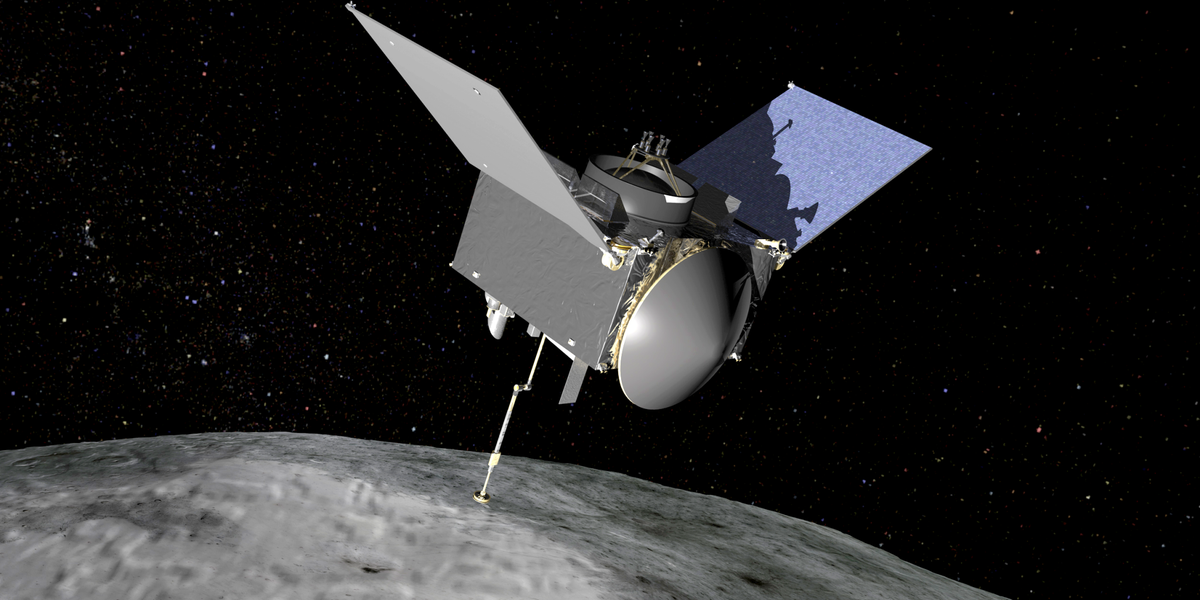
OSIRIS-REx was not designed to land like a lunar module or drill like a mining machine. Instead, it used a Touch-and-Go Sample Acquisition Mechanism, better known as TAGSAM. The concept was wonderfully bold: approach Bennu slowly, touch the surface for only a few seconds, blast nitrogen gas to stir up loose material, collect rocks and dust, and then back away. Imagine trying to vacuum crumbs from a moving table while wearing boxing gloves in zero gravity. That is roughly the vibe.
Why NASA Chose Asteroid Bennu
NASA did not choose Bennu because it had a catchy name, although it certainly helps. Bennu was picked because it checks several important boxes. It is close enough for a spacecraft to reach and return from within a practical mission timeline. It is old enough to preserve primitive solar system material. It is dark and carbon-rich, which makes it scientifically interesting. It is also one of the near-Earth asteroids studied for long-term impact risk, making it useful for planetary defense research.
Bennu’s surface turned out to be far more rugged than expected. Before arrival, scientists imagined areas of fine-grained material where sampling would be relatively straightforward. Once OSIRIS-REx got close, Bennu revealed a landscape covered with boulders, rough terrain, and hazards. It was less “smooth cosmic beach” and more “giant gravel pile with attitude.” That made sample-site selection much more difficult, but it also made the mission more scientifically interesting.
The Launch: A Seven-Year Space Delivery Route
The launch of OSIRIS-REx marked the beginning of a journey that would last seven years before the sample returned to Earth. After lifting off from Florida, the spacecraft traveled through space, used an Earth gravity assist, approached Bennu, entered operations around the asteroid, mapped the surface, collected the sample, departed Bennu, and finally released its sample capsule toward Earth.
The mission timeline was a masterclass in patience. Space missions are not like ordering pizza; nobody gets to call after 30 minutes and ask where the asteroid sample is. OSIRIS-REx spent years simply getting into the right position, studying Bennu from different angles, and allowing scientists to choose the safest and most promising sampling site.
In December 2018, the spacecraft arrived at Bennu. From there, OSIRIS-REx began detailed observations using cameras, laser altimetry, thermal instruments, and spectrometers. These tools helped the team understand Bennu’s shape, rotation, surface composition, temperature behavior, and geological features.
How OSIRIS-REx Collected a Piece of Bennu
The sample collection event took place on October 20, 2020, at a site named Nightingale. This location was chosen because it offered access to sampleable material, even though the surrounding terrain was challenging. The spacecraft descended carefully, touched Bennu for only a brief moment, fired nitrogen gas, and captured material in its collector head.
The maneuver worked almost too well. OSIRIS-REx gathered so much material that some particles began escaping before the sample could be safely stowed. That is the kind of problem mission teams probably like to have, but only after their blood pressure returns to normal. Engineers quickly adjusted plans and secured the sample inside the return capsule.
NASA’s original requirement was to return at least 60 grams of material. After the sample capsule landed in Utah on September 24, 2023, careful curation and measurement showed that OSIRIS-REx had delivered 121.6 grams of Bennu material, more than twice the minimum goal. For planetary scientists, that amount is a treasure chest. For everyone else, it is about half a cup of ancient asteroid crumbs that may help explain how our planet became habitable. Not bad for something smaller than a snack container.
Why Asteroid Samples Matter More Than Meteorites
Meteorites are useful, but they arrive with baggage. They pass through Earth’s atmosphere, crash into the ground, and sit in our environment before being collected. That exposure can alter or contaminate them. A sample-return mission gives scientists something much cleaner: material gathered directly from the source, sealed in space, and handled under strict laboratory conditions.
This is why OSIRIS-REx matters so much. Scientists can compare Bennu’s sample with telescope observations and spacecraft measurements. That connection gives the sample context. Researchers know where it came from, what the surrounding terrain looked like, and how Bennu behaved as a whole asteroid. It is like studying a single page from an ancient book while also knowing the title, author, binding, and library shelf it came from.
The Bennu sample is especially valuable because early analysis found carbon, water-bearing minerals, salts, organic compounds, amino acids, and nucleobases. These discoveries do not mean life was found on Bennu. They mean the chemical ingredients associated with life can form in space and may have been delivered to planets by asteroids long ago.
OSIRIS-REx and the Search for Life’s Ingredients
One of the biggest questions in science is how Earth became a living world. Did water arrive through impacts from asteroids and comets? Did organic molecules form here, arrive from space, or both? Bennu cannot answer everything, but it gives scientists a rare, clean sample of primitive material to test.
The discovery of water-bearing minerals supports the idea that Bennu’s parent body experienced interaction with liquid water in the distant past. The presence of organic molecules and amino acids suggests that prebiotic chemistry can occur in small bodies across the solar system. That matters because life on Earth depends on carbon chemistry, water, and complex molecules. Bennu offers a preserved record of those ingredients before planets became fully formed worlds.
For readers who enjoy dramatic phrasing, Bennu is not a “dead rock.” It is a chemical archive. It does not contain little green aliens, tiny fossils, or space microbes waving from a microscope slide. But it does contain information about how nature assembled the raw materials that eventually made biology possible. That is arguably even cooler, because it is real.
Planetary Defense: Learning From a Near-Earth Asteroid
OSIRIS-REx was not only about origins. The “Security” part of the mission name refers partly to planetary defense. Bennu is classified as a near-Earth asteroid, and scientists have studied its orbit carefully. Understanding Bennu’s mass, shape, spin, composition, and surface properties helps improve models of how small bodies move through space.
One subtle but important effect is the Yarkovsky effect, a tiny push caused when an asteroid absorbs sunlight and later radiates heat. Over long periods, that gentle force can change an asteroid’s orbit. By studying Bennu up close, OSIRIS-REx helped refine how scientists predict asteroid trajectories.
That knowledge matters for future asteroid risk assessment. If humanity ever needs to deflect a dangerous asteroid, we will need to understand what it is made of, how it rotates, how solid or rubble-like it is, and how it responds to force. Bennu, with its loose, boulder-covered surface, reminded engineers that asteroids are not all neat billiard balls. Some are messy piles of ancient debris held together by weak gravity and stubbornness.
The Engineering Behind a Cosmic Touch-and-Go
The engineering achievement of OSIRIS-REx deserves its own standing ovation. The spacecraft had to navigate around a small, irregular object with extremely weak gravity. It had to map hazards, identify a sample site, perform rehearsals, descend autonomously, touch the surface, collect material, and safely stow the sample. Any one of those steps could have gone wrong.
Because Bennu’s gravity is so weak, OSIRIS-REx did not “land” in the normal sense. Touching Bennu was more like making gentle contact with a floating rubble pile while both spacecraft and asteroid moved through space. The spacecraft used precise navigation and a guidance system that could compare real-time images with surface maps. This helped it avoid hazards during the descent.
The result was a major demonstration of robotic exploration. OSIRIS-REx showed that spacecraft can perform complex science operations around small bodies, adapt to unexpected terrain, and return high-value samples to Earth. Future missions to asteroids, moons, comets, and even Mars can learn from its playbook.
What Happened After the Sample Returned?
After the capsule landed in Utah in 2023, it was transported to NASA’s Johnson Space Center in Houston. There, specialists opened, documented, stored, and distributed portions of the sample for scientific study. Curation is a serious process because the sample must be protected from contamination and preserved for future researchers with better tools than we have today.
NASA plans to keep a large portion of the Bennu material for future generations. That is smart science. Instruments improve. Questions evolve. A sample that seems thoroughly studied today may reveal completely new information decades from now. The Apollo lunar samples proved this point beautifully; scientists are still learning from Moon rocks collected more than 50 years ago.
Meanwhile, the spacecraft itself did not retire. After releasing the sample capsule, the main spacecraft continued on a new mission called OSIRIS-APEX, heading toward asteroid Apophis. Apophis will make a rare close approach to Earth in 2029, and the spacecraft is expected to study how that encounter affects the asteroid. Apparently, after one asteroid, OSIRIS-REx decided it had become a specialist.
Why This Mission Still Feels Like Science Fiction
OSIRIS-REx feels futuristic because it turns a wild idea into a practical operation. Humans built a machine on Earth, launched it into space, sent it to a small asteroid, collected ancient material, and brought that material home. The mission required orbital mechanics, thermal engineering, robotics, chemistry, geology, navigation, and enough patience to make a houseplant jealous.
It is also a reminder that space exploration is not only about dramatic footprints and giant rockets. Sometimes the most important discoveries come from tiny grains of dust. A few grams of material can rewrite theories. A mineral vein can reveal ancient water. A molecule can hint at chemical pathways that existed before Earth was alive.
That is the beauty of OSIRIS-REx. It makes the universe feel both enormous and touchable. Bennu is millions of miles away, yet a piece of it now sits in a laboratory on Earth. The early solar system is billions of years old, yet scientists can examine its leftovers under modern instruments. Space is vast, but sometimes the evidence fits in a small metal container.
Experience Notes: What It Felt Like to Watch OSIRIS-REx Begin
Following the OSIRIS-REx launch story feels different from watching a mission that promises instant spectacle. There was no astronaut stepping onto a surface, no rover selfie from Mars the next morning, no dramatic alien landscape appearing right away. Instead, the excitement came from understanding the patience behind the plan. On launch eve, the mission felt like the opening page of a very long novel, the kind where the first chapter is mostly rocket fuel, trajectory math, and people in polo shirts trying not to look nervous on camera.
That slow-burn quality is exactly what made the mission memorable. A launch is loud, bright, and emotional, but OSIRIS-REx asked the public to care about something that would not fully pay off for years. It required trust in science, trust in engineering, and trust in the idea that a handful of asteroid dust could be worth a billion-dollar journey. For space fans, that was part of the charm. The mission felt like a promise mailed to the future.
Imagine standing outside on the night of launch, knowing that a spacecraft has just begun chasing a small dark asteroid most people could not point to on a star chart. Bennu was not glowing in the sky like the Moon. It did not have the celebrity status of Mars or Jupiter. Yet NASA treated it like a VIP guest from the beginning of time, because scientifically, that is what it was. Bennu carried material from the solar system’s childhood, and OSIRIS-REx was the courier chosen to bring some of it home.
The most human part of the experience was how many things had to go right. The rocket had to launch cleanly. The spacecraft had to survive deep space. The navigation team had to find and approach Bennu. The science team had to select a sample site after discovering that the asteroid was much rougher than expected. The spacecraft had to touch the surface without crashing. The sample had to be stowed. The capsule had to survive reentry. Even the Utah landing had to work like a carefully rehearsed handoff between space and Earth.
Looking back, the mission also teaches a useful lesson for anyone interested in science: big achievements often look boring in the middle. Years of cruise, calibration, mapping, rehearsal, and waiting do not always make flashy headlines. But those quiet years are where success is built. OSIRIS-REx was not magic. It was discipline. It was planning. It was thousands of people doing careful work so that one day a capsule could land in the desert with ancient black dust inside.
For readers, students, writers, and anyone who likes big ideas, OSIRIS-REx is a perfect reminder that exploration is not just about going somewhere. It is about returning with better questions. NASA launched a spacecraft to Bennu to understand the past, protect the future, and bring home a physical piece of the story. That is not just a mission. That is humanity sending a tiny, brilliant “be right back” note to the early solar systemand actually coming back.
Conclusion
NASA’s OSIRIS-REx mission began with a daring launch and became one of the most successful sample-return missions in history. It showed that the United States could collect material from an asteroid, protect it, return it safely, and use it to explore some of science’s deepest questions. Bennu’s rocks and dust are helping researchers study water, carbon chemistry, organic molecules, planetary formation, and asteroid behavior.
The original launch-eve headline“NASA Is Launching Its Asteroid Sample Return Spacecraft OSIRIS-REx Tomorrow”captured a moment of anticipation. Years later, the mission has delivered even more than promised. OSIRIS-REx did not just visit an asteroid. It brought home evidence from the dawn of the solar system and then kept flying toward another target. For a spacecraft with a name longer than some grocery receipts, that is a pretty elegant legacy.