Note: This article is a historical and educational feature based on documented medical history. It is not medical advice.
On December 3, 1967, in Cape Town, South Africa, a human heart did something that sounded almost impossible at the time: it left one body, entered another, and began beating again. The surgeon was Dr. Christiaan Barnard. The patient was Louis Washkansky, a grocer with severe heart disease. The donor was Denise Darvall, a young woman fatally injured in a car accident. The setting was Groote Schuur Hospital, where a team of doctors, nurses, technicians, and assistants stepped into medical history with the kind of courage that makes people whisper, “Are we absolutely sure this is a good idea?”
The world’s first human-to-human heart transplant was not a neat miracle wrapped in a bow. It was brilliant, risky, tragic, controversial, and deeply human. Washkansky survived only 18 days after the operation, dying of pneumonia while his immune system was weakened by anti-rejection drugs. Yet the surgery proved something enormous: a failing human heart could be replaced. The heart, long treated as the poetic headquarters of love, bravery, heartbreak, and questionable romantic decisions, had become a transplantable organ.
That single operation changed medicine forever. It also forced society to rethink death, donation, surgical ambition, and the price of progress. This is the unlikely story behind the first heart transplantand why its heartbeat still echoes through modern cardiac surgery.
A World Racing Toward the Impossible
To understand the first heart transplant, it helps to remember how wild the idea once sounded. Today, a heart transplant is a recognized treatment for end-stage heart failure when other therapies no longer work. In the 1950s and early 1960s, however, replacing a human heart sounded like science fiction with a scalpel.
Cardiac surgery itself was still young. The heart had once been considered almost untouchable. Surgeons could remove an appendix, repair bones, or stitch wounds, but opening the chest and operating on the heart was another level of “please do not sneeze.” The rise of the heart-lung machine changed everything. By temporarily taking over circulation and oxygenation, it allowed surgeons to stop the heart, repair it, and restart it. That machine became one of the quiet heroes of modern heart surgery.
Behind Barnard’s dramatic breakthrough stood years of experimental work by researchers around the world. In the United States, surgeons such as Norman Shumway and Richard Lower developed techniques in animal studies that helped establish how a transplanted heart could be connected to a recipient’s blood vessels. Their work at Stanford became foundational. Barnard, who trained in South Africa and also spent time studying in the United States, understood that the surgical road had already been partly paved. He was not inventing every step from scratch; he was daring to take the step everyone knew was coming but few were ready to take.
Meet Christiaan Barnard: The Surgeon Who Moved First
Christiaan Barnard was not the obvious global celebrity type before 1967. Born in Beaufort West, South Africa, he grew up far from the elite medical centers that usually dominate history books. He was talented, ambitious, and famously confident. Confidence is useful in surgery. Too little and you never lift the scalpel; too much and you become a medical disaster wearing gloves. Barnard somehow had enough to push history forward.
He worked at Groote Schuur Hospital in Cape Town and became deeply interested in cardiac surgery. By the mid-1960s, the technical possibility of heart transplantation was no longer fantasy. The barriers were practical, legal, ethical, and immunological. Surgeons could connect the plumbing, so to speak. The bigger question was whether the body would accept the new heartor attack it like an uninvited guest at a family barbecue.
Rejection was the monster in the operating room. The immune system is wonderfully protective when it fights infection, but less charming when it treats a lifesaving donor heart as an enemy invasion. Early immunosuppressive drugs could reduce rejection, but they also weakened the body’s defense against infection. That trade-off would become tragically important in Washkansky’s case.
Louis Washkansky: The Patient at the Edge of Time
Louis Washkansky was in desperate condition. He suffered from severe heart disease and diabetes, and his doctors believed he had little time left. For him, the transplant was not a luxury experiment. It was a final chance.
That distinction matters. Medical pioneers are sometimes described as if they were reckless adventurers dragging patients into history. The truth is more complicated. Washkansky was dying. His existing heart was failing. The transplant offered a possibility where almost no possibility remained. He agreed to the surgery knowing the odds were uncertain.
There is something deeply moving about that decision. In modern medicine, consent forms can feel like paperwork with medical vocabulary doing gymnastics. In 1967, consent for a heart transplant meant agreeing to an operation no human recipient had ever survived before. Washkansky was not just a patient; he was a participant in a new chapter of medicine.
Denise Darvall and the Gift That Changed History
The donor, Denise Darvall, was a young woman whose life ended suddenly after she was struck by a car. Her death created the possibility of another person’s survival. That simple sentence contains a universe of grief. Organ transplantation always does.
Darvall’s father gave permission for her heart to be used. It is difficult to imagine the weight of that moment. A family had just lost a daughter. Doctors were asking for a decision that would become part of global medical history. The first heart transplant is often told as a story about Barnard, and understandably so, but it also belongs to Denise Darvall and her family. Without donation, there is no transplant. Without grief transformed into generosity, there is no second heartbeat.
The case also raised questions that medicine was still learning how to answer. When exactly is a person dead? If a heart is still beating with support, but the brain has permanently stopped functioning, what does death mean? The modern concept of brain death became more clearly defined after this era, especially with the 1968 Harvard Medical School report on irreversible coma. The first heart transplant did not merely change surgery; it helped accelerate public discussion about death itself.
The Night at Groote Schuur Hospital
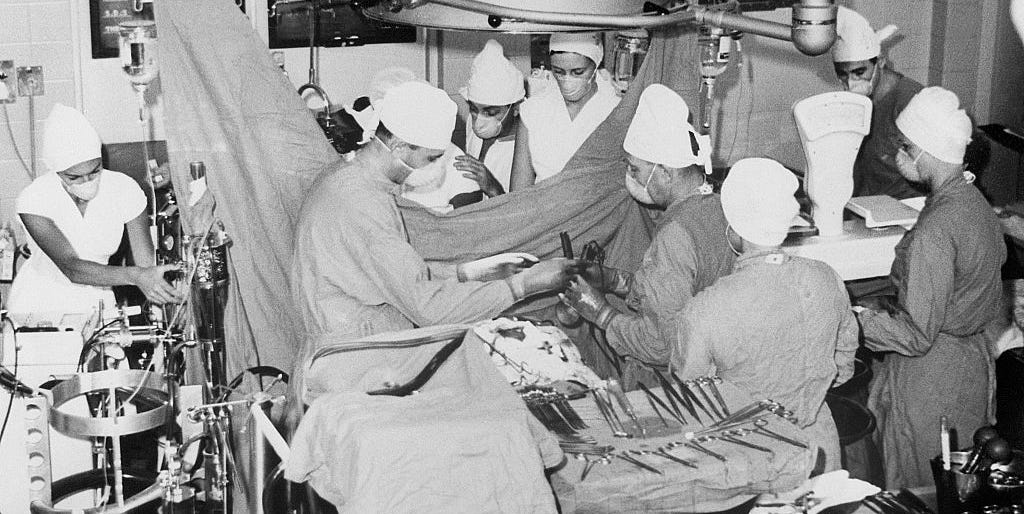
The operation began during the night of December 2 and continued into the early hours of December 3, 1967. Barnard led a large surgical team that included his brother, Dr. Marius Barnard. The procedure required extraordinary coordination. One team prepared the donor heart. Another prepared Washkansky. The heart-lung machine supported circulation while the diseased heart was removed and the donor heart was sewn into place.
Imagine the tension in that operating room. This was not just another difficult case. Every stitch carried the weight of the unknown. The team had practiced techniques, studied anatomy, and learned from experimental surgery, but no textbook could promise what would happen when the transplanted heart was asked to beat inside another human body.
Then came the moment that turned surgery into legend: the donor heart began to beat. In one sense, it was a mechanical success. Blood flowed. The new heart worked. In another sense, it was almost theatrical. The organ most associated with life had restarted in a new chest. Even the most serious surgeon could be forgiven for feeling goosebumps under the sterile gown.
Why the First Heart Transplant Was Both a Success and a Tragedy
Washkansky initially recovered well enough to speak with his wife. Newspapers around the world exploded with the news. Barnard became famous almost overnight. The operation was hailed as a medical triumph, and in an important technical sense, it was.
But the story soon turned somber. To prevent rejection, Washkansky received immunosuppressive treatment. Those drugs helped protect the donor heart from immune attack, but they also left him vulnerable to infection. He developed pneumonia and died 18 days after the transplant.
So was the operation a success? The answer is yesbut not in the simple Hollywood way. The transplanted heart functioned. The surgical method worked. The patient survived the operation itself. What failed was the fragile balance between preventing rejection and preserving immunity. That balance would become the central challenge of transplant medicine for years.
Early heart transplantation had a brutal learning curve. Many patients did not survive long. Some medical centers stepped back from the procedure. The dream was real, but the tools were not yet good enough. The immune system remained a formidable opponent, and infections were common. Medicine had opened the door, only to discover that the hallway behind it was full of traps.
The Stanford Connection and the Quiet Builders of the Field
While Barnard became the face of the first heart transplant, the broader story includes surgeons who spent years refining the science. Norman Shumway at Stanford is one of the essential figures. Shumway and his colleagues helped develop transplant techniques and later contributed significantly to making heart transplantation a durable clinical therapy.
In January 1968, shortly after Barnard’s operation, Shumway performed the first adult human heart transplant in the United States at Stanford. Over time, Stanford became one of the most influential centers in transplant research and practice. Shumway’s reputation was less flashy than Barnard’s, but his long-term impact was enormous. If Barnard lit the match, Shumway helped keep the fire from going out.
This is often how medical progress works. History remembers the dramatic first, but patients benefit from the persistent second, third, and thousandth refinements. A breakthrough gets applause. A protocol saves lives. A better drug changes survival rates. A more careful follow-up schedule keeps someone alive long enough to attend a wedding, hold a grandchild, or complain about hospital food with impressive enthusiasm.
The Revolution of Anti-Rejection Drugs
The biggest turning point after the early transplant era was improved immunosuppression. Early drugs were blunt instruments. They could quiet the immune system, but sometimes too well. Patients needed protection from rejection without being left defenseless against infection.
Cyclosporine, introduced into transplant medicine in later decades, helped transform outcomes. It gave doctors a more effective way to control rejection and made heart transplantation more practical. Later regimens added other medications and more personalized management. Today, transplant recipients still need lifelong immunosuppressive therapy, and rejection remains a serious concern, but survival has improved dramatically compared with the early years.
Modern heart transplant care is not just surgery. It is a long partnership between patient and medical team. There are biopsies, blood tests, imaging studies, medication adjustments, infection precautions, rehabilitation, and lifestyle changes. The operation is the headline, but the aftercare is the novel.
How the First Heart Transplant Changed the Meaning of Death
The first heart transplant did more than challenge surgical limits. It pushed society into a new ethical landscape. For a donor heart to be useful, it must be healthy enough to function after transplantation. That raised urgent questions about how death should be determined in patients with catastrophic brain injury.
Before ventilators and intensive care, death was usually recognized when breathing and circulation stopped. But modern machines could maintain heartbeat and respiration even after the brain had irreversibly ceased functioning. The 1968 Harvard report on irreversible coma helped shape the concept of brain death, which later became central to organ donation systems.
This shift was not merely technical. It changed how families, doctors, lawmakers, and ethicists talked about the boundary between life and death. The heart transplant era forced medicine to be more precise, more transparent, and more accountable. A donor is not a collection of spare parts. A recipient is not an experiment. Both are human beings, and ethical medicine must honor both truths at the same time.
Modern Heart Transplants: From Daring Experiment to Standard Therapy
Today, heart transplantation is considered a gold-standard treatment for selected patients with end-stage heart failure. It is still rare, complex, expensive, and emotionally intense, but it is no longer a moonshot. In the United States, thousands of heart transplants are performed each year, and national transplant data show how far the field has come since 1967.
Modern transplant teams evaluate candidates carefully. They consider disease severity, other medical conditions, age, support systems, medication adherence, and the likelihood that the patient can survive and benefit from the procedure. Donor hearts are matched through organized allocation systems that aim to balance urgency, compatibility, geography, and fairness.
The challenges remain serious. There are never enough donor hearts for everyone who needs one. Rejection can happen days, months, or years after surgery. Immunosuppressive drugs can raise the risk of infection, kidney problems, cancer, diabetes, high blood pressure, and other complications. Yet many recipients live for years, and some live for decades, with transplanted hearts.
That reality would have stunned much of the world in 1967. The first heart transplant began with one patient living 18 days. Modern transplantation has turned that fragile beginning into an entire field devoted to extending life with dignity and precision.
The Human Side: What This Story Still Teaches Us
The story of the world’s first heart transplant is not just about surgical bravery. It is about uncertainty. Barnard and his team did not have the luxury of knowing how the story would end. Washkansky did not have the comfort of proven statistics. Darvall’s family did not have decades of public familiarity with organ donation. Everyone involved stepped into the unknown.
That is why the story still matters. Medicine advances when knowledge meets courage, but courage alone is not enough. It must be guided by ethics, evidence, humility, and respect for human life. The first heart transplant reminds us that breakthroughs are rarely clean. They come with grief, debate, mistakes, and consequences.
It also reminds us that progress can begin with a small, shocking sound: a heart beating where it had never beaten before.
Experiences and Reflections: Why This Story Still Feels Personal
There is something uniquely emotional about the idea of a heart transplant. Most of us can talk calmly about replacing a knee, removing an appendix, or getting dental work, although admittedly nobody talks calmly about dental work for long. But the heart is different. We use it as shorthand for identity. We say someone has a good heart, a broken heart, a brave heart, or a heart of gold. Then transplantation comes along and says, “Actually, this is also a pump made of muscle, and we may be able to replace it.” Science can be very practical at parties.
For families facing heart failure, the transplant journey is both hopeful and terrifying. The waiting period can feel endless. A patient may carry a phone everywhere, knowing that one call could change everything. Every ring becomes dramatic. Every delay feels personal. There is excitement, but also guilt, because a donor heart usually arrives through another family’s worst day. That emotional contradiction is one of the hardest parts of transplantation: one life may continue because another has ended.
Caregivers often describe the experience as living between two clocks. One clock measures decline: symptoms, hospital visits, fatigue, and fear. The other clock measures possibility: evaluation appointments, listing status, donor matching, and the hope of surgery. When the call finally comes, there may be no movie-style speech. People pack bags, notify relatives, and drive to the hospital in a fog of gratitude and panic. The heroic soundtrack, if there is one, is usually replaced by traffic noise and someone asking, “Did we bring the charger?”
After transplant, the emotional work does not end. Many recipients must learn to trust a body that has frightened them for years. They count pills, watch for fever, attend follow-ups, and learn the early signs of rejection or infection. A new heart can bring energy back, but it also brings responsibility. The daily routine becomes an act of respectfor the donor, the medical team, and the second chance itself.
The first heart transplant makes these modern experiences easier to understand. Barnard’s operation was not simply a bold medical event from a black-and-white photograph. It was the beginning of thousands of private stories: parents seeing children grow up, spouses getting more anniversaries, patients walking farther than they once thought possible. Every modern transplant carries a trace of that first night at Groote Schuur Hospital.
Perhaps the most powerful lesson is that medical progress is not only measured in survival curves and surgical techniques. It is measured in ordinary moments returned to people: breakfast at home, a birthday candle, a walk outside, a laugh that does not end in breathlessness. The heart beats on, yesbut so do families, plans, jokes, arguments, recipes, road trips, and all the beautifully messy evidence of being alive.
Conclusion
The world’s first heart transplant was unlikely because it required so many impossible things to align: surgical skill, scientific groundwork, a dying patient brave enough to try, a donor family willing to give, and a medical team prepared to face global scrutiny. It was not a perfect victory. Louis Washkansky’s death after 18 days showed how much medicine still had to learn. But the operation proved that human heart transplantation could be done, and that proof changed the future.
From Groote Schuur Hospital to today’s advanced transplant centers, the journey has been filled with setbacks, innovations, ethical debates, and extraordinary resilience. Christiaan Barnard became famous for the first leap, but the real legacy belongs to everyone who helped transform a daring experiment into a lifesaving therapy. The first heart transplant did not end death. It did not solve heart failure. It did something humbler and more astonishing: it opened a door.
And through that door, the heart kept beating.