Note: This article is written for public-interest analysis and does not provide operational instructions, tactical guidance, or technical steps for using weapons.
In a war already defined by drones, missiles, trenches, electronic warfare, and cities turned into front lines, Russia’s so-called “vacuum weapons” occupy a special place in the public imagination. The nickname sounds almost science fiction, as if someone pulled it from a villain’s garage labeled “Do Not Touch Unless Plot Requires Disaster.” In reality, the term usually refers to thermobaric weapons, also called enhanced-blast or fuel-air explosive weapons. Their notoriety comes from a brutal combination: heat, pressure, and a blast effect that can be especially destructive in enclosed or urban spaces.
For Ukraine, the concern is not theoretical. Since Russia’s full-scale invasion began in February 2022, rights groups, journalists, defense analysts, and Ukrainian officials have repeatedly warned about thermobaric systems appearing in or near the battlefield. The most discussed Russian platform is the TOS-1A Solntsepyok, a heavy multiple-rocket system associated with thermobaric warheads. More recently, reporting has also focused on thermobaric payloads in one-way attack drones and the use of decoys to overwhelm Ukrainian air defenses. In other words, this is not just about one terrifying weapon. It is about how Russia blends fear, firepower, and saturation tactics to pressure Ukraine’s soldiers and civilians alike.
What Are “Vacuum Weapons”?
The phrase “vacuum bomb” is a popular label, not a perfect scientific description. Thermobaric weapons work differently from standard high-explosive munitions. Instead of relying only on a concentrated explosive charge, they create a blast that draws on oxygen in the surrounding air, producing a high-temperature explosion and a powerful pressure wave. That is why these weapons are often described as “enhanced blast” weapons. The terrifying part is not just the initial explosion, but the way the pressure and heat can spread through rooms, trenches, tunnels, shelters, and other confined spaces.
That does not mean thermobaric weapons are magical doomsday devices. They are conventional weapons, not nuclear weapons. They do not erase entire countries, despite what social media captions sometimes imply. But they can be devastating when used against buildings, defensive positions, or densely populated areas. Their battlefield value is tied to the exact reason they raise humanitarian alarm: they are designed to affect spaces where people may be sheltering, fighting, hiding, or simply trying to survive.
Why Russia’s Thermobaric Arsenal Matters in Ukraine
Russia inherited and developed a range of thermobaric systems from Soviet-era weapons programs. The TOS-1 and TOS-1A systems are often described as “heavy flamethrowers,” a term that sounds old-fashioned until one remembers that militaries are very good at making old labels carry modern consequences. Mounted on armored chassis, these systems can launch salvos over a target area. Their purpose is not precision in the surgical sense; it is area effect, shock, and destruction.
In Ukraine, that matters because much of the war has taken place in towns, suburbs, industrial districts, forests, trench networks, and ruined urban blocks. Places such as Mariupol, Bakhmut, Avdiivka, Vuhledar, and other battle-scarred areas have shown how quickly modern war turns civilian geography into military terrain. A school basement becomes a shelter. An apartment block becomes an observation point. A factory becomes a fortress. When enhanced-blast weapons enter that kind of environment, the risk to civilians and medical responders rises sharply.
The TOS-1A: Russia’s Infamous “Scorching Sun”
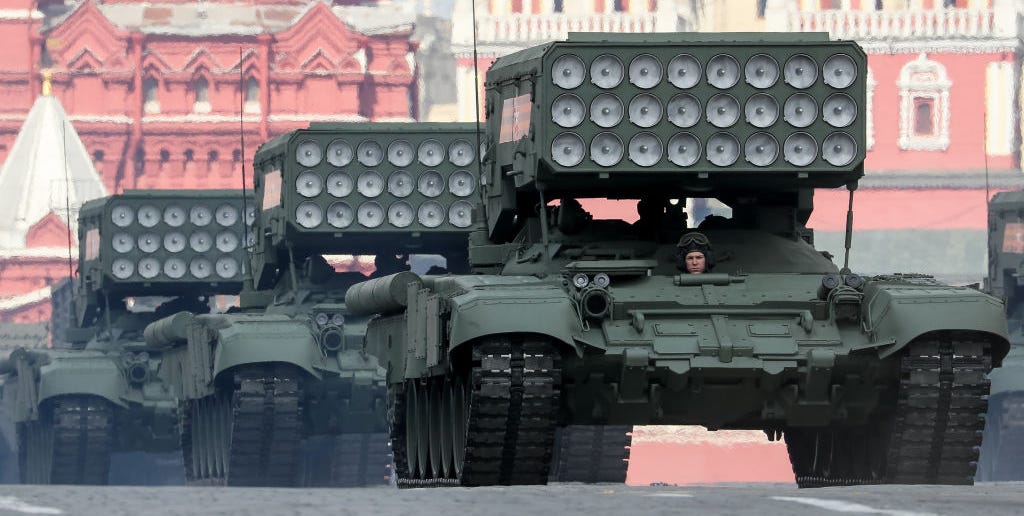
The TOS-1A Solntsepyok, often translated as “Scorching Sun,” has become one of the most recognized thermobaric systems of the war. The nickname is dramatic, but the concern is practical. The system is designed to hit concentrated areas with rockets that may carry thermobaric warheads. It has been reported in Ukraine since the early phase of the invasion, and images of these systems moving near the battlefield quickly became part of the war’s grim visual vocabulary.
Russia’s use of the TOS-1A fits a broader pattern in its military approach: heavy firepower to crush defensive positions, reduce towns to rubble, and force Ukrainian troops out of prepared lines. When Russian forces struggle to advance quickly, they often rely on artillery, glide bombs, missiles, and drones to make territory difficult to hold. Thermobaric weapons are part of that pressure campaign. They are not the only danger in Ukraine, but they are among the most feared because of their effect in enclosed spaces and their psychological impact.
Why Urban Warfare Makes These Weapons More Dangerous
Military lawyers and humanitarian organizations often focus on one phrase: populated areas. A weapon that might be lawful against a clear military target in open terrain can become deeply problematic when used near civilians. The issue is not only whether a weapon is banned by name. It is whether its use follows the core rules of international humanitarian law: distinction, proportionality, and precautions to protect civilians.
Thermobaric weapons create special concern because their effects do not politely stop at the front door, check for civilian status, and ask for identification. Blast pressure can move through openings and enclosed spaces. Fires and structural damage can compound the harm. In a city where civilians may be taking shelter underground, the danger is obvious. This is why human rights groups describe enhanced-blast weapons as especially risky in urban areas, and why their use around civilians can raise serious legal and moral questions.
Are Thermobaric Weapons Illegal?
This is where the conversation gets complicated. Thermobaric weapons are not automatically banned under international law in the same way certain chemical weapons or anti-personnel landmines are restricted by specific treaties. That does not mean “anything goes.” The use of any weapon must comply with the laws of armed conflict. A weapon used indiscriminately, or in a way that causes excessive civilian harm compared with the expected military advantage, can still be unlawful.
In plain English: the law does not only ask what weapon was used. It asks where, why, how, and against whom. A thermobaric strike against a clearly isolated military target is legally different from a strike in a crowded city block. That distinction is not legal hair-splitting. It is the difference between battlefield conduct and potential war-crime allegations. In Ukraine, where front lines often run near homes, hospitals, schools, power facilities, and evacuation routes, the legal stakes are painfully high.
Russia’s Drone War Adds a New Layer of Fear
Ukraine’s air war has changed dramatically since 2022. Russia has used waves of missiles and drones to strike infrastructure, cities, energy facilities, logistics hubs, and military targets. At the same time, cheap decoy drones have appeared alongside armed systems, forcing Ukrainian defenders to make difficult choices. Should they spend valuable air-defense ammunition on a target that might be a decoy? Should they wait and risk letting a real warhead through? It is the world’s ugliest guessing game, and nobody gets a prize for playing.
Associated Press reporting has described Russian efforts to mix decoy drones with more dangerous drones, including thermobaric variants. This approach does two things at once. First, it stretches Ukrainian air defenses by increasing the number of threats in the sky. Second, it spreads fear because defenders and civilians cannot know which incoming object is harmless, conventional, or enhanced-blast. The uncertainty itself becomes part of the weapon system.
The Psychological Weapon Behind the Physical Weapon
Thermobaric weapons are frightening not only because of what they can do physically, but because of what people believe they can do. The term “vacuum bomb” travels fast online. It is short, cinematic, and terrifying. That makes it perfect for propaganda, panic, and viral headlines. Russia benefits when Ukrainians feel every drone or rocket might carry the worst possible payload. Ukraine benefits when it can expose the presence of such systems and rally international outrage. Information warfare and explosive warfare are not separate in this conflict; they often arrive together.
This does not mean the fear is imaginary. Civilians living under constant air alerts do not have the luxury of treating every warning as a media studies exercise. For them, the difference between a decoy, a conventional explosive, and a thermobaric weapon may only become clear after impact. That uncertainty is exhausting. It drains sleep, interrupts school, slows emergency services, and turns ordinary decisions into risk calculations. Should a family stay in the hallway? Go to the shelter? Move away from windows? Wait for the all-clear? Repeat this for months, and fear becomes part of daily architecture.
How Ukraine Has Responded
Ukraine’s response has included documenting alleged use, destroying or capturing Russian systems when possible, strengthening air defenses, improving early-warning networks, and lobbying Western partners for more support. Ukrainian forces have also adapted to Russia’s battlefield systems by dispersing positions, using drones for reconnaissance, and targeting Russian artillery, ammunition depots, and launch platforms.
But there is no simple shield against enhanced-blast weapons. Air defense can stop some drones and missiles, but not all. Counter-battery fire can reduce artillery threats, but only when launchers are detected in time. Shelters can save lives, but certain types of blast effects make enclosed spaces complicated. The result is a constant contest between offensive pressure and defensive adaptation. Ukraine has become remarkably skilled at adaptation, but even the best defense has limits when the attacker can fire large numbers of drones, rockets, and missiles.
Why Civilians Pay the Highest Price
Military analysis often focuses on systems, ranges, payloads, and battlefield utility. Humanitarian analysis asks another question: who is standing underneath the arc of all that technology? In Ukraine, the answer is often civilians. Apartment residents. Utility workers. Train passengers. Doctors. Teachers. Children trying to learn during air alerts. Elderly people who cannot evacuate easily. Volunteers delivering food to towns with broken roads and broken windows.
When explosive weapons with wide-area effects are used near populated places, the damage rarely ends with the blast. Electricity fails. Water lines break. Hospitals fill. Roads close. Mines and unexploded ordnance complicate rescue work. Families move again, sometimes for the third or fourth time. The visible destruction is terrible, but the invisible destruction is also real: anxiety, lost schooling, interrupted medical care, economic collapse, and the slow erosion of community life.
The Strategic Logic: Terror, Attrition, and Exhaustion
Russia’s use of heavy weapons in Ukraine fits a strategy of attrition. Instead of relying only on rapid maneuver, Moscow has often tried to grind down Ukrainian defenses, infrastructure, and morale. Thermobaric weapons fit that logic because they are meant to overwhelm positions and create fear disproportionate to their numbers. They are not just battlefield tools. They are signals: Russia wants Ukraine to know it can escalate the pain of resistance.
However, terror does not always produce surrender. In Ukraine, heavy bombardment has often hardened public opinion rather than breaking it. The repeated targeting of cities and infrastructure has strengthened the argument among Ukraine’s supporters that Kyiv needs stronger air defense, more ammunition, faster repairs to the energy grid, and long-term security guarantees. In that sense, Russia’s “scare them into submission” playbook has a serious flaw: people under attack may become angrier, more organized, and more determined.
What the West Is Watching
For the United States and its allies, Russia’s thermobaric weapons raise several concerns. First, they show how Russia combines older Soviet-style firepower with newer drone tactics. Second, they complicate civilian protection in a war where many key targets are near populated areas. Third, they test international norms around the use of wide-area explosive weapons in cities. Finally, they add urgency to the debate over Ukraine’s air-defense supply.
Western governments are not only counting missiles. They are watching patterns: how Russia selects targets, how it mixes decoys with real weapons, how often civilian infrastructure is hit, and whether particular weapons are used in ways that may violate the laws of war. Documentation matters because wars are fought in the present but judged in the future. Evidence gathered today may shape accountability tomorrow.
Specific Examples That Show the Pattern
One example is the early appearance of TOS-1A systems near Ukraine during the first stage of the full-scale invasion. The images and reports quickly sparked alarm because the system was already associated with severe area effects. Another example is Russia’s repeated missile and drone barrages against Ukrainian cities and infrastructure. Even when these attacks do not involve thermobaric warheads, they create the same civilian-protection problem: large explosive effects in places where civilians live and essential services operate.
A newer example is the reported use of thermobaric payloads in Shahed-style attack drones, combined with decoy drones. This is especially troubling because it merges two trends: the mass production of cheap aerial threats and the psychological fear attached to enhanced-blast weapons. A defender looking at a radar screen does not get a neat label saying “decoy,” “standard explosive,” or “thermobaric.” That uncertainty forces difficult decisions in seconds.
Experiences and Lessons From the Ukraine War
To understand why Russia’s “vacuum weapons” matter, it helps to look beyond the weapon itself and consider the experiences surrounding it. For Ukrainian civilians, the threat is not an abstract headline. It is another reason to sleep in hallways, keep emergency bags near the door, memorize shelter routes, and learn the difference between ordinary city noise and the warning signs of incoming danger. War turns people into reluctant experts. A grandmother learns air-alert apps. A teenager recognizes the sound of drones. A shop owner tapes windows, not because tape is magic, but because doing something feels better than doing nothing.
For emergency responders, enhanced-blast weapons add complexity to an already dangerous job. After any strike, they must deal with damaged buildings, fires, blocked roads, unstable structures, and the possibility of follow-up attacks. Their work is not glamorous. It is muddy boots, cracked gloves, radio chatter, and the discipline to keep moving when everyone else is running away. In places hit repeatedly, responders learn that rescue is not one event. It is a cycle: warning, impact, search, evacuation, repair, and then another warning.
For soldiers, the experience is different but equally brutal. Thermobaric weapons are associated with trench lines, fortified positions, and enclosed defensive areas. The fear is not only injury; it is being trapped in a position that suddenly becomes impossible to hold. Ukrainian units have responded by improving concealment, dispersal, early warning, and drone-based reconnaissance. The lesson is simple but unforgiving: survival depends on not being found, not being fixed in place, and not allowing Russia to concentrate firepower without consequence.
For military analysts, the Ukraine war has demonstrated that old and new warfare now overlap. A TOS-1A system may look like a Cold War relic with a terrifying personality, but it operates in a battlefield shaped by satellite imagery, commercial drones, electronic warfare, open-source intelligence, and social media. A thermobaric drone may rely on modern supply chains while carrying an old idea: use blast and fear to overwhelm the enemy. The result is a war where yesterday’s weapons learn today’s delivery methods.
For journalists and editors, the challenge is language. “Vacuum bomb” is a clickable phrase, but it can also oversimplify. Responsible coverage should explain what the term means without turning the weapon into a horror-movie prop. It should describe civilian risk without sensationalizing suffering. It should avoid giving the impression that every Russian strike involves thermobaric weapons, while still recognizing that documented and reported uses deserve scrutiny. Good war reporting is a tightrope: clear enough to inform, careful enough not to mislead.
For policymakers, the experience of Ukraine offers a hard lesson about deterrence and civilian protection. Once a war reaches the stage where cities are regularly hit by drones, rockets, and missiles, the cost of delayed defense support becomes visible in lives, power outages, hospital strain, and displacement. Air defense is not a luxury item in this context. It is part of the civilian survival system, along with ambulances, generators, shelters, and reconstruction crews.
For the global public, the main lesson is that weapons with dramatic nicknames should not distract from the human reality. “Vacuum weapon” sounds exotic, but the people facing it are not characters in a military documentary. They are families trying to keep phones charged, workers repairing substations, nurses finishing shifts during alerts, and children measuring childhood by the number of times class was interrupted. The horror of thermobaric weapons is not only in the physics of blast. It is in the way such weapons turn ordinary spaces into places of dread.
Conclusion: The Real Hell Is Civilian Vulnerability
Russia’s “vacuum weapons” could unleash hell in Ukraine not because they are mysterious superweapons, but because they are built for the kind of destructive pressure that becomes especially dangerous in populated and enclosed spaces. In a war already filled with drones, missiles, artillery, and civilian suffering, thermobaric weapons add another layer of fear and humanitarian risk.
The central issue is not only whether Russia has used a particular system on a particular day. The larger issue is how Moscow wages war: by combining heavy firepower, psychological pressure, infrastructure attacks, and mass drone tactics to exhaust Ukraine. Thermobaric weapons fit that pattern. They are designed to break positions, but their broader effect is to deepen the terror of living under attack.
For Ukraine, the answer lies in documentation, defense, resilience, and continued international support. For the world, the lesson is even clearer: when explosive weapons with wide-area effects are used near civilians, legal debates cannot remain academic. The consequences land in apartment blocks, shelters, hospitals, schools, and power stations. That is where the real meaning of “hell” is measured.