Note: This article is written as an original editorial feature for web publication. It discusses the creative idea, cultural background, visual storytelling, and reader appeal behind the “Soviet princesses” illustration concept without reproducing copyrighted images.
Disney princesses have been reimagined as everything: warriors, fashion models, modern college students, gothic queens, superheroes, runway icons, and probably at least one latte foam design somewhere on the internet. The reason is simple. These characters are instantly recognizable, visually flexible, and emotionally familiar. Give Ariel a leather jacket or Belle a sci-fi library, and the audience still understands the joke, the mood, and the nostalgia before the first caption finishes loading.
But one artist took that familiar trend and pointed it toward a different treasure chest of childhood memory: Soviet animated films. Instead of drawing yet another version of Cinderella with a smartphone or Snow White in streetwear, the project imagined “Soviet princesses” inspired by beloved animated fairy-tale characters from Russian and Soviet-era cartoons. The result feels both nostalgic and fresh, like opening an old storybook and discovering someone has lovingly redrawn the margins with new ink, new confidence, and just enough sparkle to make your inner child sit up straight.
The original idea came from illustrator Svetlana Kuznetsova, who explained that she had been inspired by other artists’ Disney princess redesigns and wanted to create a project connected to the culture she grew up with. Having lived abroad for years, she felt a stronger pull toward the animated films, fairy tales, and visual traditions of her native background. That emotional detail matters because the illustrations are not just “what if Disney, but Soviet?” They are about memory, homesickness, identity, and the way childhood cartoons become tiny cultural passports we carry around long after we forget where we packed them.
Why Reimagined Disney Princesses Became an Internet Art Genre
Reimagining Disney princesses has become its own online art category because it gives artists a shared visual language. The audience already knows the characters, so the artist can focus on transformation. A new costume, historical setting, body type, ethnicity, art style, or personality shift can say something instantly. It is fan art, fashion design, social commentary, and character study all wearing the same glittery shoes.
Part of the appeal comes from contrast. Disney princesses are often polished, bright, and highly branded. When artists place them in another world, the friction creates interest. A princess in armor asks what strength looks like. A princess in traditional cultural clothing asks who gets represented in fantasy. A princess in modern life asks whether fairy-tale heroines would still wait for a royal invitation or simply start a group chat and solve the problem themselves.
Soviet princesses add another layer because they do not simply update familiar American pop culture. They invite viewers into a parallel animation tradition. Many people raised in the United States know Disney’s versions of Cinderella, The Little Mermaid, and fairy-tale royalty. But Soviet animation had its own visual grammar: painterly backgrounds, folklore-inspired costumes, expressive faces, lyrical pacing, and a sense of mystery that often felt closer to an illustrated folk tale than a Broadway musical with sidekicks.
What Makes “Soviet Princesses” Such a Strong Concept?
The phrase “Soviet princesses” sounds almost contradictory at first, which is part of its charm. Soviet culture was not exactly built around royal branding, tiara collections, and castle gift shops. Yet Soviet animation adapted many stories that included queens, princesses, tsars, magical girls, enchanted brides, and mysterious heroines. The result is a fascinating artistic tension: aristocratic fairy-tale figures filtered through a culture known for collective ideals, folklore preservation, and state-supported animation studios.
That tension gives the concept more depth than a simple costume swap. These princesses are not merely Disney characters wearing ushankas or standing in front of onion domes. They come from specific fairy tales, animated films, and literary traditions: Hans Christian Andersen, the Brothers Grimm, Alexander Pushkin, Alexander Afanasyev, and Soviet-era adaptations that became household memories for generations.
The eight illustrated characters in the project include Vasilisa the Beautiful, the Snow Queen, the Swan Princess, the Little Mermaid, Princess Zabava from The Flying Ship, the princess from The Bremen Town Musicians, the Queen of Shamakhan, and Cinderella. Some are sweet and luminous. Some are icy, regal, or dangerous. Some feel like they wandered out of a folk painting and discovered a modern portrait studio on the way.
The Eight Soviet Princesses and Their Storybook Power
1. Vasilisa the Beautiful
Vasilisa is one of the most famous heroines in Russian folklore. Often associated with the tale of a brave girl sent into danger and aided by a magical doll, she represents endurance, intuition, and quiet courage. In a modern illustration series, Vasilisa works beautifully because she is not merely “pretty.” She carries the visual energy of embroidery, forests, firelight, and Baba Yaga’s shadowy world. Her beauty is not delicate decoration; it is survival with excellent cheekbones.
2. The Snow Queen
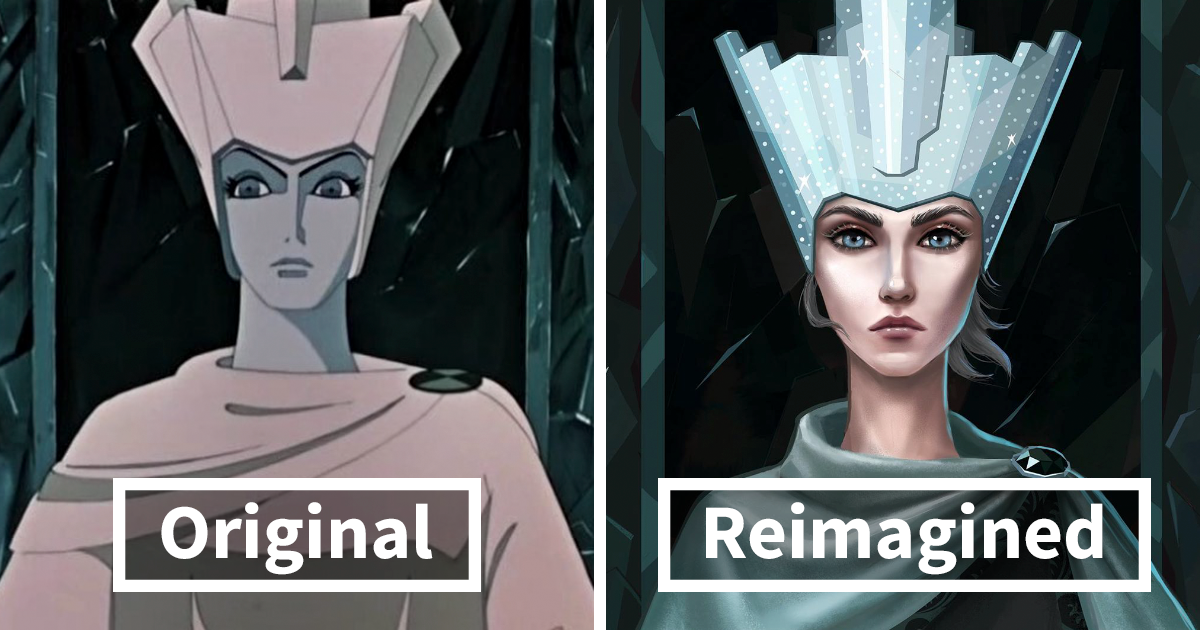
The Snow Queen, rooted in Hans Christian Andersen’s literary fairy tale, is one of the most visually irresistible figures in animation history. Ice, silver, blue-white light, sharp silhouettes, and emotional distance make her a dream subject for illustrators. Unlike many princess archetypes, she does not need warmth to command attention. She is winter with a crown, elegance with frostbite, and the type of character who could silence a room simply by blinking slowly.
3. The Swan Princess
The Swan Princess, connected to Pushkin’s fairy-tale world in The Tale of Tsar Saltan, carries a softer but equally magical presence. Swan imagery gives artists a rich visual palette: feathers, water, moonlight, white fabric, graceful posture, and transformation. In Soviet-style reinterpretation, she can feel less like a commercial princess and more like a figure painted onto porcelain, floating between human tenderness and mythic distance.
4. The Little Mermaid
Many viewers know the mermaid through Disney’s bright red-haired Ariel, but Andersen’s original story has a more bittersweet soul. Soviet and Eastern European interpretations often leaned into that melancholy. A Soviet-inspired Little Mermaid can therefore look more poetic, mysterious, and fragile than the bubbly pop-culture version. She belongs to the sea, but not in the “collectible shell purse” way. More like “I have stared into the moonlit water and learned secrets humans are not emotionally prepared for” way.
5. Princess Zabava
Princess Zabava from The Flying Ship is a wonderful example of how Soviet animation could make royal characters feel playful, musical, and full of personality. She is not just a palace ornament. Her story world involves humor, romance, magical helpers, and a lively folk atmosphere. Visually, she allows for bright traditional clothing, expressive eyes, and the kind of charming stubbornness that says, “Yes, I am a princess, but I also have opinions, and possibly a song about them.”
6. The Princess from The Bremen Town Musicians
The Soviet version of The Bremen Town Musicians became famous partly because it gave the old Grimm-inspired material a rebellious musical twist. The princess in that animated world feels connected to youth culture, romance, and freedom. She is royal, but the mood is more rock-and-roll fairy tale than polished palace etiquette. That makes her perfect for an illustration project: she can be glamorous, mischievous, and just one guitar riff away from running out the castle gate.
7. The Queen of Shamakhan
The Queen of Shamakhan, from Pushkin’s The Tale of the Golden Cockerel, is one of the most visually dramatic figures in the lineup. She is exoticized, mysterious, seductive, and dangerous in the original literary and animated tradition, which makes her a complicated but striking character to reinterpret. A thoughtful modern illustration can preserve the theatrical power while avoiding flat caricature. Her design space includes jeweled fabrics, commanding posture, hypnotic expression, and the dangerous calm of someone who absolutely knows she is the plot twist.
8. Cinderella
Cinderella is one of the few characters who bridges Western Disney familiarity and Soviet animated adaptation almost effortlessly. Charles Perrault’s version, the Brothers Grimm’s variant, Disney’s film, and Soviet interpretations all circle the same core fantasy: kindness under pressure, transformation, and justice arriving in a pair of very impractical shoes. In a Soviet-inspired portrait, Cinderella can appear less like a showroom princess and more like a tender folk heroine shaped by patience, modesty, and quiet resilience.
Soviet Animation Had Its Own Kind of Magic
To understand why these illustrations resonate, it helps to understand the cultural weight of Soviet animation. Studios such as Soyuzmultfilm produced a wide range of animated shorts and features that became deeply familiar to children across the Soviet Union and beyond. These films often adapted folk tales, literary classics, and moral stories, but they did not always follow the same rhythm as American animation.
Disney animation became famous for fluid character acting, musical storytelling, comic companions, and a strong commercial identity. Soviet animation, by contrast, often embraced painterly textures, slower atmospheres, handmade charm, and a strong relationship with book illustration and folklore. Some films were funny and energetic; others were haunting, philosophical, or gently strange. In other words, Disney might invite you to sing along, while Soviet animation might invite you to sit quietly in a snowy forest and think about the moral condition of your soul. Both approaches have value. One just comes with more talking teapots.
This difference gives the “Soviet princesses” project its emotional flavor. It is not trying to crown a winner between animation traditions. It is showing that princess imagery is not owned by one studio, one country, or one visual style. Fairy tales travel. They change clothes. They pick up local colors, fears, jokes, and hopes. They survive because each generation redraws them.
Why Nostalgia Makes These Illustrations So Shareable
Nostalgia is a powerful engine for online art. When people recognize a character from childhood, they do not just see a drawing. They see a Saturday morning, a family television, a book with worn corners, a song their parents hummed, or the slightly dramatic feeling of being six years old and convinced that a cartoon queen could personally control the weather.
For viewers who grew up with Soviet animated films, these princesses may feel like old friends returning in new clothes. For viewers who did not, the images become an invitation into a different childhood canon. That is why the concept works internationally. It does not demand that everyone share the same memories. It simply says: here are mine, illustrated with care.
The project also arrives at a time when audiences are more curious about global animation histories. Anime, European animation, independent shorts, and restored classic films have expanded what many viewers expect from the medium. People are increasingly aware that animation is not a single pipeline from fairy tale to musical number to lunchbox. It is a global language with many accents.
The Art of Reimagining Without Erasing
The best character redesigns do not erase the original. They translate it. That is a subtle but important difference. A weak redesign simply adds trendy details: sunglasses, tattoos, neon, maybe a random leather jacket because apparently leather jackets are the universal sign for “modern.” A strong redesign asks what the character means and then finds a new visual way to express that meaning.
In the Soviet princesses concept, the goal is not to “improve” Disney or to claim Soviet animation was better. The stronger reading is that the artist is placing two traditions in conversation. Disney reimaginings provided the spark, but the finished project turns inward toward personal heritage. It asks: what princesses did I grow up with? What did beauty look like in those films? What stories shaped my imagination before I even knew they were shaping it?
That approach gives the work sincerity. It avoids the empty feeling of trend-chasing because the subject is personal. The illustrations are not just content; they are cultural remembering.
What Artists Can Learn From This Project
For illustrators, fan artists, and visual storytellers, this project offers several useful lessons. First, a familiar trend can still feel original if you connect it to your own background. The internet does not need another generic “princesses as modern girls” series unless the artist brings a new point of view. Personal history is a creative advantage.
Second, research makes fantasy stronger. Costumes, hairstyles, ornaments, color palettes, and facial expressions become more convincing when they are rooted in a real visual tradition. Even stylized art benefits from cultural specificity. A kokoshnik, embroidered sleeve, icy crown, swan motif, or folk-inspired color choice can communicate more than a paragraph of explanation.
Third, nostalgia works best when it is not lazy. Simply referencing childhood is not enough. The art has to reawaken the feeling while offering something new. That is where reinterpretation becomes meaningful: it lets viewers revisit the past without trapping the artwork there.
Why These Soviet Princesses Still Feel Modern
Although the source material comes from older stories and animated films, the project feels surprisingly modern because it reflects current conversations about representation, cultural memory, and alternative canons. Audiences want to see familiar fantasy expanded beyond one dominant version. They want more princesses, more art styles, more cultural roots, and more complicated heroines.
Modern audiences also enjoy seeing softness and strength combined. Vasilisa can be beautiful and brave. The Snow Queen can be elegant and intimidating. Princess Zabava can be romantic and independent. The Queen of Shamakhan can be dazzling and unsettling. These characters do not all fit one mold, which makes the lineup richer than a simple parade of pretty dresses.
In a web culture overflowing with remakes, reboots, and redesigns, the Soviet princesses idea stands out because it has a reason to exist. It is not only asking, “What would this look like?” It is also asking, “What did my childhood look like, and how can I honor it now?”
Experiences Inspired by Soviet Princesses and Reimagined Fairy-Tale Art
Spending time with a project like “Soviet princesses” can change the way you look at childhood animation. At first, it is easy to approach the images as a fun novelty: eight pretty illustrations, a clever title, a quick scroll, maybe a comment about which character has the best outfit. But the longer you think about it, the more the project opens up. It becomes a reminder that every culture has its own dream vocabulary. One person’s Cinderella castle is another person’s snowy forest, flying ship, golden cockerel, or magical doll hidden in a pocket.
For artists, the experience is especially energizing because it proves that inspiration does not have to come from the most obvious sources. Many illustrators grow up studying popular Western animation, anime, comic books, or social media trends. Those influences are valuable, but they can also become crowded rooms. When an artist turns back toward personal heritage, family stories, old cartoons, folk tales, or regional design, the work often gains a voice that feels more specific and memorable.
There is also a deeply relatable feeling in missing your culture after living away from it. Distance has a strange way of sharpening memory. A song you barely noticed as a child suddenly feels important. A cartoon background becomes a landscape of home. A character you once accepted as ordinary becomes a symbol of where you came from. That emotional shift is one reason this illustration series feels warmer than a typical fan-art challenge. It is not just about drawing princesses. It is about drawing a bridge back to a childhood world.
Viewers can have their own version of that experience, even if they did not grow up with Soviet animation. The project may encourage someone to revisit the fairy tales their grandparents told them, the picture books they forgot, or the animated films from their own country that never became global brands. That is the quiet magic of culturally rooted art: it does not only represent one culture; it gives other people permission to value theirs.
Another experience connected to the topic is the pleasure of comparing styles without turning the comparison into a competition. Disney princesses are iconic for a reason. Their silhouettes, songs, colors, and character arcs have shaped global popular culture. Soviet animated heroines, however, carry a different atmosphere: sometimes more poetic, sometimes stranger, often more connected to folklore illustration. Seeing these traditions side by side can make viewers appreciate both. It is like comparing a Broadway musical to a hand-painted storybook. You do not have to choose one forever. You can enjoy the big chorus number and still want to wander into the enchanted woods afterward.
For web audiences, the project also offers a refreshing break from repetitive content. A familiar headline structure becomes more interesting when the subject brings unexpected cultural depth. Instead of another predictable makeover series, Soviet princesses introduce characters some readers may never have heard of. That curiosity keeps people reading, sharing, and searching. It is SEO-friendly not because it stuffs keywords into every corner, but because it gives readers a reason to stay.
Finally, the project shows that fairy tales are never really finished. They are retold by writers, animated by studios, redesigned by artists, discussed by fans, and rediscovered by adults who suddenly realize their childhood cartoons were more beautiful than they remembered. A princess can move from oral folklore to literature, from literature to animation, from animation to digital illustration, and from there into a reader’s imagination on the other side of the world. Not bad for someone who often starts the story trapped in a tower, cursed by a witch, or dealing with the worst stepfamily management system in fiction.
Conclusion
“I Was Inspired By How Other Artists Reimagined Disney Princesses, So I Decided To Illustrate Soviet Princesses (8 Pics)” is more than a clever art concept. It is a celebration of visual memory, cultural identity, and the endless flexibility of fairy tales. By turning attention from globally famous Disney heroines to princesses rooted in Soviet animated films and classic folklore, the project reminds us that childhood magic has many accents, many color palettes, and many crowns.
The illustrations work because they combine nostalgia with reinterpretation. They honor familiar stories while giving them a fresh emotional surface. For artists, the project is a lesson in using personal heritage as creative fuel. For viewers, it is an invitation to explore a beautiful corner of animation history that deserves more attention. And for anyone who has ever missed home, it is proof that sometimes the shortest path back is through a drawing.