Note: This article synthesizes public information from NASA and major U.S. Artemis industry partners, current as of May 2026, and is written for web publication without embedded source links.
For more than fifty years, the Moon has been the most famous “we should go back there sometime” destination in human history. It has sat in the night sky like a dusty silver invitation, quietly reminding us that twelve Apollo astronauts once walked there, collected rocks, bounced around in glorious low-gravity awkwardness, and then came home. NASA’s Artemis program is the answer to that invitationbut this time, the goal is not a quick visit. NASA wants to return to the Moon, learn how to live and work there, build a sustainable exploration system, and use those lessons to prepare for the first human missions to Mars.
In other words, Artemis is not Apollo 2.0. It is more like the opening chapter of a much longer spacefaring story. Apollo proved humans could reach the Moon. Artemis aims to prove humans can go back, stay longer, work smarter, include more partners, and turn the Moon into a training ground for deep space. The plan involves giant rockets, new spacecraft, commercial lunar landers, advanced spacesuits, Moon rovers, robotic cargo deliveries, an orbital station called Gateway, international agreements, and a long-term Moon-to-Mars architecture. Yes, it is complicated. Space exploration rarely comes with an “easy mode” button.
What Is Artemis?
Artemis is NASA’s campaign to return astronauts to the Moon and prepare humanity for Mars. The name is fitting: in Greek mythology, Artemis is the twin sister of Apollo. NASA is deliberately linking the new lunar era to the old one while making it clear that this is a different kind of mission. The program is designed to send the first woman and the first person of color to the lunar surface, expand scientific discovery near the Moon’s South Pole, and establish the technologies needed for long-duration exploration beyond Earth.
The main keyword here is NASA return to the Moon, but the bigger idea is “return, learn, build, repeat.” Artemis starts with test flights, moves toward crewed lunar landings, adds infrastructure, and eventually supports a more regular rhythm of Moon missions. NASA’s Moon to Mars Architecture divides the journey into stages: Human Lunar Return, Foundational Exploration, Sustained Lunar Evolution, and Humans to Mars. That structure matters because NASA is not treating the Moon as the finish line. It is treating it as a proving ground.
The Artemis Roadmap: From Test Flights to Lunar Landings
The Artemis timeline has evolved, as ambitious space timelines often do. Rockets, spacesuits, lunar landers, life-support systems, and deep-space operations all have to work together. If one piece is late or under-tested, astronauts do not simply “wing it.” Space is not a forgiving workplace, and the Moon does not offer roadside assistance.
Artemis I: The Uncrewed Test That Started the Campaign
Artemis I launched in 2022 as an uncrewed test of NASA’s Space Launch System rocket and Orion spacecraft. It sent Orion around the Moon and back to Earth, proving key systems before any astronauts climbed aboard. That flight gave NASA critical data on launch performance, navigation, communications, radiation exposure, re-entry heating, and recovery operations.
Think of Artemis I as the dress rehearsal where nobody wanted the dress to catch fire. The mission helped validate the basic transportation system: SLS provides the muscle, Orion provides the crew vehicle, and Earth recovery teams bring the spacecraft home after a high-speed return from deep space.
Artemis II: Humans Return to Lunar Space
Artemis II became the first crewed Artemis mission, sending astronauts on a lunar flyby and safely returning them to Earth in April 2026. The mission tested Orion’s life-support systems, crew operations, navigation, communications, thermal protection, and recovery procedures with humans aboard. It did not land on the Moon, but it was a crucial milestone: astronauts traveled around the Moon for the first time in more than half a century.
The Artemis II crew included NASA astronauts Reid Wiseman, Victor Glover, Christina Koch, and Canadian Space Agency astronaut Jeremy Hansen. Their flight also showed how international cooperation is baked into Artemis from the beginning. The mission was a reminder that lunar exploration is no longer just about planting a flag and taking historic photos. It is about building a system that can be used again and again.
Artemis III: A New Systems Test Before the Surface
NASA updated the Artemis architecture in 2026, adding a 2027 mission focused on testing integrated systems and operational capabilities closer to Earth before the next crewed lunar landing. Under this refined plan, Artemis III is designed as a low Earth orbit demonstration mission. The crew will launch aboard Orion on SLS and test rendezvous and docking with one or more commercial lunar landers from SpaceX and Blue Origin.
This may sound less dramatic than a Moon landing, but it is strategically important. Docking Orion with future lunar landers, checking crew transfer procedures, testing life support, validating communications, and evaluating new exploration spacesuits are exactly the kinds of operations NASA must trust before sending astronauts down to the lunar surface. It is the spaceflight version of checking the brakes before driving down a mountain roadwise, practical, and much better than learning the hard way.
Artemis IV: Humanity’s Return to the Lunar Surface
NASA continues to target early 2028 for the first Artemis lunar landing. Artemis IV is planned to send astronauts to lunar orbit, where two crew members will transfer to a commercial Human Landing System and descend to the Moon’s South Pole region. They are expected to spend approximately a week on the surface conducting science, collecting samples, testing tools, and learning how humans and hardware perform in one of the Moon’s most challenging environments.
The South Pole is especially important because permanently shadowed regions may contain water ice. Water is not just useful for drinking; it can potentially be split into hydrogen and oxygen for rocket propellant and breathable air. If future explorers can use lunar resources responsibly, they may reduce the amount of material that must be launched from Earth. That is a big deal, because launching everything from Earth is expensive, heavy, and about as convenient as packing your entire house for a weekend trip.
The Machines That Make Artemis Possible
NASA’s plan depends on a network of systems, not a single magic rocket. Artemis combines government-led exploration with commercial development and international partnerships. Each component has a specific job, and the whole system only works if those jobs fit together.
Space Launch System: The Heavy-Lift Rocket
The Space Launch System, or SLS, is NASA’s deep-space rocket for launching Orion and astronauts toward the Moon. It is designed to provide the lift and energy needed to send crew and cargo beyond Earth orbit. Boeing builds the massive core stage, while other partners contribute engines, boosters, avionics, and ground systems.
SLS is not small. It is the kind of machine that makes launch pads look nervous. Its role in Artemis is to push Orion out of Earth’s gravity well and onto a path toward lunar space. For early Artemis missions, that heavy-lift capability is central to NASA’s transportation strategy.
Orion: The Crew’s Deep-Space Home
Orion is the spacecraft that carries astronauts from Earth to lunar orbit and back. Built by Lockheed Martin with a European Service Module provided through ESA, Orion includes crew systems, propulsion, navigation, power, communications, and heat-shield protection for high-speed re-entry. It must keep astronauts alive in deep space, guide them toward the Moon, and bring them home safely through Earth’s atmosphere.
Orion is not a roomy space hotel. It is more like a high-tech survival cabin with excellent engineering and very limited personal space. But for deep-space missions, reliability matters more than elbow room.
Human Landing Systems: The Ride Down to the Moon
NASA is working with commercial companies to develop Human Landing Systems that can carry astronauts from lunar orbit to the surface and back. SpaceX’s Starship Human Landing System is part of NASA’s Artemis plan, while Blue Origin’s Blue Moon lander was selected as a second provider for later Artemis missions. Having more than one provider is important because it encourages competition, builds redundancy, and gives NASA more flexibility for future lunar surface access.
Unlike Apollo’s lunar module, Artemis landers are being designed for a more sustainable era. NASA wants landers that can support longer stays, carry more cargo, dock with Gateway, and eventually contribute to a regular cadence of Moon missions.
Spacesuits and Rovers: Working on the Surface
Returning to the Moon requires more than reaching the Moon. Astronauts also need to walk, bend, collect samples, drive, communicate, stay warm, stay cool, and avoid inhaling lunar dust, which is basically space glitter with a grudge. NASA selected Axiom Space to develop next-generation exploration spacesuits for Artemis. These suits are designed to improve mobility, fit a wider range of astronauts, and support science work near the lunar South Pole.
NASA is also pursuing Lunar Terrain Vehicle services through commercial teams. The new rover is intended to carry astronauts across the lunar surface and operate remotely when crews are not present. That dual-use approach means the rover can support human exploration during crewed missions and continue science operations between visits.
Gateway: A Space Station Around the Moon
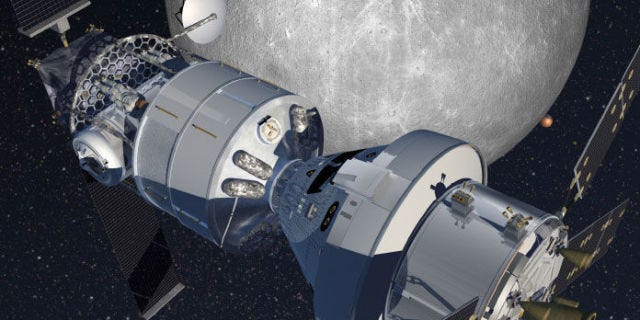
Gateway is NASA’s planned small space station in lunar orbit. It will serve as a staging point for lunar surface missions, a science platform, a communications hub, and a proving ground for future deep-space operations. Its first major elements include the Power and Propulsion Element and HALO, the Habitation and Logistics Outpost. These modules will support power, propulsion, communications, docking, and crew habitation.
Gateway is planned for a near-rectilinear halo orbit, a special path around the Moon that supports access to the lunar surface and communication with Earth. Artemis IV, V, and VI are expected to help assemble and use Gateway as lunar operations become more complex. Future missions may dock Orion, landers, logistics modules, and international elements at Gateway before crews descend to the surface.
Gateway matters because Mars missions will require astronauts to live and work far from Earth for long periods. A lunar station gives NASA a place to test deep-space habitation, logistics, radiation protection, autonomous operations, and international mission management without going all the way to Mars first. It is the cosmic equivalent of practicing in the shallow end before swimming across the ocean.
Robotic Scouts and Commercial Lunar Deliveries
Artemis is not only about astronauts. NASA’s Commercial Lunar Payload Services initiative, known as CLPS, uses commercial companies to deliver science instruments and technology demonstrations to the Moon. These robotic missions help NASA study lunar geology, radiation, surface conditions, navigation, communications, and resource potential before and between crewed missions.
CLPS missions also support the growth of a lunar economy. Companies such as Intuitive Machines, Firefly Aerospace, and Astrobotic are part of a broader commercial ecosystem that may one day deliver cargo, instruments, infrastructure, and services to the lunar surface. NASA is essentially saying: “We do not need to own every delivery truck; we need reliable deliveries.” That shift could make lunar exploration more flexible and affordable over time.
Why the Lunar South Pole?
The Moon’s South Pole is one of the most scientifically valuable and operationally interesting places on the lunar surface. Some crater floors there never receive direct sunlight, creating extremely cold traps where water ice and other volatiles may have accumulated over billions of years. Nearby high ridges may receive extended periods of sunlight, which could help support solar power.
For scientists, the South Pole offers clues about the history of the Moon, Earth, impacts, solar wind, and the early solar system. For engineers, it offers a challenging test environment for power systems, thermal control, mobility, communications, drilling, navigation, and resource use. For future Mars planners, it is a natural laboratory for learning how to operate in extreme, remote terrain.
International Cooperation and the Artemis Accords
NASA’s return to the Moon is not a solo act. The Artemis Accords establish principles for peaceful, transparent, safe, and sustainable exploration. By May 2026, dozens of nations had signed the accords, reflecting broad international interest in the future of lunar and deep-space activity.
International partners are also contributing hardware and expertise. Canada is involved through Gateway robotics and astronaut participation. ESA provides the European Service Module for Orion. Japan is contributing to Gateway-related capabilities and lunar exploration planning. Other partners are supporting science, logistics, communications, and long-term exploration goals.
This matters because the Moon is becoming a busy neighborhood. Government agencies, private companies, and international coalitions are all planning missions. Clear norms around transparency, interoperability, emergency assistance, scientific data, and preservation of historic sites help reduce confusion and risk. Space may be vast, but lunar landing zones can get crowded quickly.
How Artemis Leads to Mars
The phrase “Moon to Mars” is not just branding. NASA plans to use Artemis missions to test technologies and operations that will be essential for human Mars exploration. These include life-support systems, deep-space habitats, radiation protection, surface power, spacesuits, rovers, resource utilization, autonomous operations, medical procedures, logistics, and crew psychology.
Mars is far harder than the Moon. A lunar mission can last days or weeks, and Earth is about three days away. A Mars mission may last years, and communication delays mean astronauts cannot rely on real-time help from mission control. If something breaks on Mars, nobody can ship a replacement overnight. There is no “Prime delivery to Jezero Crater,” at least not yet.
The Moon lets NASA practice living off Earth while still remaining close enough to learn quickly. Every Artemis mission can reduce risk for Mars by answering practical questions: How do astronauts work in dust? How do habitats handle radiation? How much maintenance do rovers require? Can crews use local resources? How should mission control support astronauts when they are increasingly independent?
The Bigger Goal: A Sustainable Space Economy
NASA’s Artemis plan also aims to stimulate a broader space economy. By using commercial contracts for landers, suits, rovers, payload deliveries, communications, and logistics, NASA is encouraging private companies to develop capabilities that may serve government and commercial customers. This model is similar in spirit to the commercial cargo and crew programs that helped reshape access to the International Space Station.
If Artemis succeeds, the Moon could become a place where companies deliver cargo, test technologies, operate communications networks, support scientific instruments, and eventually provide infrastructure. That does not mean lunar cities will pop up next Tuesday. The Moon is still harsh, expensive, and deeply inconvenient. But Artemis is laying the groundwork for a future where lunar operations become more routine than heroic one-off expeditions.
Challenges NASA Must Solve
NASA’s plan is ambitious, and ambition brings problems. Schedules can slip. Hardware can underperform. New landers must prove complex capabilities such as docking, propellant transfer, crew support, and safe landing. Spacesuits must be reliable in extreme cold, abrasive dust, and low gravity. Gateway must be assembled and operated far from Earth. Surface power, communications, and logistics must support longer missions.
There are also policy and budget challenges. A sustainable lunar program requires long-term funding, political support, international coordination, and careful management of commercial contracts. The Artemis plan is not a single mission that can be declared “done.” It is a continuing campaign that must survive technical delays, changing administrations, and the occasional reminder that space hardware is allergic to shortcuts.
Experience Section: What Humanity’s Return to the Moon Feels Like
Watching NASA return astronauts to lunar space feels different from reading about Apollo in a history book. Apollo has become almost mythic: grainy footage, white spacesuits, black sky, and those famous words echoing across generations. Artemis feels more like a bridge between memory and tomorrow. It has the emotional pull of the old Moon race, but the structure of a modern global project. It is less “plant the flag and sprint home” and more “build the campsite, test the tools, invite the neighbors, and figure out how to stay.”
One of the most interesting experiences related to Artemis is realizing how much invisible work sits behind a single lunar mission. A launch may last minutes, but the mission depends on years of welding, testing, simulation, software reviews, suit fittings, engine checks, pad upgrades, recovery rehearsals, astronaut training, and failure analysis. Spaceflight looks glamorous on launch day because thousands of people spent years making it less terrifying than it naturally is.
There is also something deeply human about the Moon as a destination. Unlike Mars, which appears as a reddish dot to most people, the Moon is familiar. We see it from sidewalks, beaches, farms, apartment windows, and traffic jams. It belongs to everyone’s sky. When Artemis astronauts head there, the journey feels personal even to people who will never step inside a spacecraft. The Moon is close enough to feel reachable and far enough to remain magical.
The Artemis experience is also educational. It encourages people to think about science not as a list of facts, but as a process of careful risk reduction. NASA does not jump directly from one success to the next grand finale. It tests, revises, delays when necessary, and learns. That can be frustrating for the public, especially in an age of instant updates and impatient comment sections. But in human spaceflight, patience is not bureaucracy; it is survival.
For students, Artemis offers a powerful example of interdisciplinary work. Returning to the Moon requires physics, biology, geology, robotics, software engineering, materials science, medicine, communications, logistics, law, diplomacy, and even storytelling. The astronaut on the surface may become the face of the mission, but the mission itself is a team sport played across laboratories, factories, universities, launch sites, control rooms, and international agencies.
For ordinary space fans, Artemis brings back the delightful habit of looking up. A Moon mission turns the night sky into a live destination. Suddenly, the glowing object above the rooftops is not just scenery; it is a place with planned landing regions, spacecraft routes, future rovers, science stations, and human footprints yet to be made. That sense of connection is hard to measure, but it is one of space exploration’s greatest gifts.
And yes, there is humor in it too. Humanity is trying to cross deep space inside machines built by committees, contractors, engineers, and people who probably drink too much coffee during launch week. We are designing Moon cars, Moon boots, Moon elevators inside giant landers, Moon habitats, Moon power systems, and Moon traffic rules. It is absurd in the best possible way. We are tiny creatures on a blue planet deciding that the gray rock in the sky should become our next classroom.
Conclusion: Artemis Is the Moon Mission That Points Past the Moon
NASA’s plan for humanity’s return to the Moon is bold because it is not satisfied with repeating the past. Artemis is designed to build a future: safer deep-space transportation, longer surface stays, better science, commercial lunar services, international cooperation, Gateway operations, advanced suits and rovers, and a practical path toward Mars.
The Moon is the first destination, but not the final one. Through Artemis, NASA is trying to learn how humans can live and work beyond Earth in a sustainable way. The next footprints on the lunar surface will be historic, but the real achievement will be what comes after them: repeated missions, deeper science, stronger partnerships, and a space exploration system that can carry humanity farther than ever before.
So when someone asks why NASA is going back to the Moon, the answer is simple: because going back is how we move forward.