Editorial note: This article is based on real astronomy findings from public science releases, telescope mission updates, and peer-reviewed research about newly confirmed early-universe galaxies, especially MoM-z14 and related James Webb Space Telescope discoveries.
A Tiny Smudge That Just Rewrote a Big Chapter of Space History
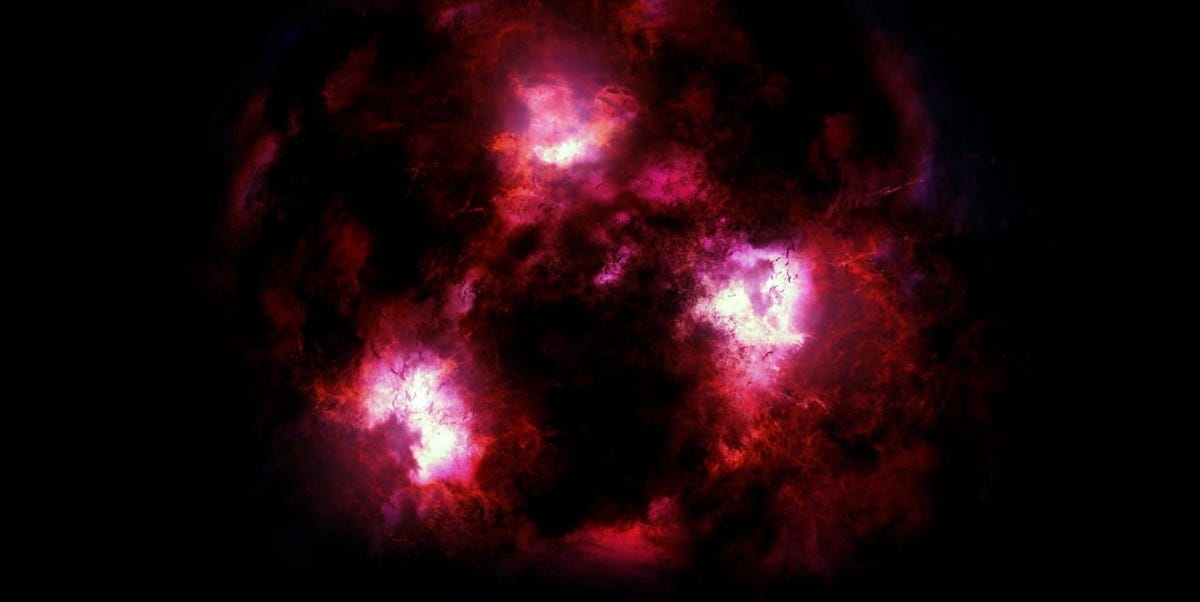
A new galaxy discovered near the edge of the observable universe sounds like the opening line of a sci-fi movie, preferably one with dramatic music and at least one astronaut whispering, “That should not be there.” But in this case, the plot twist is real. Astronomers using the James Webb Space Telescope have confirmed a remarkably distant galaxy known as MoM-z14, a compact, bright object seen as it existed only about 280 million years after the Big Bang.
That number deserves a moment. The universe is about 13.8 billion years old, so observing a galaxy from 280 million years after the Big Bang is like flipping through a 500-page history book and finding a detailed city map on page ten. Scientists expected the early universe to be busy, yes, but not quite this organized, luminous, and chemically interesting so soon. MoM-z14 is not simply another faint dot in a telescope image. It is a clue, a challenge, and possibly the universe’s way of saying, “Your models were cute.”
The phrase new galaxy discovered can be a little misleading, because the galaxy itself is ancient. It is not new in the sense of having recently formed. It is new to us because its light has finally been captured and confirmed by modern instruments. That light has been traveling through expanding space for roughly 13.5 billion years, stretched into infrared wavelengths before reaching Webb’s sensitive detectors. In astronomy, looking far away is also looking far back in time. The telescope is not just a camera; it is a time machine with excellent mirrors.
What Exactly Was Discovered?
The newly highlighted galaxy, MoM-z14, is one of the most distant galaxies ever confirmed. Its name may sound like a Wi-Fi password chosen by a tired astrophysicist, but it comes from the “Mirage or Miracle” survey, a program designed to test whether bright early galaxies found by Webb are real cosmic surprises or measurement illusions. In this case, the galaxy appears to be very real, and the “miracle” part is doing some heavy lifting.
MoM-z14 was identified in the COSMOS field, a well-studied patch of sky that astronomers have used for years to understand galaxy evolution. Webb’s Near-Infrared Camera, or NIRCam, helped spot the candidate. Then Webb’s Near-Infrared Spectrograph, or NIRSpec, confirmed its distance by splitting its light into a spectrum. That spectrum showed a strong break caused by hydrogen absorption, along with ultraviolet emission lines that helped researchers measure its redshift.
The confirmed redshift is about 14.44. Redshift measures how much the universe’s expansion has stretched light. The higher the redshift, the farther back in cosmic time we are usually looking. For everyday comparison, imagine drawing a tiny blue line on a rubber band and stretching the rubber band until the line looks redder and longer. The universe does something similar to light traveling across billions of years. It stretches that light until visible and ultraviolet signals shift into infrared wavelengths, exactly the kind Webb was built to detect.
Why MoM-z14 Matters
The discovery matters because MoM-z14 is not behaving like a sleepy newborn galaxy. It is surprisingly bright for such an early era. Before Webb launched, many galaxy formation models predicted that galaxies this early should be rarer, smaller, and harder to see. Webb has repeatedly found that the early universe was livelier than expected, full of galaxies that appear bright, compact, and rapidly forming stars.
MoM-z14 adds fuel to that debate. It appears to belong to a growing population of unexpectedly luminous galaxies from cosmic dawn, the period when the first stars and galaxies began transforming the universe from darkness into structure. Scientists are now asking whether early galaxies formed stars more efficiently than expected, whether early star clusters were unusually dense, or whether some unknown factor helped these galaxies shine so strongly.
This does not mean cosmology is broken, despite the internet’s deep love of dramatic headlines. Science is not a porcelain vase that shatters every time new data arrives. It is more like a whiteboard that gets erased, corrected, and occasionally attacked with three colors of marker. MoM-z14 does not overthrow everything astronomers know. Instead, it forces researchers to refine their understanding of how quickly galaxies, stars, dust, and heavy elements developed in the young universe.
How Webb Finds Galaxies That Old
The James Webb Space Telescope is uniquely suited to this work because it observes infrared light with extraordinary sensitivity. The earliest galaxies emitted energetic ultraviolet and visible light, but over billions of years, cosmic expansion stretched that light into the infrared. Earlier telescopes, including Hubble, could glimpse some distant galaxies, but Webb was designed to go deeper into cosmic history.
Webb’s instruments work together like a cosmic detective team. NIRCam takes deep images and helps identify galaxy candidates based on how they appear or disappear in different filters. This “dropout” behavior can suggest that light has been shifted by extreme cosmic distances. NIRSpec then provides the stronger evidence by spreading the light into a spectrum. Spectroscopy is crucial because photometric estimates can be wrong. A galaxy may look extremely distant in images but turn out to be closer after a careful spectral check.
That is why confirmation matters. In astronomy, a candidate galaxy is exciting, but a spectroscopically confirmed galaxy gets the VIP badge. It has passed a much tougher test. MoM-z14’s confirmation gives researchers a more reliable anchor point for studying the earliest known stages of galaxy growth.
The Early Universe Was Not Supposed to Be This Flashy
When astronomers look at galaxies such as MoM-z14, JADES-GS-z14-0, and Maisie’s Galaxy, a pattern begins to appear. The early universe seems to have produced bright galaxies faster than many models expected. JADES-GS-z14-0, previously one of the most distant confirmed galaxies, was seen less than 300 million years after the Big Bang and was already surprisingly large and luminous. Later observations even detected oxygen in that galaxy, suggesting that stars had already formed, lived, died, and enriched their surroundings with heavier elements.
That chemical enrichment is a big deal. The first stars were born mostly from hydrogen and helium. Heavier elements such as oxygen, carbon, and nitrogen had to be forged inside stars and spread by stellar winds or supernova explosions. Finding signs of chemical maturity so early means the first generations of stars may have lived fast and died young. Apparently, the early universe was not easing into its career. It went straight from “primordial fog” to “busy construction zone.”
MoM-z14 also shows hints that may connect it to unusual stellar populations. Researchers have noted nitrogen features that resemble patterns seen in some ancient star clusters in the Milky Way. One possibility is that very dense early star-forming environments produced extremely massive stars, helping explain the unusual chemistry. This is still an active research area, but it gives astronomers a tantalizing link between the first galaxies and old stellar relics much closer to home.
What Is Cosmic Dawn?
Cosmic dawn is the era when the universe’s first stars and galaxies began to shine. Before that, the universe passed through a long period often called the cosmic dark ages. There was matter, gas, gravity, and potential, but no stars lighting the place up. Eventually, gravity pulled gas into dense regions, stars ignited, and galaxies began assembling.
These first stars changed everything. Their radiation began clearing the fog of neutral hydrogen that filled the early universe. This process, called reionization, gradually made the universe more transparent to light. Galaxies like MoM-z14 are valuable because they existed during this transformation. They help scientists understand when reionization began, how quickly it progressed, and what kinds of objects powered it.
Think of the early universe as a foggy morning before sunrise. The first stars were not polite little candles. They were floodlights cutting through the mist. MoM-z14 may be one of the sources helping astronomers reconstruct how that cosmic fog lifted.
Why This Discovery Is Not Just About One Galaxy
A single galaxy can be fascinating, but the larger story is population. Webb is not finding one strange early galaxy and calling it a day. It is finding multiple bright galaxies at extremely high redshifts. That trend is what makes astronomers lean forward in their chairs.
If early bright galaxies are common, researchers must explain why. Did stars form more efficiently in small early galaxies? Were the first stars hotter, brighter, or more massive than stars forming today? Did black holes contribute to the light in some cases? Are current simulations missing important physics? Each possibility carries consequences for how scientists model the universe’s first few hundred million years.
There is also a practical reason these discoveries matter. Galaxies are cosmic archives. Their light contains information about star formation, gas, dust, chemical elements, black holes, and the large-scale growth of structure. Studying a galaxy like MoM-z14 is like finding a fossil from Earth’s earliest life, except the fossil is glowing, moving away from us, and requires a space telescope parked about a million miles from Earth. Simple hobby, really.
How “New Galaxy Discovered” Changes Public Imagination
Galaxy discoveries have a special way of grabbing attention because they expand the scale of what people think is possible. We are used to discoveries on Earth: a new species in a rainforest, a shipwreck under the ocean, an ancient city beneath desert sand. A new galaxy discovered by Webb belongs to the same emotional category, but it stretches the imagination across billions of years.
The discovery reminds us that space is not static scenery. The universe has a history. Galaxies are born, collide, grow, fade, and sometimes surprise everyone by showing up earlier than expected. The Milky Way itself is part of that long story. Our Sun, Earth, and bodies are made from elements produced by previous generations of stars. When astronomers study the first galaxies, they are not only studying distant objects. They are studying the beginning of the chain that eventually made planets, oceans, biology, and people arguing online about whether Pluto should still be a planet.
What Comes Next?
The next step is more observation. Scientists will continue using Webb to search for even more distant galaxies, confirm candidates with spectroscopy, and compare early galaxies across different survey fields. The Nancy Grace Roman Space Telescope, planned as a wide-field infrared observatory, is also expected to help astronomers discover huge numbers of distant galaxy candidates once it begins operations. Webb can study selected targets in exquisite detail, while Roman is designed to survey wide areas of sky efficiently. Together, they could turn today’s record-breaking discoveries into tomorrow’s statistical map of cosmic dawn.
Future research will also focus on improving simulations. Astronomers need models that can reproduce the number, brightness, chemistry, and structure of galaxies Webb is finding. If models cannot keep up, they will be revised. That is not a failure of science. That is science doing its job in public, wearing slightly mismatched socks and carrying a clipboard.
Experience Section: What It Feels Like to Follow a New Galaxy Discovery
For many readers, the experience of learning about a new galaxy discovered by Webb begins with a headline that sounds almost too grand to be real: “Most distant galaxy ever found” or “Galaxy seen near the beginning of time.” The first reaction is usually awe. The second reaction is confusion. How can a galaxy be 13.5 billion years old? How can we see something that no longer looks the same today? And why does every galaxy name look like someone sneezed into a keyboard?
The best way to experience this topic is to slow down and imagine the journey of the light. When MoM-z14 emitted the light Webb now sees, Earth did not exist. The Sun did not exist. The Milky Way was still building itself through mergers, star formation, and gravitational drama. That ancient light crossed space while generations of stars were born and died, while our solar system formed, while life appeared on Earth, while dinosaurs came and went, and while humans eventually built a telescope cold and sensitive enough to catch the signal. That is not just astronomy. That is patience on a cosmic scale.
Stargazing makes the idea more personal, even without professional equipment. A person standing outside under a dark sky can see the Milky Way as a pale band of light, the combined glow of countless stars in our own galaxy. With binoculars, they might spot the Andromeda Galaxy, a neighboring spiral about 2.5 million light-years away. That already feels enormous. Then Webb enters the conversation and stretches the scale from millions of years to billions. Suddenly, Andromeda feels like the house next door, and MoM-z14 is a message from the deep childhood of the universe.
Another memorable experience comes from seeing Webb images for the first time. Deep-field images are crowded with galaxies, not stars. Every tiny oval, streak, dot, or red smudge may be a galaxy containing billions of stars. The emotional effect is humbling and slightly comedic. Humans spend all day worrying about inboxes, traffic, and whether the coffee machine is making that noise again, while the sky quietly contains more galaxies than our brains can comfortably process before lunch.
Teachers, parents, and science communicators can use discoveries like MoM-z14 to make astronomy feel alive. Instead of presenting the universe as a finished diagram in a textbook, they can show that new data still changes the story. Students can learn that science is not memorizing old answers. It is asking better questions when the universe refuses to behave neatly. A new galaxy discovered at cosmic dawn becomes a doorway into physics, chemistry, time, engineering, and human curiosity.
For amateur astronomy fans, the practical experience is also rewarding. You cannot see MoM-z14 through a backyard telescope, but you can follow the discovery process. Read telescope updates, compare images, learn what redshift means, and watch how candidate objects become confirmed galaxies. Understanding the method makes the announcement more exciting. It turns “scientists found a dot” into “scientists measured ancient light, confirmed its spectrum, and used it to test the history of the universe.” That is a much better story, and thankfully it does not require anyone to personally travel 13.5 billion light-years. Parking would be impossible.
Conclusion: A New Galaxy, an Older Universe, and a Better Question
The discovery of MoM-z14 is more than a record-setting astronomy headline. It is a reminder that the universe still has surprises waiting in the dark. This new galaxy discovered by the James Webb Space Telescope gives scientists a clearer look at cosmic dawn, when the first galaxies were forming, stars were igniting, and primordial fog was beginning to clear.
MoM-z14’s brightness, extreme distance, and intriguing chemical clues suggest that early galaxy formation may have been faster and more energetic than many models predicted. Alongside other discoveries such as JADES-GS-z14-0 and Maisie’s Galaxy, it shows that Webb is not simply confirming old expectations. It is expanding them.
The most exciting part is that this is probably not the final record. As Webb continues scanning the deep universe and future observatories join the search, astronomers may find even older galaxies, perhaps closer to the birth of the first stars. Every discovery sharpens the picture. Every red smudge becomes a sentence in the universe’s autobiography. And every time we find a galaxy this ancient, the same question returns with new force: how did the cosmos grow up so fast?