Note: This article is written for web publication and is based on real public information about the Hackaday Prize 2023 Gearing Up Challenge finalists, rewritten in an original editorial style.
The Hackaday Prize 2023 Gearing Up Challenge was basically a love letter to the workbench. Not the shiny, suspiciously clean workbench from stock photos, but the real one: half-covered in jumper wires, mystery screws, coffee stains, 3D-printed brackets, and at least one tool you made because buying it felt either too expensive, too boring, or too emotionally damaging.
That is the spirit of “Gearing Up.” Instead of asking makers to build a finished consumer gadget, the challenge asked a more wonderfully practical question: what have you built that helps you build the next thing? The finalists answered with tools for electronics prototyping, PCB fabrication, testing, manufacturing, work-holding, cybersecurity fieldwork, and everyday device control. In other words, they built the kind of hardware that makes other hardware possible.
The ten finalists each earned a place in the 2023 Hackaday Prize Finals and a $500 finalist prize. More importantly, they showed why open source hardware competitions still matter. A good tool does not just solve one person’s problem. It becomes a shortcut for the next builder, a teaching object for the next student, and occasionally a polite insult to overpriced commercial equipment.
What Was the Gearing Up Challenge?
The Hackaday Prize 2023 marked ten years of the competition, and the Gearing Up Challenge focused on fabrication, production, manufacturing, lab equipment, fixtures, and functional tools. The theme was broad enough to welcome a 3D-printed CNC mill, a pocket electronics lab, a high-power electronic load, and a robotic helper arm without forcing them into the same awkward elevator pitch.
At its core, Gearing Up celebrated the maker’s oldest instinct: when the existing tool is too expensive, too limited, too bulky, or simply not weird enough, build your own. That attitude runs through every finalist. Some projects attacked cost barriers. Others improved portability or workflow. A few turned the humble electronics bench into something closer to a superhero utility belt, minus the cape and legal department.
The Ten Hackaday Prize 2023 Gearing Up Finalists
The finalist list included DIY Spin Coater, Jumperless, Felini, Low-Cost Universal Tensile Testing Machine, UV Projection Printer for PCBs and Item Marking, 10kW Electronic Load, OMOTE DIY Universal Remote, CyberSecDeck-001, Work-holding Robotic Arm for Electronic Workshop, and Minamil 3dp. Together, they form a surprisingly complete picture of what modern hardware builders actually need: faster prototyping, better testing, cheaper machines, cleaner workflows, and tools that do not require selling a kidney on a mysterious industrial auction site.
Jumperless: Breadboarding Without the Jumper Wire Jungle
Jumperless may be the finalist that makes the most electronics hobbyists pause mid-sip. It rethinks the solderless breadboard by replacing physical jumper-wire routing with analog crosspoint switches. Instead of manually connecting rows with a spaghetti festival of wires, users can create real hardware connections through software while still working with actual components.
The beauty is not just tidiness, although tidiness deserves a tiny parade. Jumperless also brings sensing and visual feedback into the breadboard experience. RGB LEDs under the rows can show information about the circuit, helping builders understand what is connected and what is happening. For educators, rapid prototypers, and anyone who has ever pulled one jumper wire and accidentally dismantled their evening, this is a serious workflow upgrade.
Felini: A Pocket-Sized Electronics Lab
Felini describes itself like a Swiss Army knife for electronics, and that comparison is fair as long as we imagine a Swiss Army knife that cares deeply about embedded systems. The device aims to replace several common electronics tools with a compact touchscreen interface. Its feature set targets real field and bench needs: debugging, communication buses, GPIO work, voltage measurements, timing, servo testing, and more.
The larger lesson behind Felini is portability. Modern electronics work does not always happen in a perfectly equipped lab. Sometimes it happens next to a machine, in a classroom, on a kitchen table, or in the corner of a hackerspace where the good oscilloscope has mysteriously “just walked away.” A capable compact tool lowers the friction between “I should test this” and actually testing it.
DIY Spin Coater: Semiconductor Vibes on a Maker Budget
A spin coater is used to spread a thin, consistent layer of liquid over a flat surface, such as applying photoresist to PCB material. Commercial spin coaters can be painfully expensive, especially for hobbyists or small labs. The DIY Spin Coater finalist tackles that problem with an approachable design built around readily available parts such as brushless motors, speed control electronics, a microcontroller, and a protective enclosure.
This is classic Gearing Up energy: take a tool associated with serious laboratory work, study the actual requirement, and rebuild it at a scale and price that makes sense for independent builders. The result is not just a cheaper machine. It is a practical reminder that many “professional” tools are understandable once someone is brave enough to remove the aura of mystery, preferably while wearing safety glasses.
Low-Cost Universal Tensile Testing Machine: Breaking Things Scientifically
The Low-Cost Universal Tensile Testing Machine brings mechanical testing into a more accessible range. Tensile testing machines stretch samples until they fail, measuring force along the way. Commercial systems can cost many thousands of dollars, which is excellent news for companies with procurement departments and terrible news for students, makers, and small research groups.
This finalist proposes a roughly $300 open source testing machine for loads under 1000 newtons, made with 3D-printed and commercial components. That matters because materials testing is not just an academic luxury. Anyone developing 3D-printed parts, experimental composites, adhesives, brackets, fixtures, or prototypes benefits from knowing how strong their parts actually are. “It feels sturdy” is a vibe. Force data is an argument.
UV Projection Printer for PCBs and Item Marking
The UV Projection Printer for PCBs and Item Marking is one of those projects that sounds modest until you realize how many shop problems it touches. It can help create PCB etching masks, apply artwork to objects, and mark panels or 3D prints. For one-off production and prototypes, that kind of flexible marking system can save time, money, and a surprising amount of grumbling.
Its approach uses UV exposure with printed or physical masks, including a 3D-printed holder and magnetic frame. The project emphasizes low cost, ease of preparation, and versatility. For builders who need labeling, masks, small graphics, or functional markings without diving into full screen printing or pad printing workflows, it offers a very maker-friendly middle path.
10kW Electronic Load: Testing Power Without Guessing
The 10kW Electronic Load finalist goes big. Very big. It targets applications where power supplies, batteries, and other high-current systems need demanding load tests. Modern computer power supplies, battery systems, and similar hardware can experience transient spikes far above their nominal operating levels, so testing under realistic stress is valuable.
Instead of following the usual linear MOSFET-based approach used in many smaller electronic loads, this design uses switched high-power chassis-mount resistors to create scalable load conditions. It is a project that reminds readers of an important truth: sometimes “tool building” is not cute and desktop-sized. Sometimes it is high-power, heat-heavy, and deeply serious. Also, it probably deserves a fan roughly the size of a small weather system.
OMOTE: The DIY Universal Remote That Refuses to Be Ugly
OMOTE is an ESP32-based open source universal remote with a 2.8-inch capacitive touchscreen, infrared, Wi-Fi, Bluetooth, and a 3D-printed ergonomic case. It is designed to work without a hub or docking station and can be customized because the design files and code are open source.
What makes OMOTE fit the Gearing Up theme is its relationship to everyday control. A good remote is a tool for reducing friction. It turns a pile of devices and interfaces into something manageable. The project also shows that open source hardware does not have to look like a loose PCB zip-tied to a dream. It can be polished, friendly, and still hackable.
CyberSecDeck-001: A Portable Platform for Authorized Security Work
CyberSecDeck-001 sits somewhere between a cyberdeck, a field computer, and a server-room crash cart. It is designed as a mobile Linux-based platform for legitimate cybersecurity work and systems administration, with a physical keyboard, robust construction, portability, and modular expansion.
The project stands out because it treats fieldwork as a hardware design problem. If you need to inspect, administer, or troubleshoot systems in authorized environments, a normal laptop may not always be the ideal form factor. CyberSecDeck-001 makes the tool itself part of the workflow. It also has enough cyberpunk personality to make a plain laptop look like it forgot to put on shoes.
Work-holding Robotic Arm for Electronic Workshop
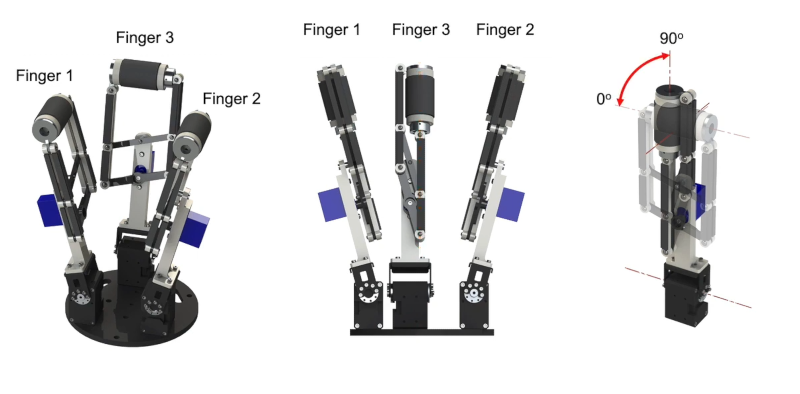
Every electronics builder eventually needs a third hand. Then a fourth. Then perhaps a calm assistant who does not sigh when asked to hold a PCB at a slightly different angle for the ninth time. The Work-holding Robotic Arm for Electronic Workshop explores that need through robotic assistance for holding, sorting, and manipulating objects in a workshop setting.
The project includes multiple versions using hardware such as Arduino, ESP32, Alexa Echo Dot integration, Infineon hardware, and sensing mechanisms. Its purpose is not to replace the builder, but to support repetitive or awkward tasks: holding boards, handling parts, picking objects, or sorting items. In a world where workshop ergonomics often means “try not to drop the hot thing,” this is a welcome direction.
Minamil 3dp: A Small CNC Mill With a Big Point
Minamil 3dp is a compact, 3D-printed CNC mill designed for small, precise work. Its work volume is modest, but that is part of the design philosophy. Instead of pretending to be a full industrial machine, it leans into small cutters, light cuts, and accessible construction.
The project is especially interesting for PCB milling and small parts. A machine like this is not trying to hog steel like a factory beast. It is trying to make precision more available to people who have a desktop, a 3D printer, and the patience to let light cuts do their quiet little dance. That is exactly the kind of tool that can change how fast someone moves from design to object.
Why These Finalists Matter
The Gearing Up finalists matter because they are not just gadgets. They are multipliers. A universal testing machine helps validate materials. A CNC mill helps create parts and PCBs. A spin coater improves coating workflows. Jumperless accelerates circuit exploration. Felini brings test equipment into a pocket. OMOTE makes control customizable. The robotic arm improves bench handling. CyberSecDeck-001 packages a field workstation. The UV printer adds marking and masking capability. The electronic load enables serious power testing.
That is the secret sauce of tool projects: the output is not only the tool, but every future project the tool enables. A homemade fixture may not look glamorous on social media, but it can quietly save hundreds of hours. A well-documented open source machine can travel farther than its original creator ever intended. A clever test rig can turn guesswork into engineering.
Open Source Hardware as a Practical Culture
The Hackaday Prize has always been more than a trophy race. Its best projects document decisions, failures, bill-of-materials choices, design tradeoffs, and lessons learned. That matters because hardware is stubborn. Software may throw an error message; hardware throws smoke, vibration, noise, thermal problems, and occasionally a tiny spring that teleports into another dimension.
By publishing open documentation, makers give others a head start. A builder reading the DIY Spin Coater logs can learn from motor-control challenges. Someone studying Minamil 3dp can think more clearly about stiffness and small-machine constraints. A user exploring Jumperless can see how analog switching can reinvent a familiar prototyping format. This shared learning is the real prize ecosystem.
Experience Notes: What Builders Can Learn From the Gearing Up Finalists
If there is one experience that connects the Hackaday Prize 2023 Gearing Up Challenge finalists, it is the moment when a builder realizes the missing tool is now the project. This happens constantly in real workshops. You begin with a goal like “make a PCB,” “test a battery,” or “hold this board steady,” and suddenly you are designing a machine, writing firmware, tuning a motor, printing brackets, and wondering why your weekend has developed a bill of materials.
The first lesson is that tool projects should begin with workflow, not features. Jumperless is compelling because it attacks a daily annoyance in breadboarding: physical wire management. Felini works as a concept because it imagines the technician in the field who needs several small tools without carrying a suitcase. OMOTE succeeds because it does not simply say “remote control,” it says “customizable control without the usual hub drama.” The best tool projects start by watching where people lose time.
The second lesson is to be honest about scale. Minamil 3dp does not pretend to be a giant CNC mill. Its strength is being small, accessible, and precise within limits. That honesty is powerful. A DIY machine fails when it promises industrial performance from hobby-grade structure. It succeeds when it defines the job clearly and optimizes around that job. Light cuts, small work areas, and repeatable setup can be better than raw power when the target is desktop fabrication.
The third lesson is that cost reduction is not just about cheaper parts. The Low-Cost Universal Tensile Testing Machine and DIY Spin Coater show that affordability comes from understanding the required function. What measurement range is actually needed? What speed is enough? What level of accuracy matters? What parts are already common because another industry, like drones or 3D printing, made them cheap? Smart tool builders borrow from existing ecosystems instead of reinventing every screw.
The fourth lesson is documentation. A brilliant tool with no build notes becomes a museum artifact: nice to admire, hard to reproduce. The Hackaday culture rewards logs, photos, files, parts lists, and frank explanations of what went wrong. Those details are gold. A note about a bad ESC, a vibration issue, a power spike, or a mechanical alignment problem can save another builder days of confusion. In open hardware, failure notes are not embarrassing; they are community service.
The final lesson is that personality helps. CyberSecDeck-001 has a strong visual identity. OMOTE looks polished. The robotic work-holding arm is memorable because everyone understands the “third hand” problem. A tool does not have to be bland to be serious. In fact, a little character can help people care long enough to study the design, fork the files, and build their own version. The best Gearing Up projects are practical, but they also carry the spark of “I want one of those on my bench.” That spark is how open source hardware keeps moving.
Conclusion
The Hackaday Prize 2023 Gearing Up Challenge finalists show the maker community at its most useful: not just building things, but building the things that help everyone else build better things. From jumper-free breadboarding to compact CNC milling, from pocket electronics tools to high-power testing equipment, the finalist lineup captures a broad and energetic view of open source hardware.
These projects are not merely clever contest entries. They are evidence that the workshop is still evolving. The future of making will not be defined only by faster chips or shinier dev boards. It will also be shaped by the jigs, testers, fixtures, printers, mills, arms, remotes, and portable labs that turn ideas into working prototypes. And if those tools happen to look cool while doing it, nobody at the bench is going to complain.