Imagine ordering a “perfect clone” the way you might duplicate a file on your laptop: click, copy, paste, and boomanother you, same face, same memories, same terrible habit of opening the fridge every ten minutes. Science fiction loves that idea because it is dramatic, creepy, and wonderfully convenient for plot twists. Real biology, however, is much less cooperative. Creating a perfect clone is impossible because life is not a photocopier. It is more like a jazz band playing during a thunderstorm: there is a score, but every performance changes.
The main keyword here is simple: perfect clone. But the real answer is layered. A biological clone may share nearly identical nuclear DNA with another organism, but DNA is not destiny in the simple, movie-trailer sense. Genes interact with epigenetics, cell division errors, mitochondrial DNA, the womb, the microbiome, random development, social environment, learning, memory, and plain old chance. Even identical twinsnature’s closest thing to human clonesare not carbon copies. They may look alike, finish each other’s sentences, and confuse substitute teachers, but they are still two separate people with different bodies, brains, experiences, and futures.
What Does “Clone” Actually Mean?
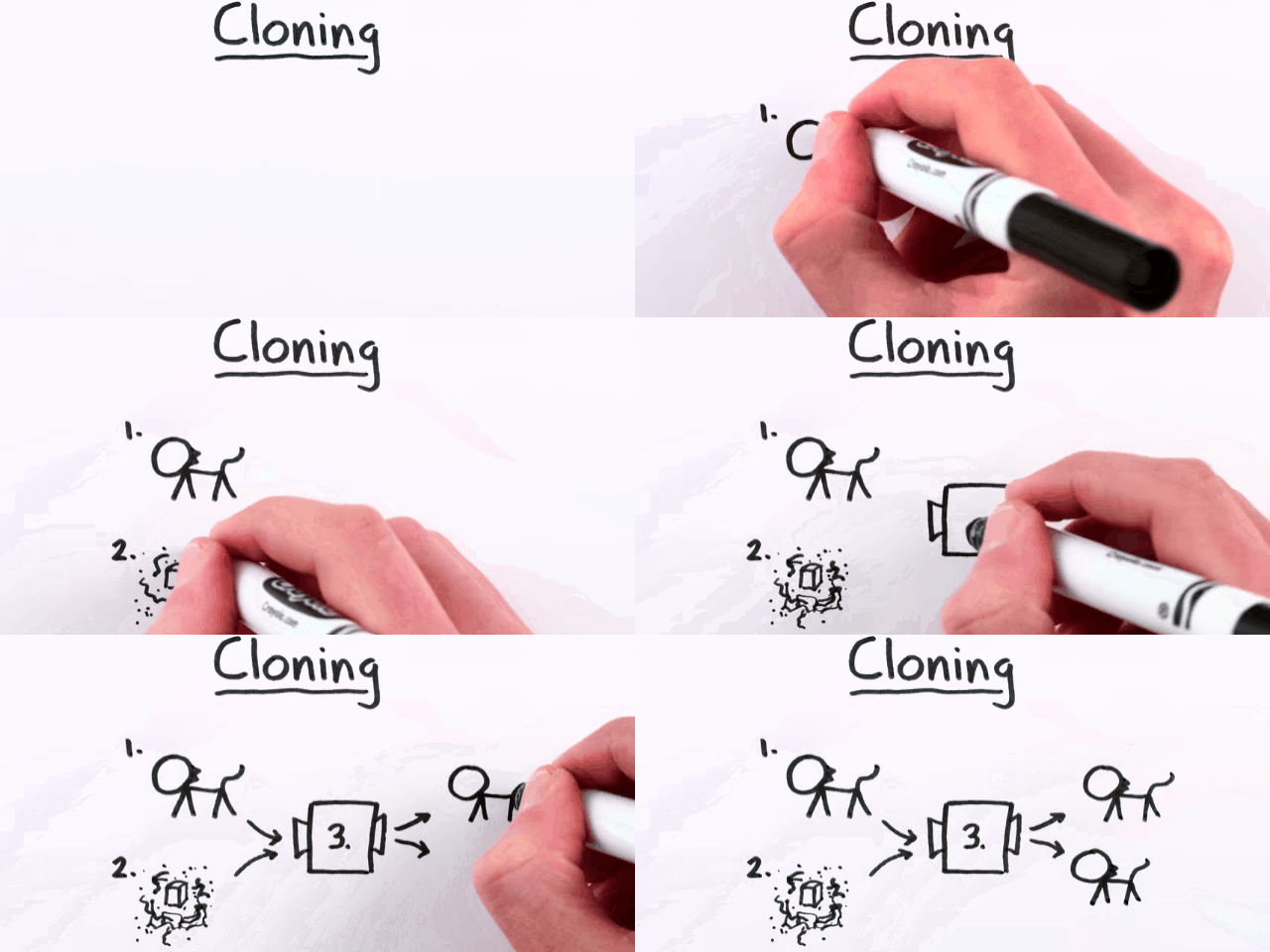
A clone is a biological copy that shares genetic material with an original source. Scientists use the word in several ways. Gene cloning copies a piece of DNA. Therapeutic cloning may create cells for research or potential medical use. Reproductive cloning aims to create a living organism with the same nuclear DNA as another organism. These are not the same thing, even though headlines often mash them together like a science smoothie.
The famous example is Dolly the sheep, the first mammal cloned from an adult cell. Dolly was created through somatic cell nuclear transfer, a process in which scientists removed the nucleus from an egg cell and inserted the nucleus from an adult donor cell. That nucleus carried the donor’s genetic instructions. The reconstructed egg was then stimulated to develop into an embryo. It was revolutionary, but not magical. Dolly proved that adult cell DNA could be reprogrammed to build a whole animal, not that science had discovered a biological copy machine with a “perfect duplicate” button.
Reason One: DNA Is Only Part of the Story
The biggest misunderstanding about cloning is the belief that identical DNA creates an identical individual. DNA is more like a giant instruction library than a finished sculpture. Two organisms can start with very similar instructions and still develop differently because the body constantly decides which instructions to read, ignore, amplify, silence, or modify.
Think of DNA as a cookbook. Two cooks can use the same recipe and still produce different cakes. One oven runs hot. One person adds a little extra vanilla. One forgets the timer because a cat knocked over a plant. Biology has even more variables than a chaotic kitchen. Cells respond to chemical signals, oxygen levels, nutrient availability, temperature, hormones, stress, and random molecular events. The recipe matters, but the cooking conditions matter too.
Reason Two: Epigenetics Changes How Genes Behave
Epigenetics is one of the strongest reasons a perfect clone cannot exist. Epigenetic marks do not usually change the DNA sequence itself. Instead, they influence how genes are turned on or off. These marks help explain why a liver cell and a brain cell can contain the same DNA but behave completely differently. The liver cell is not sitting around wondering why it cannot write poetry; it is following a different set of gene-expression instructions.
Environment, behavior, development, aging, diet, chemical exposures, stress, and other factors can shape epigenetic patterns. In cloning, the donor nucleus must be reprogrammed so it can act like an early embryonic nucleus again. That reprogramming is difficult and imperfect. Some genes may be activated at the wrong time. Others may remain too quiet. Even when a clone is healthy, its gene-expression patterns are not guaranteed to match the original.
Identical Twins Prove the Point
Identical twins are often used as a natural comparison for cloning because they begin from the same fertilized egg. Yet studies show that twins accumulate biological differences over time. Their epigenetic patterns can drift apart, especially as they age and live through different experiences. One twin may have a different diet, illness history, sleep pattern, emotional stress load, or exposure to pollutants. Over the years, those differences can affect gene activity.
In other words, even nature’s best attempt at genetic duplication does not create perfect copies. If identical twins are not perfect clones, a laboratory clone has no realistic chance of becoming a perfect repeat of an existing person.
Reason Three: Mutations Happen Early and Randomly
Even before birth, cells divide again and again. Every division requires DNA copying, and DNA copying is impressively accurate but not flawless. Small mutations can occur during early development. If a mutation happens early enough, many cells in the body may carry it. If it happens later, only a smaller patch of cells may be affected.
This means two genetically identical embryos can become slightly genetically different as they grow. Research on monozygotic twins has found that even twins may differ by early developmental mutations. That is a big deal for the “perfect clone” fantasy. If two embryos created naturally from one original zygote can diverge, a clone created through a complicated laboratory procedure will also carry its own developmental history.
These tiny differences may not always be obvious. They may not change eye color or personality in a dramatic way. But they prove the deeper point: a living body is not a static file. It is a moving process, and moving processes gather differences.
Reason Four: Mitochondrial DNA Complicates the Copy
Most cloning discussions focus on nuclear DNA, the DNA stored in the cell nucleus. But cells also contain mitochondria, the energy-producing structures that carry their own small amount of DNA. In somatic cell nuclear transfer, the donor nucleus is inserted into an egg cell whose nucleus has been removed. The egg still contains mitochondria from the egg donor.
That means the clone may share nuclear DNA with the donor but not necessarily mitochondrial DNA. This is not a tiny technical footnote. Mitochondria influence energy metabolism, cell function, and development. A so-called clone may therefore be genetically close in one major way while still biologically different in another. The copy has a different cellular “power grid,” and that matters.
Reason Five: The Womb Is Not a Neutral Container
Development does not happen in a vacuum. For mammals, the womb is an active biological environment. Nutrients, hormones, immune signals, blood flow, maternal health, stress chemistry, and placental function all influence development. Even embryos with the same DNA can grow differently in different womb conditions.
This is why a clone of an adult animal could never “restart” the original life. It would develop in a different body, at a different time, under different conditions. The original may have grown during one season, in one maternal environment, with one set of exposures. The clone would experience another. Biology keeps receipts, and it writes them into development.
Reason Six: The Microbiome Is Personal
Every person carries a vast community of bacteria, viruses, fungi, and other microbes. This microbiome helps shape digestion, immunity, inflammation, skin health, and possibly even aspects of mood and metabolism. A clone would not inherit an identical microbiome like a preinstalled app bundle. Microbes are acquired through birth, feeding, touch, environment, illness, antibiotics, pets, food, travel, and daily life.
Two people with the same nuclear DNA can host different microbial ecosystems. That alone prevents a perfect clone. Your body is not just “you plus DNA.” It is also you plus trillions of tiny roommates, many of whom did not sign a lease but definitely influence the household.
Reason Seven: Brains Are Built by Experience
For human cloning, the biggest myth is psychological duplication. A clone would not wake up with the original person’s memories, skills, fears, jokes, favorite songs, heartbreaks, or suspiciously specific coffee order. Memories are not stored in DNA like files in a hard drive. They are built through neural connections shaped by experience.
A cloned baby of a brilliant musician would not be born knowing scales. A clone of a chess champion would not arrive with grandmaster instincts and a tiny dramatic cape. The clone might inherit certain biological tendencies, but talent still requires learning, practice, opportunity, culture, motivation, and luck. Personality is also shaped by relationships, childhood experiences, education, trauma, encouragement, and millions of small moments that cannot be replayed exactly.
Reason Eight: Cloning Technology Is Inefficient and Imperfect
Animal cloning has improved since Dolly, but it remains biologically difficult. Reprogramming an adult nucleus is not a simple reset. Embryos may fail to develop normally. Pregnancies may fail. Some cloned animals have had health problems, especially during early development. Even when clones survive and appear healthy, the process itself shows that cloning is not precision manufacturing.
Dolly’s creation required hundreds of attempts before one successful birth. That historical fact is often overlooked because the final result became famous. Science remembers the sheep; biology remembers the failed embryos. The gap between “we created a clone” and “we created a perfect clone” is not a crack in the sidewalk. It is the Grand Canyon wearing a lab coat.
Reason Nine: A Perfect Clone Would Require a Perfectly Repeated Universe
To create a perfect clone of a person, you would need more than matching DNA. You would need the same womb environment, the same nutrition, the same childhood, the same infections, the same accidents, the same teachers, the same friendships, the same cultural moment, the same books, the same jokes, the same heartbreaks, and the same random thoughts at 2:17 a.m. on a Tuesday.
That is impossible because life is time-sensitive. A person is not only a genome; a person is a biography. You cannot clone timing. You cannot clone the exact weather on the day someone learned to ride a bike. You cannot clone the particular tone of a parent’s encouragement, the sting of a childhood embarrassment, or the weird confidence boost of wearing a great jacket to school. These details sound small, but small details are how humans become themselves.
Perfect Clone vs. Genetic Twin: The Better Comparison
The most accurate way to think about a human clone is not “duplicate adult.” It is “delayed identical twin, with important biological differences.” A clone would begin life as a new individual. It might resemble the donor. It might share genetic risks or traits. But it would not be the donor. It would have its own development, its own cells, its own epigenetic marks, its own microbiome, its own memories, and its own legal and moral status as a separate person.
This distinction matters because sloppy language creates sloppy ethics. Calling a clone a “copy” can make people imagine a manufactured object rather than a living being. A cloned person, if one existed, would not be a backup drive, replacement child, celebrity remake, or immortality hack. They would be a human being with shared genetic material and an independent life.
Why the Myth of the Perfect Clone Sticks Around
The perfect clone myth survives because it is emotionally powerful. It promises control over biology, grief, talent, beauty, intelligence, and mortality. It suggests that we might duplicate what we love or preserve what we fear losing. That is tempting. Humans are very good at wanting the impossible and then asking science to please hurry up.
Movies and novels also prefer simple rules. “Same DNA, same person” is easy to explain in ten seconds. The truth takes longer: “Same nuclear DNA, but different epigenetic regulation, mitochondrial background, developmental environment, stochastic mutation pattern, microbiome, neural history, and lived experience.” That is more accurate, but it does not fit neatly on a movie poster unless the designer uses a very small font.
Real-World Examples That Make the Idea Clear
Example 1: Identical Twins With Different Health Outcomes
Identical twins can differ in disease risk and health outcomes. One twin may develop an autoimmune condition while the other does not. One may have allergies, anxiety, diabetes, or cancer while the other remains unaffected. Shared DNA can create shared risk, but it does not guarantee the same result. Environmental exposure, random cell events, immune history, and epigenetic changes all matter.
Example 2: Cloned Pets That Do Not Act Like the Original
Pet cloning companies sometimes market genetic continuity, but owners should not expect the same animal to return. A cloned cat or dog may look similar, yet its personality can differ. The new animal did not have the same puppyhood, training, smells, routines, fears, or bonds. It may share a genetic blueprint, but it writes a new story on that blueprint.
Example 3: Dolly the Sheep Was Historic, Not Identical in Every Way
Dolly showed that cloning from an adult cell was possible. She did not show that perfect biological duplication was possible. Her life demonstrated both the power and limits of cloning technology. The breakthrough was real, but it belonged to genetics and developmental biology, not science-fiction immortality.
Experience-Based Reflections: What This Topic Teaches Us
One practical experience related to this topic comes from classrooms, where cloning is often introduced with a deceptively simple question: “Would a clone be the same person?” At first, many students say yes. The logic feels obvious. Same DNA, same person. Then the discussion shifts to identical twins. Students usually know twins who dress differently, choose different hobbies, or have completely different personalities. Suddenly the idea of a perfect clone starts wobbling like a cheap folding chair. The twin comparison helps people understand that identity is not printed from DNA alone.
Another useful experience comes from pet ownership. Anyone who has raised two dogs from the same breedor even from the same litterknows how quickly individuality appears. One puppy charges into life like a tiny furry linebacker. Another hides behind a shoe and judges everyone. Genetics may shape size, coat, instincts, and temperament, but daily experiences shape behavior. Training, socialization, illness, fear, affection, and environment all leave marks. If siblings are already different, a cloned pet raised years later in a new home would be even less likely to recreate the original.
There is also a lesson from technology. People sometimes compare cloning to copying a digital file, but even digital “clones” can fail to behave identically when the environment changes. Move the same software to a different operating system, hardware setup, user profile, or corrupted dependency, and suddenly the clone acts strange. Biology is far more sensitive than software. Cells are not clean folders. They are wet, reactive, crowded, noisy systems. A living organism has no simple restore point.
In medical and genetics discussions, the topic teaches humility. Modern science can sequence genomes, edit genes, grow organoids, study stem cells, and clone animals. That is astonishing. But the more scientists learn, the clearer it becomes that life is not controlled by one master switch. The genome matters enormously, yet it works inside networks. Cells talk. Tissues respond. Environments interfere. Randomness sneaks in wearing socks on a polished floor. This complexity is not a failure of science; it is the reason biology is so fascinating.
On a personal level, the impossibility of a perfect clone is oddly comforting. It means each person is more than a biological pattern. You are not just your genes, your family traits, or your inherited risks. You are also your choices, your memories, your relationships, your timing, your mistakes, your recoveries, and your strangely specific preferences. A clone might share a genetic starting point, but it could never steal the full meaning of an individual life. The original remains original, not because science is weak, but because life is wonderfully, stubbornly unrepeatable.
Conclusion: The Perfect Clone Belongs to Fiction
Creating a perfect clone is impossible because no organism is only its DNA. A clone can copy nuclear genetic material, but it cannot copy epigenetic history, developmental randomness, mitochondrial background, womb conditions, microbiome, memories, relationships, culture, or lived experience. Even identical twins, the closest natural example, are not perfect duplicates. They are separate individuals who begin with similar genetic instructions and then grow into different lives.
The science of cloning is real, powerful, and important. It has changed genetics, agriculture, stem cell research, and the way we think about development. But the fantasy of copying a person exactlybody, mind, identity, and destinyis not biology. It is storytelling. In the real world, every living being is a one-time event. DNA may start the sentence, but life writes the paragraph.
Note: This article is written for web publication in standard American English and is based on real scientific concepts from genetics, cloning research, epigenetics, microbiome science, and developmental biology.