When people argue about the “oldest” MCU characters, things can get delightfully chaotic. Thor is thousands of years old in-universe. Loki has been causing cosmic customer-service complaints for ages. Groot may be a walking tree with the emotional range of a poetry professor trapped in three words. But this ranking is not about fictional age. It is about real-world comic book history: which Marvel Cinematic Universe characters appeared first on the printed page?
That makes the question much more interesting. The MCU may have launched with Iron Man in 2008, but many of its biggest characters were born decades earlier, back when Marvel was still Timely Comics, superhero covers were loud enough to be heard across the room, and villains had names like “The Red Skull” because subtlety was apparently on vacation.
Below, we rank some of the oldest MCU characters based on their first comics appearance, focusing on characters who have appeared in Marvel Studios films or series. Some dates are surprisingly ancient, some are comic-history trivia gold, and some prove that Marvel was building a shared universe long before post-credit scenes trained us to sit through the entire credits.
What Does “Oldest MCU Characters” Mean Here?
For this article, “oldest” means the earliest real-world comic book debut, not the character’s age inside the MCU story. That is why Namor can outrank Thor, even though Thor is a literal god and Namor is more of an aquatic royal with winged ankles and excellent posture.
We are also focusing on recognizable MCU characters: heroes, villains, antiheroes, and supporting figures who made the jump from Marvel Comics to Marvel Studios. The ranking uses first comic appearances, including Golden Age issues, Silver Age relaunches, and important caveats where Marvel reused or reimagined earlier characters.
Quick Ranking: Oldest MCU Characters by First Comics Appearance
| Rank | Character | First Comics Appearance | Year | MCU Connection |
|---|---|---|---|---|
| 1 | Namor | Motion Picture Funnies Weekly #1 / Marvel Comics #1 | 1939 | Black Panther: Wakanda Forever |
| 2 | Captain America | Captain America Comics #1 | 1941 | Captain America: The First Avenger |
| 3 | Bucky Barnes | Captain America Comics #1 | 1941 | The Winter Soldier, Thunderbolts* |
| 4 | Red Skull | Captain America Comics #1 / #7 | 1941 | The First Avenger, Infinity War |
| 5 | Loki | Venus #6 / Journey into Mystery #85 | 1949 / 1962 | Thor, Loki |
| 6 | Groot | Tales to Astonish #13 | 1960 | Guardians of the Galaxy |
| 7 | Hank Pym | Tales to Astonish #27 | 1962 | Ant-Man |
| 8 | Hulk | The Incredible Hulk #1 | 1962 | The Incredible Hulk, The Avengers |
| 9 | Thor | Journey into Mystery #83 | 1962 | Thor, The Avengers |
| 10 | Spider-Man | Amazing Fantasy #15 | 1962 | Captain America: Civil War, Spider-Man: Homecoming |
| 11 | Iron Man | Tales of Suspense #39 | 1963 | Iron Man |
| 12 | Doctor Strange | Strange Tales #110 | 1963 | Doctor Strange |
1. Namor: Marvel’s Ancient Antihero of the Deep
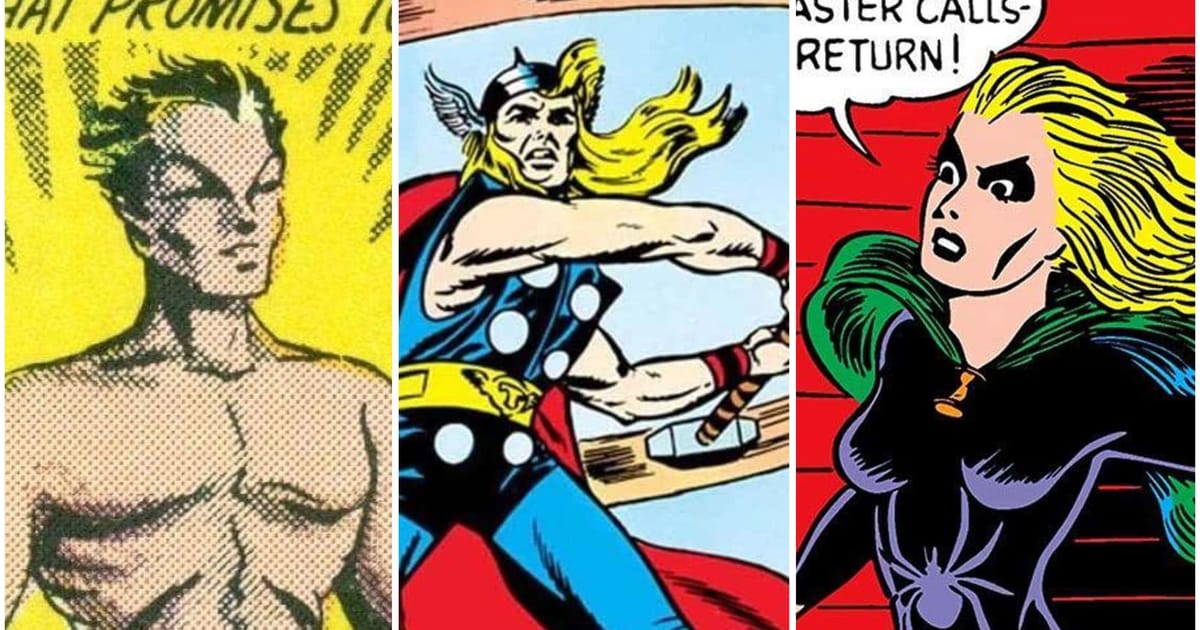
Namor is the surprise winner of this list, and frankly, he would probably demand a crown for it. Created by Bill Everett, Namor the Sub-Mariner first appeared in an early 1939 project called Motion Picture Funnies Weekly, then reached a wider audience in Marvel Comics #1 later that year. That places him at the very dawn of Marvel history, before Captain America, before the Avengers, and long before anyone in the MCU was arguing about multiverse rules.
In the comics, Namor was not a clean-cut superhero. He was arrogant, royal, angry, noble, and occasionally one bad mood away from declaring war on the surface world. That complicated personality made him one of Marvel’s earliest antiheroes. In the MCU, Black Panther: Wakanda Forever reimagined him as the ruler of Talokan, giving him a Mesoamerican-inspired background while preserving his essential traits: pride, power, suspicion of outsiders, and dramatic entrance energy strong enough to flood a room.
2. Captain America: The Star-Spangled Veteran
Steve Rogers debuted in Captain America Comics #1 in 1941, famously appearing on a cover where he punches Adolf Hitler. Subtle? No. Historically memorable? Absolutely. Created by Joe Simon and Jack Kirby, Captain America arrived before the United States entered World War II, which gave the character an unusually direct political edge for the time.
In the MCU, Steve Rogers became the moral center of the Infinity Saga. His comic book origin already had the essential ingredients: a frail young man, a super-soldier serum, a shield, and a stubborn refusal to back down from bullies. The movies updated the tone, but the core idea remained intact. Captain America is old not just because he was frozen in ice, but because his comic book DNA comes straight from the Golden Age of superheroes.
3. Bucky Barnes: From Sidekick to Winter Soldier
Bucky Barnes also debuted in Captain America Comics #1, making him one of the oldest MCU characters by publication history. Originally, Bucky was Captain America’s youthful sidekick, a common superhero trope of the era. Comic book sidekicks were everywhere, because apparently every adult crimefighter in the 1940s needed a brave teenager nearby for emotional stakes and questionable workplace safety.
The MCU transformed Bucky into one of its most tragic long-running characters. His reinvention as the Winter Soldier came from modern comics, but his roots go all the way back to 1941. That contrast is what makes him fascinating: Bucky began as a bright wartime companion and evolved into a brainwashed assassin trying to recover his identity. Few MCU characters show the difference between Golden Age simplicity and modern psychological storytelling better than Bucky.
4. Red Skull: One of Marvel’s Earliest Supervillains
The Red Skull is tangled in comic book continuity, because early appearances involved different versions and later retcons. The villainous identity appeared in Captain America Comics #1, while the more famous Johann Schmidt version is closely associated with Captain America Comics #7. Either way, Red Skull belongs firmly among the earliest MCU-linked characters.
In the MCU, Johann Schmidt begins as the leader of HYDRA and becomes a cosmic warning label after the Tesseract sends him to Vormir. That is quite a career path: Nazi villain, failed cube enthusiast, floating space monk. His comic book history, however, is rooted in wartime propaganda, spy fiction, and the Golden Age need for villains who were visibly, unmistakably evil.
5. Loki: Mischief With a Golden Age Footnote
Loki’s comic book history has a fun twist. A version of Loki appeared in Venus #6 in 1949, but the modern Marvel versionthe one most fans recognize as Thor’s adopted brother and god of mischiefarrived in Journey into Mystery #85 in 1962.
That makes Loki both older and younger than expected, depending on how strict you want to be. In the MCU, Tom Hiddleston’s Loki became one of the franchise’s breakout characters by turning betrayal into performance art. His comics-to-screen journey shows how Marvel often retools older mythology, pulp ideas, and Silver Age superhero drama into something emotionally sharp and oddly lovable. Loki may stab people in the back, but he does it with excellent cheekbones and brand consistency.
6. Groot: From Monster Comic to Cosmic Sweetheart
Groot first appeared in Tales to Astonish #13 in 1960, long before he joined the Guardians of the Galaxy. His earliest version was not the gentle tree friend audiences adore today. He was introduced as a giant alien invader from Planet X, which is a very 1960 way of saying, “Please enjoy this monster with a dramatic title.”
The MCU made Groot a global favorite by simplifying his speech, amplifying his heart, and pairing him with Rocket Raccoon. What makes Groot so interesting is that his first appearance came from Marvel’s monster-comic period, when the company was publishing strange creatures before fully committing to superheroes. In a way, Groot is a reminder that the MCU’s warmest characters sometimes come from Marvel’s weirdest corners.
7. Hank Pym: The Scientist Before the Superhero
Hank Pym debuted in Tales to Astonish #27 in January 1962, in a story called “The Man in the Ant Hill.” At first, he was not exactly the polished Ant-Man audiences might expect. He was a scientist experimenting with size-changing technology, which is comic book language for “this will either revolutionize physics or go terribly wrong by page four.”
The MCU introduced Hank as an older inventor and mentor, letting Scott Lang take center stage as Ant-Man. Still, Hank’s early debut makes him one of the oldest Avengers-related characters in Marvel publication history. He is also important because he represents a classic Marvel theme: brilliant science mixed with very questionable lab safety protocols.
8. Hulk: Marvel’s Green Giant of Inner Conflict
Bruce Banner and the Hulk first appeared in The Incredible Hulk #1 in May 1962. The original Hulk was gray before becoming green, but the central idea was already there: a scientist transformed by gamma radiation into a monstrous alter ego. It is part horror story, part superhero origin, and part cautionary tale about why nobody should stand near experimental bombs.
The MCU used Hulk as both spectacle and character study. He smashed aliens, argued with himself, joined the Avengers, and eventually became Smart Hulk. His first comic appearance matters because it helped define the Marvel style: heroes were not perfect icons. They had problems, tempers, flaws, and in Banner’s case, a second personality capable of remodeling a city block without a permit.
9. Thor: The God Who Entered Marvel in 1962
Thor made his Marvel debut in Journey into Mystery #83 in August 1962. Inspired by Norse mythology, the comic introduced a superhero version of the thunder god, complete with Mjolnir, transformation drama, and the kind of cape that says, “Yes, I control lightning, but I also understand branding.”
In the MCU, Thor grew from royal warrior to comedic cosmic survivor. His first appearance came during Marvel’s Silver Age boom, when Stan Lee, Larry Lieber, Jack Kirby, and other creators were expanding the universe at astonishing speed. Thor brought myth into the same world as scientists, spies, monsters, and teenagers with spider powers. That mix became one of Marvel’s greatest strengths.
10. Spider-Man: The Teen Hero Who Changed Everything
Peter Parker first appeared in Amazing Fantasy #15 in August 1962. Even though Spider-Man entered the MCU much later because of film rights, his comic debut is one of the most important in Marvel history. He was a teenager who was not a sidekick, a superhero who worried about money, school, guilt, family, and social embarrassment. In other words, he was the first superhero many readers could imagine accidentally sitting next to in chemistry class.
The MCU version kept that youthful nervous energy while placing Peter inside a much larger superhero ecosystem. His first comics appearance still matters because Spider-Man helped define Marvel’s emotional formula: great power, personal consequences, and a hero who can save New York but still forget his backpack.
11. Iron Man: The Armored Hero Who Launched the MCU
Tony Stark first appeared in Tales of Suspense #39 in March 1963. On the page, he was a genius weapons manufacturer who built armor to survive. On screen, he became the spark that launched the MCU in 2008. That is a remarkable jump: from Cold War-era armored adventurer to the face of the modern superhero blockbuster.
Iron Man is not the oldest MCU character by comics history, but he may be the most important to the MCU as a film franchise. Without Tony Stark’s first movie, Marvel Studios might not have built the shared cinematic universe that turned mid-credit scenes into a global ritual. His comic book debut gave him the armor. The MCU gave him the spotlight.
12. Doctor Strange: The Sorcerer Who Opened Stranger Doors
Doctor Strange first appeared in Strange Tales #110 in July 1963. Created during Marvel’s Silver Age, he stood apart from the company’s science-heavy heroes. While Tony Stark had armor and Bruce Banner had gamma rays, Stephen Strange had spells, dimensions, mystic artifacts, and a house that would absolutely fail a normal real estate inspection.
The MCU used Doctor Strange to expand the franchise into magic, alternate realities, and multiverse storytelling. His early comics were visually distinctive, especially because of Steve Ditko’s surreal art style. Strange brought psychedelic imagination to Marvel long before the MCU made portals and mirror dimensions part of mainstream movie language.
Honorable Mentions: More Early MCU Characters Worth Knowing
Janet Van Dyne, the Wasp
Janet Van Dyne first appeared in Tales to Astonish #44 in June 1963. In the comics, she was a founding Avenger, while the MCU introduced her as a legendary figure from Hank Pym’s past. Her publication history is much bigger than her early MCU screen time suggests.
Black Widow
Natasha Romanov debuted in Tales of Suspense #52 in April 1964. She began as an antagonist in Iron Man stories before becoming one of Marvel’s most important spy characters. The MCU turned her into a founding Avenger and gave her a long arc about loyalty, guilt, and chosen family.
Scarlet Witch and Quicksilver
Wanda and Pietro Maximoff first appeared in X-Men #4 in 1964 as members of the Brotherhood of Evil Mutants. Their MCU versions took a different path, especially because of film-rights complications, but Wanda became one of the franchise’s most powerful and tragic figures.
Black Panther
T’Challa first appeared in Fantastic Four #52 in 1966, making him the first Black superhero in mainstream American comics. His MCU arrival in Captain America: Civil War and the cultural impact of Black Panther proved that some characters become more important with every generation.
Why These First Appearances Matter
First appearances are more than collector trivia. They show how Marvel evolved. The Golden Age gave us wartime heroes like Captain America and underwater antiheroes like Namor. The monster era gave us strange creatures like Groot. The Silver Age exploded with flawed heroes: Hulk, Thor, Spider-Man, Iron Man, Doctor Strange, Ant-Man, and the Wasp.
The MCU works because it borrows from all of these eras. It does not simply adapt one version of Marvel. It remixes decades of storytelling into a cinematic timeline. That is why a 1939 sea prince can share cultural space with a 1963 billionaire in armor and a 1962 teenager bitten by a radioactive spider. Comic book history is messy, layered, and occasionally ridiculousbut that is exactly what makes it fun.
Experience Notes: Reading the Oldest MCU Characters Today
Exploring the oldest MCU characters by first comics appearance feels a little like opening a time capsule with a cape stuck in the lid. The first thing readers usually notice is how different the early comics feel from modern Marvel movies. The pacing is faster, the dialogue is louder, and almost every character speaks as if they are standing on a theater stage with no microphone. A villain does not simply enter a room; he announces his plan, his mood, and possibly his entire résumé before throwing a punch.
That older style can be funny at first, but it becomes charming once you understand the context. Golden Age and Silver Age comics were built for impact. Covers had to shout from newsstands. Stories had to hook young readers quickly. Characters needed bold designs, clear conflicts, and memorable powers. That is why Captain America’s shield, Thor’s hammer, Spider-Man’s webbing, Iron Man’s armor, and Hulk’s rage still work today. The details have changed, but the visual language remains incredibly strong.
One of the best experiences is comparing a character’s first appearance with their MCU version. Namor’s early comic personality is aggressive and theatrical, while the MCU version feels regal, wounded, and politically driven. Bucky began as a teen sidekick, yet modern audiences know him as a traumatized soldier trying to rebuild himself. Groot started as a monster, then somehow became the emotional support tree of the galaxy. If that is not character development, what is?
Reading these old comics also helps explain why Marvel became so adaptable. The original stories often contain simple plots, but the concepts are flexible. A weak man becoming Captain America can work as wartime fantasy, political drama, or personal sacrifice. A scientist becoming Hulk can become horror, comedy, tragedy, or action spectacle. A teenager becoming Spider-Man can fit almost any decade because awkwardness, guilt, and responsibility never go out of style. Sadly, neither does being broke.
For fans, this history adds texture to every MCU rewatch. When Steve Rogers lifts the shield, you are seeing a character born in 1941. When Namor rises from the water, you are watching one of Marvel’s earliest creations finally claim mainstream attention. When Loki smiles like he has already betrayed someone in another room, you are seeing decades of mythology, comics reinvention, and screen charisma collide.
The biggest takeaway is simple: the MCU is not just a movie franchise. It is a living museum of American comic book storytelling. Some exhibits are shiny, some are strange, and some are wearing horned helmets. But each first appearance marks the moment an idea entered pop culture and refused to leave.
Conclusion
The oldest MCU characters based on their first comics appearance reveal how deep Marvel’s history really goes. Namor reaches back to 1939, Captain America and Bucky carry the legacy of 1941, Loki has roots before his famous Thor-era reinvention, and characters like Groot, Hulk, Thor, Spider-Man, Iron Man, and Doctor Strange helped shape the explosive creativity of the 1960s. The MCU may look modern, polished, and powered by blockbuster budgets, but its foundation is built on old comics, big ideas, and characters durable enough to survive changing tastes, changing costumes, and occasionally changing timelines.
That is the magic of Marvel history: yesterday’s oddball comic panel can become tomorrow’s billion-dollar movie moment. Somewhere, a 1960 monster tree is very proud.