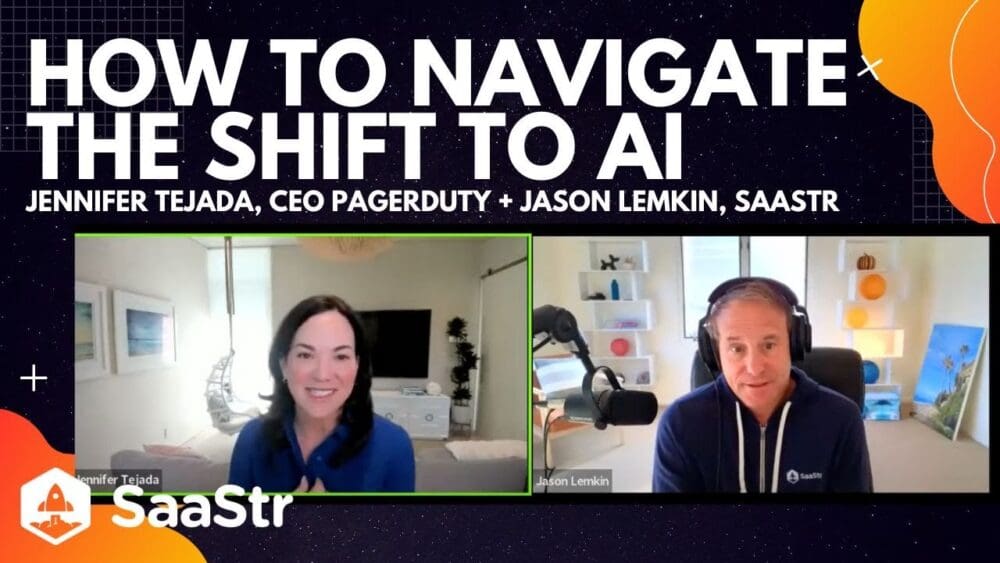
Generative AI has moved from “interesting experiment” to “boardroom-level priority” faster than most companies can update their internal policy documents. One minute, teams were asking whether AI could summarize a meeting. The next, executives were asking whether AI could reduce operating costs, improve customer experience, write code, prevent outages, and somehow make the coffee taste less like a printer cartridge.
That is why PagerDuty CEO Jennifer Tejada’s perspective matters. As Chairperson and CEO of PagerDuty, Tejada leads a company built around digital operations, incident response, automation, and business resilience. PagerDuty’s work sits in the messy middle of modern technology: alerts, outages, customer-impacting incidents, overloaded engineering teams, and the urgent need to keep digital services running when everything is on fire and Slack is making that little “ping” sound again.
The shift to generative AI is not just about adding a chatbot to a product page. It is about changing how work gets done. For software companies, IT leaders, operations teams, and business executives, the real challenge is learning how to use generative AI responsibly while protecting trust, reliability, data, and human judgment. Tejada’s message is refreshingly practical: move fast, yesbut do not spray AI-generated noise into mission-critical workflows and call it innovation.
Why Jennifer Tejada’s View on Generative AI Stands Out
PagerDuty is not approaching AI from a trendy, “we added sparkles to the dashboard” angle. The company has long operated in incident management and digital operations, where accuracy matters. When a system is down, nobody wants a poetic AI response that says, “The server appears to be enjoying a quiet moment of reflection.” They want context, action, escalation, and resolution.
Tejada has led PagerDuty since 2016, helping the company evolve from an incident response pioneer into a broader Operations Cloud platform. That background gives her a grounded view of generative AI. In digital operations, AI is valuable only if it helps people understand what is happening, respond faster, reduce risk, and learn from past incidents. The goal is not AI for decoration. The goal is AI for operational intelligence.
The Big Shift: From Automation to Intelligent Operations
Traditional automation follows rules. If this alert fires, notify this team. If this threshold is crossed, run this workflow. That is useful, but limited. Generative AI and agentic AI introduce a more flexible layer: systems that can summarize incidents, surface historical context, recommend next steps, identify patterns, and assist humans during complex operational moments.
PagerDuty’s AI direction reflects this shift. The company’s generative AI capabilities, including PagerDuty Advance and newer AI agents, are designed to help teams reduce repetitive work, resolve incidents faster, and make better decisions during time-sensitive events. In other words, AI is not replacing the firefighter; it is handing the firefighter the building map, smoke pattern, equipment checklist, and a very strong cup of coffee.
Generative AI Is Really a Context Revolution
One of Tejada’s most useful ideas is that context is where generative AI creates real value. Many companies start with the obvious use cases: writing emails, summarizing notes, drafting customer replies, or producing first versions of documents. Those are helpful. But the deeper business value comes when AI can connect data across systems and bring the right information to the right person at the right moment.
In incident response, context is everything. A single alert rarely tells the full story. Teams need to know whether the issue has happened before, what changed recently, which services are affected, who owns those services, whether customers are impacted, and what fixes worked in the past. Without that context, engineers waste precious time switching between tools, searching old tickets, reading logs, and asking, “Didn’t this happen last quarter?”
Generative AI can help by turning scattered operational data into usable guidance. It can draft incident summaries, recommend response steps, identify similar historical incidents, and help teams prepare post-incident reviews. That is a major upgrade from the old way, where everyone gathered in a virtual war room and collectively tried to remember who had the runbook.
How Businesses Should Navigate the Shift to Generative AI
The smartest companies are not asking, “How do we use AI everywhere?” They are asking, “Where can AI create measurable value without damaging trust?” That distinction is critical. Generative AI is powerful, but it can also be inaccurate, risky, or simply annoying when applied carelessly. A mediocre AI feature is not transformation. It is just autocomplete wearing a blazer.
1. Start With the Problem, Not the Technology
Tejada’s approach suggests that teams should begin with the customer pain point or operational bottleneck. What work is slow, repetitive, expensive, or prone to human error? Where do employees spend time gathering information instead of making decisions? Which processes create delay during high-pressure moments?
For example, a software company might discover that engineers spend too much time writing incident updates. A support team might struggle to connect customer complaints with backend service issues. An IT team might lose time because alert data lives in one tool, logs in another, and ownership details in yet another. These are strong candidates for generative AI because the business problem is clear.
2. Keep Humans in the Loop
Generative AI can recommend, summarize, classify, and draft. But in mission-critical environments, human oversight still matters. Tejada has emphasized that enterprises remain cautious because they must consider security, privacy, data risk, regulation, and customer trust. That caution is not fear. It is responsible leadership.
A practical AI strategy should define where humans approve decisions, where AI can act autonomously, and where automation should be limited. For example, an AI assistant might safely draft a post-incident summary without approval, but executing a production rollback may require human confirmation. The more business-critical the action, the clearer the guardrails should be.
3. Protect Trust Before Chasing Speed
Speed is seductive. Every executive wants faster workflows, faster service, faster development, and faster decisions. But trust is the foundation. If AI produces unreliable answers, exposes sensitive data, or creates false confidence, the damage can outweigh the benefits.
PagerDuty’s world makes this especially obvious. Incident response depends on fidelity. If responders cannot trust the information they receive, they will stop using the toolor worse, they will act on bad guidance. Companies adopting generative AI should test accuracy, monitor outputs, document limitations, and build feedback loops before scaling broadly.
Why Enterprise AI Adoption Is Both Exciting and Complicated
Generative AI adoption has accelerated quickly across business functions, especially in IT, software engineering, customer service, marketing, and operations. But adoption does not automatically equal transformation. Many companies are still experimenting. Some have pilots scattered across departments. Others have employees using unauthorized tools because official systems move too slowly. This is how “shadow AI” enters the chat, wearing sunglasses and carrying compliance risk.
The enterprise challenge is to convert scattered experimentation into governed, measurable, secure adoption. That means leaders need more than enthusiasm. They need a roadmap.
Build an AI Roadmap That Connects to Business Outcomes
An effective generative AI roadmap should tie directly to outcomes such as reduced mean time to resolution, lower support costs, faster engineering cycles, better customer satisfaction, improved uptime, or stronger risk management. If an AI project cannot be connected to a measurable goal, it may still be interestingbut interesting does not always survive budget review.
For operations teams, useful metrics might include alert noise reduction, incident response time, escalation accuracy, post-incident review completion, automation coverage, and employee time saved. For customer-facing teams, the metrics may include first response time, resolution rate, customer satisfaction, and fewer handoffs between support and engineering.
Centralize Governance Without Killing Innovation
Large organizations often struggle to balance control and experimentation. Too much control slows everyone down. Too little control creates security and data problems. The best approach is usually a shared governance model: central policies, approved tools, clear data rules, and room for teams to test use cases within safe boundaries.
Leaders should answer basic questions early. What data can employees put into AI tools? Which models are approved? How are outputs reviewed? Who owns AI risk? What happens if an AI-generated recommendation causes a problem? These questions are not glamorous, but neither is explaining a preventable data leak to the board.
The Role of AI Agents in the Next Phase of Operations
Generative AI began with content generation and assistance. The next phase is agentic AI: AI systems that can reason through tasks, take action within defined limits, and coordinate work across tools. PagerDuty’s AI agents point toward this future, especially in areas like site reliability engineering, operational insights, and scheduling optimization.
For SREs and operations teams, AI agents can reduce toil by triaging alerts, gathering context, identifying likely root causes, recommending mitigations, and documenting what happened. The best use of AI agents is not to remove humans from the system entirely. It is to remove the repetitive, low-value tasks that keep skilled people from doing deeper engineering work.
Example: A Smarter Incident Workflow
Imagine an e-commerce platform experiencing checkout failures. In a traditional workflow, alerts fire, engineers join a call, logs are reviewed, dashboards are checked, recent deployments are investigated, and customer support waits for an update. In an AI-enhanced workflow, an operations agent could immediately collect relevant telemetry, compare the incident to similar past events, identify a recent payment API change, draft a status update, recommend rollback steps, and route the issue to the correct team.
The humans still decide. But they begin with a rich starting point instead of a blank screen and three people saying, “Can everyone see my dashboard?”
What Leaders Can Learn From PagerDuty’s AI Strategy
PagerDuty’s approach offers a practical playbook for any company navigating generative AI. The most important lesson is that AI should be embedded where work already happens. If employees must open yet another tool, copy information manually, and interpret AI output without context, adoption will suffer. AI should make workflows smoother, not create a new tab graveyard.
Make AI Part of the Workflow
Generative AI works best when it appears inside the systems people already use: incident management platforms, collaboration tools, customer support systems, knowledge bases, and cloud environments. This is why integrations matter. When AI can access approved, relevant operational data, it becomes more useful and less generic.
Use AI to Improve Learning Loops
One of the most underrated opportunities is post-incident learning. Many teams complete postmortems inconsistently because everyone is busy, tired, or emotionally recovering from the 2 a.m. outage that somehow involved a forgotten configuration file named “final-final-real-final.yaml.”
AI can help create more consistent learning loops by drafting post-incident reports, identifying recurring patterns, highlighting unresolved risks, and recommending preventive actions. Over time, this turns incident management from a reactive process into a continuous improvement engine.
Focus on Better Work, Not Just Fewer Workers
A common fear is that AI will simply eliminate jobs. The more useful leadership question is how roles will evolve. Tejada’s view points toward a future where people move up the value chain. Engineers spend less time chasing repetitive alerts and more time improving architecture. Support teams spend less time hunting for status updates and more time helping customers. Managers spend less time assembling reports and more time making decisions.
That does not mean workforce change will be painless. It does mean leaders must invest in training, role redesign, and honest communication. AI adoption without change management is like buying gym equipment and calling it a fitness plan. Technically, something changed. Practically, not enough.
Common Mistakes Companies Make With Generative AI
The rush to adopt generative AI has created a few predictable mistakes. Fortunately, they are avoidable.
Mistake 1: Launching AI Without Clear Ownership
If nobody owns AI governance, everyone owns the riskand that usually means nobody manages it well. Companies need clear executive sponsorship, technical ownership, security review, and business accountability.
Mistake 2: Measuring Activity Instead of Value
Counting prompts, pilots, or AI features is not the same as measuring impact. Better questions include: Did resolution time improve? Did customer satisfaction rise? Did engineers save time? Did costs decrease? Did risk go down?
Mistake 3: Ignoring Employee Trust
Employees will not adopt AI just because leadership announces it in an all-hands meeting with dramatic slides. They need training, practical examples, safe-use guidelines, and reassurance that AI is there to help them do better worknot quietly judge their calendar habits.
A Practical Framework for Navigating the Shift
Companies can use a simple framework inspired by the operational discipline behind PagerDuty’s approach.
Discover
Identify high-friction workflows where teams lack context, waste time, or repeat manual work. Interview users, study operational data, and prioritize problems with measurable business impact.
Design
Create AI use cases with clear boundaries. Decide what data the system can access, what actions it can take, where human approval is required, and how success will be measured.
Deploy
Start with controlled pilots. Choose teams that are close to the problem and motivated to improve the workflow. Provide training and collect feedback early.
Defend
Build governance around security, privacy, accuracy, compliance, and auditability. Use guardrails, approved integrations, and monitoring to reduce risk.
Develop
Continuously improve the system based on user feedback, performance data, incidents, and new business needs. AI adoption is not a one-time launch; it is an operating model.
Experiences and Lessons From Navigating Generative AI Change
Organizations adopting generative AI often discover that the technology is the easy part. The harder part is changing habits. People are used to their tools, their workflows, their approval chains, and their private little spreadsheet kingdoms. Introducing AI into that environment requires patience, clarity, and a willingness to redesign worknot just sprinkle software on top of old processes.
One common experience is the “pilot trap.” A company launches several promising AI experiments, everyone gets excited, and then nothing scales. Why? Because the pilots were not connected to budget, governance, data access, or operational ownership. The lesson is simple: from day one, every AI pilot should have a path to production. Who will own it? What systems will it connect to? What risk review is needed? What metric will prove success? Without those answers, a pilot becomes a science fair project with better branding.
Another lesson is that employees need concrete examples. Telling teams to “use AI responsibly” is too vague. Show a support agent how to use AI to summarize a customer history before escalation. Show an engineer how AI can draft a post-incident review from approved incident data. Show a manager how AI can identify recurring operational bottlenecks. Practical use cases beat abstract inspiration every time.
Companies also learn quickly that bad data creates bad AI outcomes. If service ownership is outdated, runbooks are incomplete, incident notes are inconsistent, and documentation lives in six places, generative AI will struggle. AI can amplify knowledge, but it cannot magically fix years of digital clutter. Before scaling AI, teams should clean up critical knowledge sources, standardize documentation, and improve metadata. Yes, this is less glamorous than a keynote demo. It is also where real value begins.
Security teams often become essential partners in successful AI adoption. Instead of acting as the department of “no,” they can help define safe patterns: approved tools, data classification rules, access controls, retention policies, and review processes. The best AI programs make security part of the design phase, not a panicked checkpoint two days before launch.
Leaders should also expect cultural resistance. Some employees will worry about job loss. Others will distrust AI outputs. Some will overtrust the system and accept answers too quickly. All three reactions are normal. Training should focus not only on how to use AI, but how to question it. The healthiest AI cultures teach employees to verify, refine, and escalate. In high-stakes work, confidence should come from evidence, not from a fluent paragraph with excellent punctuation.
The most successful experiences tend to share one trait: AI is introduced as a teammate, not a magic replacement. In operations, that means AI gathers context, drafts updates, finds patterns, and recommends action while humans provide judgment. This model is realistic, scalable, and much easier for teams to trust.
Conclusion
The shift to generative AI is not a side quest for modern businesses. It is becoming a core part of how companies build products, serve customers, manage operations, and compete. Jennifer Tejada’s PagerDuty perspective is valuable because it focuses on the part of AI adoption that actually matters: trusted execution in real workflows.
Generative AI can reduce toil, improve decision-making, accelerate incident response, and help teams learn faster. But it must be adopted with discipline. Companies need clear problems, strong governance, human oversight, reliable data, measurable outcomes, and a culture that treats AI as an operational capabilitynot a shiny shortcut.
The winners in this shift will not be the companies that use AI the loudest. They will be the companies that use it where it counts: in the moments when context, speed, trust, and resilience make all the difference.