Before The Simpsons became the longest-running animated sitcom in American TV history, it became something even more powerful: a cultural lie detector with yellow skin. If a trend smelled fake, overpriced, overhyped, or covered in celebrity fingerprints, Springfield usually found a way to roast it until it was crispier than a Krusty Burger left under a heat lamp since 1993.
That is why one almost-lost behind-the-scenes story feels so strange. A classic Simpsons episode, Season 5’s “$pringfield (Or, How I Learned to Stop Worrying and Love Legalized Gambling)”, reportedly came close to including a major subplot built around Planet Hollywood, the celebrity-backed restaurant chain associated with Arnold Schwarzenegger, Sylvester Stallone, Bruce Willis, and other 1990s stars. In other words, one of television’s sharpest anti-hype machines nearly gave prime-time oxygen to one of the loudest hype machines of the decade. That is not just ironic. That is Springfield-level ironic, the kind that should arrive with a saxophone sting and a worried look from Lisa.
The finished episode, which aired in December 1993, is remembered for Mr. Burns opening a casino, Marge developing a gambling problem, Homer becoming a blackjack dealer, Bart running his own mini-casino, and Lisa trying to survive a state pageant dressed like Florida. It is chaotic, hilarious, oddly dark, and packed with jokes that still feel fresh because they are not chained to a single corporate logo. But according to later commentary and reporting, an earlier version could have devoted real story space to Planet Hollywood after the show’s team was apparently told that Schwarzenegger, Stallone, and Willis might appear if the restaurant was included.
The guest-star promise did not work out. The subplot was dropped. And thank heavens, because the episode we got is a compact little satire machine. The episode we almost got sounds like it might have needed a menu insert.
Why “$pringfield” Still Works So Well
To understand why the abandoned Planet Hollywood idea matters, we need to look at what “$pringfield” actually became. The plot begins with Springfield facing economic decline. The town, never known for sober policy discussions or basic chair-folding competence, legalizes gambling as a quick fix. Mr. Burns promptly builds a casino, and Springfield transforms into a mini-Las Vegas with all the subtlety of a neon billboard wearing a feather boa.
What makes the episode special is not merely that it makes fun of gambling, casinos, or local government desperation. It makes fun of how civic panic gets packaged as progress. Everybody in town acts as if one flashy business will solve everything. That is pure Simpsons: Springfield does not thoughtfully solve problems; it slaps a novelty attraction on them and hopes nobody asks about zoning.
The episode also gives Marge one of her most memorable storylines. Usually the responsible center of the family, she becomes absorbed by slot machines while the household collapses around her. Homer’s rescue speech, complete with his battle against the imaginary neon monster “Gamblor,” remains one of the great ridiculous-serious moments in the show’s golden era. It is funny because Homer has no idea how to say something correctly; it lands because he is trying.
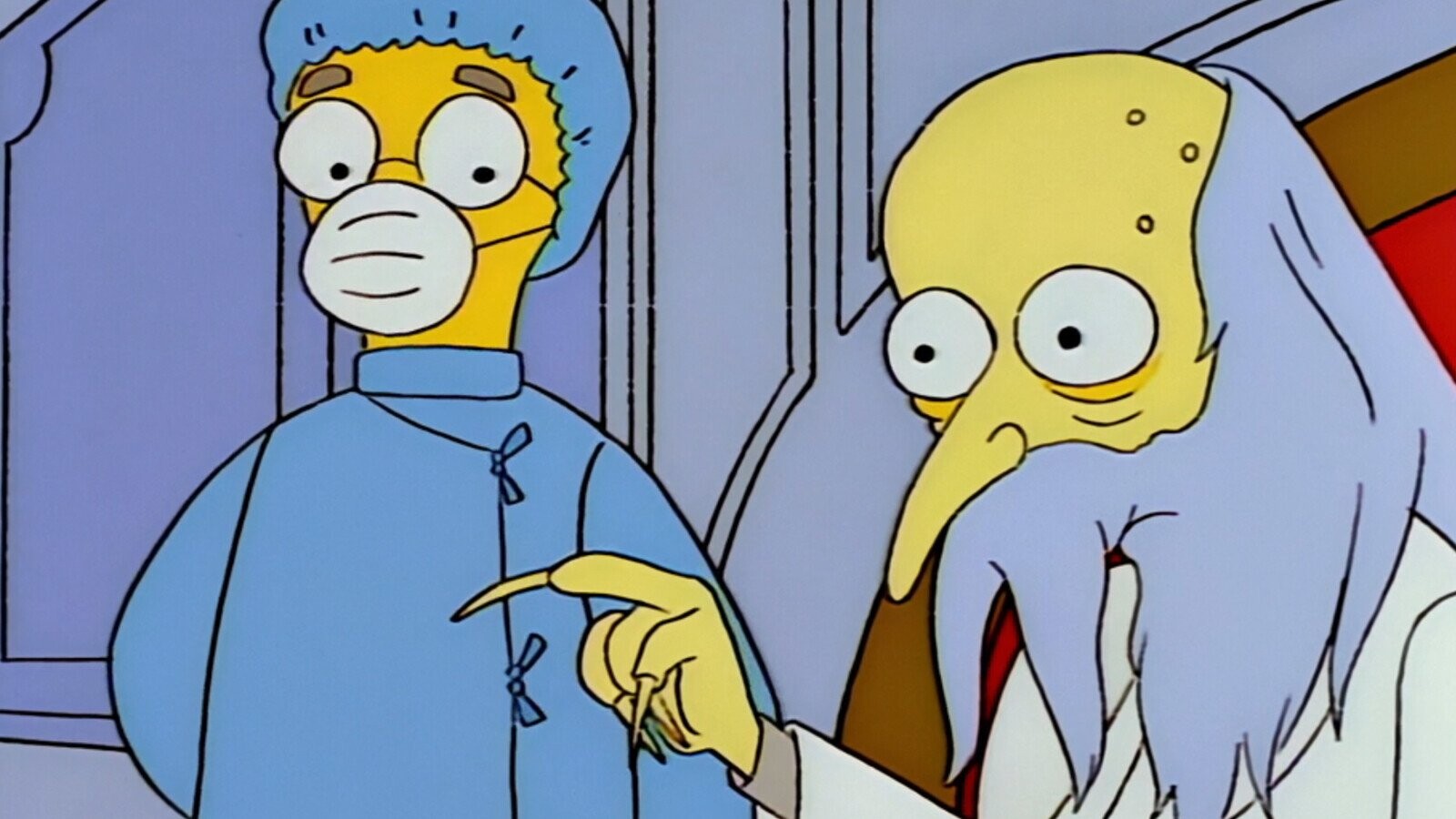
Meanwhile, Mr. Burns slips into Howard Hughes-style paranoia, complete with germ fears and increasingly bizarre behavior. Bart, refused entry into the adult casino, starts his own gambling operation in his treehouse. Lisa, neglected by Marge, melts down over a school costume event. The episode is loaded, but it does not feel bloated. Every subplot reflects the same central joke: once Springfield worships money as a solution, everybody gets a little weird.
The Planet Hollywood Subplot That Almost Happened
The strange almost-commercial angle comes from the reported attempt to work Planet Hollywood into the episode. Planet Hollywood was not just a restaurant chain; it was 1990s celebrity culture served with fries. Its pitch was simple: eat near movie memorabilia, buy a logo shirt, maybe feel one table closer to fame. The brand launched in the early 1990s with high-profile celebrity backing and became a magnet for tourists, photographers, and people who thought dinner tasted better under a jacket allegedly worn in an action movie.
For The Simpsons, the offer was tempting on paper. The show had already become famous for celebrity appearances, and a triple cameo from Schwarzenegger, Stallone, and Willis would have been a huge get. These were not minor names. They were action-movie titans, the Mount Rushmore of “things explode behind me while I squint.” A Planet Hollywood subplot could have delivered a ratings-friendly guest-star event.
But the trade-off was obvious. If the episode had spent significant time promoting a real celebrity restaurant, the satire could have curdled into advertising. The Simpsons was always willing to mock brands, celebrities, entertainment, and consumer behavior. But it usually worked best when it bent reality into parody: Krusty Burger instead of McDonald’s, Duff Beer instead of Budweiser, Malibu Stacy instead of Barbie, Lard Lad instead of every donut temptation ever created by mankind.
A real Planet Hollywood appearance would have shifted the energy. Instead of laughing at celebrity branding, the episode might have helped sell it. That is a dangerous line for a show whose superpower is making audiences recognize the absurdity of being sold to.
Why Planet Hollywood Was the Perfect 1990s Target
Planet Hollywood was almost too perfect for The Simpsons. It was loud, star-powered, merchandise-heavy, and built on the idea that celebrity proximity could turn a meal into an event. The chain did not simply sell food; it sold the feeling of standing near fame without having to make eye contact with an agent.
The concept made sense in its era. The 1990s were full of themed restaurants, collectible merchandise, celebrity endorsements, and giant entertainment brands trying to turn every object into a lifestyle. Hard Rock Cafe had already shown that a restaurant could become a souvenir shop with appetizers. Planet Hollywood pushed that idea further by attaching itself to movie stars and props. A burger was not merely a burger. It was a burger in the same building as something that may have once been near Sylvester Stallone.
That is exactly the kind of cultural excess The Simpsons loved to parody. The show understood that America does not simply consume entertainment; it builds little churches to it, then sells T-shirts in the lobby. Springfield is full of fake brands because fake brands allow the writers to exaggerate real consumer culture without giving free advertising to the real thing.
So the idea of a real Planet Hollywood subplot feels like a glitch in the matrix. It would have been a parody show temporarily letting the thing being parodied walk in, sit down, and ask for a close-up.
The Guest Stars Fell Through, and the Episode Was Better for It
In the end, the celebrity cameos did not materialize, and the Planet Hollywood plot was removed. Creatively, this may have been a blessing disguised as a scheduling problem. Without the restaurant subplot, “$pringfield” stayed focused on Springfield’s casino fever. It became less about guest-star spectacle and more about the town’s collective moral collapse, which is much funnier because Springfield collapses with such confidence.
The best classic Simpsons episodes often feel like they are about one thing and secretly about five things. “$pringfield” is about legalized gambling, but it is also about desperate economic development, addiction, bad parenting, civic boosterism, and the way flashy promises can make a whole town forget its common sense. A Planet Hollywood storyline might have added celebrity glitter, but glitter is not structure. In fact, glitter usually means someone is trying to distract you from the bill.
The missing subplot also highlights a major reason the golden-era episodes hold up. They were not afraid to cut ideas, even ideas involving major celebrities. That restraint matters. A weaker show might have kept the restaurant material simply because the names were famous. The Simpsons was famous enough, and confident enough, to survive without them.
How “The Simpsons” Got Its Planet Hollywood Joke Anyway
The story did not end there. A few years later, The Simpsons took a much more natural swing at Planet Hollywood-style celebrity dining in Season 8’s “My Sister, My Sitter.” In that episode, Homer and Marge visit the Springfield Squidport, where they encounter Planet Hype, a fictional celebrity restaurant tied to Rainier Wolfcastle, the show’s Schwarzenegger-like action star.
That joke worked because it was safely in the show’s own universe. Planet Hype was not a brand placement; it was a punchline. The name alone says everything. “Planet Hype” is not subtle, but neither were 1990s celebrity restaurants. The parody let the writers mock the idea of celebrity-approved menus, movie memorabilia, and manufactured excitement without handing over the steering wheel to an actual company.
That difference is crucial. The Simpsons can include fake advertising because fake advertising is part of its satire. Krusty’s entire empire is built on shoddy products, irresponsible licensing, and the terrifying thought that a clown might have a board of directors. Duff Beer is funny because it turns beer marketing into a religion of foam, slogans, and poor decisions. Planet Hype fits that tradition. Planet Hollywood, used straight, might not have.
Celebrity Vanity Projects and the Springfield Test
The phrase “celebrity vanity project” sounds harsh, but it fits a certain kind of business. These are ventures where fame is not just part of the marketing; fame is the product. The restaurant, clothing line, tequila bottle, app, fragrance, or wellness gadget becomes a container for celebrity identity. Sometimes the product is good. Sometimes it exists because somebody noticed fans have wallets.
Planet Hollywood was not created by actors alone, and it was run as a real business by experienced hospitality figures. Still, its public identity leaned heavily on stars. The celebrity names gave the chain its aura. That aura made the restaurant feel less like a place to eat and more like a laminated backstage pass. And in the 1990s, that was enough to attract crowds.
Springfield would understand this immediately. The town has always been vulnerable to hype. Give Springfield a monorail, a casino, a film festival, a miracle health craze, or a suspiciously confident salesman, and the town will form a line before anyone checks the emergency exits. That is why The Simpsons remains such a good lens for celebrity branding: it knows that people do not fall for hype because they are stupid. They fall for it because hype is fun. It feels like belonging to something shiny.
The show’s job is to ask what happens after the shine wears off. In the case of many themed restaurants, the answer was: the memorabilia stayed dusty, the food had to stand on its own, and the celebrity glow became harder to maintain.
Product Placement vs. Pop-Culture Satire
Product placement is not automatically evil. Sometimes it makes a fictional world feel real. A character drinking a recognizable soda or driving a recognizable car can help the audience understand the setting. But in comedy, especially satire, product placement can become awkward fast. The moment viewers sense that a joke has been written around a marketing obligation, the comedy starts wearing a name tag.
The Simpsons usually avoided that trap by creating its own consumer universe. This gave the writers total freedom. They could make Krusty endorse unsafe products, turn Duff into a parody of beer culture, and use the Kwik-E-Mart to mock convenience-store economics, immigrant stereotypes, and American snack dependency all at once. No real brand had to approve the joke. No corporate partner could ask for “a more positive depiction of the radioactive hot dog.”
That freedom is why the near-Planet Hollywood story is so fascinating. It shows that even a show as sharp as The Simpsons operated inside a larger entertainment machine. Networks wanted ratings. Publicists wanted exposure. Celebrities wanted visibility. Brands wanted cultural legitimacy. The writers, meanwhile, wanted jokes that would still be funny when the restaurant chain was no longer the hottest place in town.
History proved the writers’ instincts right. “$pringfield” still plays beautifully because it is not trapped inside one 1990s business fad. It captures something broader: the American habit of solving problems with spectacle.
Specific Examples That Show Why the Finished Episode Wins
1. Mr. Burns as a Casino Mogul
Mr. Burns opening a casino is funnier than any celebrity restaurant cameo because it exaggerates a character we already know. Burns does not need outside glamour; he is already a walking monopoly board with liver spots. His casino gives the episode a villainous center while also letting him unravel into bizarre isolation.
2. Marge’s Addiction Story
Marge’s gambling problem gives the episode emotional stakes. It is still a comedy, but the jokes have consequences. The house falls apart, Lisa feels abandoned, and Homer is forced to notice that the family’s responsible adult has been swallowed by the casino floor. That is stronger storytelling than a detour to admire celebrity memorabilia.
3. Bart’s Treehouse Casino
Bart creating his own casino is classic Simpsons escalation. The adult world makes a bad decision, and Bart immediately miniaturizes it for profit. It is a perfect child-sized parody of capitalism: illegal, badly supervised, and probably sticky.
4. Lisa’s Florida Costume Disaster
Lisa’s state pageant subplot seems small, but it gives the episode one of its best emotional beats. Her disappointment is not world-ending, but to a child it feels enormous. The joke works because the show takes her feelings seriously while still letting the situation be ridiculous.
5. “Gamblor”
Homer describing Marge’s addiction as being trapped in the clutches of “Gamblor” is the kind of line that only The Simpsons could make immortal. It is silly, oddly sincere, and instantly quotable. No brand integration can compete with a fake monster name that fans still remember decades later.
What This Near-Miss Says About Classic “Simpsons” Quality Control
The abandoned subplot is a reminder that great television is not just about what makes it into an episode. It is also about what gets cut. Creative restraint is invisible, but it matters. A scene that never airs can save an episode from becoming dated, cluttered, or compromised.
Classic Simpsons had an unusually strong filter. The show could be random, but it was rarely careless. Its best episodes move quickly because every joke is fighting for space. If a subplot does not feed the main theme or produce enough laughs, it has to go. A celebrity restaurant storyline, even with huge names attached, might have slowed the episode down or shifted its center of gravity toward promotional spectacle.
The final version of “$pringfield” feels like Springfield looking into a slot machine and seeing America reflected back at itself. A Planet Hollywood-heavy version might have felt like Springfield looking into a gift shop mirror while someone asked whether viewers wanted to buy a sweatshirt.
Experience Section: Watching the Story Today Makes the Almost-Ad Feel Even Stranger
Rewatching “$pringfield” today is a funny experience because the episode feels both extremely 1993 and weirdly timeless. The animation style, pacing, and references clearly belong to the golden era of the show. Yet the central idea still feels modern: a struggling community believes one flashy commercial project will rescue everyone, and suddenly all normal judgment disappears. Replace the casino with a stadium, luxury development, crypto conference, influencer restaurant, or “immersive experience,” and the joke still works.
That is why learning about the abandoned Planet Hollywood subplot feels like finding a trapdoor under a familiar couch gag. The episode we know is so cleanly built that it is hard to imagine it pausing for a celebrity-restaurant promotion. The current version has a beautiful internal rhythm. The town needs money. Burns builds a casino. Marge gets hooked. Homer works there. Bart imitates the adult economy. Lisa gets neglected. Burns loses his mind. Everything spirals, but it spirals around one theme. Add Planet Hollywood, and suddenly the episode might have had to explain why Arnold Schwarzenegger, Sylvester Stallone, and Bruce Willis were hanging around Springfield’s gambling crisis like extremely muscular garnish.
As a viewer, I can understand why the writers explored it. Big guest stars can be exciting. A celebrity cameo, when used well, gives an episode an extra spark. The Simpsons had already shown it could use famous people brilliantly, often by making them play slightly absurd versions of themselves. But there is a difference between a celebrity serving the joke and a joke serving the celebrity. The finished “$pringfield” never feels like it owes anyone a favor. That independence is part of its charm.
The Planet Hollywood angle also hits differently because many people remember that kind of restaurant culture. Even for those who never visited one, the concept is instantly understandable: big signs, movie props, famous names, collectible shirts, and the promise that dinner could somehow brush against stardom. It was not just a restaurant; it was a souvenir you could chew. That makes it perfect for satire, but dangerous as straight promotion. The more a brand already resembles a parody, the harder it becomes to include it without accidentally doing free marketing.
What makes The Simpsons special is that it usually knows how to fictionalize reality just enough. Planet Hype is funnier than Planet Hollywood because it belongs to Springfield. Rainier Wolfcastle is funnier than a real Schwarzenegger cameo would have been because Wolfcastle can be as vain, clueless, and ridiculous as the joke requires. No publicist needs to approve whether the menu has been “personally approved” by someone’s secretary. The parody can breathe.
This is also a useful lesson for modern entertainment writing. Audiences are better than ever at detecting when a story has been bent around a brand, cameo, or marketing partnership. People may enjoy references, nostalgia, and guest appearances, but they do not want to feel like they have been tricked into watching an ad with jokes attached. The classic Simpsons model still works because it treats pop culture as material, not as a master. It borrows the shape of real life, paints it yellow, gives it an overbite, and then makes it confess.
In the end, the near-Planet Hollywood subplot is more than a quirky footnote. It is a behind-the-scenes example of a show dodging a creative pothole. The writers did not get the promised celebrity trio, the promotional storyline disappeared, and the episode became stronger because of it. Sometimes the best version of a classic is created not by landing the big names, but by losing them.
Conclusion
The story of how a classic Simpsons episode nearly became a showcase for Planet Hollywood is funny because it sounds like something The Simpsons would parody. A sharp satire of American hype almost got pulled toward a real-life hype empire. But the finished episode avoided that fate, and “$pringfield” remains one of the show’s strongest golden-era installments because it focuses on character, theme, and absurdity instead of celebrity-brand sparkle.
Planet Hollywood eventually got the kind of treatment it deserved from Springfield: not as a promotional centerpiece, but as Planet Hype, a fictional parody that exposed the silliness of celebrity dining culture without becoming part of it. That is the difference between satire and advertising. One makes the audience laugh at the machine. The other asks the audience to buy a hat on the way out.
Note: This article is based on publicly available entertainment reporting, episode-history references, commentary accounts, and pop-culture background information. It is written as original SEO content for web publication, without source-link clutter or automated citation artifacts.