Note: This article is an original editorial piece based on verified public award information, photography history, and professional street photography context.
Street photography is the art of catching life before it remembers to pose. One second, a city corner is just traffic, pigeons, coffee cups, wet pavement, and someone checking their phone like it owes them money. The next second, a photographer presses the shutter andbamordinary life suddenly looks like a tiny theater production staged by chaos itself.
That is the magic behind The Independent Photographer’s Street Photography Award, a global contest that celebrates photographers who can observe, wait, react, and transform public moments into memorable visual stories. The September 2022 edition brought together submissions from more than 40 countries, with judge Jamel Shabazz helping select 10 winners and finalists whose images prove that the street is still one of the richest, strangest, funniest, and most emotionally honest places to make photographs.
The winning works move across Central Java, New York, Istanbul, Mumbai, Cairo, Chicago, Atlanta, and Sri Lanka. Some images lean on color. Others use shadow. Some feel intimate, others graphic and architectural. Together, they show why street photography is not simply “pictures taken outside.” It is timing, instinct, geometry, empathy, and the ability to notice the little human dramas most people walk past while looking for parking.
Why This Street Photography Contest Matters
The Independent Photographer has built its reputation around monthly photography awards that give emerging and established photographers international exposure. Its street photography category is especially interesting because it rewards one of the hardest skills in visual storytelling: recognizing a meaningful scene while it is still happening.
In studio photography, a photographer can move lights, adjust props, ask the subject to tilt a chin, or politely beg a wrinkled shirt to stop ruining the mood. Street photography offers none of that luxury. The city does not wait. The stranger does not repeat the gesture. The shadow does not hold its position because your camera settings are confused. A great street photo happens when the photographer’s eye, reflexes, and patience all clock in at the same time.
This is why contests like The Independent Photographer’s Awards are valuable. They create a public stage for images that may not fit neatly into commercial photography, fashion, travel, or hard-news photojournalism. They also remind us that public spaces are full of unscripted stories: a commuter in motion, children gathering near a shrine, a person framed by a reflection, or a balloon floating through a celebration like it has been hired as the emotional support object of the day.
Meet The Top Three Winners
1st Place: David Keith Brown “Balloon Dance”
The first prize went to David Keith Brown for “Balloon Dance,” photographed in Tegal, Central Java. The image captures women dancing with balloons during a back-lane celebration. On paper, that may sound simple. In the frame, however, it becomes a layered visual story about movement, childhood, friendship, intimacy, and small-town festivity.
What makes the photograph successful is its sense of balance. The balloons create circular points of interest. The figures form relationships across the frame. A child becomes a quiet emotional center, creating a scene that feels both lively and strangely private. It is exactly the kind of image that street photography lovers chase for years: not a spectacle, not a headline, but a real moment where everyone in the picture seems to belong to a secret rhythm.
Brown’s image also shows why strong street photography does not need a famous landmark. No Eiffel Tower. No Times Square neon. No dramatic skyline politely screaming, “Please know where this is.” Instead, the photograph finds drama in gesture, placement, and human connection. That is often where the best street photographs live: in the spaces between big events.
2nd Place: Erich Wohlenberg “Candid Street Scene”
Erich Wohlenberg took second place with “Candid Street Scene,” an image built around reflection, contrast, and careful timing. The photograph features a colorful street facade reflected on the rear window of a parked car, with a walker framed by the surrounding architecture.
This is the sort of picture that rewards slow looking. At first, it may appear like a stylish urban composition. Then the layers begin to reveal themselves: the reflection, the silhouette, the shapes, the light, the sense of a city folding in on itself. Street photography often works best when it gives the viewer more than one way to enter the image, and Wohlenberg’s frame does exactly that.
The car window becomes more than a surface. It becomes a second frame inside the frame, turning a parked object into a visual portal. That is a classic street photography move: take something most people ignore and make it carry the whole picture. Somewhere, a dusty hatchback is feeling very artistically validated.
3rd Place: Julien Schoener “Shadows of New York’s Early Steel Years”
Third place went to Julien Schoener for “Shadows of New York’s Early Steel Years,” made in New York, USA. This black-and-white image uses an elevated perspective to turn pedestrians and shadows into a near-abstract composition.
New York has always been a generous city for street photographers, partly because it refuses to be boring for more than four seconds. Schoener’s image taps into that history but avoids postcard familiarity. Instead of focusing on faces or street-level action, it looks down from above, allowing bodies and shadows to become graphic forms.
The result feels connected to the visual tradition of classic 20th-century street photography, where public space becomes a stage and human figures become marks in a larger design. It also proves that street photography can be both documentary and abstract. A photograph can show real people in a real place while still behaving like a study in line, tone, and negative space.
The Finalists: Seven More Ways To See The Street
Beyond the top three, the finalists expand the contest’s visual language. Each photographer brings a different strategy for observing public life, and together they show how flexible street photography can be.
- Branden May “You’re Late”: Shot on Peachtree Center Avenue in Atlanta, Georgia, this finalist image uses signage, timing, and urban rhythm to capture the humor and pressure of city movement.
- Gokhan Arer “A Cup of Juxtaposition”: Made at Galata Bridge in Istanbul, Turkey, this photograph highlights the visual surprise that happens when unrelated elements suddenly click together.
- John Yuhas “Subway Light Play”: Photographed in Chicago, this image follows a commuter taking the stairs to the subway, using light and motion to elevate an everyday transit moment.
- Jonathan Jasberg “Mount Lavinia”: Captured in Mount Lavinia, Sri Lanka, the image shows children gathered at a shrine, blending childhood energy with a strong sense of place.
- Maude Bardet “Vivid Conversation”: Made in Cairo, Egypt, this finalist image suggests the importance of color, relationship, and cultural texture in public photography.
- Mehmet Esen “Stranger”: A minimalist title for a street image that reminds us how much mystery can exist in one encounter.
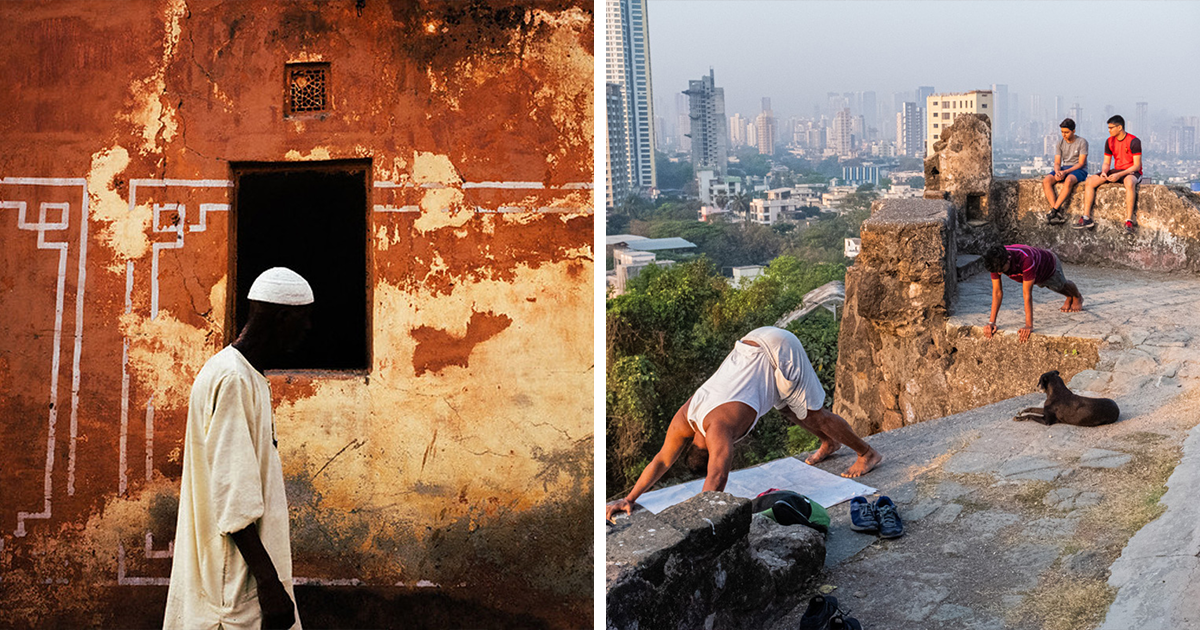
- Suresh Naganathan “Morning Exercise”: Photographed in Mumbai, India, this work shows people using historic urban structures for daily activity, turning architecture into lived space.
What The Judge Was Looking For
Judge Jamel Shabazz was a fitting voice for this award. Known for decades of photographing New York City street life, especially Black communities, youth culture, subway scenes, and everyday urban identity, Shabazz brings a human-centered approach to street photography. His work is not cold observation. It is attentive, socially aware, and often deeply affectionate toward the people in front of the lens.
That background helps explain the choices in this contest. The winning images are not just visually clever. They contain relationships. They ask the viewer to imagine what happened before and after the shutter clicked. They reward composition, but they also reward curiosity.
Great street photography is not simply about being fast. Speed helps, of course. Nobody wants to be the photographer who sees the perfect moment, checks the battery, changes a setting, updates firmware, files taxes, and then finally takes the picture after everyone has gone home. But timing matters only when the photographer also understands what is happening inside the frame.
Street Photography: A Genre Built On Fleeting Moments
Street photography has long been associated with public life, spontaneous encounters, and the ability to isolate moments that might otherwise disappear. From early urban photographs to the work of major figures such as Henri Cartier-Bresson, Garry Winogrand, Lee Friedlander, Diane Arbus, and many contemporary photographers, the genre has always lived somewhere between documentary truth and personal interpretation.
Cartier-Bresson’s famous idea of the “decisive moment” still echoes through the field. It suggests that a photograph becomes powerful when form and meaning peak at the same instant. In modern street photography, that might mean a perfectly placed shadow, a gesture that completes a composition, a reflection that creates a visual joke, or a moment of human emotion that appears for one heartbeat and then vanishes into lunch traffic.
The Independent Photographer’s finalists show that today’s street photography is not locked into one style. It can be black and white or color, close or distant, humorous or contemplative, urban or rural, crowded or minimal. The common thread is attention. These photographers are not merely pointing cameras at sidewalks. They are reading the street like a sentence that keeps rewriting itself.
What Makes A Winning Street Photograph?
1. Strong Composition
Composition is the skeleton of a street image. Without it, even a fascinating moment can collapse into visual soup. The winning photographs in this contest use framing, depth, reflection, shadow, and repeated shapes to guide the viewer’s eye. Brown’s balloons, Wohlenberg’s reflection, and Schoener’s overhead shadows all show how structure turns a quick observation into a lasting image.
2. Human Curiosity
Street photography depends on curiosity, but not nosiness for its own sake. The best images respect the complexity of public life. They notice how people gather, wait, celebrate, hurry, rest, and improvise. A finalist like “Morning Exercise” works because it sees how daily routines adapt to physical space. A city is not just buildings; it is what people do with them.
3. Timing That Feels Inevitable
The strongest street photos often feel as if they could not have been taken one second earlier or later. That is the trick. The photographer may have waited, walked, guessed, reacted, or gotten luckybut the final frame feels complete. Good timing makes chaos look organized without removing its energy.
4. A Sense Of Place
The contest’s global range is one of its strengths. Tegal, New York, Istanbul, Mumbai, Cairo, Chicago, Atlanta, and Mount Lavinia each bring different textures. Street photography becomes more powerful when it respects the specific character of a place rather than turning every city into the same generic background for “person walking past wall.” The wall deserves better. So does the person.
Ethics, Rights, And Respect In Street Photography
Street photography often raises important questions. In many public settings, photographers may have the legal right to photograph what is visible. But legality and sensitivity are not identical twins; they are more like cousins who sometimes disagree at family dinner.
Responsible street photographers think about context, dignity, and power. They avoid exploiting vulnerable people for dramatic effect. They consider whether a photograph informs, celebrates, questions, or merely embarrasses. They understand that the street is public, but the people in it are still human beings with stories, families, bad hair days, and possibly zero interest in becoming someone’s “gritty urban mood” post.
The best photographers develop a personal code: be honest, avoid staging candid scenes, do not manipulate the meaning of the image, and treat subjects with respect. A strong street photograph should feel alert, not predatory. It should reveal life, not steal it.
Why These Winners Still Feel Fresh
The September 2022 award remains relevant because the images do not depend on a trend. They rely on core photographic strengths: light, gesture, form, culture, humor, and emotional tension. That gives them staying power.
“Balloon Dance” works because celebration is universal, but the scene is specific. “Candid Street Scene” works because cities are layered with accidental reflections and visual puzzles. “Shadows of New York’s Early Steel Years” works because it turns a familiar city into a graphic memory. The finalists work because they reveal how public spaces hold private moments.
That is why street photography remains addictive for photographers and viewers alike. It offers the thrill of recognition: “I have seen something like this.” Then it adds the thrill of surprise: “But I have never seen it quite this way.”
Experience-Based Lessons For Photographers Inspired By This Contest
For anyone hoping to enter a street photography contest, the first lesson is simple: walk more than you shoot. That sounds painfully obvious, but it is the secret sauce. Street photography is not a sport where you win by machine-gunning 4,000 frames and hoping one of them pays rent. Strong images usually come from attention before action. Watch how light moves across a corner. Notice who pauses near a doorway. Study how people behave around signs, windows, vehicles, markets, stations, and public squares.
The second lesson is to build patience without becoming invisible to yourself. Many beginners think street photography means being sneaky. A better goal is to be calm. Move naturally. Keep your camera ready. Do not act like a raccoon stealing snacks behind a restaurant. People are more likely to react badly if you look guilty before you even press the shutter.
The third lesson is to simplify your gear. Use a camera or phone you understand well enough that it does not become a tiny electronic puzzle during a decisive moment. A lightweight setup helps you stay responsive. Many strong street images are made with modest equipment because the hardest part is not owning the sharpest lens. The hardest part is recognizing when the world briefly arranges itself into a photograph.
The fourth lesson is to study backgrounds. Beginners often focus only on the subject. Experienced street photographers know the background can make or destroy the image. A perfect gesture loses power if a lamppost appears to grow out of someone’s head like an urban antenna. Good backgrounds create separation, context, contrast, and rhythm. In the winning images from The Independent Photographer’s contest, backgrounds are not passive. They participate.
The fifth lesson is to embrace repetition. Return to the same corners at different times of day. Revisit markets, train stations, beaches, festivals, and neighborhoods. Street photography rewards familiarity. The more you know a place, the better you can predict where light will fall, where people will gather, and where visual surprises tend to happen. Luck still matters, but repeated effort gives luck a place to sit down.
The sixth lesson is to edit ruthlessly. A street photo may feel exciting because you remember taking it, but viewers only see the frame. They do not know your heroic struggle with rain, crowds, awkward eye contact, or the pigeon that judged you. Choose images that stand without your explanation. If the photograph needs a long defense speech, it may not be the one.
Finally, remember that street photography is a conversation with reality. Sometimes reality whispers. Sometimes it yells. Sometimes it wears a hat, walks into perfect light, and disappears before your autofocus wakes up. The photographers recognized by The Independent Photographer’s Awards succeeded because they were ready for those brief gifts. They noticed, framed, and trusted the moment. That is the real contest behind every street photography contest: can you stay open to the world long enough to see what everyone else missed?
Conclusion
The Independent Photographer’s Street Photography Award highlights the beauty of public life at its most spontaneous. From David Keith Brown’s warm and layered “Balloon Dance” to Erich Wohlenberg’s reflective urban composition and Julien Schoener’s abstract New York shadows, the winners show how much visual poetry can exist in ordinary spaces.
The finalists deepen that story by bringing in scenes from Atlanta, Istanbul, Chicago, Sri Lanka, Cairo, Mumbai, and beyond. Together, they remind us that street photography is not about chasing perfection. It is about recognizing small truths in motion: a gesture, a shadow, a glance, a rhythm, a joke, a mystery.
In a world overflowing with images, the best street photographs still make us stop. They ask us to look again at the streets we hurry through every day. And occasionally, they prove that a balloon, a shadow, or a subway staircase can carry more drama than an entire blockbuster sequel with a suspiciously large CGI budget.