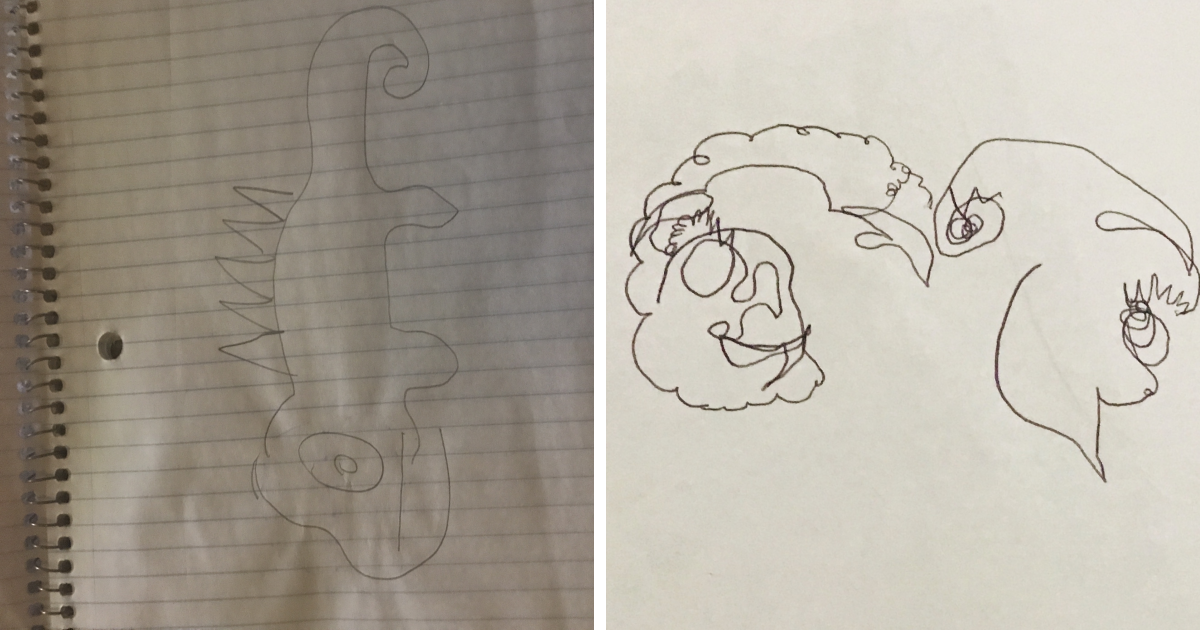
There are art challenges that ask for perfection, and then there are art challenges that walk into your living room, trip over a charger cable, and say, “Let’s draw the lamp without looking at the paper.” The prompt “Hey Pandas, Draw Something In Your Home, Without Looking At The Paper While Drawing” belongs proudly in the second category. It is playful, weirdly brave, and guaranteed to make your coffee mug look like it has been through a minor identity crisis.
At first, the idea sounds simple: choose an object in your home, keep your eyes on it, and draw without checking the page. But the moment your pencil touches paper, your brain starts acting like a nervous backseat driver. “Are we drawing the chair leg? Is that the sofa? Why does the plant have seventeen elbows?” That is exactly the charm. This challenge is not about producing a museum-ready masterpiece. It is about observation, patience, humor, and letting your hand follow your eyes instead of your inner perfectionist.
In art education, this activity is closely related to blind contour drawing, a classic exercise used to train people to truly look at what they are drawing. Instead of relying on symbols stored in memorylike “a cup is an oval on top and two lines down”you slow down and notice the actual edges, curves, bumps, shadows, handles, dents, and strange little design choices hiding in plain sight. Your house suddenly becomes a studio. Your toaster becomes a model. Your couch becomes a mountain range with throw pillows.
What Is This Home Drawing Challenge Really About?
The basic rule is beautifully chaotic: draw something in your home without looking at the paper while drawing. You can draw a shoe by the door, a houseplant, a spoon, a bookshelf, a pet bed, a backpack, a coffee cup, a remote control, or that one mystery object in the junk drawer that no one can identify but everyone respects.
The point is not accuracy in the usual sense. In fact, the finished drawing may look hilariously off. Your vase might lean like it just heard bad news. Your chair may develop extra legs. Your lamp could resemble a confused giraffe. That is fine. The goal is to train your eyes to move slowly along the object while your hand records the journey. Think of it as drawing with your eyeballs while your hand tries to keep up.
The Three Main Rules
First, pick one object you can see clearly. Start with something simple but interesting: a mug, a plant, a pair of glasses, a sneaker, a fruit bowl, or a lamp. Avoid overly complicated scenes at the beginning unless you enjoy emotional plot twists.
Second, do not look at the paper. This is the heart of the challenge. Once the pencil starts moving, keep your eyes on the object. Follow its edges slowly. If your hand wanders into artistic outer space, let it. Space drawings need love too.
Third, keep going until the drawing feels complete. You can set a timer for 60 seconds, three minutes, or five minutes. Short drawings are fun and energetic. Longer drawings create more detail, more confusion, and usually more laughter.
Why Drawing Without Looking Works
Most beginners do not struggle because they cannot move a pencil. They struggle because the brain loves shortcuts. It sees a chair and instantly says, “I know chairs. Four legs, seat, back. Next!” But real chairs are not icons. They have angles, worn corners, uneven shadows, soft cushions, and awkward proportions. Blind drawing forces you to stop drawing the idea of a thing and start observing the thing itself.
That is why contour drawing is often used in classrooms, museum education, and beginner art lessons. Contour means the outline or edge of a form. When you follow the contour carefully, you begin to understand shape, proportion, and space. When you do it without looking at the paper, you remove the temptation to constantly judge, erase, and “fix” the drawing. You become less obsessed with the result and more focused on the act of seeing.
This is also why the exercise can feel surprisingly calming. You are not scrolling, comparing, optimizing, or trying to impress anyone. You are simply paying attention to a teapot like it is the most important celebrity in the room. For a few minutes, the world gets smaller and quieter. The pencil moves. The object sits there. You notice things you have walked past a thousand times.
Best Things at Home to Draw Without Looking
Your home is packed with excellent drawing subjects. You do not need fancy supplies, dramatic lighting, or a marble statue imported from an ancient palace. A regular kitchen spoon can become a dramatic study in curves. A laundry basket can become a geometry exam with handles.
1. A Coffee Mug
A mug is a perfect beginner subject because it has a simple shape with one tricky feature: the handle. The handle is where blind drawings usually become comedy gold. It may float away from the cup. It may attach itself to the rim like a confused ear. It may vanish entirely. Still, mugs teach you to notice curves, ellipses, thickness, and small details like chips or printed designs.
2. A Houseplant
A plant is excellent if you want your drawing to look energetic and slightly wild. Leaves overlap, stems bend, and every plant has its own personality. Some look elegant. Some look like they stayed up all night reading conspiracy theories. Blind contour drawing helps you follow each leaf slowly instead of drawing a generic “leaf symbol.”
3. A Shoe
Shoes are surprisingly complex. Laces, seams, soles, holes, tongues, stitching, and worn edges make them ideal for observation practice. A blind drawing of a sneaker may look like a sleeping dragon, but it will also teach you a lot about layered forms.
4. A Chair
Chairs are humble troublemakers. They look simple until you try to draw their legs in perspective. Without looking at the paper, your chair might become a modern sculpture. That is not failure. That is interior design with confidence.
5. A Kitchen Utensil
A fork, whisk, ladle, spatula, or pair of tongs can become a fantastic line drawing subject. Utensils have clear contours and interesting negative spaces. A whisk, especially, is not for the faint of heart. It is basically a metal tornado with a handle.
How to Do the Challenge Step by Step
Step 1: Set Up Your Space
Place your paper on a table or clipboard. Use a pencil, pen, marker, or any tool that glides easily. Pens are great because they remove the urge to erase. A marker makes the experience bolder. A pencil is fine too, but try not to negotiate with it like a lawyer.
Step 2: Choose an Object
Pick something nearby and position it where you can see it clearly. Good lighting helps. Avoid objects that are too tiny or too far away. The goal is to observe, not squint like a detective in a foggy movie.
Step 3: Put Your Pencil Down and Look at the Object
Start at one edge of the object. Move your eyes slowly along that edge. As your eyes move, let your hand move at the same pace. Pretend your pencil is attached to your gaze by an invisible string.
Step 4: Do Not Peek
This is the hard part. Your brain will beg you to check the page. It will say, “Just one tiny look. We are reasonable people.” Do not fall for it. The magic happens when you let go of control.
Step 5: Laugh, Then Look
When you finish, look at the drawing. It may be strange. It may be wonderful. It may look like your blender melted in a dream. Smile anyway. Then try again with the same object. The second drawing will often feel more confident, even if it is still delightfully weird.
What This Challenge Teaches You
It Improves Observation
Drawing without looking at the paper makes you spend more time studying the object. You notice edges, angles, spacing, and details that usually disappear into the background. This skill helps not only in art but also in science, design, writing, photography, and everyday problem-solving.
It Builds Hand-Eye Coordination
Your eyes and hand learn to work together. The hand does not lead. The eyes lead. Over time, this can make your regular drawings more accurate because you become better at translating what you see into marks.
It Reduces Perfectionism
Perfectionism is the tiny bossy goblin that sits on your shoulder and says, “That line is wrong.” Blind drawing gives the goblin a snack and sends it to another room. Since the result is expected to be imperfect, you are free to experiment.
It Makes Art More Social
This challenge is perfect for families, classrooms, group chats, online communities, or a cozy weekend activity. Everyone can draw the same object and compare results. The best drawing is not necessarily the most accurate. Sometimes the winner is the one whose lamp looks most like an anxious flamingo.
Fun Variations to Try
The One-Minute Object Sprint
Choose five objects and draw each one for only one minute without looking. This keeps the energy high and prevents overthinking. It is great for warm-ups or quick creative breaks.
The Same Object Three Times
Draw the same object three times in a row. The first drawing will probably be chaos. The second will feel more familiar. The third may show real improvement. Even if it does not, you will have a tiny series called “Mug Descending Into Madness,” which sounds very gallery-worthy.
The Family Challenge
Put one household object in the center of the table and have everyone draw it without looking. Then display the results. This works especially well with objects like shoes, stuffed animals, plants, or kitchen tools. Pets are also popular subjects, though they rarely respect the modeling contract.
The No-Lift Line Drawing
Try not to lift your pencil from the paper. This creates a continuous line drawing. It may connect parts of the object in odd ways, but it also adds rhythm and personality.
The Color Finish
After the blind drawing is done, add color while looking at the paper. Use markers, colored pencils, watercolor, or digital tools. The contrast between the wobbly linework and confident color can create a charming final piece.
Common Mistakes and Why They Are Actually Useful
Peeking too often: This turns the activity into regular drawing. If you peek, simply start another round. No drama. The paper forgives you.
Moving too fast: Fast lines can be fun, but blind contour drawing works best when your eye crawls slowly along the object. Imagine an ant walking around the edge of the mug. Be the ant. A very artistic ant.
Trying to make it pretty: Pretty is not the goal. Honest looking is the goal. Beautiful drawings may happen later, but this exercise is more about training your attention.
Choosing something too complicated: A crowded bookshelf might be overwhelming at first. Begin with one object, then build up to scenes.
Why This Prompt Works So Well Online
The phrase “Hey Pandas” has the friendly feel of an online community calling everyone to play. It removes pressure. Instead of saying, “Create an advanced observational study of domestic objects,” it says, “Hey, draw something in your house and do not look at the paper.” That casual tone matters. People are more likely to join a creative challenge when it feels welcoming instead of intimidating.
Online drawing prompts also work because they turn private creativity into shared entertainment. A person can draw a toaster, upload the result, and discover that someone else’s toaster looks like a haunted suitcase. Suddenly, art is not a lonely skill test. It is a conversation. It is permission to be imperfect together.
of Personal-Style Experience: What Happens When You Actually Try It
The first time you try drawing something at home without looking at the paper, you may experience a very specific emotion: suspicious confidence. You sit down with a normal object, maybe a coffee mug, and think, “How hard can this be?” This confidence lasts approximately four seconds.
You put the pencil on the paper. You stare at the mug. You begin with the rim, slowly moving your eyes around the oval. Your hand follows, or at least it claims to. Then you reach the handle. The handle curves outward and back in, which seems simple until you remember you have no idea where your pencil currently is. You continue bravely. This is not art anymore. This is trust-building with stationery.
When you finally look down, the mug may appear to have survived a small earthquake. The rim is floating. The handle is attached to nothing. The bottom of the cup has wandered south for the winter. And yet, there is something oddly alive about it. The line has movement. It has character. It looks less like a product photo and more like the mug’s emotional autobiography.
Then you try a plant. This is where the challenge becomes even more interesting. You realize that leaves are not just “leaf shapes.” Some curl forward. Some twist. Some have tiny bites or browned tips. Some overlap in ways your brain refuses to process politely. As you trace them with your eyes, you start noticing the plant as an individual object rather than green decoration. Your drawing may look like spaghetti wearing leaves, but your attention has sharpened.
A shoe is another memorable subject. Shoes contain more details than they have any right to contain. Laces cross, seams curve, soles thicken, and the tongue hides in the middle like it owes someone money. Drawing a shoe blindly forces you to slow down. You stop assuming and start investigating. Even when the final sketch looks like a soft taco with shoelaces, you can usually identify the parts you truly observed.
The best part of this experience is the laughter. Not mean laughter, but the good kindthe kind that loosens your shoulders. Many people avoid drawing because they think the result must be good. This challenge flips the expectation. The result is allowed to be strange. In fact, strange is part of the fun. Once the pressure disappears, drawing becomes easier to enjoy.
After several attempts, you may notice that your regular drawings improve a little. You look longer before making marks. You pay more attention to edges. You become less afraid of imperfect lines. Most importantly, you start seeing your home differently. The lamp is not just a lamp. The spoon is not just a spoon. The chair is a complex arrangement of angles pretending to be furniture. Your ordinary space becomes full of tiny art lessons, waiting patiently for a pencil and a brave little no-peeking rule.
Conclusion
“Hey Pandas, Draw Something In Your Home, Without Looking At The Paper While Drawing” is more than a funny art prompt. It is a low-pressure way to practice observation, build confidence, and rediscover the objects around you. You do not need expensive supplies, advanced skills, or a perfectly clean desk. You need paper, something to draw with, and the courage not to peek.
The finished sketch may be crooked, tangled, or completely unreasonable. That is part of its charm. Blind drawing reminds us that creativity is not always about control. Sometimes it is about paying attention, accepting surprise, and laughing when your houseplant comes out looking like it just joined a jazz band.
Note: This article is original, written in standard American English, and designed for web publication with a fun SEO-friendly style. It avoids copied wording, unnecessary source-code elements, and citation placeholders.