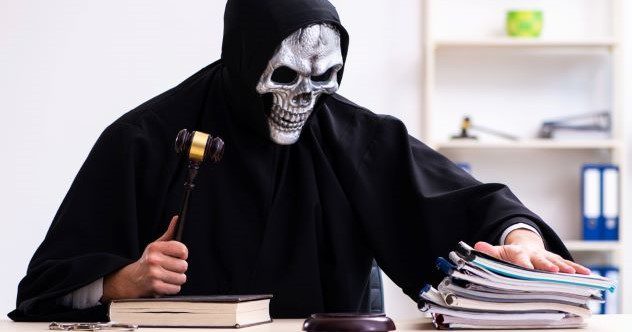
Courts are designed for flesh-and-blood dispomes a family blood feud. Yet legal history contains a stranger docket. Ghosts have affected home sales, Satan has been named as a civil-rights defendant, God has received an injunction request, and alleged demons have wandered into criminal defenses without bothering to pass the bar exam.
These weird court cases are entertaining, but they also reveal something serious. Judges usually do not decide whether supernatural beings exist. Instead, they ask ordinary legal questions: Was the defendant properly served? Was evidence admissible? Did a seller conceal a reputation that affected property value? Was a belief sincerely religious? Could a claimed possession satisfy a recognized insanity defense? The result is a fascinating collision between extraordinary allegations and very earthly rules.
1. Stambovsky v. Ackley: The House Haunted “as a Matter of Law”
When Jeffrey Stambovsky agreed to buy a Victorian home in Nyack, New York, he apparently expected old plumbing, not poltergeists. Seller Helen Ackley had previously described ghostly activity in the home to the press, helping create a local reputation that the property was haunted. Stambovsky, an out-of-town buyer, learned of that reputation after signing the contract and sued to cancel the deal.
In 1991, a New York appellate court allowed his rescission claim to proceed. The court did not launch an official ghost census. Instead, it reasoned that Ackley, having publicly promoted the haunting, could not deny the reputation when selling the home. In the opinion’s famous phrase, the house was haunted “as a matter of law.” The court even borrowed from Ghostbusters while explaining why a normal inspection would not reveal poltergeists. This supernatural property case became a contracts-class classic because the real issue was disclosure, not ectoplasm. tion>
2. United States ex rel. Mayo v. Satan and His Staff
In 1971, Pennsylvania prisoner Gerald Mayo filed a federal civil-rights complaint against “Satan and His Staff.” Mayo alleged that Satan had caused misery, threatened him, placed obstacles in his path, and contributed to his downfall. That is an ambitious complaint, especially when the defendant’s organizational chart is traditionally difficult to subpoena.
The federal judge denied Mayo permission to proceed without paying court fees. The opinion raised several practical problems: Did the court have personal jurisdiction over Satan? Where did the defendant reside? Could the lawsuit qualify as a class action? Most immediately, Mayo had failed to provide instructions enabling the U.S. Marshal to serve process. The judge also joked about an “unofficial” New Hampshire proceedingan unmistakable nod to The Devil and Daniel Webster. The court did not rule Satan innocent; it ruled that even infernal litigation must follow procedure. tion>
3. Chambers v. God: The Problem of Serving an Omniscient Defendant
Nebraska state senator Ernie Chambers filed suit against God in 2007, seeking a permanent injunction against disasters, suffering, and threats attributed to the Almighty. Chambers used the case to make a broader point about access to the courts and the danger of dismissing unusual claims before litigants can be heard.
The case eventually ran into the most basic obstacle in civil litigation: service of process. A judge dismissed it because the named defendant had no listed address and could not be properly notified. Chambers answered with a theological procedural argument worthy of a law-school exam: If God is omniscient, then God already knows about the lawsuit. If God is omnipresent, jurisdiction should not be difficult either. The argument was memorable, but it did not produce an enforceable injunction. Apparently, even divine notice must satisfy earthly civil procedure. tion>
4. United States v. Ballard: Can a Jury Decide Whether Miracles Are Real?
The leaders of the “I AM” movement claimed communication with spiritual beings, supernatural healing powers, and extraordinary religious experiences. Federal prosecutors charged them with mail fraud, arguing that they solicited money through claims they knew were false.
The case reached the U.S. Supreme Court in 1944. The Court drew a crucial line: A jury could not be asked to determine whether religious doctrines or supernatural experiences were objectively true. Turning religious truth into a courtroom fact question would place judges and jurors in the business of selecting valid faiths. The sincerity of a defendant’s professed belief, however, could be legally relevant in a fraud case. The result was not a judicial endorsement of spirit communication. It was a First Amendment warning that courts may examine dishonest conduct without putting miracles themselves on trial. tion>
5. The Arne Cheyenne Johnson Trial: “The Devil Made Me Do It”
After Arne Cheyenne Johnson killed his landlord, Alan Bono, in Connecticut in 1981, his lawyer attempted to build a defense around demonic possession. The allegation followed claims that a younger boy in Johnson’s circle had been possessed and that a demon later transferred to Johnson.
Judge Robert Callahan refused to let the defense present possession as a standalone route to innocence, reasoning that it could not be scientifically or objectively established through evidence. Johnson’s attorney therefore argued self-defense instead. A jury convicted Johnson of first-degree manslaughter, and he received a sentence of 10 to 20 years, serving roughly five. The case became a pop-culture landmark, but its legal lesson is less cinematic: American criminal law recognizes defenses such as insanity, duress, and self-defensenot a separate “demon took the wheel” doctrine.
tion>
6. People v. Kashney: Was the Police Officer Possessed?
Illinois defendant Robert Kashney confessed to two murders and armed robberies, then later denied committing them. His explanation for the confession was unusual even by the standards of supernatural court cases: He said demons had possessed one of the investigating officers and coerced him into confessing.
The defense called two psychiatrists and two witnesses described as experts in demonology. One discussed the possible existence of demons; another explained that a person who believed someone was demonically possessed might react with extreme fear. The Illinois Supreme Court did not decide whether the officer had supernatural company. The appellate issue concerned whether Kashney had opened the door to statements from court-ordered psychiatric examinations. The court held that he had waived certain protections by introducing psychiatric testimony supporting his possession-based explanation. In other words, demons entered the record, but evidentiary waiver decided the appeal.
tion>
7. State v. Hyden: A Request for a Demonic-Possession Expert
Christopher James Hyden, facing extremely serious criminal charges in Minnesota, asked the court to fund an expert who could evaluate whether he had a defense based on demonic possession. His proposed expert was his minister.
The trial court denied the request. It noted the lack of a recognized demonic-possession defense, the absence of reputable scientific support, and the failure to explain what qualified the minister as an expert on the defendant’s mental state. The Minnesota Court of Appeals affirmed. The decision illustrates an important distinction: A defendant may describe beliefs involving demons, and mental-health evidence may be relevant, but expert testimony still must meet ordinary standards of qualification, relevance, and necessity. Calling a witness an exorcism specialist does not automatically unlock public fundingor admissibility.
tion>
8. Dettmer v. Landon: When a Court Recognized Wicca as a Religion
Herbert Dettmer, an inmate in Virginia, argued that prison officials violated his First Amendment rights by denying access to items used in his Wiccan worship. His requested materials included candles, incense, a statue, a white robe, salt or sulfur, and a timer. Prison officials raised security concerns, some more understandable than others; sulfur and timers tend to make corrections officers nervous.
In 1985, a federal district court concluded that Wicca qualified as a religion for First Amendment purposes. The court emphasized sincerity, spiritual concerns, ceremonies, literature, and worship of godsnot whether outsiders considered the beliefs conventional. It then ordered supervised access to several ritual items, with safer substitutions where appropriate. The strange-looking inventory made headlines, but the holding was straightforward: Unfamiliar religions do not lose constitutional protection merely because their practices seem unusual to the majority.
tion>
9. The Trial of Grace Sherwood: Virginia’s Water Test
Grace Sherwood, a midwife and healer in colonial Virginia, was accused by neighbors of witchcraft, including harming crops, livestock, and people through supernatural means. In 1706, the Princess Anne County Court ordered a “water test.” Sherwood was bound and placed in the Lynnhaven River. Under the logic of the ordeal, sinking suggested innocence; floating suggested that the water rejected a witch.
Sherwood floated, managed to free herself, and survived. Authorities then searched her body for supposed witch’s marks and jailed her. Records indicate that another trial was contemplated, but its outcome is unclear, and she was not executed. The case is a grim reminder that supernatural evidence once included physical ordeals designed so that survival could be treated as proof of guilt. It also shows how rumor, gender expectations, neighborhood conflict, and legal authority can combine into something far more dangerous than folklore. tion>
10. The Trial of Bridget Bishop: Spectral Evidence in Salem
Bridget Bishop was the first person tried by Salem’s special Court of Oyer and Terminer in 1692. Witnesses accused her of witchcraft, and the proceedings accepted “spectral evidence”claims that a defendant’s spirit or apparition had appeared to torment someone even while the defendant’s physical body was elsewhere.
Bishop maintained her innocence, but the court convicted her. She was hanged on June 10, 1692, becoming the first person executed during the Salem witch trials. Ministers warned that the Devil might assume the shape of an innocent person, which should have made spectral testimony legally radioactive. The court nevertheless continued relying on it. Bishop’s case remains one of history’s clearest warnings about evidence that cannot be independently tested, challenged, or separated from fear. When an accusation is treated as its own proof, due process has already left the building. tion>
What These Supernatural Court Cases Actually Teach
Courts Usually Avoid Deciding the Paranormal Question
The most interesting pattern is judicial restraint. In Stambovsky, the court addressed a property’s reputation, not the scientific existence of ghosts. In Ballard, the Supreme Court refused to let jurors decide whether religious claims were true. In the demonic-possession cases, judges focused on recognized defenses, expert qualifications, evidentiary rules, and mental condition.
Procedure Is the Ultimate Monster Hunter
Supernatural defendants tend to loseor escapeon extremely ordinary grounds. Satan presented a jurisdiction and service problem. God lacked an address. The alleged demon experts encountered relevance and qualification requirements. Civil procedure may not be dramatic, but it has defeated more cosmic litigation than any silver bullet.
Belief and Legal Proof Are Different Things
A person can sincerely believe in ghosts, demons, divine messages, witchcraft, or spiritual healing. The law may protect that belief, especially in religious-freedom cases. But a sincere belief does not automatically prove an external fact, erase criminal responsibility, or make testimony admissible. Modern courts generally ask what can be demonstrated under legal standards while avoiding unnecessary judgments about theology.
The Historical Cases Carry a Human Cost
The modern cases can be funny because the judicial language is witty and the procedural puzzles are absurd. The witch trials are different. Grace Sherwood was subjected to a dangerous ordeal, and Bridget Bishop was executed. Their cases show what happens when institutions treat supernatural suspicion as reliable evidence and social prejudice as confirmation.
The Experience of Exploring Weird Supernatural Court Records
Reading these cases creates immediate tonal whiplash. One page contains a judge making a Ghostbusters joke; the next describes a woman being tied up and thrown into a river. That contrast is part of the experience. “Weird court cases” sounds like light entertainment, but the category includes clever satire, constitutional disputes, mental-health questions, real violence, and historical injustice.
The first useful habit is separating the allegation from the holding. A case may contain pages about demons without a judge ever recognizing demons as real. Headlines often flatten that distinction. “Court hears demon defense” can become “court rules demons exist” after enough retelling, which is approximately how legal folklore reproduces in the wild. The actual opinion usually reveals a narrower question involving evidence, procedure, competency, or religious liberty.
The second habit is following the procedural posture. Did the plaintiff win a final judgment, merely survive a motion to dismiss, or only receive permission to file? Did an appellate court review the supernatural claim itself, or a side issue such as psychiatric confidentiality? In People v. Kashney, for example, demonology drew attention, but waiver rules drove the decision. In Mayo v. Satan, the court did not conduct a trial and clear Satan of wrongdoing; it denied a request to proceed without fees and noted service and jurisdiction problems.
The third experience is realizing how much tone matters. Some opinions use humor to explain an unusual legal principle. That can make dense law memorable, but readers should not confuse wit with disrespect for the people involved. The Arne Johnson, Hyden, and Kashney matters arose from serious crimes and complex questions about mental condition. The Salem and Sherwood cases involved systems that punished people on evidence modern courts would consider deeply unreliable.
There is also a surprisingly practical lesson for property owners, lawyers, and curious readers: Reputation can have measurable consequences even when the underlying claim cannot be proven. A home known as haunted may attract tourists, repel buyers, or alter its market value. The law can address those consequences through disclosure, fraud, contract, or consumer-protection principles without deciding whether a ghost is upstairs reorganizing the silverware.
Finally, these records reward skeptical curiosity. The best approach is neither automatic belief nor smug dismissal. Read the primary opinion, identify the legal issue, note what the court did not decide, and treat sensational summaries cautiously. Supernatural court cases are most fascinating when the mythology is peeled back and the legal machinery becomes visible. Beneath the ghosts, gods, witches, and demons, the recurring questions are intensely human: Who is responsible? What counts as proof? Which beliefs deserve protection? And what must a fair court refuse to decide?
Conclusion
These 10 weird court cases featuring supernatural beings prove that the law can encounter almost any claim without abandoning its familiar tools. Judges have handled haunted real estate through contract principles, divine defendants through service rules, spirit communication through the First Amendment, and demonic-possession claims through evidence and criminal-law standards.
The funniest cases remind us that legal writing occasionally has a pulse. The darkest ones remind us why reliable evidence and due process matter. A courtroom cannot guarantee that every story entering its doors will be ordinary. It can, however, insist that even the strangest story meet standards designed for fairness, testability, and human responsibility.