Few fictional worlds have turned simple shapes, animals, objects, and tiny design details into global icons quite like Harry Potter. A lightning bolt is no longer just weather with confidence issues. A badger is no longer simply a woodland creature with excellent digging credentials. And a triangle with a circle and line inside it? Congratulations, you have entered the land of legendary magical objects, complicated destiny, and fans who can spot a Deathly Hallows necklace from across a crowded bookstore.
Harry Potter symbols matter because they do more than decorate robes, book covers, movie posters, and mugs. They tell us who characters are, what they value, what they fear, and what kind of magic shapes their choices. Some symbols represent courage, loyalty, wisdom, or ambition. Others warn us about obsession, power, secrecy, and the danger of chasing immortality like it is a clearance sale at Borgin and Burkes.
Below are 22 magical Harry Potter symbols and their meanings, explained in a clear, fan-friendly way for readers who love the Wizarding World, literary symbolism, Hogwarts houses, magical objects, and, naturally, a little mischief managed.
1. The Lightning Bolt Scar
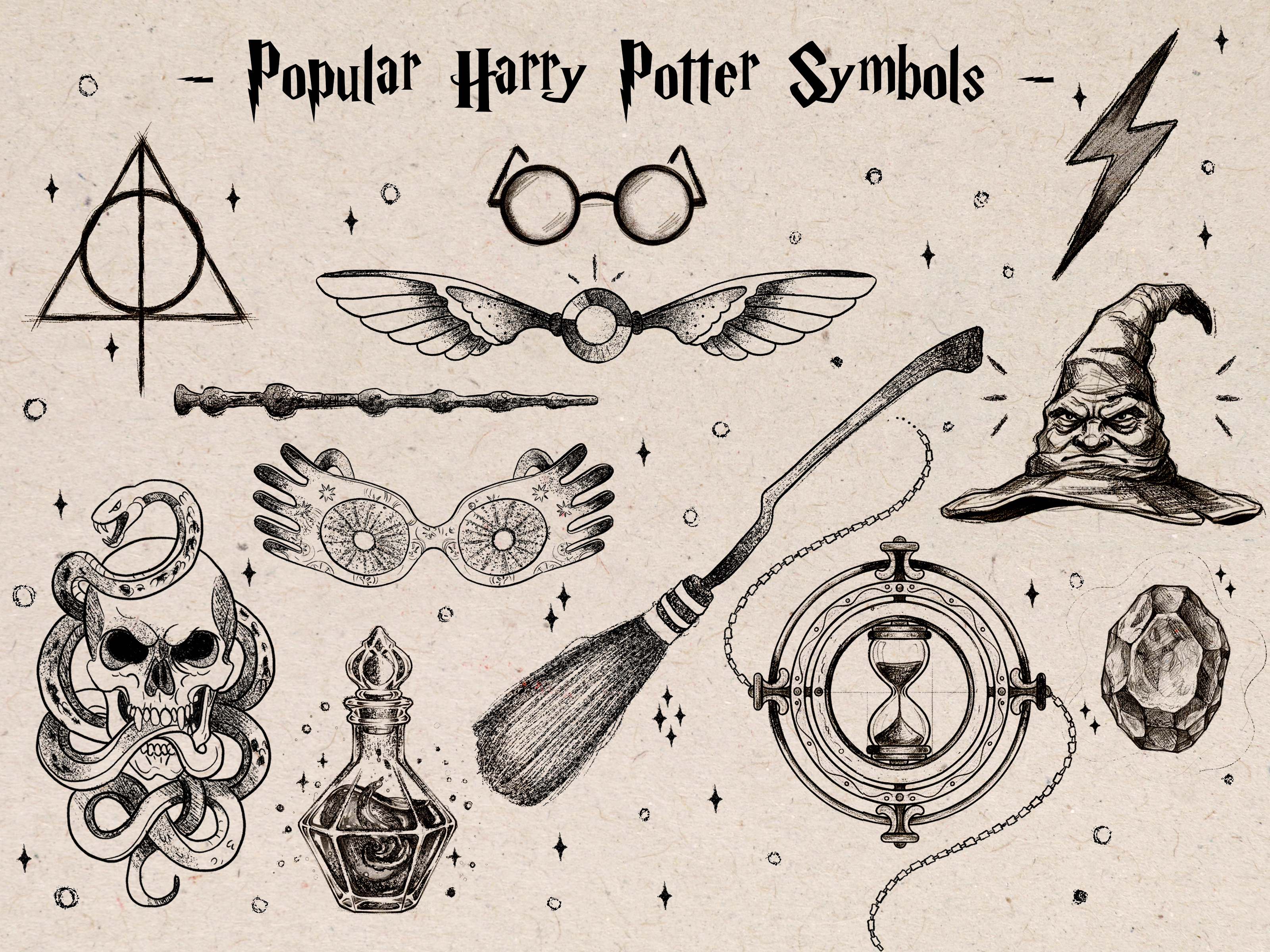
Harry’s lightning bolt scar is the most recognizable symbol in the series. It represents survival, sacrifice, and the strange burden of fame Harry never asked for. The scar marks him as “The Boy Who Lived,” but it also reminds readers that trauma and identity can become tangled. Symbolically, it is both a wound and a badge: proof that love protected him, but also proof that his past will keep calling collect.
2. The Deathly Hallows Symbol
The Deathly Hallows symbol combines a triangle, circle, and vertical line. Each part represents one legendary object: the Cloak of Invisibility, the Resurrection Stone, and the Elder Wand. Together, the symbol points to humanity’s oldest magical temptation: mastering death. Its deeper meaning is not “collect all three and win wizard Monopoly.” It warns that power, grief, and fear can mislead even brilliant people.
3. The Elder Wand
The vertical line in the Deathly Hallows symbol stands for the Elder Wand, the most powerful wand in wizarding legend. As a symbol, it represents domination, ambition, and the belief that strength can solve every problem. In the story, the wand exposes the emptiness of power without wisdom. It is basically the magical version of buying the fanciest sports car and forgetting how brakes work.
4. The Resurrection Stone
The circle in the Deathly Hallows symbol represents the Resurrection Stone. Its meaning is tied to grief, memory, and the human desire to bring back what has been lost. The stone does not offer simple happiness. Instead, it shows how love can remain powerful even when people are gone. Symbolically, it asks a painful question: should we live in memory, or carry memory while still moving forward?
5. The Invisibility Cloak
The triangle in the Deathly Hallows symbol represents the Invisibility Cloak. Unlike the Elder Wand, the cloak is not about conquest. It symbolizes humility, protection, patience, and choosing when not to be seen. Harry uses it for sneaking, yes, but also for observing truth. In a world full of noise and ego, the cloak whispers, “Maybe survival sometimes means keeping your head down and your footsteps quiet.”
6. The Hogwarts Crest
The Hogwarts crest gathers all four house animals around the letter “H,” making it one of the richest Harry Potter symbols. It represents unity through difference. Gryffindor, Slytherin, Ravenclaw, and Hufflepuff all value different traits, but together they form the school. The crest’s meaning is simple and surprisingly adult: communities work best when courage, ambition, intelligence, and loyalty stop arguing long enough to share the same table.
7. The Gryffindor Lion
The Gryffindor lion represents courage, nerve, daring, and chivalry. Lions have long been associated with bravery and leadership, making the animal a natural match for the house of Harry, Hermione, Ron, Neville, and Professor McGonagall. But Gryffindor’s symbol is not about being fearless. It is about doing the right thing while fear is still sitting beside you eating popcorn.
8. The Slytherin Serpent
The Slytherin serpent symbolizes ambition, cunning, resourcefulness, and self-preservation. Because Voldemort and many Death Eaters are associated with Slytherin, the serpent often gets treated like the franchise’s suspicious uncle. But the symbol itself is more layered. Snakes can represent transformation, secrecy, and strategy. Slytherin reminds readers that ambition is not automatically evil; it depends on what you are willing to sacrifice to achieve it.
9. The Ravenclaw Eagle
Ravenclaw is represented by an eagle, a bird linked with vision, perspective, and intellectual height. The eagle symbolizes wisdom, creativity, wit, and the ability to see beyond obvious answers. Ravenclaw energy is not merely “I own many books,” although that helps. It is curiosity with wings. The symbol celebrates thinkers, inventors, question-askers, and students who probably enjoy extra-credit assignments without being asked.
10. The Hufflepuff Badger
The Hufflepuff badger represents loyalty, patience, fairness, and quiet strength. Badgers may not look as flashy as lions or eagles, but they are tough, grounded, and not easily pushed around. That makes them perfect for Hufflepuff. The house symbol suggests that kindness is not weakness. In fact, being decent when nobody is applauding may be one of the hardest forms of magic.
11. The Dark Mark
The Dark Mark is Lord Voldemort’s symbol: a skull with a snake. It represents fear, control, dark allegiance, and the public announcement of terror. As a symbol, it is intentionally theatrical. Voldemort understands branding, unfortunately. The Dark Mark shows how symbols can be used to intimidate people and bind followers together. It is the opposite of the Hogwarts crest: division instead of community.
12. The Patronus
A Patronus is a protective magical guardian, often appearing as an animal unique to the caster. Symbolically, it represents hope, memory, emotional strength, and the power of joy against despair. Harry’s stag Patronus connects him to his father, while other Patronuses reveal personality, love, and inner resilience. The Patronus is one of the warmest Harry Potter symbols because it says happiness is not silly; it can be armor.
13. The Stag
The stag is tied to James Potter, Harry’s father, and later to Harry’s own Patronus. It symbolizes protection, inheritance, courage, and family connection. In many traditions, stags also suggest nobility and guidance. For Harry, the stag becomes a sign that he is not alone, even when he feels abandoned. It is a quiet, antlered reminder that love can echo across generations.
14. The Doe
The doe Patronus is associated with Lily Potter and Severus Snape’s enduring love for her. Its meaning is gentler than the stag’s but equally powerful. The doe symbolizes devotion, sacrifice, grief, and emotional truth. It also shows that symbols in Harry Potter are rarely flat. The same image can hold tenderness, regret, loyalty, and pain without needing a dramatic musical cue, though the films kindly provide one anyway.
15. The Golden Snitch
The Golden Snitch is the tiny winged ball used in Quidditch. It represents focus, speed, victory, and the pursuit of something elusive. In the wider story, the Snitch also becomes a container of memory and inheritance. Its meaning shifts from sports glory to personal destiny. That is impressive for something roughly the size of a walnut with the attitude of a hummingbird.
16. Platform Nine and Three-Quarters
Platform Nine and Three-Quarters symbolizes the threshold between ordinary life and the magical world. To reach it, students pass through what appears to be a solid barrier at King’s Cross Station. That action captures the central fantasy of the series: hidden wonder exists just beyond what adults call impossible. It is the doorway to school, friendship, danger, homework, and the occasional suspiciously moving staircase.
17. The Sorting Hat
The Sorting Hat symbolizes identity, choice, and self-knowledge. It sorts students into Hogwarts houses by reading their qualities and potential. Yet the series makes clear that people are more than labels. The hat represents the beginning of belonging, but also the danger of assuming a house defines a whole person. It is wise, ancient, and, frankly, long overdue for a fabric freshener.
18. The Marauder’s Map
The Marauder’s Map symbolizes mischief, friendship, hidden knowledge, and the thrill of knowing the secret routes of a place. Created by the Marauders, it reveals Hogwarts and the movements of people inside it. The map is fun, but it is also meaningful: it shows that stories have layers. Every castle, school, and person contains passages not visible at first glance.
19. The Time-Turner
The Time-Turner represents consequence, responsibility, and the temptation to fix life by revisiting it. Hermione uses one for an impossible class schedule, which is peak Hermione and also a warning label with hair. Symbolically, the Time-Turner suggests that time is powerful but dangerous. You cannot casually rearrange reality because Tuesday got inconvenient. Magic may bend time, but wisdom must guide it.
20. Fawkes the Phoenix
Fawkes, Dumbledore’s phoenix, symbolizes rebirth, loyalty, healing, and moral courage. Phoenixes burst into flame and are reborn from ashes, making them natural symbols of renewal. Fawkes also comes to Harry’s aid in crucial moments, showing that help can arrive when hope seems thin. As Harry Potter symbols go, the phoenix is a blazing reminder that endings are not always final.
21. Hedwig the Snowy Owl
Hedwig symbolizes friendship, freedom, communication, and Harry’s connection to the magical world. Given to Harry on his eleventh birthday, she is more than a pet or postal service with feathers. Hedwig represents companionship during lonely years and the first tangible proof that Harry belongs somewhere else. She is elegant, loyal, occasionally sassy, and far better at delivering mail than most real-world apps.
22. The Mirror of Erised
The Mirror of Erised symbolizes desire, longing, and the difference between dreams and reality. It shows the viewer their deepest wish, which makes it fascinating and dangerous. Harry sees family. Ron sees achievement. The mirror’s meaning is beautifully uncomfortable: what we want most can reveal who we are, but staring at desire forever can keep us from actually living.
Why Harry Potter Symbols Still Feel Magical
Harry Potter symbols remain popular because they are easy to recognize but rich enough to revisit. A casual viewer can enjoy the lightning scar, house crests, or Golden Snitch as cool visual icons. A deeper reader can see themes of sacrifice, identity, temptation, courage, grief, and belonging. That is good storytelling design: the symbols work on a T-shirt, but they also work in an English essay. Very efficient. Ten points to narrative structure.
Another reason these symbols endure is that they help fans express themselves. A Gryffindor lion may say, “I value bravery.” A Hufflepuff badger may say, “I believe kindness counts.” A Ravenclaw eagle suggests curiosity, while a Slytherin serpent announces ambition and strategy. Even the Deathly Hallows symbol, despite its darker history, has become a fan shorthand for mystery, legend, and the bittersweet wisdom of the final books.
The strongest symbols in the Wizarding World are not merely decorative. They carry choices. Harry chooses humility over domination. Hermione uses knowledge responsibly. Neville grows into courage. Snape’s doe Patronus reveals a painful emotional truth. Dumbledore’s phoenix imagery suggests rising again after failure. These symbols remind readers that magic is not just what a wand does. Magic is also what people decide to become.
Personal Experience: Reading the Symbols Like a Fan, Not a Goblin Accountant
The fun thing about Harry Potter symbols is that they sneak up on you. The first time many readers meet them, they simply look cool. The Hogwarts crest feels official, the scar looks iconic, the Snitch seems exciting, and the Sorting Hat feels like the world’s strangest school counselor. But over time, those images start collecting meaning like a robe collecting cat hair in Professor McGonagall’s office.
For many fans, the house symbols become personal almost immediately. People do not just say, “I like Ravenclaw.” They say it with the energy of someone defending a dissertation while holding a blue scarf. Gryffindor fans often connect with bravery and boldness. Hufflepuff fans embrace fairness and loyalty, sometimes with the quiet confidence of people who know they would bring snacks to a dangerous quest. Slytherin fans often appreciate ambition and complexity. Ravenclaw fans enjoy creativity and intelligence, plus the right to overthink every quiz question until breakfast.
The Deathly Hallows symbol usually hits differently as readers grow older. At first, it seems mysterious and stylish. Later, it becomes a reminder that wanting control over death, pain, and loss is deeply human. That is why the symbol feels bigger than the objects themselves. It is not simply about a wand, a stone, and a cloak. It is about the choices people make when they are afraid. Do they chase power? Do they cling to the past? Or do they accept limits and keep walking?
The Patronus is another symbol that becomes more meaningful with time. As a younger reader, it may feel like the coolest magical animal quiz ever invented. As an older reader, it feels like emotional survival translated into silver light. The idea that a happy memory can protect someone is simple, but it is not childish. It suggests that joy, friendship, humor, and love are practical forces. In other words, your happiest memories are not decorative throw pillows for the mind. They are emergency equipment.
Even small symbols, like Platform Nine and Three-Quarters, carry a special emotional charge. That platform represents the dream that an ordinary place might hide an extraordinary door. Anyone who has ever stood in a train station, school hallway, library, airport, or boring family event and wished for adventure understands the appeal. The symbol says magic may be closer than it appears. Please do not run into real walls to test this theory. Let us keep the magic metaphorical and our noses unbroken.
That is the lasting charm of these Harry Potter symbols. They give fans a visual language for big feelings: bravery, loyalty, grief, hope, ambition, curiosity, friendship, and the longing to belong. They are not perfect little icons locked inside a fictional museum. They are living signs that readers keep reinterpreting. Every reread adds a new layer. Every fan brings a different memory. And somehow, a scar, a badger, a phoenix, and a tiny golden ball still manage to feel like home.
Conclusion
The 22 magical Harry Potter symbols above show why the Wizarding World continues to fascinate readers and viewers. These images are memorable because they combine visual simplicity with emotional depth. The lightning bolt scar tells a story of survival. The Hogwarts crest celebrates unity. The house animals reveal values. The Deathly Hallows explore power, grief, and acceptance. The Patronus turns hope into protection, while Fawkes proves that rebirth is possible even after the darkest moments.
Whether you are a lifelong fan, a new reader, or someone trying to decode a friend’s mysterious triangle-circle-line tattoo, Harry Potter symbols offer more than nostalgia. They give us a magical vocabulary for real human themes. And that may be the biggest meaning of all: the best symbols do not just belong to a story. They help us understand our own.