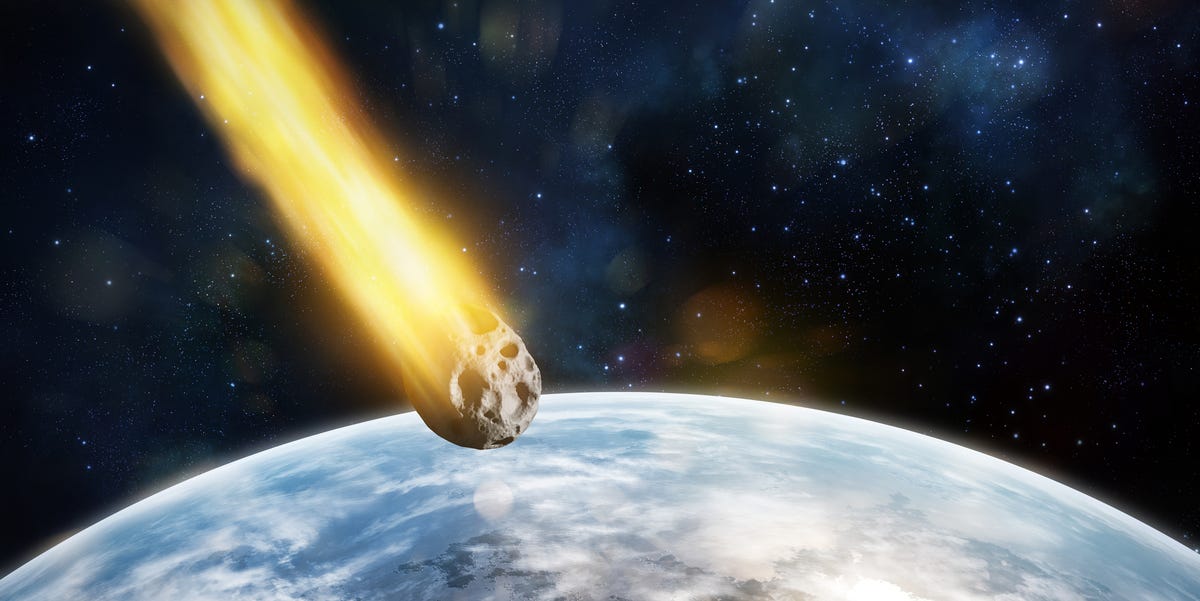
There is a moment in almost every asteroid disaster movie when the scientists run out of elegant ideas, the politine has been thinking: “What if we just nuke it?”
Usually, dramatic music follows. A rugged crew is assembled. Someone discovers that drilling in space is surprisingly difficult. Humanity learns a valuable lesson about family approximately nine minutes before the credits roll.
Real planetary defense is less cinematic, but here is the wonderfully strange part: the nuclear option is not pure Hollywood nonsense. Scientists at U.S. national laboratories have been studying whether radiation from a nuclear explosion could push a dangerous asteroid away from Earth. Laboratory experiments and advanced computer simulations suggest that, under the right conditions, a nuclear device might deliver an enormous deflecting force without requiring astronauts to land on the asteroid, drill a hole, or dramatically sacrifice themselves while Aerosmith plays in the background.
The most intriguing approach is not necessarily to blast an asteroid into cosmic gravel. Instead, researchers are investigating a nuclear asteroid deflection strategy in which intense radiation vaporizes part of the asteroid’s surface. The escaping material acts somewhat like rocket exhaust, pushing the remaining asteroid in the opposite direction.
Newton’s third law may not have had a movie franchise, but apparently it could help save civilization.
Why Asteroid Defense Is a Real Scientific Priority
Earth is constantly surrounded by space rocks. Most are harmless. Tiny objects burn in the atmosphere, creating the streaks we call meteors. Larger near-Earth objects are tracked by astronomers who calculate their orbits and continually update estimates of future impact risk.
The important phrase here is future impact risk. Planetary defense works best when scientists find a dangerous object years or decades before a predicted collision.
NASA’s planetary defense programs support the discovery, tracking, and characterization of near-Earth objects. The National Academies of Sciences, Engineering, and Medicine has also identified planetary defense as an important part of America’s planetary science strategy.
Why take the threat seriously when a civilization-ending impact is extremely rare? Because rare and impossible are not the same thing.
Earth’s geological record contains rather persuasive evidence that large impacts can have a terrible day at the office. The Chicxulub impact roughly 66 million years ago produced global environmental consequences associated with the mass extinction that ended the age of non-avian dinosaurs.
Humans have one major advantage over the dinosaurs: telescopes, orbital mathematics, spacecraft, supercomputers, and an impressive inability to leave any possible engineering problem unexamined.
DART Proved We Can Actually Move an Asteroid
Before reaching for the nuclear toolbox, it is worth remembering that humanity has already performed its first successful full-scale asteroid deflection experiment.
NASA Deliberately Crashed a Spacecraft Into Dimorphos
On September 26, 2022, NASA’s Double Asteroid Redirection Test, better known as DART, intentionally collided with Dimorphos. The roughly 160-meter-wide moonlet orbits the larger asteroid Didymos. Neither object threatened Earth; the system was selected as a safe planetary defense test target.
DART slammed into Dimorphos at high speed. Scientists then measured a major change in the moonlet’s orbital period around Didymos. Early NASA measurements found that its orbit had shortened by about 32 minutes, comfortably exceeding the mission’s minimum success benchmark.
Later research continued to refine the details of the impact and the asteroid system. The essential result did not change: a kinetic impactor can alter the motion of an asteroid.
That is a fairly important sentence for a species living on a planet with a finite number of emergency exits.
A Tiny Push Can Become a Huge Miss
The goal of asteroid deflection is usually not to send a space rock flying across the solar system like an interplanetary baseball. A relatively small change in velocity can be enough when applied years before the predicted impact.
Imagine two cars traveling toward the same intersection. Change one vehicle’s arrival time by several seconds and there is no collision. Asteroid defense uses the same broad principle on an astronomical scale.
A slight alteration in an asteroid’s speed changes where it will be in the future. Given enough time, the difference between the original orbit and the modified orbit can grow until Earth and the asteroid reach the crossing point at different moments.
In planetary defense, “missed us by thousands of miles” earns a perfect score.
So Why Would We Need a Nuclear Asteroid Defense?
DART demonstrated the kinetic impact method, but a spacecraft crash is not equally suitable for every possible asteroid threat.
The size of the asteroid matters. Its density matters. The strength of the material matters. Its shape, rotation, internal structure, and porosity matter. Warning time matters enormously.
A relatively modest asteroid discovered decades in advance might be addressed with one or more kinetic impactors. Scientists have also considered concepts involving gravity tractors, ion beams, and other slow deflection methods.
But what happens if astronomers discover a very large object with limited warning?
This is where researchers at Lawrence Livermore National Laboratory and other institutions have repeatedly examined nuclear deflection and disruption. Nuclear explosive devices can release much more energy relative to the mass that a spacecraft must transport. In extreme scenarios involving large asteroids or short warning times, that energy advantage could be critical.
In other words, a nuclear device is not the preferred answer to every asteroid.
It is the planetary defense equivalent of a fire axe behind glass.
Sandia’s X-Ray Experiment Changed the Conversation
One of the most fascinating developments in asteroid impact prevention came from Sandia National Laboratories in New Mexico.
Physicist Nathan Moore and colleagues wanted to study what happens when asteroid-like material is exposed to the intense X-ray radiation associated with a nuclear explosion.
There was a minor experimental inconvenience: scientists cannot casually detonate nuclear weapons in space every Thursday afternoon for research purposes.
Instead, the team used Sandia’s Z machine, an extraordinary pulsed-power research facility capable of producing extremely powerful bursts of X-rays.
The “X-Ray Scissors” Experiment
The researchers tested small samples made from quartz and fused silica as asteroid surrogate materials. These targets were only about 12 millimeters wide, which is slightly less intimidating than a four-kilometer killer asteroid but considerably easier to fit into a laboratory.
To properly study asteroid deflection, however, the target needed to behave as though it were floating freely in space. A sample attached to a support would experience forces that could distort measurements.
The Sandia team developed a clever technique nicknamed X-ray scissors.
When the X-ray pulse arrived, it rapidly removed the thin supports holding the sample. At almost the same instant, the radiation heated and vaporized material on the target’s surface. For a tiny fraction of a second, the sample effectively experienced conditions suitable for observing free-flight momentum transfer before gravity had time to significantly influence the experiment.
That is the laboratory equivalent of removing the training wheels while simultaneously firing the bicycle with a radiation cannon. Science occasionally has excellent branding.
Vaporized Rock Became Rocket Exhaust
The physics behind the proposed nuclear deflection method is surprisingly intuitive.
Intense X-rays heat the side of the asteroid facing the explosion. Surface material becomes extremely hot and rapidly expands outward as vapor. When that material shoots away from the surface, the remaining asteroid receives momentum in the opposite direction.
Think of an inflated balloon released without tying the end. Air rushes one way; the balloon flies the other way.
An asteroid is, admittedly, a less festive balloon.
In Sandia’s tests, the X-ray pulse produced surface ablation and accelerated the quartz and fused-silica targets to roughly 70 meters per second. The researchers then used experimental measurements and numerical modeling to explore how the physics could scale to real asteroid defense scenarios.
Their analysis suggested that a powerful standoff nuclear explosion could potentially deflect rocky asteroids measuring several kilometers across under modeled conditions. The research discussed objects up to approximately four kilometers wide, although actual mission effectiveness would depend on numerous variables.
That does not mean scientists now possess a universal “press button, asteroid disappears” system. It means an important piece of nuclear asteroid deflection physics can be studied experimentally instead of existing only inside computer models.
The Big Misunderstanding: We May Not Want to Blow Up the Asteroid
Whenever nuclear weapons and asteroids appear in the same sentence, the natural mental image is a spectacular explosion followed by millions of asteroid fragments flying toward Earth.
Congratulations. You have identified one of the biggest concerns in planetary defense.
Deflection and Disruption Are Different Strategies
Deflection changes the asteroid’s trajectory while keeping much or most of the object together.
Disruption breaks the asteroid into fragments.
Planetary defense researchers study both options because the best response depends on the threat scenario.
With sufficient warning, deflection is generally attractive. Push the asteroid slightly, allow orbital mechanics to amplify that small change over time, and let the object pass Earth harmlessly.
If warning time is extremely short, researchers have explored whether disruption could still reduce the danger. Lawrence Livermore simulations have examined scenarios in which a threatening object is broken into many widely dispersed fragments. The objective would be to prevent a concentrated catastrophic impact.
However, disruption is complicated. Breaking one dangerous asteroid into multiple large dangerous fragments would be less “planet saved” and more “problem now available in family size.”
This is one reason the Sandia standoff concept is so interesting. A nuclear device detonated near the asteroid could use radiation to ablate the surface and provide a strong push without intentionally burying a bomb inside the object and attempting to pulverize it.
Asteroid Composition Could Decide Whether the Plan Works
Calling something “an asteroid” is a little like calling everything on Earth “a ground object.” Technically convenient, scientifically inadequate.
Asteroids vary dramatically.
Some are rocky. Others are rich in carbonaceous material. Some contain significant amounts of metal. Many are highly porous. Several spacecraft missions have shown that certain asteroids are loose rubble piles, collections of rocks and debris held together by weak gravitational and cohesive forces.
NASA’s OSIRIS-REx mission revealed the surprisingly loose nature of asteroid Bennu. Research associated with DART also indicates that Dimorphos is a weak rubble-pile object rather than a monolithic block of solid stone.
This creates a serious challenge for asteroid mitigation modeling.
Hit a solid metallic body with energy and it may respond one way. Apply the same energy to a loosely bound rubble pile and the result can be dramatically different. Surface material might eject more efficiently. Shock waves may propagate differently. The asteroid might deform, fragment, or absorb energy in unexpected ways.
Recent extreme-energy experiments involving metal-rich meteorite material have added another wrinkle. Early results suggest some iron-rich asteroid material may withstand intense energy deposition better than certain previous models assumed, potentially allowing stronger deflection forces without immediate catastrophic fragmentation.
Promising? Yes.
A universal conclusion for every asteroid in the solar system? Absolutely not.
Researchers still need data covering more complicated rocky, porous, and carbon-rich materials. The next killer asteroid, should humanity ever face one, will not politely select its composition based on which laboratory experiment produced the prettiest graph.
How a Nuclear Asteroid Deflection Mission Might Work
A real planetary defense mission would begin long before anyone discussed nuclear devices.
Step One: Find the Asteroid
Telescopes and survey programs continuously search for near-Earth objects. Once an object is discovered, astronomers collect repeated observations to improve knowledge of its orbit.
Impact probabilities can change dramatically as more observations arrive. An asteroid may initially appear to have a concerning chance of collision before improved orbital calculations rule out the threat.
This is normal. Early uncertainty is not the same as impending apocalypse.
Step Two: Characterize the Threat
Scientists would need to estimate the asteroid’s diameter, mass, composition, rotation, shape, and internal structure.
Remote observations could provide some information. Depending on the available warning time, a reconnaissance spacecraft might be sent to investigate the object directly.
This stage is crucial because the difference between a dense monolith and a fluffy rubble pile could change the entire mitigation plan.
Step Three: Model the Deflection
Researchers would simulate different mission scenarios. How far from the asteroid should the device detonate? How much energy is required? Which side of the object should receive the radiation? What velocity change is necessary to produce a safe Earth miss?
Laboratory experiments such as those at Sandia help improve these simulations by supplying real measurements of how materials respond to extreme X-ray pulses.
Lawrence Livermore researchers have similarly developed radiation-hydrodynamics modeling techniques designed to predict energy deposition, surface ablation, and asteroid motion during a potential nuclear mitigation mission.
Step Four: Deliver a Carefully Designed Standoff Mission
In the concept studied by researchers, a spacecraft would carry a nuclear explosive device toward the threatening object. Rather than necessarily hitting or penetrating the asteroid, the device could detonate at a calculated distance from its surface.
The resulting radiation would strike the asteroid. Surface material would vaporize and expand. The asteroid would receive a push.
Afterward, tracking observations would be essential. Scientists would measure the asteroid’s modified orbit and determine whether additional intervention was necessary.
The phrase “additional intervention” sounds delightfully calm when the subject is a second attempt to prevent planetary disaster.
Why Early Detection Is Still Better Than Nukes
The most important planetary defense technology may not be an explosive device.
It may be a telescope.
Warning time is enormously valuable because orbital deflection becomes easier when scientists can act early. A tiny velocity change applied decades before impact can grow into a huge positional difference by the time the asteroid reaches Earth’s orbit.
With very little warning, the necessary velocity change becomes larger. Mission development schedules become compressed. Launch opportunities may be limited. Scientists may have less time to characterize the asteroid and test their models.
This is why NASA’s near-Earth object surveys and planned detection capabilities are central to planetary defense. Finding dangerous asteroids earlier expands the menu of possible solutions.
With 20 years of warning, humanity might calmly discuss kinetic impactors and reconnaissance missions.
With six months of warning, the meeting probably contains more coffee.
The Nuclear Option Comes With Enormous Challenges
It would be irresponsible to describe nuclear asteroid defense as a solved problem. The research remains highly dependent on models, laboratory scaling, asteroid properties, and mission-specific conditions.
Scaling Laboratory Tests to Kilometer-Wide Objects Is Difficult
Sandia’s experiments provided valuable high-precision data, but a centimeter-scale sample is not a real asteroid.
Real near-Earth objects may contain fractures, voids, boulders, dust, metals, hydrated minerals, and layers of material with different physical properties. They rotate. They have irregular shapes. Some appear to be collections of debris rather than coherent bodies.
Computer models must bridge the enormous gap between laboratory experiments and planetary-scale objects.
Fragmentation Remains a Concern
Deliver too little energy and the asteroid may remain on a dangerous trajectory. Deliver energy inefficiently and the course change may be inadequate. Under some circumstances, excessive energy could cause unwanted disruption.
Mission designers would need to understand exactly how a particular target is likely to respond.
International Policy Would Be Complicated
Nuclear explosions in outer space face major international legal and political restrictions. A genuine asteroid emergency involving nuclear mitigation would therefore create questions extending far beyond physics.
Who verifies the threat? Who supplies the device? Who launches it? Who approves the mission? What happens if the deflection changes the predicted impact location rather than eliminating the collision risk?
Planetary defense is international by nature. An asteroid does not check passports before entering the atmosphere.
What Researching Asteroid Defense Actually Feels Like: of Perspective
Following the science of asteroid defense is a strange experience because it constantly switches between terrifying and reassuring.
One minute, you are reading about objects traveling through the solar system at velocities that make highway speeding tickets seem adorable. The next minute, you are looking at an orbital diagram and realizing scientists can predict an object’s future position using observations gathered from millions of miles away.
The first lesson is that headlines and planetary defense research speak very different languages. A headline says, “KILLER ASTEROID MAY HIT EARTH.” An orbital scientist says, “The uncertainty region currently overlaps Earth, but we require additional observations to constrain the trajectory.”
The scientist is technically more comforting, although perhaps less likely to trend on social media.
Another fascinating part of researching nuclear asteroid deflection is discovering how little the real science resembles movie logic. I used to think the nuclear option meant destroying the asteroid. That seems obvious: dangerous rock approaches Earth, humans possess extremely powerful explosives, therefore humans explode rock.
But the more interesting idea is considerably subtler.
You do not need to defeat the asteroid in combat. The asteroid has no intentions. It is not angry. It does not need to be conquered. It is simply following an orbit.
The job is to make Earth and the asteroid arrive at the same part of space at different times.
That perspective completely changes the problem.
The Sandia experiments are particularly memorable because the mechanism sounds almost absurdly elegant. Radiation heats the surface. Surface material vaporizes. The escaping material pushes the asteroid. An object millions or billions of times more massive than the laboratory target could, in principle, receive the same basic kind of momentum transfer.
It is a reminder that dramatic results can come from simple physical laws applied under extreme conditions.
The DART mission produces a similar feeling. NASA did not build a science-fiction force field. Engineers built a spacecraft and deliberately crashed it into a small asteroid moon. The collision generated ejecta, the ejecta added momentum, and the orbit changed.
Simple sentence. Years of engineering.
Then comes the uncomfortable part: uncertainty.
Asteroids are weird.
Bennu looks like a rubble pile. Dimorphos appears weak and loosely structured. Other asteroids may be rich in metals or composed of carbonaceous material. Some spin quickly. Some have moons. Some may contain deep voids. You cannot assume that the technique that works beautifully on one target will behave identically on another.
This makes planetary defense feel less like building a universal weapon and more like emergency medicine. The diagnosis matters before the treatment.
Size, composition, orbit, warning time, and internal structure all influence the response.
Perhaps the most reassuring experience, though, is realizing that serious scientists are working on these problems before a crisis exists. NASA, national laboratories, universities, international organizations, and observatories conduct simulations and exercises precisely because the worst possible moment to invent an asteroid defense plan is after astronomers confirm an impact.
The public may joke about “just nuking it.” Scientists ask the less glamorous questions: How much momentum is transferred? What is the uncertainty? How does porosity change the result? Where should the energy be deposited? How do we track the object’s new orbit?
And honestly, that is comforting.
Saving Earth probably will not require a hero delivering a clever one-liner.
It will require measurements, models, telescopes, spacecraft, international cooperation, and a truly unreasonable number of spreadsheets.
Conclusion: Nuking an Asteroid Is Not Crazy, but It Is Not Easy
Humanity has not developed a guaranteed doomsday-asteroid delete button. What scientists have developed is something more useful: a growing collection of tested technologies, experimental data, and increasingly sophisticated models.
NASA’s DART mission proved that humans can deliberately change an asteroid’s motion. Sandia National Laboratories demonstrated in laboratory experiments how an intense X-ray pulse can vaporize asteroid-like material and produce a significant deflecting push. Lawrence Livermore researchers continue improving nuclear mitigation simulations and studying both deflection and disruption scenarios.
The emerging picture is surprisingly hopeful.
For many threats discovered early, kinetic impactors or other non-nuclear techniques may be sufficient. For an unusually large asteroid or a short-warning emergency, a carefully planned nuclear standoff explosion could offer substantially more energy for deflection.
So, yes, the joke contains a grain of truth.
We may someday discover a massive asteroid headed toward Earth, run the calculations, examine every alternative, and arrive at the most scientifically responsible conclusion imaginable:
Fine. Nuke the asteroid.
Note: Nuclear asteroid deflection remains a high-level planetary defense research concept, not a currently deployed system. NASA continues tracking near-Earth objects, and current monitoring does not identify a known asteroid posing a significant Earth-impact threat over the next century. Any real nuclear planetary defense response would require extensive scientific analysis and extraordinary international coordination.