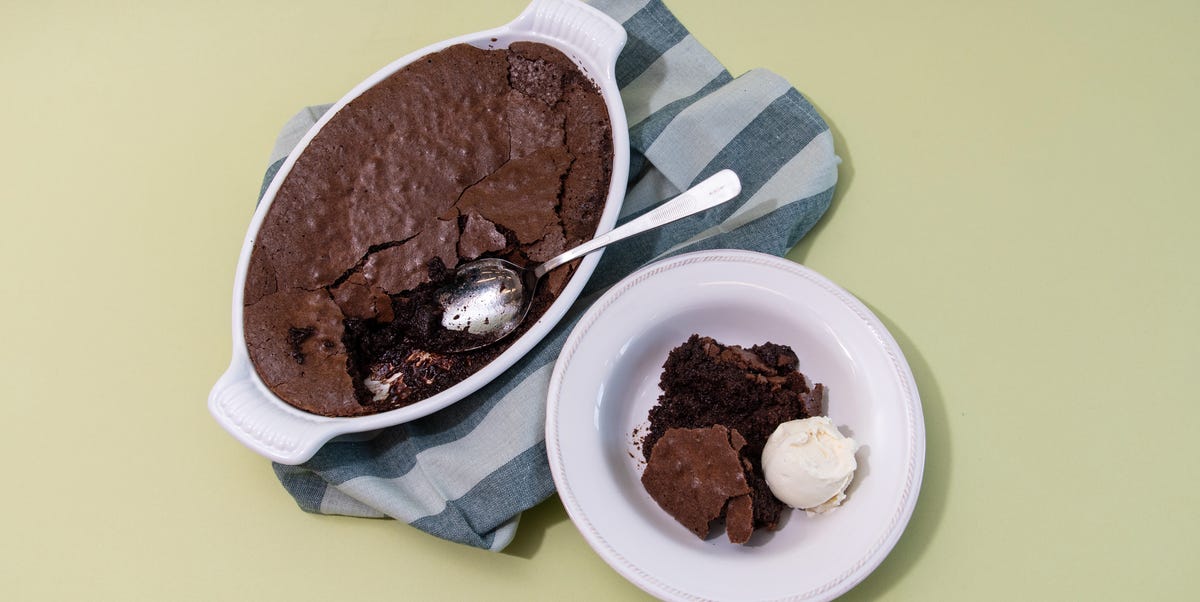
Ina Garten has built a career on recipes that make you feel as though a calm, extremely competent friend has entered your kitchen, handed you a wooden spoon, and quietly prevented dinner from becoming a disaster. So when I came across her famous baked chocolate pudngI expected the usual Barefoot Contessa experience: follow the directions, look effortlessly brilliant, accept compliments.
Mostly, that is exactly what happens. This dessert is intensely chocolatey, beautifully crackled on top, and soft enough in the center to demand a spoon rather than a cake server. But after examining the method closely and comparing the variables that make or break the final texture, I found one important problem: the recipe does not tell the home baker quite enough about what happens after the one-hour baking time.
And with a dessert designed to be intentionally underbaked in the middle, those missing details matter. A lot.
What Is Ina Garten’s Baked Chocolate Pudding?
Despite the name, Ina Garten’s baked chocolate pudding is not a traditional stovetop pudding thickened with cornstarch, and it is not a conventional brownie that you cool and cut into tidy squares. It is a deliberately ambiguous dessertand I mean that as a compliment.
The basic formula is wonderfully simple: butter, eggs, sugar, cocoa powder, a small amount of flour, vanilla, and optional raspberry liqueur. The eggs and sugar are beaten for several minutes until thick and pale, creating aeration that helps form the dessert’s delicate upper structure. Cocoa powder and flour provide chocolate flavor and just enough body, while a generous amount of melted butter creates the luxurious, almost molten interior.
The batter is baked at 325°F in a water bath. That gentle cooking environment is one reason the dessert can develop contrasting textures instead of simply turning into a pan of brownies. The outside sets first. The upper surface becomes thin, crisp, and slightly chewy. Underneath, the texture becomes progressively softer until the center reaches that famous pudding-like consistency.
On paper, it sounds almost suspiciously easy. In practice, it is easybut only after you understand what “done” is supposed to mean.
The Recipe’s Brilliant Trick: It Is Not Really One Texture
The best part of Ina Garten’s baked chocolate pudding is the contrast. A good scoop can contain three experiences at once.
The Crackly Top
The surface develops a delicate crust with some of the appeal of the shiny top on a great brownie. Beating the eggs and sugar thoroughly is essential here. This is not a step to rush because you are bored, hungry, or emotionally attached to your mixer’s highest speed.
The mixture should become visibly thicker and lighter before the dry ingredients go in. That aeration contributes to the light upper layer, which eventually contrasts with the dense chocolate beneath it.
The Fudgy Middle
Below the crust, the pudding becomes thicker and more brownie-like. This is where the dessert feels most familiar: rich, buttery, and deeply chocolatey, but too soft to cut into a neat square.
The Soft, Spoonable Center
The middle is intentionally underbaked compared with an ordinary cake. That does not mean it should necessarily resemble completely raw batter. The ideal texture is soft, glossy, and spoonablemore structured than brownie batter but considerably looser than a finished brownie.
That distinction is exactly where the recipe can become confusing.
What’s Missing: Clear Instructions for Cooling the Pudding
The published method is unusually precise about the baking time: one hour. It also explains that the center should appear very underbaked. Then comes a deceptively simple instruction: allow the dessert to cool before serving.
But where?
Should the baking dish be lifted immediately out of the hot water bath? Should it remain in the water for 10 or 15 minutes? Should it cool completely? Should it be served warm enough to melt the ice cream on contact?
Those are not tiny details. A water bath holds heat, and the pudding continues to change after leaving the oven. Leaving the dish surrounded by hot water encourages additional gentle cooking. Removing it immediately slows that process. Because the center is already supposed to be very soft, that difference can determine whether you get a luxurious pudding or something that looks alarmingly similar to warm brownie batter.
For more reliable results, I would add this instruction: after baking, let the pudding rest in the water bath for about 10 to 15 minutes before carefully removing the baking dish and serving it warm.
That one sentence gives the center time to settle without turning the entire dessert into cake.
The Baking Dish Matters More Than You Might Think
Another missing piece is a stronger warning about the shape and depth of the baking dish.
Ina specifies a 2-quart oval baking dish measuring approximately 9 by 12 by 2 inches. It is tempting to read “2-quart” as the only important measurement and substitute any casserole dish with similar capacity. Unfortunately, capacity and geometry are not the same thing.
A deeper, narrower dish creates a thicker layer of batter. The center takes longer to heat and set. A wider, shallower dish spreads the batter into a thinner layer, allowing it to cook more evenly during the same one-hour baking period.
That means two dishes capable of holding the same amount of batter can produce noticeably different puddings.
My Best Advice for the Baking Vessel
Use a dish as close as possible to the recommended dimensions. A shallow 2-quart ceramic or glass baking dish is a safer choice than a deep casserole. If your dish is significantly deeper, do not assume that the one-hour timing will produce the same result.
This is also why visual cues matter. In a recipe with an intentionally soft center, the clock should not be the only source of information.
The Doneness Test Could Be More Specific
Traditional cake recipes have a comforting finish line: insert a toothpick, and if it comes out clean, you are done. Ina Garten’s baked chocolate pudding laughs politely at that idea and continues being mysterious.
The recipe instructs bakers to test the pudding about two inches from the side rather than directly in the center. That is smart because the center is supposed to remain underbaked. Still, home bakers would benefit from more description of the finished appearance.
Here is what I would look for:
- The top should appear set rather than wet.
- A thin crust should have developed across most of the surface.
- The edges should look more structured than the center.
- The middle may move slightly but should not behave like a pan of completely liquid batter.
- A tester inserted away from the center should show moist crumbs rather than a coating of raw batter.
The dessert will continue settling as it rests, so cutting into it the second it leaves the oven is a little like opening a package while the delivery driver is still carrying it to your door. Technically possible. Not ideal.
There Is Another Thing Missing: Salt
The instructions are not the only place where I would make a small adjustment. The ingredient list contains no salt.
That surprised me because this is a dessert with two cups of sugar and a very concentrated chocolate flavor. Salt does not need to make a dessert taste salty to be useful. A small amount can sharpen the cocoa flavor and keep sweetness from feeling one-dimensional.
I would add approximately 1/4 teaspoon of kosher salt to the cocoa powder and flour before sifting them together. It is a tiny change, but in a recipe built from relatively few ingredients, tiny changes are easy to notice.
The original dessert is still delicious without it. This is not a rescue operation. Think of the salt as adjusting the focus on an already good photograph.
Does the Framboise Liqueur Matter?
The recipe includes a tablespoon of framboise, a raspberry liqueur, but marks it as optional. In theory, raspberry and chocolate are natural partners. In practice, one tablespoon has to compete with a substantial amount of cocoa, butter, and sugar.
The result is subtle.
Unless you already own a bottle or particularly enjoy the fruit-and-chocolate combination, I would not buy an entire bottle solely for this dessert. The pudding works beautifully without it.
For a more obvious flavor accent, a small amount of espresso powder is another possibility. Coffee is widely used in chocolate desserts because it can deepen the perception of chocolate flavor without necessarily making the finished dish taste like a cup of coffee. This would be a variation rather than part of Ina’s original formula, but it makes sense for serious chocolate lovers.
Do You Really Need a Vanilla Bean?
A whole vanilla bean sounds luxurious because it is luxuriousand priced accordingly.
In a delicate vanilla custard, those aromatic seeds can be the star. In an intensely cocoa-rich baked pudding, the nuance is harder to detect. Vanilla still matters, but you do not necessarily need to spend premium-ingredient money to obtain it.
Vanilla bean paste or good-quality pure vanilla extract can provide a practical substitute. The chocolate is still going to dominate the conversation. Vanilla is the excellent supporting actor standing just outside the spotlight.
How I Would Make Ina Garten’s Baked Chocolate Pudding More Foolproof
I would not dramatically rewrite the recipe. Its basic method is the reason the dessert is so appealing. Instead, I would add a few notes that reduce uncertainty.
- Use the correct egg size. Ina calls for extra-large eggs. In a dessert with little flour and a deliberately soft center, changing the egg quantity can affect structure.
- Beat the eggs and sugar fully. Give the mixture the required time to become thick, pale, and aerated.
- Use a shallow baking dish close to the specified dimensions. Do not rely on volume alone when substituting a pan.
- Use a proper water bath. The hot water should reach roughly halfway up the outside of the pudding dish.
- Judge doneness away from the center. The center is supposed to remain softer than the edges.
- Rest the pudding in the water bath for 10 to 15 minutes. This helps the interior settle and gently continue cooking.
- Add a small pinch of salt. It can balance the considerable sweetness and sharpen the chocolate flavor.
- Serve it warm, not violently hot. A short rest improves both texture and flavor.
Is Ina Garten’s Baked Chocolate Pudding Worth Making?
Absolutelywith an asterisk shaped like a baking dish.
This is an exceptional dessert for people who prefer the gooey center of a brownie to the tidy corner piece. It is rich, theatrical, and almost impossible to serve without everyone at the table asking what exactly they are eating.
“Is it cake?”
Not really.
“Is it pudding?”
Sort of.
“Can I have more?”
Now we are asking the important questions.
The recipe succeeds because it refuses to choose between textures. The only weakness is that a dessert this dependent on subtle degrees of doneness deserves more guidance about pan dimensions, cooling, and the final consistency.
With those details understood, Ina Garten’s baked chocolate pudding becomes much easier to reproduceand considerably less likely to trigger a nervous late-night search for “is brownie batter supposed to move like that?”
My Extended Experience With the Dessert: What Became Clear After the First Scoop
The most interesting thing about this baked chocolate pudding is that the experience changes minute by minute. Straight from the oven, the dessert looks finished on top but feels almost rebellious underneath. The crust suggests brownie. The spoon says otherwise.
My first instinct was to treat the one-hour baking time as an absolute finish line. After all, few recipes say to bake something for “exactly” a certain amount of time. That kind of language makes you afraid that minute 61 will cause the culinary equivalent of a solar eclipse.
But this recipe taught me that the oven time is only part of the process. The rest is part of the cooking, too.
When the pudding is allowed to sit briefly, the difference is obvious. The top remains delicate, but the interior gains enough structure to hold on a spoon. It still flows slightly when warm, particularly near the center, yet it no longer feels unfinished. That short waiting period is frustrating because the kitchen smells like melted chocolate and butter, but it is worth exercising the emotional discipline of an adult for approximately 15 minutes.
Serving temperature also changed my opinion of the dessert. Extremely hot, the sweetness and molten texture dominate. Warm, after a short rest, the cocoa flavor becomes easier to appreciate and the contrast between crust and center becomes clearer.
Then there is the ice cream.
I initially considered vanilla ice cream the usual optional accessorythe dessert equivalent of adding parsley to a restaurant plate. It is not. Here, vanilla ice cream is doing actual work. The cold creaminess cuts through the warm, dense chocolate and tempers the sweetness. As the scoop melts into the pudding, it creates its own sauce around the edges.
A small serving with ice cream was more satisfying than a large bowl of the pudding alone. This is a rich dessert, and pretending otherwise would be like describing a sofa as “a little bit furniture.”
I also became convinced that the texture is more important than adding complicated flavors. The optional raspberry liqueur can provide a subtle background note, but I did not find the dessert desperately missing it. Chocolate remains the main event. A pinch of salt, however, makes more practical sense to me because it affects every bite rather than introducing a flavor you may have to concentrate to notice.
The baking dish may have been the biggest lesson. A deeper dish can make the same one-hour instruction produce a much looser center. That is the kind of variable home cooks are rarely warned about because recipes often focus on pan capacity. But when a dessert contains so little flour and is designed to remain underbaked, depth becomes part of the recipe whether the ingredient list admits it or not.
Would I make Ina Garten’s baked chocolate pudding again? Yes, but I would approach it differently. I would use a shallow dish close to the intended dimensions, add a small pinch of kosher salt, beat the eggs and sugar without rushing, and leave the finished pudding in its warm water bath for about 15 minutes before serving.
I would also stop expecting the center to resemble an ordinary brownie. That expectation is responsible for much of the confusion surrounding this dessert. If you bake until the center behaves like cake, you have probably missed the point. The goal is controlled gooeynessa phrase that sounds ridiculous until you take the first spoonful.
Ultimately, what is missing from the recipe is not another elaborate ingredient or a secret pastry-chef technique. It is context. Home bakers need to know how the shape of the dish affects the center, what the pudding should look like when it leaves the oven, and how long it benefits from resting in the water bath.
Add those details, and the recipe suddenly feels complete. You get the crisp top, the fudgy layer, the soft center, and the glorious mess created when warm chocolate meets melting vanilla ice cream.
And yes, you should probably bring the baking dish to the table. This is not a dessert interested in neat slices or formal behavior.
Final Verdict
Ina Garten’s baked chocolate pudding deserves its reputation as an outrageously comforting chocolate dessert. The technique is clever, the ingredient list is manageable, and the combination of a crackly top with a soft, fudgy center is difficult to resist.
What is missing is clearer guidance. The recipe would be more dependable with explicit instructions about baking-dish depth, resting in the water bath, visual doneness cues, and serving temperature. I would also add a small amount of salt to balance the sweetness.
None of those changes reinvent Ina’s dessert. They simply make it easier for the person standing in the kitchen, staring nervously at a wobbling pan of chocolate, to know that everything is going exactly according to plan.
Note: This article is an original editorial synthesis informed by the published Ina Garten recipe and established American test-kitchen guidance on brownie pudding, water-bath baking, chocolate desserts, texture, and ingredient balance. Exact results can vary with oven calibration, baking-vessel dimensions, ingredient brands, and serving temperature.