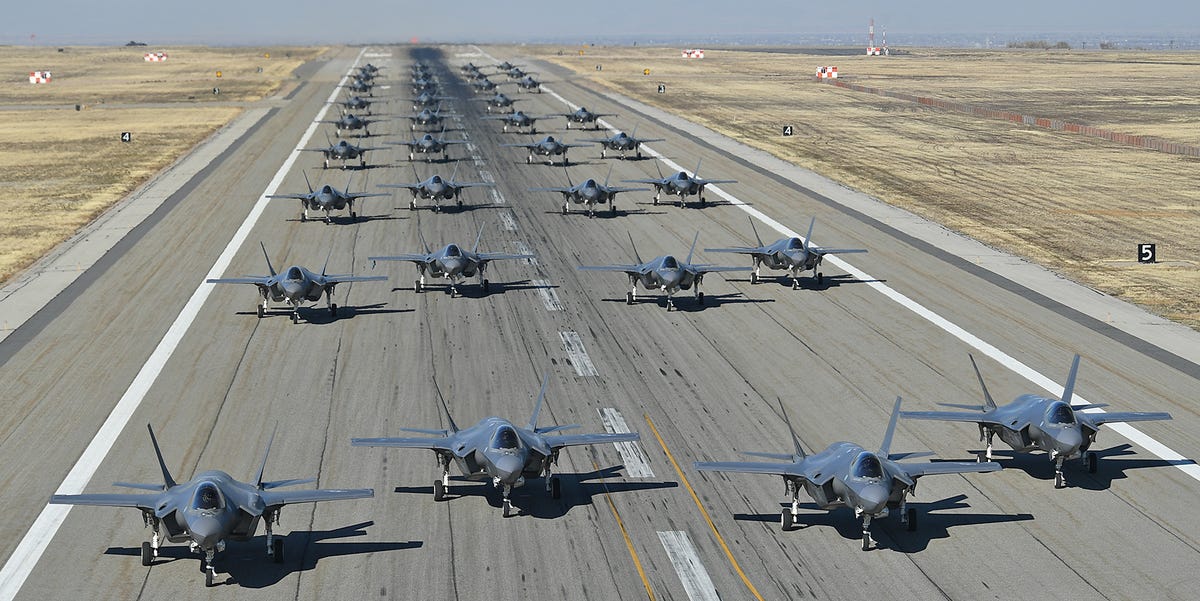
Thirty-five F-35A Lightning II fighters rolling down a runway in close formation is not the kind of sight that blends politely into the background. It is loud, expensive-looking, and about as subtle as a marching band made entirely of thunderclouds.
On November 19, 2018, Hill Air Force Base in Utah staged the U.S. Air Force’s first major F-35 “elephant walk” during a combat power exercise. The event brought together active-duty Airmen from the 388th Fighter Wing and reservists from the 419th Fighter Wing, launching 35 F-35As in a tightly compressed period.
The drill was far more than a flashy photo opportunity. It was a test of whether the Air Force could generate a large number of fifth-generation stealth fighters quickly, coordinate pilots and ground crews, move fuel and equipment efficiently, and send a meaningful amount of combat power into the air before an enemy could ruin everyone’s morning.
For aviation fans, it was a breathtaking display. For military planners, it was a giant checklist with jet engines attached.
What Is an “Elephant Walk” in Military Aviation?
An elephant walk is a mass formation of military aircraft taxiing closely together before takeoff. The name comes from the visual effect: aircraft moving in a long, connected line, much like elephants following one another across open ground.
Despite the charming wildlife comparison, there is nothing casual about an elephant walk. These drills are used to show and test a unit’s ability to rapidly launch many aircraft during a crisis. In a real-world scenario, an air base may need to get fighters airborne quickly because of a looming attack, a sudden deployment order, or a need to establish air superiority before an opponent gains momentum.
Think of it as the aviation equivalent of getting an entire restaurant kitchen ready during the dinner rushexcept the ovens fly at supersonic speed, the chefs wear flight suits, and one misplaced wrench can delay a mission worth millions of dollars.
More Than a Runway Parade
It is easy to see an elephant walk as military theater, and yes, the visuals are undeniably dramatic. But the exercise also reveals whether a wing can move from routine operations to high-tempo combat operations without tripping over its own logistics.
Before aircraft even reach the taxiway, crews must inspect jets, repair faults, fuel aircraft, load weapons when appropriate, update mission data, coordinate flight plans, brief pilots, confirm weather conditions, and clear aircraft for launch. A fighter jet does not simply wake up, stretch its wings, and decide it is ready for work.
What Happened at Hill Air Force Base?
Hill Air Force Base was already an important location in the F-35 program when the elephant walk took place. The base hosted the Air Force’s first combat-ready F-35A units: the active-duty 388th Fighter Wing and the Air Force Reserve’s 419th Fighter Wing.
During the November 2018 combat power exercise, 35 F-35A Lightning II fighters were launched in rapid succession. The aircraft taxied in formation, took off with tight spacing, and conducted training over the Utah Test and Training Range.
The mission was designed to demonstrate the wings’ ability to employ a large force of F-35s against air and ground targets. That phrase matters. The goal was not simply to prove that 35 jets could leave the runway. The larger purpose was to show that they could launch as an organized combat formation capable of participating in coordinated missions.
At the time, the exercise represented the largest number of Air Force F-35As launched together. It also marked an important milestone for a platform that had spent years under a microscope because of its cost, development delays, maintenance challenges, and software complexity.
The F-35 had been asked to do a lot: replace aging fighters, perform air-to-air and air-to-ground missions, support allies, share battlefield data, operate in highly contested environments, and somehow avoid becoming the world’s most expensive garage ornament. The Hill AFB exercise was a visible sign that the aircraft was becoming a more mature operational system.
Why the F-35A Elephant Walk Mattered
The F-35A is the conventional takeoff-and-landing variant of the Lightning II family. Unlike the Marine Corps’ short-takeoff F-35B or the Navy’s carrier-capable F-35C, the F-35A is designed for traditional Air Force runways.
Its defining features include low-observable stealth characteristics, advanced sensors, electronic warfare capabilities, data fusion, and the ability to share information with other aircraft and forces. In plain English, the F-35 is not just meant to shoot things or avoid being shot at. It is also meant to collect information, make sense of it, and help the wider force make smarter decisions.
That is why a mass F-35 launch carries a different message than a similar formation of older fighters. A large formation of F-35As is not simply a pile of airplanes with sharp wings. It is a network of sensors, pilots, communications systems, maintainers, command-and-control teams, and support personnel working together.
Combat Power Is Not Just About Aircraft Count
Thirty-five fighters look impressive on a runway, but military effectiveness is not measured only by how many jets appear in a photograph. The real question is whether those aircraft can launch on time, reach their assigned areas, communicate securely, identify threats, coordinate with other forces, and return safely.
The 2018 exercise tested several parts of that process at once. Pilots had to prepare for their missions. Maintenance crews had to generate aircraft quickly. Operations personnel had to coordinate launches. Air traffic controllers had to manage a crowded runway environment. Logistics teams had to ensure fuel, equipment, and support materials were available at exactly the right moment.
It was military readiness with a stopwatch running.
The Total Force Team Behind the Formation
One of the most important parts of the Hill Air Force Base event was the partnership between the active-duty 388th Fighter Wing and the Reserve 419th Fighter Wing.
The Air Force often uses the phrase “Total Force” to describe cooperation among active-duty, Reserve, and Air National Guard units. At Hill AFB, that concept was not just a slogan printed on a banner somewhere near the coffee machine. The two wings operated and maintained F-35As together, combining personnel, expertise, aircraft, and operational capacity.
That partnership gave the Air Force more flexibility. Active-duty units provide full-time operational capability, while reserve units bring experienced personnel who can reinforce missions, training cycles, and deployments. When both components work as one organization, the service can build more combat capacity without duplicating every function.
The elephant walk demonstrated what that collaboration could look like under pressure. Pilots and maintainers from both wings contributed to the effort, proving that a modern fighter force depends as much on teamwork as it does on stealth coatings and fancy cockpit displays.
The People You Do Not See in the Viral Video
When an elephant walk appears online, most viewers focus on the pilots and aircraft. That is understandable. Jets are objectively cooler than spreadsheets.
But the people who make the event possible often work far from the camera. Crew chiefs inspect aircraft. Weapons specialists prepare munitions. Fuel teams keep the aircraft supplied. Logistics personnel manage parts and equipment. Intelligence teams prepare mission information. Communications experts ensure systems can exchange secure data. Emergency crews stand ready in case something goes wrong.
Then there are planners who have to turn a complicated idea into a sequence that works in real time. A large launch requires aircraft parking plans, taxi routes, runway spacing, fuel calculations, weather monitoring, maintenance status reviews, and contingency plans for delays or equipment problems.
One unavailable part, one late inspection, or one software issue can upset the flow. In a 35-aircraft launch, small delays can multiply faster than group-chat notifications after someone accidentally replies all.
A Powerful Image, but Not a Perfect Readiness Scorecard
The Hill Air Force Base elephant walk was a meaningful readiness milestone, but it should not be mistaken for proof that every F-35 issue had vanished into the Utah sky.
The F-35 program has faced well-documented sustainment concerns over the years, including spare-parts availability, depot repair capacity, software delays, maintenance workloads, and mission-capable rates that have often fallen short of stated goals. A successful surge exercise proves that a unit can generate substantial combat power on a particular day. It does not automatically solve every long-term problem related to fleet availability, cost, or sustainment.
That distinction is important. Readiness has layers. A wing may be able to launch a large number of aircraft during an exercise, while the broader fleet still faces challenges in keeping enough aircraft ready across multiple bases, deployments, and years of operation.
Still, the exercise had value because it tested exactly what it claimed to test: the ability of Hill’s F-35 wings to rapidly prepare and employ a large formation of aircraft.
How the 2018 Drill Set the Stage for Bigger F-35 Launches
The 2018 event was not the end of the story. Hill Air Force Base continued expanding its F-35 operations, and the wings later conducted an even larger combat power exercise involving 52 F-35As in January 2020.
That later milestone showed how quickly the base’s F-35 enterprise had grown. It also reflected the transition from early operational capability toward a more mature warfighting posture.
The progression mattered because the F-35 was becoming a central part of the Air Force’s future fighter force. As older aircraft age and threats become more sophisticated, the ability to generate stealthy, sensor-rich aircraft in large numbers becomes increasingly important.
Large-scale exercises also help units find weak points before a real crisis exposes them. Maybe a maintenance process takes too long. Maybe a supply chain bottleneck slows launches. Maybe runway procedures need refinement. Exercises are useful precisely because they allow organizations to discover these problems when the consequences are frustrating rather than catastrophic.
What the F-35 Elephant Walk Says About Modern Airpower
The 2018 Hill AFB event represented a shift in how military airpower is presented and measured. In earlier eras, a mass launch might have emphasized speed, bomb load, or aircraft numbers. Modern airpower still cares about those things, but it also depends heavily on data, connectivity, survivability, electronic warfare, and the ability to operate as part of a larger joint force.
An F-35 formation can help detect threats, share targeting information, support other aircraft, and contribute to missions across air, land, sea, cyber, and space domains. The F-35’s value is not limited to what one pilot sees through one canopy.
That makes a mass F-35 drill symbolically important. It is not merely a formation of stealth fighters. It is a demonstration of a modern military trying to combine advanced technology with the timeless basics of readiness: trained people, reliable equipment, disciplined planning, and the ability to move quickly when needed.
Experience: What an F-35 Elephant Walk Can Teach a Civilian Observer
Even without standing on the Hill Air Force Base flightline, it is possible to understand why an F-35 elephant walk leaves such a strong impression. The image is almost cinematic: rows of dark gray fighters moving slowly, canopies reflecting the light, engines building noise, and ground crews working with the kind of focused urgency that suggests nobody is about to stop for a snack break.
But the most interesting part of the experience is what happens before the jets begin rolling. A civilian observer might see a row of aircraft and assume the difficult part is flying them. In reality, the launch sequence is the visible tip of a massive support system.
Each aircraft must be inspected, serviced, fueled, configured, and cleared. Each pilot needs mission information. Each team needs to know where it should be, what it should do, and what happens if a jet cannot launch. The process is a reminder that advanced technology does not eliminate human effort. It often makes human coordination even more important.
There is also a psychological side to an elephant walk. Seeing 35 F-35As taxi in formation sends a message to friendly forces, potential adversaries, and the public. It says that the unit can organize, move, and launch a serious amount of airpower in a short period. Military deterrence is not only about possessing equipment; it is also about convincing others that the equipment can be used effectively when it matters.
At the same time, the drill offers a useful lesson in perspective. A dramatic formation does not mean the work is finished. The aircraft still have to fly their missions, operate safely, communicate with other forces, return to base, undergo maintenance, and prepare for the next sortie. A powerful launch is only one chapter in a much longer operational story.
For people interested in aviation, the event also highlights the strange combination of precision and chaos involved in military flight operations. The aircraft look perfectly organized, almost like they are following invisible lines painted across the runway. Behind that calm appearance is a controlled storm of planning, radio calls, inspections, checklists, fuel trucks, maintenance actions, and last-minute decisions.
That contrast may be the real takeaway from the F-35 elephant walk. The spectacle is memorable because it looks effortless. The achievement is meaningful because it absolutely is not.
Conclusion
The U.S. Air Force’s first major F-35 elephant walk at Hill Air Force Base was a landmark moment for the Lightning II program. The November 2018 combat power exercise showed that the 388th Fighter Wing and 419th Fighter Wing could rapidly launch 35 F-35A fighters, coordinate active-duty and reserve personnel, and demonstrate a growing ability to generate fifth-generation airpower.
It was not a magic wand that erased every F-35 sustainment challenge. It was something more practical: a real test of people, processes, aircraft, and planning under operational pressure. The formation may have looked like a runway parade, but its purpose was far more serious.
In the end, the elephant walk proved a simple truth about modern military aviation: stealth matters, sensors matter, software matters, and jet engines definitely matter. But none of it works without trained people who can turn a complicated machine into credible combat power before the clock runs out.
Note: This article recounts the November 2018 Hill Air Force Base combat power exercise. An “elephant walk” is a readiness drill involving mass aircraft taxi and launch operations; it is not a combat mission.