Some haircuts whisper, “I needed adown the door, overturn the furniture, and announce, “My barber had a vision, and nobody stopped them.” A viral collection of 35 hilariously bad haircuts proves that hair can become art, accident, optical illusion, and public safety announcementall before lunch. From unfinished fades and alarmingly short bangs to gravity-defying mullets, these styles offer laughs, cautionary lessons, and one comforting truth: hair usually grows back.
Note: The humor here targets haircut decisions, styling mishaps, and technical executionnot anyone’s identity, culture, natural texture, or physical appearance.
When a Haircut Becomes a Question
A normal haircut can be described with familiar words: bob, fade, crop, layers, fringe, taper. The 35 looks gathered by Bored Panda from Reddit’s irreverently named “Just [Eff] My [Stuff] Up” community require a more experimental vocabulary. “Architectural uncertainty” might work. So might “regional weather event.” The original May 2023 roundup includes aggressively uneven shapes, isolated patches of hair, and styles whose front, back, and sides appear to have attended separate design meetings. ew0
The community format is half the entertainment. Reddit organizes posts into interest-based communities where users submit, vote, and comment. One strange haircut arrives with a caption, then hundreds of people build an entire fictional universe around it.
Still, unusual does not automatically mean bad. Hair has long communicated identity, status, rebellion, culture, and belonging. Smithsonian reporting on hair history emphasizes that hairstyles can carry meanings far beyond fashion. The fair approach is to separate an obvious technical failure from a deliberate style that simply refuses mainstream approval.
Why Bad Haircuts Make the Internet Laugh
They Break Visual Expectations
Most successful cuts create agreement between length, shape, texture, and proportion. In a haircut fail, the left side has not spoken to the right side, the fade ends like a canceled highway, and the bangs seem to have been measured during turbulence. We recognize what the style was trying to become, then see the precise moment the plan wandered into traffic.
They Turn Regret Into Shared Comedy
A bad haircut is difficult to hide. It attends meetings, appears on video calls, and reacts dramatically to wind. Humor can reduce the embarrassment. Psychology sources describe laughter as a way people cope with awkwardness, stress, and minor social blunders; inviting others to laugh with you can make an unpleasant moment feel less isolating.
The Comments Add Another Layer
The strongest comments do more than declare a haircut bad. They identify its emotional energy. Does it resemble a haunted office manager, a medieval helmet, a nervous shrub, or a mop applying for a mortgage? Suddenly, the hair has a résumé, a backstory, and several pending legal matters.
Seven Species in the Gallery of Haircut Chaos
1. The Unfinished Fade
A proper fade moves smoothly between lengths. The failed version looks as though the clippers lost Wi-Fi. One area is shaved clean, another remains dense, and the transition line is visible from low Earth orbit.
2. The Bangs of Sudden Regret
Bangs are the high-stakes poker hand of hair. One extra snip can turn a chic fringe into a tiny curtain that appears startled to exist. Professional guidance for at-home trimming recommends working on dry hair, using sharp hair shears, cutting small sections, and repeatedly checking the result. Translation: remove less hair than your panic suggests.
3. The Mullet That Rejected Diplomacy
The mullet itself is not automatically bad. Short-front, long-back hairstyles have existed far longer than the 1980s and have carried rebellious and cultural meaning across different eras. disaster begins when the front and back behave like rival nations: closed for business in front, police responding to a noise complaint in back.
4. The Precision Patch
Some styles preserve one tiny square, stripe, island, or peninsula of hair for reasons known only to the designer. The patch is often sharply outlined, which makes it more mysterious. It seems less like hair and more like a secret entrance.
5. The Accidental Helmet
This category includes bowl cuts, overly rounded bobs, and dense caps with so much rigid volume that the wearer appears prepared for low-speed construction work. The bob itself has a proud history as a symbol of modernity and independence; the problem is not the shape but the absence of proportion.
6. The Product Emergency
Not every disaster begins with scissors. Some require gel, glue, spray, dye, heat, and the optimism of someone who has never met a consequence. Dermatologists recommend limiting excessive heat and harsh treatments, while repeatedly tight styles can contribute to traction-related hair loss. A hairstyle should not require your scalp to file a workplace complaint.
7. The “Wait, Is It Actually Cool?” Cut
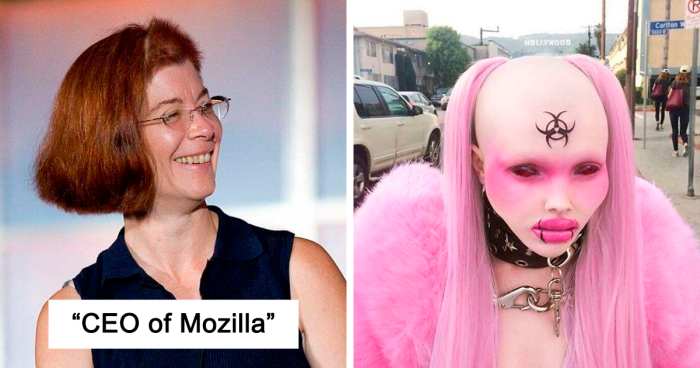
The most interesting images divide the audience. One viewer sees chaos; another sees punk confidence, camp, editorial fashion, or deliberate anti-beauty. If the wearer requested it, loves it, and the stylist executed the plan, the haircut has succeeded. The internet may remain confused, but confusion is not a professional certification.
Roast the Haircut, Not the Person
Before making a joke, ask whether the result was intentional, whether the person shared the image themselves, and whether the humor targets technique rather than someone’s body, ethnicity, age, disability, gender expression, or natural hair. Hair can be culturally and personally significant, especially in traditional styles, natural hair, braids, locs, religious practices, and gender-affirming cuts.
“That fade has a loading screen” is a joke about execution. “That person is ugly” is not a joke; it is merely a sentence that should have remained unemployed.
How to Avoid Becoming Entry Number 36
Bring Reference Photos and Explain Them
Do not simply show a celebrity image and hope telepathy handles the rest. Explain what you like: the length, soft layers, weight at the bottom, fringe placement, or low-maintenance finish. Point out what you do not want.
Describe Your Actual Routine
If you will not spend 25 minutes blow-drying every morning, do not claim that you might. Your alarm clock knows you are lying. Stylists need to understand texture, previous treatments, daily grooming habits, and realistic maintenance before choosing the best cut.
Make the Consultation Specific
Ask where the shortest layer will fall, how much length will be removed, and how the cut behaves when air-dried. Hairstylist Tabatha Coffey has called the consultation the most important part of a haircut. Once the scissors close, the negotiation phase has ended.
Use Measurements, Not “Just a Little”
“A little” can mean half an inch to one person and enough hair to stuff a decorative pillow to another. Show the exact stopping point with your fingers. If the stylist positions the scissors far above it, pause and clarify. Speaking up before the dramatic snip is easier than debating the missing inches afterward.
How to Recover From a Bad Haircut
Do Not Perform an Emotional Second Haircut
Going home and attacking one uneven section with kitchen scissors is how a disappointing cut becomes a trilogy. Wash and style the hair normally, change the part, and inspect it in natural light before doing anything permanent.
Contact the Salon
Explain the mismatch calmly and specifically. Many salons will adjust unevenness, excessive weight, or a clear departure from the consultation. If trust is gone, ask for a senior stylist or seek a second opinion. An experienced cutter may be better able to create a realistic correction plan.
Use Temporary Camouflage
Try a different part, waves, texture, clips, headbands, braids, or strategic volume. Meanwhile, reduce unnecessary heat and chemical stress so the hair can grow without starting a second crisis.
Accept the Calendar
Scalp hair grows graduallyabout one centimeter per month on averageand trimming the ends does not accelerate growth at the follicle. That is biology’s calm but deeply unhelpful customer-service response.
The 500-Word Bad Haircut Experience: From Shock to Story
Stage One: The Suspicious Mirror
The experience often begins before the cape comes off. The stylist spins the chair and asks, “What do you think?” You recognize your face, but your brain has opened an internal support ticket regarding everything above the eyebrows. You tilt left. The haircut gets worse. You tilt right. It has formed a committee.
Many people become extremely polite. “Wow, it is definitely shorter,” they say, because technically accurate statements feel safer than emotion. The stylist fluffs the crown. You nod as if volume was the missing ingredient rather than half the side of your hair.
Stage Two: The Parking-Lot Investigation
Outside, you open the phone camera. The front view is concerning. The side view is evidence. The back view, captured through a complicated mirror arrangement, should be submitted to an independent review board. You compare the result with the reference photo. The reference showed soft movement. You appear to have been cut according to a treasure map.
The group chat activates. A trusted friend replies, “It is not that bad,” confirming that it is bad. Another sends a hat emoji. The funniest friend starts typing and does not stop for three minutes.
Stage Three: The Home Laboratory
You wash the hair because perhaps salon styling caused the problem. Then you dry it and discover the problem has excellent water resistance. You try a middle part, side part, and a part so deep it technically begins behind the ear. You add clips, mousse, a round brush, and a tutorial hosted by someone whose hair has never experienced adversity.
The temptation to cut one tiny section becomes overwhelming. Remember that every disastrous home renovation begins with someone saying, “I can probably fix that.” Put down the scissors. Make tea. Contact a professional when judgment has returned to the building.
Stage Four: The Temporary New Identity
For several days, the haircut controls your schedule. You avoid strong wind, overhead lighting, spontaneous photos, and acquaintances who enjoy follow-up questions. Then something shifts. You find a styling method that works. The harsh line softens. The fringe settles. Growth begins its slow administrative process.
You may even discover an advantage. A shorter layer creates volume. A strange shape looks better with texture. An accessory becomes your signature. Bad haircuts are rarely gifts, but occasionally they arrive carrying a coupon for creativity.
Stage Five: The Legendary Retelling
Eventually, the haircut becomes history. Photos that once caused distress become premium comedy material. You show them at parties and exaggerate the final reveal. The disaster joins your personal mythology: the pre-wedding bangs, the quarantine buzz cut, the bargain fade, or the childhood bowl cut administered by a parent using optimism and kitchen equipment.
This is why haircut-fail communities remain popular. They turn an isolating moment into a shared ritual. Almost everyone has trusted a trend, a photo, a barber, a friend, or their own confidence and paid the follicular price. Shared laughter does not restore the missing inches, but it restores perspective. The haircut was terrible. Your life was not.
Conclusion: Hair Grows, Screenshots Are Forever
These 35 hilariously bad haircuts combine confidence, surprise, technical chaos, and the universal fear of leaving a salon with less hair and more questions. Some are genuine mistakes. Some are reckless experiments. A few may be bold looks the internet simply lacks the courage to understand.
The lesson is not to avoid creative hair. Communicate clearly, choose a stylist who understands your texture and routine, confirm the plan before cutting, and keep emergency scissors out of reach during emotional moments. Most cuts can be corrected, disguised, or grown out. Until then, develop a good caption.