A portable generator is one of those purchases that feels wildly unnecessaryright up until the refrigerator goes silent, the sump pump stops, or your campsite becomes a very expensive patch of darkness. The best portable generators of 2025 offer more than brute-force wattage. Today’s standout models combine cleaner inverter power, flexible fuel choices, useful outlets, carbon-monoxide shutoff systems, and frames that are at least theoretically movable by a human being.
This guide synthesizes Popular Mechanics’ editor testing with specifications and guidance from generator manufacturers, Consumer Reports, the Consumer Product Safety Commission, the Portable Generator Manufacturers’ Association, OSHA, the American Red Cross, and electrical-safety organizations. Popular Mechanics evaluates generators under real electrical loads, measures sound output, examines voltage, and checks waveform quality with equipment such as oscilloscopes and clamp meters.
The Best Portable Generators of 2025 at a Glance
| Generator | Best For | Running/Starting Watts | Fuel |
|---|---|---|---|
| Honda EU2200i Companion | Best Overall | 1,800/2,200 | Gasoline |
| Champion 4,750-Watt Dual-Fuel | Best Value | 3,800/4,750 on gasoline | Gasoline and propane |
| WEN DF360iX | Best Budget Inverter | 2,900/3,600 on gasoline | Gasoline and propane |
| Generac iQ3800 DF | Best for Sensitive Electronics | 3,000/3,800 on gasoline | Gasoline and propane |
| Pulsar PGDA70BiSCO | Most Versatile | 6,000/7,250 on gasoline | Gasoline and propane |
| Champion 4,500-Watt Dual-Fuel Inverter | Best for RV Camping | 3,500/4,500 on gasoline | Gasoline and propane |
| Pulsar GD400BN | Best Compact Power | 3,200/4,000 on gasoline | Gasoline and propane |
| Predator 9500 Super Quiet Inverter | Best High-Capacity Model | 7,600/9,500 | Gasoline |
Published sound and runtime figures are not perfectly comparable because manufacturers may use different loads, distances, and test conditions.
1. Honda EU2200i Companion: Best Overall
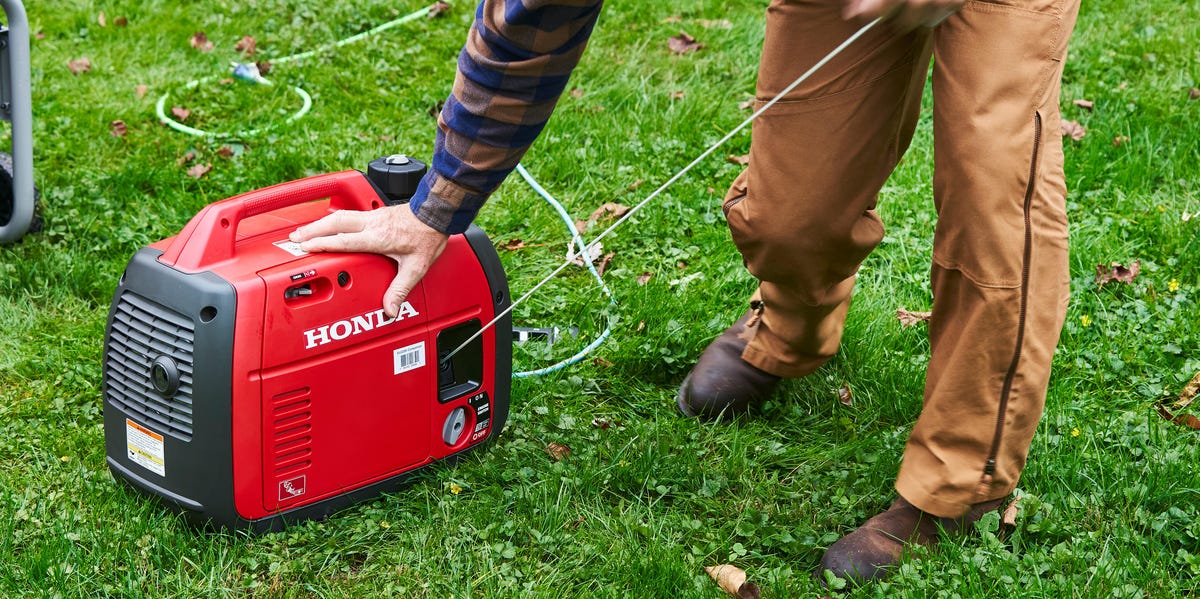
The Honda EU2200i Companion remains the portable generator to beat when reliability, quiet operation, and actual portability matter more than maximum output. It delivers 1,800 running watts and 2,200 starting watts while weighing about 47 pounds. That is manageable enough for one healthy adult to lift into a vehicle without first drafting a will.
Its closed-frame inverter design helps reduce noise and produces stable power suitable for laptops, televisions, chargers, and other sensitive electronics. Popular Mechanics’ testing found that its electrical waveform remained smooth even as motor-driven equipment started and stopped. The Companion version also includes a 30-amp receptacle and can be connected to a compatible second Honda generator for increased output.
Where It Works Best
Choose the EU2200i for camping, tailgating, outdoor events, mobile work, or keeping a few essentials operating during a short outage. It is not large enough to run multiple major household appliances simultaneously, but it excels when compact size and dependable power matter.
2. Champion 4,750-Watt Dual-Fuel: Best Value
Champion’s 4,750-watt dual-fuel generator gives buyers a lot of usable output without wandering into premium-generator pricing. On gasoline, the engine produces approximately 4,750 starting watts and 3,800 running watts. Propane output is slightly lower, but the ability to switch fuels can be invaluable when gasoline stations are closed, crowded, or temporarily auditioning for a disaster movie.
A dedicated 30-amp RV receptacle makes it useful for campers, while its output can support several essential 120-volt household loads. The important limitation is the lack of a 240-volt outlet, so it is not the right choice for equipment or transfer-switch arrangements that require 240 volts.
Where It Works Best
This Champion is a strong match for budget-conscious homeowners, RV owners, and users who value fuel flexibility more than whisper-quiet operation. As an open-frame model, it is louder than a fully enclosed inverter generator.
3. WEN DF360iX: Best Budget Inverter Generator
The WEN DF360iX proves that clean inverter power does not have to come with a luxury-car payment. It produces 3,600 starting and 2,900 running watts on gasoline, or 3,500 starting and 2,600 running watts on propane. At roughly 49 pounds, it delivers an unusually favorable power-to-weight ratio.
The outlet panel includes household receptacles, a 30-amp RV connection, a 12-volt DC outlet, and USB ports. Its inverter system is designed for sensitive electronics, while WEN’s CO Watchdog can shut the engine down when dangerous carbon-monoxide levels are detected. The trade-off is a relatively small gasoline tank, making propane the more convenient choice for extended operation.
Where It Works Best
The DF360iX is ideal for occasional outages, small RVs, campsites, and jobsites where users need respectable output without moving a machine that weighs as much as a refrigerator.
4. Generac iQ3800 DF: Best for Sensitive Electronics
The Generac iQ3800 DF combines dual-fuel convenience with low-distortion inverter power. It provides 3,800 starting and 3,000 running watts on gasoline, with approximately 3,400 starting and 2,700 running watts on propane. Generac specifies total harmonic distortion below 3 percent, making this a strong candidate for computers, televisions, smart appliances, and modern RV electronics.
Popular Mechanics praised its straightforward controls, electric starting system, readable display, and easy fuel switching. The display helps users monitor fuel, operating hours, and electrical load, reducing the chance of discovering an overload only after everything abruptly goes dark. It weighs around 110 pounds, so the wheels are not decorative.
Where It Works Best
It is particularly useful for RV owners, urban backup-power users, mobile offices, and anyone who plans to run expensive electronics alongside ordinary appliances.
5. Pulsar PGDA70BiSCO: Most Versatile
The Pulsar PGDA70BiSCO sits in the useful middle ground between recreational generators and full-size home-backup machines. It produces 7,250 starting and 6,000 running watts on gasoline, with somewhat lower output on propane. Unlike many smaller inverter models, it offers both 120- and 240-volt service.
Its outlet selection includes household receptacles, an RV outlet, a 120/240-volt locking outlet, USB connections, and enough capacity to operate demanding tools or charge a substantial off-grid battery system. Popular Mechanics reported stable frequency during extended operation, while Pulsar lists remote, electric, and recoil starting methods.
Where It Works Best
This is the most adaptable choice for users who need home backup, workshop power, off-grid charging, RV compatibility, and dual-fuel operation from one machine.
6. Champion 4,500-Watt Dual-Fuel Inverter: Best for RV Camping
Champion designed this 4,500-watt inverter generator with RV owners firmly in mind. It supplies 3,500 running watts on gasoline and 3,150 on propane, with up to 4,500 starting watts. Its dedicated 30-amp RV receptacle eliminates the need for an awkward collection of adapters resembling a hardware-store octopus.
The enclosed inverter design keeps operation quieter than a traditional open-frame generator, while the EZ Start Dial simplifies startup. Champion lists up to 14 hours of gasoline runtime or 21 hours from a 20-pound propane tank at a light load. It also produces less than 3 percent total harmonic distortion and includes a CO Shield automatic shutoff system.
Where It Works Best
Choose it for travel trailers, campground use, tailgating, or backup power for a refrigerator, lights, chargers, and selected small appliances.
7. Pulsar GD400BN: Best Compact Power
The Pulsar GD400BN squeezes 4,000 starting and 3,200 running watts into a package weighing only about 47 pounds. On propane, it still offers roughly 3,700 starting and 3,000 running watts. That is unusually muscular performance for something one person can carry.
Its inverter technology provides a stable sine wave for electronics, and the panel includes a standard household outlet plus a 30-amp connection. The limited number of receptacles is its biggest weakness; a generator with this much output could comfortably feed more devices if its panel offered additional connections. Its one-gallon gasoline tank also favors shorter sessions unless propane is used.
Where It Works Best
This Pulsar is a compelling option for mobile contractors, compact RV setups, emergency appliance power, and buyers who refuse to confuse “portable” with “technically equipped with wheels.”
8. Predator 9500 Super Quiet Inverter: Best High-Capacity Model
The Predator 9500 is the heavyweight of this group, producing 9,500 starting watts and 7,600 running watts. That is enough capacity to support several critical household circuits when connected through an appropriate transfer system. Its pure-sine-wave inverter design also makes the output suitable for modern electronics.
The large engine, 120/240-volt capability, electric start, extensive outlet panel, CO Secure shutoff system, and long runtime make it a serious backup machine. Four wheels and a folding handle help with movement, but at more than 250 pounds, “portable” means rolling it across a flat surfacenot cheerfully carrying it upstairs.
Where It Works Best
It is best for extended outages, mobile businesses, large workshops, food trucks, and homes needing more capacity than a recreational inverter generator can provide.
How to Choose the Right Portable Generator
Calculate Running and Starting Watts
Running watts describe the continuous power a generator can supply. Starting watts cover the brief surge required when a refrigerator, air conditioner, pump, or power tool starts. Add the running wattage of everything you expect to operate, identify the largest starting surge, and leave extra capacity rather than running the generator continuously at its limit. Consumer Reports also recommends choosing generator size before comparing secondary features.
Decide Whether You Need an Inverter
An inverter generator converts and electronically conditions its output, creating a steadier waveform with less distortion. That makes inverter models preferable for laptops, televisions, communication equipment, and smart appliances. They are generally quieter and more fuel-efficient under changing loads, although they tend to cost more than conventional open-frame generators.
Compare Gasoline, Propane, and Dual-Fuel Models
Gasoline usually delivers the generator’s highest output, but it degrades during storage and may be difficult to obtain during a widespread emergency. Propane stores longer and burns more cleanly, although it usually produces slightly fewer watts. Dual-fuel generators provide welcome flexibility, especially for RV owners who already carry propane.
Check the Outlets Before Buying
A large wattage number is not useful when the generator lacks the outlet needed for your equipment. RV owners should look for a TT-30R receptacle. Home-backup users may need a 120/240-volt locking outlet. USB ports are convenient, but they should not distract from the larger connections that determine what the generator can actually operate.
Consider Weight, Noise, and Storage
A 47-pound generator and a 257-pound generator technically occupy the same product category, but they offer dramatically different ownership experiences. Measure the storage area, consider how the machine will be loaded into a vehicle, and determine whether one person can move it. Also remember that manufacturer noise ratings are not always measured under identical conditions.
Portable Generator Safety Is Not Optional
Never operate a gasoline or propane generator in a house, garage, basement, shed, crawlspace, porch, or partially enclosed area. The CPSC recommends placing portable generators outdoors at least 20 feet from the home, with exhaust directed away from doors, windows, vents, and nearby buildings. A CO shutoff sensor is a valuable backup feature, but it does not make indoor operation safe. Install working carbon-monoxide alarms on every level of the home and outside sleeping areas.
Keep the generator dry and operate it on a stable surface under a properly designed open canopy when weather protection is necessary. Allow ventilation space around the unit, avoid handling electrical connections with wet hands, and use outdoor-rated cords capable of carrying the required load.
Never connect a portable generator to a household wall outlet. This dangerous shortcut can backfeed electricity onto utility lines and potentially injure lineworkers or neighbors. A qualified electrician should install an approved transfer switch and exterior power inlet when a generator will energize household circuits.
Final Verdict
The Honda EU2200i Companion is the best all-around portable generator for buyers prioritizing reliability, quiet performance, and easy transport. The Champion 4,750-watt dual-fuel model delivers the strongest basic value, while the WEN DF360iX offers affordable inverter technology in a lightweight package.
RV travelers should look closely at Champion’s 4,500-watt dual-fuel inverter. Homeowners needing substantial 120/240-volt backup capacity will be better served by the Pulsar PGDA70BiSCO or Predator 9500. The smartest choice is not automatically the generator with the largest number printed on its side. It is the model that can safely start your highest-demand equipment, connect to your required outlets, run on fuel you can store, and move without requiring a forklift and emotional support.
Real-World Portable Generator Experience: What Ownership Is Actually Like
The first lesson of generator ownership usually arrives during unboxing: portable generators rarely arrive completely ready to run. Depending on the model, you may need to attach wheels, install a handle, connect a starter battery, add engine oil, and inspect several fittings. Doing this during daylight on a calm Saturday is mildly inconvenient. Doing it at midnight during a thunderstorm while holding a flashlight between your teeth is a master class in regrettable planning.
A practice run changes everything. Start the generator outdoors, connect one appliance at a time, and learn how the engine responds when a compressor or motor starts. A refrigerator may consume modest power once running but briefly demand much more when its compressor engages. The same is true for window air conditioners, sump pumps, and many power tools. During a test, this surge is educational. During an outage, it can look like flickering lights, a tripped breaker, or a generator suddenly sounding as though it has been asked to tow a boat.
Fuel choice also feels different in actual use. Gasoline offers maximum power and is easy to pour, but storing it requires rotation, approved containers, and attention to fuel quality. Propane is cleaner to handle and can sit in a cylinder for a long time, although connecting the hose and opening the valve adds a few steps. Many dual-fuel owners use propane for routine testing and save gasoline for situations where every available watt matters.
Noise becomes more important after the first hour. A conventional open-frame generator may seem perfectly tolerable when demonstrated outside a store. At home, however, a steady engine drone bouncing between houses can test neighborhood diplomacy. Enclosed inverter generators are generally easier to live with, especially at campsites or in dense residential areas. Even then, distance and placement matter. Never reduce noise by moving the generator into a garage or enclosed shelter.
Cable management is another overlooked part of the experience. Heavy-duty extension cords are bulky, and undersized cords can overheat or cause voltage drop. Labeling cords for the refrigerator, freezer, internet equipment, and lights turns a dark-house setup into an orderly process. Homeowners using a transfer switch get a cleaner arrangement, but they still need a written load plan showing which circuits can operate together.
Maintenance is pleasantly boring when performed regularly and extremely exciting when ignored. Check the oil, inspect the air filter, keep the unit clean, and follow the manufacturer’s service schedule. Run the generator periodically and place a maintenance reminder on a calendar. Old gasoline can clog the fuel system, while a neglected electric-start battery may fail precisely when the power does.
Finally, the best ownership experience comes from treating a generator as part of an emergency system rather than as a single machine. That system includes fuel, oil, cords, CO alarms, weather protection, flashlights, hearing protection, a fire extinguisher, and written startup and shutdown instructions. When all of those pieces are prepared, an outage becomes inconvenient rather than chaoticwhich is about the highest compliment any emergency tool can earn.