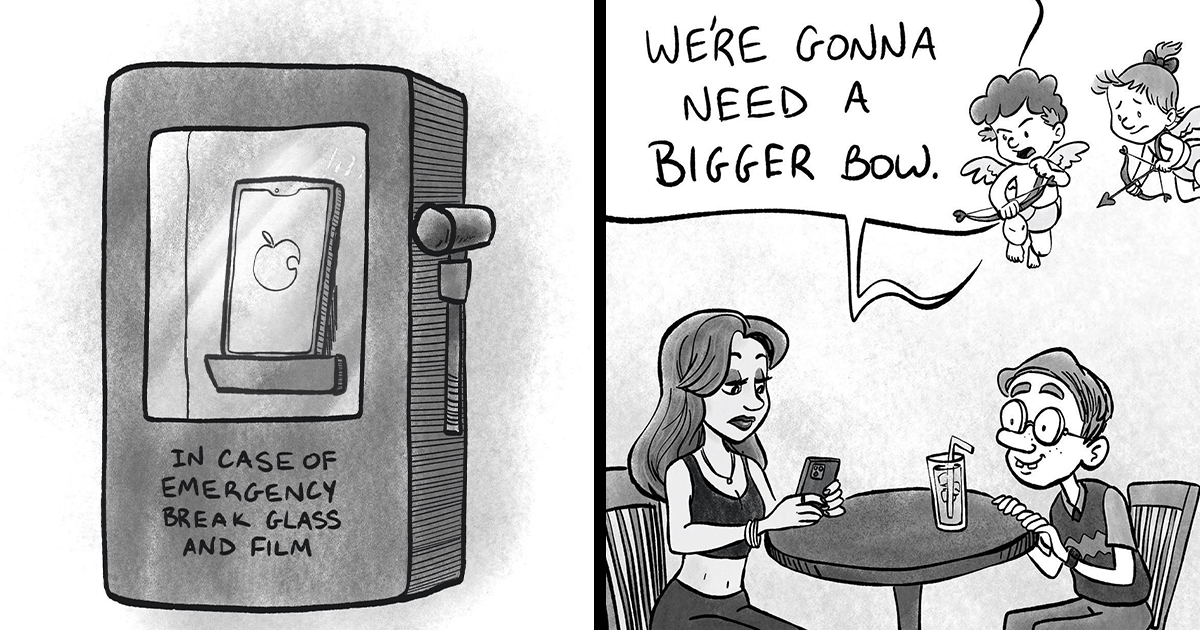
Some comics take several pages to build a world, introduce a hero, establish a conflict, and dramatically reveal that the villain was the hero’s suspiciously well-groomed uncle all along. Quickies Comics needs only one panel.
Created by writer Brandon Martin and illustrator Joey Murphy, Quickies delivers compact cartoons in which the setup, visual clue, and punchline occupy the same small space. The reader arrives, notices something strange, connects the pieces, and laughsoften before realizing just how ridiculous the premise actually is.
The project began as a creative pastime during the pandemic and gradually developed into a widely followed online comic. Murphy, a lifelong artist from Alaska, handles the digital illustrations, while Martin, a former touring musician who became a professional writer, supplies the comic ideas and captions. Their division of labor gives Quickies a distinctive balance: concise writing paired with images that reveal just enough information to make each joke click.
The result feels familiar without becoming predictable. There are traces of classic magazine cartoons, the surreal logic associated with The Far Side, modern relationship humor, visual puns, workplace awkwardness, pop-culture references, and a generous helping of jokes that would make a dad proud and everyone else groan affectionately.
Who Are the Artists Behind Quickies Comics?
Quickies is a genuine collaboration rather than a single cartoonist switching between a keyboard and a drawing tablet. Brandon Martin develops the jokes, while Joey Murphy transforms those ideas into finished one-panel cartoons.
That distinction matters because writing and illustrating a gag comic require related but different instincts. The writer must reduce an idea to its funniest essential form. The illustrator must decide what the reader sees first, which details remain in the background, how the characters react, and whether a raised eyebrow would improve the joke or accidentally explain it to death.
Martin’s background in music, advertising, and screenwriting is well suited to this kind of compressed storytelling. Songwriting rewards rhythm. Advertising demands brevity. Screenwriting teaches creators to communicate through visible action. All three disciplines are useful when a joke must work within a single frozen moment.
Murphy’s digital artwork gives the series a clean, accessible appearance. Characters, props, signs, and settings are immediately recognizable, allowing readers to understand the scene before moving toward the twist. The drawings do not compete with the joke. They deliver it.
Why One-Panel Comics Are Harder Than They Look
A successful one-panel comic resembles a very short story whose beginning, middle, and end have been stacked on top of one another. The setting establishes the beginning. The unusual situation provides the middle. The caption or visual contradiction supplies the ending.
There is no second panel available for clarification. No narrator can appear five frames later to explain why the talking toaster has hired an attorney. Every object must earn its place.
This limitation creates a useful creative pressure. A cartoonist has to remove anything that slows the reader without making the scene confusing. Too much information makes the punchline feel labored. Too little information turns the cartoon into a tiny mystery no one volunteered to solve.
Quickies frequently succeeds by placing an impossible character in an ordinary setting. A supernatural creature may face a mundane social problem. An animal may behave like an exhausted office worker. A familiar figure from mythology, entertainment, or holiday folklore may suddenly have to deal with human resources.
The contrast does much of the comedic work. A bizarre character is funny, but a bizarre character completing paperwork is often funnier.
30 Comic Ingredients That Make Quickies So Entertaining
The individual cartoons rely on different premises, but the following 30 creative ingredients explain why the collection works. Consider this a spoiler-light tour through the mechanics of Quickies humor.
-
1. Everyday Situations Become Absurd
Quickies often begins with a recognizable momenta meeting, date, meal, medical appointment, or family conversationand adds one wonderfully inappropriate detail. Normality becomes the straight-faced assistant to nonsense.
-
2. Visual Puns Do Half the Talking
Some jokes depend on seeing a familiar phrase interpreted literally. The caption points in one direction while the illustration cheerfully drives through a hedge in another.
-
3. The Characters Accept the Impossible
The funniest person in a Quickies cartoon is often the one who is not surprised. Monsters, animals, appliances, and legendary figures may appear, yet everyone behaves as though this is simply Tuesday.
-
4. Workplace Humor Travels Everywhere
Offices are naturally comic environments because adults must pretend spreadsheets are exciting. Quickies applies workplace rules to characters who clearly never expected to attend a performance review.
-
5. Dating Culture Gets a Cartoon Makeover
Modern romance supplies endless material: profiles, mixed signals, unrealistic expectations, awkward conversations, and the ancient ritual of staring at a phone while waiting three hours to seem casual.
-
6. Pop Culture Is Reduced to Human Size
Famous monsters and recognizable entertainment concepts become funnier when their epic reputations collide with toys, household objects, or minor inconveniences. Grandeur meets a very small problem and loses.
-
7. Mythology Meets Modern Bureaucracy
Mythological and biblical characters already carry enormous cultural baggage. Dropping them into modern life lets one visual reference establish the entire setup before the caption delivers the twist.
-
8. Holiday Characters Have Regular Jobs
Reindeer, elves, and other seasonal figures may be magical, but apparently they still have workplace complaints. Nothing deflates wonder quite like a meeting with human resources.
-
9. Signs Become Punchlines
A carefully placed sign can change the meaning of an entire drawing. Readers first understand the activity, then notice the wording, and finally experience the delayed laugh.
-
10. Household Objects Develop Personalities
Electrical outlets, cords, furniture, food, and technology occasionally behave like social creatures. Their physical functions become personality traits, which is bad news for appliances but excellent news for comedy.
-
11. Dad Jokes Receive Better Production Values
A pun may be gloriously corny, but a polished illustration gives it confidence. Quickies sometimes presents a groan-worthy joke with such commitment that resistance becomes pointless.
-
12. Villains Are Allowed to Be Silly
Traditional villains want power, revenge, or a dramatic throne surrounded by unnecessary lightning. Quickies villains may instead struggle with branding, family life, or a disappointing punchline.
-
13. Animals Inherit Human Anxiety
Giving animals recognizable emotional problems creates instant contrast. Their appearance remains animal-like, but their worries sound suspiciously like something overheard beside an office coffee machine.
-
14. Dark Humor Remains Playful
Death, danger, and disaster sometimes enter the frame, but the tone generally remains mischievous rather than cruel. Grim subjects are treated with enough absurdity to keep the mood light.
-
15. Food Refuses to Stay Quiet
Personified food is a dependable source of visual comedy. Ingredients can argue, panic, misunderstand their purpose, or discover that the menu has made their afternoon considerably worse.
-
16. Familiar Expressions Become Literal
Idioms are miniature absurdities waiting to be illustrated. Quickies can turn an expression people use automatically into a physical situation no sensible person would willingly enter.
-
17. Social Media Behavior Looks Stranger on Paper
Selfies, online attention, and digital performance become especially funny when practiced by creatures or characters who should have more urgent priorities.
-
18. Relationships Fail Efficiently
A long romantic disagreement can be condensed into one look and one sentence. Quickies understands that couples rarely need a dragon; the wrong tone of voice can cause enough destruction.
-
19. Technology Becomes the Difficult Coworker
Phones, computers, and digital services already seem to have personalities, particularly when they demand an update during an emergency. Giving them literal motives merely confirms our suspicions.
-
20. Customer Service Becomes Surreal
Customer service follows scripts, while reality rarely cooperates. Placing an unusual character on either side of the counter turns routine politeness into comic theater.
-
21. Generational Habits Create Instant Conflict
Different attitudes toward work, communication, entertainment, and technology allow Quickies to establish conflict without lengthy introductions. One prop can reveal an entire generation.
-
22. Background Details Reward Observant Readers
The main caption may produce the first laugh, but a small poster, label, expression, or object can add another. Those details make the cartoon feel constructed rather than merely decorated.
-
23. Captions and Images Disagree Productively
A strong gag sometimes emerges because the words suggest one interpretation while the picture reveals another. The reader becomes the final collaborator by connecting them.
-
24. Recognition Arrives a Second Late
Several one-panel jokes become funnier after a brief delay. You see the scene, read the caption, look back at the scene, and finally notice the trap waiting politely in the corner.
-
25. Facial Expressions Carry the Subtext
A caption may deliver the official joke, but the character’s expression tells readers how uncomfortable the situation really is. Mild concern is often funnier than theatrical panic.
-
26. The Artwork Stays Easy to Read
Murphy’s clean digital presentation helps readers identify the setting and characters quickly. Clarity matters because a visual joke cannot land while the audience is still searching for the door.
-
27. The Writing Avoids Unnecessary Setup
Martin’s captions tend to enter the scene late. Instead of explaining the premise, they provide the final piece needed to understand it. The reader does the remaining mental work.
-
28. The Comics Know When to Stop
Quickies rarely adds a second joke after the first has landed. Restraint prevents a sharp premise from becoming a paragraph wearing a fake mustache.
-
29. Many Jokes Improve on a Second Look
Once readers know the punchline, they can examine how the scene was arranged to support it. Re-reading reveals visual clues that seemed unimportant moments earlier.
-
30. Every Cartoon Is Built for Sharing
A single self-contained image fits naturally into social feeds and group chats. No previous episode is required, so a new reader can understand the joke immediately.
The Creative Chemistry Between Brandon Martin and Joey Murphy
Collaboration can be risky in comedy. One person may prefer subtle wordplay while another wants a bear to crash through a conference-room wall. Quickies benefits from a partnership in which the writing and drawing appear to challenge each other without fighting for control.
A strong premise gives Murphy something visually interesting to stage. A clear illustration gives Martin the freedom to keep the caption short. When the drawing already explains who, where, and what, the words can concentrate on why the situation is funny.
This relationship also creates a useful editing system. An idea that seems hilarious in sentence form may not produce a strong image. Conversely, an amusing drawing may need a more surprising line. Passing the concept between two creative minds helps expose weaknesses before the cartoon reaches the audience.
The partnership is especially effective because the artists share an appreciation for classic single-panel comedy while addressing current behavior. Their influences may belong to magazine pages and newspaper cartoon sections, but their subjects understand dating apps, selfies, workplace jargon, and internet culture.
A Reader’s Experience: Spending Time With 30 Quickies Comics
Reading a collection of Quickies is different from reading a continuous comic strip. There is no plot to remember and no cast list to study. Each image resets the world. One moment you may be observing an animal with a surprisingly human problem; the next, you are watching a legendary character encounter modern bureaucracy.
That constant reset keeps the reading experience energetic. You cannot predict which setting will appear next, yet you quickly recognize the creative rhythm. First comes the ordinary scene. Then comes the detail that does not belong. Finally, the caption rearranges the meaning of everything you just saw.
The best way to enjoy the collection is not necessarily to race through all 30 cartoons. One-panel comics look quick because they are small, but the stronger examples reward a pause. After reading the caption, look at the image again. Examine the background. Notice which character understands the situation and which one is still emotionally buffering.
Sharing the cartoons creates another layer of entertainment. Different readers favor different types of humor. A friend who loves language may choose a pun. A colleague may prefer workplace satire. Someone with an alarming enthusiasm for dark comedy may immediately select the cartoon involving mortality and send it to the family group chat before breakfast.
There is also pleasure in encountering a joke that is almost embarrassingly simple. Complicated humor can be impressive, but a basic idea presented at exactly the right angle produces a special kind of laugh. It feels obvious after you have seen it, which is usually evidence that the creators have done substantial work to make it look effortless.
Some readers will recognize the influence of traditional magazine cartoons, where a single caption transforms an otherwise formal scene. Others will notice the offbeat logic of surreal newspaper comics. Younger audiences may simply recognize the pace of social media: immediate, visual, self-contained, and ready to be forwarded with no explanation beyond “This is you.”
The experience also demonstrates how much storytelling can fit inside one frame. Clothing establishes personality. Furniture suggests social status. A sign identifies the location. Body language reveals conflict. One line of dialogue completes the story. Remove any of those elements and the joke might collapse like a folding chair at a company picnic.
After several cartoons, readers may begin trying to predict the punchlines. That game is part of the fun, although Quickies is usually waiting with an alternative interpretation. The mind searches for a logical answer, while the comic benefits from having no professional obligation to remain logical.
A 30-comic collection is long enough to reveal the duo’s range without turning the experience into homework. There are verbal jokes, visual jokes, cultural references, anthropomorphic objects, relationship problems, and characters who urgently need better career counseling. The format changes just enough to prevent repetition.
Most importantly, the collection provides brief comic interruptions rather than demanding sustained attention. Readers can enjoy one cartoon while waiting for coffee or explore all 30 during a break. In a digital environment crowded with videos, notifications, arguments, and people announcing what time they woke up, a well-made single-panel comic offers a pleasantly complete experience.
Why Quickies Comics Connect With Modern Audiences
Quickies demonstrates that brevity does not require shallowness. A cartoon can be understood in seconds while still containing layers of visual storytelling. The immediate joke attracts attention, and the construction behind it encourages a second look.
The series also benefits from being approachable. Readers do not need specialized comic-book knowledge or a detailed understanding of an imaginary universe. Familiar experiencesdating, work, technology, family, food, and social embarrassmentprovide the foundation.
From there, Martin and Murphy add the unexpected. They may replace an employee with a monster, give an everyday object emotional needs, or allow a familiar phrase to become physically real. The audience recognizes the situation before discovering how creatively it has been broken.
Conclusion
The 30 witty one-panel comics created under the Quickies name show how productive collaboration can sharpen a simple idea. Brandon Martin’s concise writing provides rhythm and surprise, while Joey Murphy’s illustrations establish the world, guide the eye, and add visual personality.
Together, they turn common experiences into compact scenes of absurdity. Offices become stranger, mythical characters become more relatable, technology becomes more suspicious, and even household objects appear to have complicated social lives.
Quickies Comics does not ask readers to commit to an elaborate storyline. It offers a collection of complete comic moments, each designed to create recognition, confusion, and laughter in roughly that order. The cartoons are fast, but the creative thinking behind them is anything but hurried.