Extinction is nature’s most permanent unsubscribe button. One moment, a species is flying, swimming, grazing, singing, or waddling awkwardly across an island; the next, it exists only in museum drawers, old sketches, DNA fragments, and the guilty silence of human history. The stories of extinct animals are not just sad bedtime tales for conservationists. They are warning labels written in feathers, horns, shells, stripes, and bones.
Many extinct species disappeared because of a familiar pattern: overhunting, habitat destruction, invasive species, pollution, climate stress, disease, and the dangerous human habit of assuming nature has an unlimited backup supply. Spoiler alert: it does not. The animals below were not imaginary monsters or ancient dinosaurs lost to deep time. Most vanished within the last few centuries, often after people had already noticed they were in trouble.
This article explores 10 tragic stories of extinct animals, from the famous dodo to the lonely Pinta Island tortoise. These real examples show how quickly abundance can become absenceand why protecting endangered species today is not just sentimental, but necessary.
1. The Dodo: The Bird That Became Extinction’s Mascot
The dodo lived on Mauritius, an island in the Indian Ocean east of Madagascar. It was a large, flightless bird related to pigeons, though admittedly it looked more like a bird designed by a committee that had never seen gravity before. Because it evolved without major land predators, the dodo had little reason to fear humans or the animals humans brought with them.
That trust became fatal. Sailors hunted dodos for food, while introduced pigs, rats, monkeys, dogs, and cats destroyed nests, ate eggs, and competed for food. Habitat loss added another blow. By the late 1600s, the dodo was gone.
Why the dodo’s story still matters
The dodo is often used as shorthand for foolishness, but the real foolishness belonged to the people who underestimated how fragile island ecosystems can be. The dodo did not fail evolution. It succeeded perfectly in its environmentuntil humans changed the rules almost overnight.
2. The Passenger Pigeon: From Billions to Zero
If any extinct animal story proves that “too many to fail” is a dangerous myth, it is the passenger pigeon. Once, these birds filled North American skies in flocks so enormous they could darken the sun for hours. Estimates suggest there may have been billions of passenger pigeons when Europeans arrived in North America.
Then came industrial-scale hunting. Passenger pigeons were killed for meat, sport, and market sale. Their nesting forests were cut down. Hunters targeted huge breeding colonies, destroying adults, chicks, and eggs in staggering numbers. The species collapsed with shocking speed.
The last known passenger pigeon, named Martha, died at the Cincinnati Zoo on September 1, 1914. Her death transformed a once-common bird into one of the most famous symbols of human-caused extinction.
The tragedy of abundance
The passenger pigeon teaches a brutal lesson: a species can be incredibly numerous and still vulnerable if its breeding strategy, habitat, and social behavior are disrupted. Billions are not a guarantee when human pressure becomes relentless.
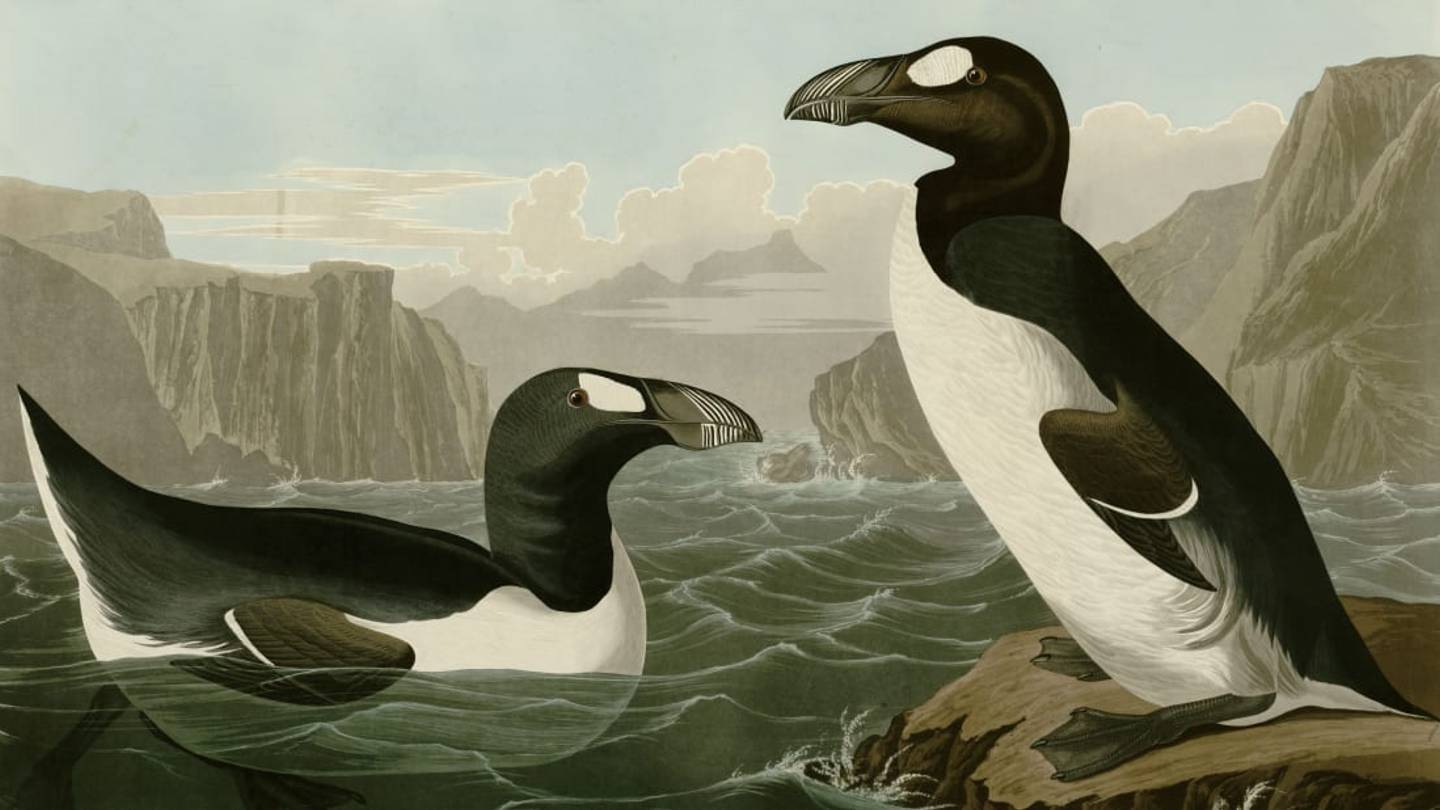
3. The Great Auk: The Penguin of the North That Wasn’t a Penguin
The great auk was a large, flightless seabird of the North Atlantic. It looked a bit like a penguin, but it was not closely related to the penguins of the Southern Hemisphere. Unfortunately, its resemblance to an easy meal was very real.
Great auks were excellent swimmers but awkward on land. They nested on remote rocky islands, laying a single egg. For centuries, sailors and hunters killed them for meat, oil, feathers, bait, and later museum specimens. Their rarity made them even more desirable to collectors, which is a special kind of human absurdity: “There are almost none leftquick, grab one.”
The last confirmed pair was killed on Eldey Island, off Iceland, in 1844. Their egg was reportedly destroyed as well. With that, one more ocean bird disappeared into history.
A lesson in collector-driven extinction
The great auk shows how rarity can become a death sentence. When collectors prize the last individuals more than the living species, extinction can become a market event.
4. Steller’s Sea Cow: The Gentle Giant Hunted in Less Than 30 Years
Steller’s sea cow was a massive marine mammal related to manatees and dugongs. It lived in the cold waters around the Commander Islands in the Bering Sea. Reaching impressive lengths and feeding on kelp, it was slow-moving, social, and apparently not equipped with a strong “avoid humans at all costs” policy.
European explorers first documented the species in 1741. Within 27 years, it had been hunted to extinction. Sailors and fur traders killed Steller’s sea cows for meat, fat, and hides. Their slow reproduction and limited range made recovery impossible once hunting pressure increased.
The speed of loss
Few extinction stories are as painfully fast. Steller’s sea cow went from scientific discovery to extinction in less than three decades. That is not a biological timeline; that is a human management failure with fins.
5. The Carolina Parakeet: America’s Lost Native Parrot
Long before escaped pet parrots became surprise residents of city parks, North America had its own brilliantly colored parrot: the Carolina parakeet. With green feathers, a yellow head, and an orange face, it once lived across parts of the eastern, midwestern, and southern United States.
Its decline had several causes. Forest clearing destroyed habitat. Farmers shot the birds because they ate crops. Their bright feathers were used in fashion, especially for hats. Disease may also have contributed. The last known captive Carolina parakeet, a male named Incas, died at the Cincinnati Zoo in 1918the same zoo where Martha the passenger pigeon had died four years earlier.
A colorful silence
The Carolina parakeet’s extinction is especially haunting because it removed a native splash of tropical color from American landscapes. Imagine orange, yellow, and green flocks flashing through winter forests. Now imagine explaining that we traded them for hats. Not humanity’s strongest résumé entry.
6. The Thylacine: The Tasmanian Tiger That Was Not a Tiger
The thylacine, often called the Tasmanian tiger or Tasmanian wolf, was a carnivorous marsupial with a doglike body and dark stripes across its back. It once lived in Australia, Tasmania, and New Guinea, but survived into modern times only in Tasmania.
European settlers blamed thylacines for killing sheep, often exaggerating their impact. Bounty programs encouraged hunting. Habitat loss, disease, competition with dogs, and human persecution pushed the species downward. The last known thylacine died in captivity at Hobart Zoo in 1936, only shortly after legal protection finally arrived.
Protection that came too late
The thylacine’s story is a classic case of conservation arriving after the final curtain. It reminds us that declaring a species protected is not magic. If action begins when only one or two animals remain, nature may not be able to perform a miracle on command.
7. The Golden Toad: A Tiny Warning From the Cloud Forest
The golden toad lived in the cloud forests of Monteverde, Costa Rica. Males were a bright, almost unreal orange, as if someone had turned the saturation setting all the way up. First scientifically described in the 1960s, the species became famous for its beauty and extremely limited range.
Then it vanished. Large numbers were seen in the 1980s, but by 1988 only a few remained. The last confirmed sighting was in 1989. Scientists have linked its disappearance to a combination of factors, including restricted habitat, unusual climate conditions, and the deadly amphibian disease chytridiomycosis.
Small range, big risk
The golden toad shows why species with tiny ranges can be so vulnerable. When your whole world is a small patch of mountain forest, one environmental disruption can be catastrophic. It is like living in a studio apartment and discovering the ceiling is also on fire.
8. The Baiji: The River Dolphin Lost in the Yangtze
The baiji, or Yangtze River dolphin, was a freshwater dolphin native to China’s Yangtze River. Sometimes called the “Goddess of the Yangtze,” it lived in one of the world’s busiest and most altered river systems.
As China industrialized, the Yangtze changed dramatically. Pollution, boat traffic, fishing gear, dam construction, and habitat degradation battered the baiji population. A major survey in 2006 failed to find any individuals, and scientists declared the species functionally extinct. Although occasional unverified sightings have been reported, there is no confirmed evidence that a viable population remains.
When a river becomes too loud to live in
The baiji’s tragedy is not just about one dolphin. It is about what happens when rivers become highways, drains, and construction zones all at once. Freshwater ecosystems can look powerful, but their wildlife can be astonishingly delicate.
9. The Western Black Rhinoceros: Poached Out of Existence
The western black rhinoceros was a subspecies of black rhino that once lived in parts of central and western Africa. Like other rhinos, it suffered from intense poaching driven by demand for rhino horn. Habitat loss and weak protection added to the pressure.
Surveys failed to find surviving western black rhinos in their last known range, and the subspecies was declared extinct in 2011. Its disappearance is especially painful because it happened in modern times, when conservation science, wildlife laws, and international awareness already existed.
The cost of illegal wildlife trade
The western black rhino was not lost because people did not know rhinos were in trouble. It was lost because knowledge did not translate quickly enough into protection. In the battle between conservation and profit, delay can be deadly.
10. The Pinta Island Tortoise: Lonesome George and the End of a Line
The Pinta Island tortoise was a Galápagos giant tortoise subspecies. Its most famous member was Lonesome George, discovered on Pinta Island in 1971 and moved to a breeding center for protection. Conservationists hoped he might reproduce, but no successful offspring were produced.
George died on June 24, 2012. With his death, the known Pinta Island tortoise line ended. His story became one of the most emotional conservation symbols in the world: one animal carrying the weight of an entire vanished population on his shell.
What Lonesome George represented
Lonesome George was not just a tortoise. He was a living countdown clock. For decades, visitors could look at him and understand extinction in the most direct way possible: when this individual is gone, there are no more.
Common Causes Behind These Animal Extinctions
Although each extinct animal has a unique story, several patterns repeat with uncomfortable consistency. Overhunting appears again and again, from passenger pigeons and great auks to Steller’s sea cows and rhinos. Habitat destruction reshaped forests, islands, rivers, and wetlands faster than species could adapt. Invasive species devastated island animals such as the dodo. Pollution and industrial development contributed to the baiji’s decline. Disease and climate stress played major roles in amphibian losses like the golden toad.
The most sobering pattern is not that humans caused damage. It is that warning signs were often visible before extinction happened. People saw populations falling. They noticed scarcity. They collected the last specimens. They wrote reports. They passed protection too late. Extinction is rarely a surprise ending; more often, it is the final chapter of a book everyone had time to read.
Why Extinct Animals Still Matter Today
It is tempting to treat extinct animals as historical curiosities, like old coins or embarrassing fashion trends. But extinct species still matter because they reveal how ecosystems work. Passenger pigeons once shaped forests through their massive flocks. Steller’s sea cows likely influenced kelp forest systems. Giant tortoises disperse seeds and shape island vegetation. When a species disappears, the ecosystem does not simply shrug and move on. It changes.
Extinct animals also matter because their stories can help save living species. The passenger pigeon influenced modern wildlife protection. The thylacine warns against predator persecution based on fear. The western black rhino shows the urgency of fighting illegal wildlife trade. The baiji warns that freshwater conservation cannot wait until rivers are nearly empty.
Experiences and Reflections: What These Tragic Stories Teach Us
Reading about extinct animals can feel strangely personal. Maybe it is because these stories do not sound like distant science. They sound like missed appointments. Someone should have stopped the hunters earlier. Someone should have protected the nesting island. Someone should have listened when the river dolphin numbers began to crash. The tragedy is not only that these animals died; it is that many of them died while humans were watching.
One powerful experience related to extinct animals is visiting a natural history museum. A mounted passenger pigeon or great auk behind glass can be beautiful, but it is also uncomfortable. The specimen is close enough to study, yet forever out of reach. You can admire the feathers, the beak, the body shape, and the evolutionary geniusbut the living animal is gone. Museum halls are wonderful places to learn, but extinct species turn them into quiet courtrooms. The evidence is displayed neatly. The verdict is not flattering.
Another experience comes from walking through forests, wetlands, beaches, or rivers and realizing that absence has a texture. We often think of nature by what is present: birds calling, insects buzzing, leaves moving, fish flashing under the surface. But extinct animals remind us to notice what is missing. North American skies no longer pulse with passenger pigeon flocks. American forests no longer ring with Carolina parakeet calls. The Yangtze no longer reliably carries the baiji through its murky channels. These absences are not empty trivia; they are holes in the living fabric of the world.
For writers, educators, parents, travelers, and nature lovers, the stories of extinct animals offer a difficult but useful emotional tool. They make conservation real. It is one thing to say “biodiversity loss is a global problem.” It is another to say “Lonesome George died, and an entire tortoise lineage ended.” Specific stories stick. Names matter. Dates matter. The last individual matters. Extinction becomes harder to ignore when it has a face, a nickname, or a final day on the calendar.
These stories also change the way we look at endangered animals alive today. A vaquita, an orangutan, a black rhino, a red wolf, or a sea turtle is not merely “rare.” It may be standing near the edge of the same cliff these extinct species crossed. Conservation is not about creating a perfect world where no species ever dies naturally. Extinction has always existed. The issue is speed, scale, and cause. When human choices drive species into oblivion, human choices can also slow, prevent, or reverse the damage.
The most useful response to extinct animals is not despair. Despair is dramatic, but it is not very good at habitat restoration. The better response is attention. Support protected areas. Reduce demand for illegal wildlife products. Respect native habitats. Learn which species are threatened in your region. Vote for policies that protect clean water, forests, and biodiversity. Teach children that animals are not decorations on the planet; they are participants in systems that keep life functioning.
The 10 tragic stories of extinct animals are sad, yes. But they are also instructions. They tell us what not to repeat. They remind us that common species can become rare, rare species can become legends, and legends can become labels on museum drawers. The next chapter is still being written for many endangered animals. This time, we should try very hard not to make the ending another apology.
Conclusion
The stories of the dodo, passenger pigeon, great auk, Steller’s sea cow, Carolina parakeet, thylacine, golden toad, baiji, western black rhinoceros, and Pinta Island tortoise are more than sad animal histories. They are case studies in how quickly human pressure can erase life forms that took thousands or millions of years to evolve.
These extinct animals remind us that conservation must happen before a species becomes famous for being almost gone. The time to protect wildlife is not when the last individual has a name and a global fan club. The time is when there are still habitats to restore, populations to strengthen, and choices to change.
Extinction is permanent, but indifference does not have to be. If these lost species can still teach us anything, it is this: the future of wildlife depends on whether humans learn from the ghosts we created.