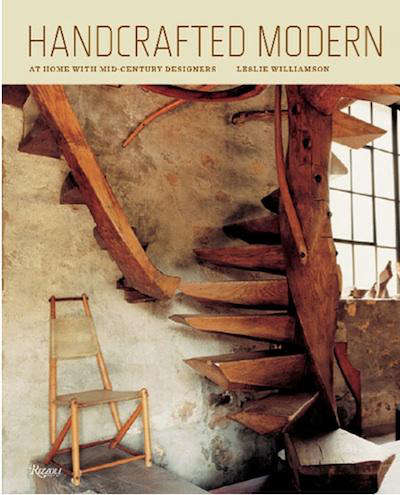
Mid-century modern design is frequently presented as a parade of immaculate chairs, photogenic lamps, and living rooms so tidy that even a coffee mug seems afraid to leave a ring. Leslie Williamson’s Handcrafted Modern: At Home with Mid-century Designers offers something far more interesting: the private environments in which modernism’s celebrated designers actually lived, worked, collected, experimented, and occasionally allowed ordinary life to make a mess.
Published by Rizzoli in 2010, the 224-page photography book explores the homes of 14 influential American designers, architects, artists, and craftspeople. Its subjects include Wharton Esherick, George Nakashima, Harry Bertoia, Russel Wright, Jens Risom, Eva Zeisel, Vladimir Kagan, Irving Harper, Walter Gropius, Jerome and Evelyn Ackerman, Charles and Ray Eames, J.B. Blunk, John Kapel, and Albert Frey. Together, their homes reveal a version of domestic modernism that is warmer, stranger, and much more personal than the showroom stereotype.
A Design Book About People, Not Pedestals
Williamson began the project out of personal curiosity. She wanted to know how the designers she admired lived when no client was watching and no advertising campaign was arranging the fruit bowl. What started as an independent photographic project gradually became a five-year exploration of American creative homes.
Her selection rules were unusually strict. A residence had to remain intact, either because its designer still lived there or because the space had been carefully preserved with original belongings. Williamson photographed with natural light or the home’s existing fixtures and generally left objects where she found them. She was not trying to manufacture perfection. She was recording evidence.
That approach gives Handcrafted Modern its emotional weight. A worn desk, a collection of handmade toys, a stack of papers, or a chipped ceramic bowl can explain more about a designer’s thinking than another polished image of a famous chair floating against a white wall. Williamson has described these layered residences as a visual library of how creative people livehomes shaped gradually by work, travel, friendship, curiosity, and time.
When the House Becomes a Self-Portrait
Designers’ private homes are especially revealing because they eliminate the usual separation between maker and client. Every decision becomes personal. The designer chooses the scale, materials, furniture, storage, lighting, landscape, and degree of acceptable clutter. There is nobody else to blame for the tiny kitchen or the sofa that requires Olympic-level flexibility.
In these houses, architecture is not merely a container. It becomes an evolving self-portrait. Some homes express a devotion to industrial efficiency. Others feel almost carved from the earth. Several combine mass-produced modern furniture with folk art, natural specimens, textiles, prototypes, tools, and inexpensive curiosities. The result is not one official mid-century modern style but a collection of individual philosophies.
Modernism Was Never One Single Look
The book quietly corrects the popular belief that mid-century design equals walnut credenzas, tapered legs, and a strategic mustard-yellow cushion. Those ingredients can be delightful, but they represent only a retail-friendly slice of a much broader movement.
For Walter Gropius, modernism involved efficiency, new technology, and an intelligent dialogue with regional architecture. For George Nakashima, it involved honoring the natural character of wood. For Albert Frey, it meant making architecture almost disappear into the desert. For Wharton Esherick, it could mean turning a staircase into a muscular wooden sculpture. Modernism, it turns out, contained multitudesand several very impressive stairs.
Wharton Esherick: A House Built Like a Sculpture
The cover of Handcrafted Modern features the famous wooden staircase inside Wharton Esherick’s Pennsylvania studio. That choice immediately announces the book’s central argument: modern design can be rigorous without being sterile and handcrafted without becoming nostalgic.
Esherick’s hilltop studio and residence developed over decades rather than arriving as a frozen master plan. Built into a wooded landscape, it combines hand-hewn beams, local stone, irregular forms, sculpted furniture, and architectural details that seem to grow from one another. His spiral staircase, added in 1930, remains one of the studio’s defining features.
The building feels less like a house filled with art than an inhabitable work of art. Doors, desks, beams, stools, handles, and steps participate in the composition. Nothing appears to have been selected simply because a decorating checklist demanded “one organic accent.” The structure demonstrates how craftsmanship can influence the entire experience of space, from the way a hand meets a railing to the way the body turns while climbing.
George Nakashima: Listening to the Material
George Nakashima’s home and workshop complex in New Hope, Pennsylvania, presents a different form of handcrafted modernism. Nakashima trained as an architect, worked internationally, and developed a furniture practice centered on the individuality of trees. Instead of forcing timber into anonymous perfection, he often retained expressive edges, grain patterns, fissures, and irregularities.
He began developing the New Hope property in the 1940s. Over time, the site expanded into a group of homes, workshops, studios, and display spaces oriented to the landscape. Several buildings face south to benefit from passive solar warmth, joining environmental sensitivity with practical design long before sustainability became a mandatory paragraph in every architectural press release.
Williamson’s photographs show that Nakashima’s philosophy was not limited to tabletops. It shaped the entire environment. Wood appears as structure, surface, furniture, memory, and living presence. The spaces are restrained but never cold. They suggest that simplicity becomes meaningful when it grows from close attention rather than from the hurried removal of everything interesting.
Russel Wright: Domestic Design in Conversation with Nature
Industrial designer Russel Wright helped reshape American domestic life through approachable tableware, furniture, and ideas about informal living. His home and studio, Dragon Rock at Manitoga in Garrison, New York, translated those ideas into architecture and landscape.
Created with architect David Leavitt and completed in 1961, Dragon Rock was built beside an abandoned quarry. Wright treated the surrounding woodland as a sequence of outdoor rooms, using paths, water, stone, moss, mountain laurel, and carefully framed views to guide movement through the property.
Inside, large areas of glass connect the rooms to terraces and trees. Natural and manufactured materials sit side by side without starting an argument. The compact studio supported working, sleeping, and entertaining, demonstrating Wright’s interest in flexible spaces and efficient domestic rituals.
Manitoga is important because it refuses to separate product design, architecture, and landscape. Plates, tables, rooms, paths, and views all participate in one larger idea of living well. It is lifestyle design in the best sensenot a brand selling scented candles, but a serious attempt to shape everyday experience.
Charles and Ray Eames: Serious Work, Playful Living
The Eames House in Pacific Palisades is one of the most recognizable residences in American modernism. Built as Case Study House No. 8, it used prefabricated industrial components to create a flexible home and studio within a grove of eucalyptus trees.
Yet the interior is anything but an empty machine. Ray and Charles Eames filled it with textiles, folk objects, plants, toys, shells, artwork, dishes, books, and visual discoveries gathered from around the world. Williamson’s photographs highlight Ray’s collections, including blue-and-white ceramics and small personal objects left near the bed.
This abundance matters. The Eameses believed that design involved observation, experimentation, communication, and delight. Their home demonstrates that a rational architectural framework can support a richly layered life. The structure provides order; the inhabitants provide energy.
For contemporary homeowners, the lesson is liberating. You do not have to choose between minimal architecture and sentimental possessions. A disciplined room can hold playful objects. A modern home can include things that are old, handmade, humorous, or impossible to explain to guests.
Walter Gropius: Bauhaus Logic Meets New England
Walter Gropius designed his 1938 family home in Lincoln, Massachusetts, after arriving to teach at Harvard’s Graduate School of Design. Rather than dropping a completely foreign white box into the countryside, he combined modern planning with familiar New England materials such as clapboard, brick, and fieldstone.
The house is modest in scale but highly organized. Built-in storage, efficient circulation, carefully planned views, modern fixtures, glass block, and tubular metal details express Bauhaus principles without turning domestic life into a laboratory demonstration.
Original family possessions and furniture help the preserved house feel inhabited rather than clinically reconstructed. That distinction is crucial to Williamson’s project. She was drawn to spaces in which personal objects remained connected to the architecture, allowing viewers to understand not only what a designer believed but how those beliefs functioned during breakfast, work, entertaining, and winter in Massachusetts.
Albert Frey: A Small House with a Very Large Rock
Albert Frey’s House II, completed in Palm Springs in 1964, is a compact architectural response to an extraordinary desert site. Frey spent years selecting and studying the hillside location, including observing the movement of the sun before finalizing the design.
The residence sits high above the city and incorporates a massive natural boulder directly into the interior. Lesser designers might have removed the obstacle. Frey effectively invited it inside and built around it. The rock becomes structure, sculpture, geographical marker, and perhaps the world’s least movable accent table.
Metal, glass, built-in furniture, and an efficient floor plan allow the house to remain visually light against the rugged terrain. Color and material choices respond to the desert instead of competing with it. The result shows that modern architecture does not need to dominate a landscape. It can acknowledge that the landscape arrived first and has seniority.
The Softer Side of Mid-century Modern Design
Handcrafted Modern expands beyond famous houses by examining the domestic worlds of furniture designers, ceramicists, textile artists, and sculptors. Their interiors show how modernism entered daily life through objects that could be held, stacked, poured from, sat upon, or accidentally knocked over.
Eva Zeisel and the Beauty of Useful Things
Eva Zeisel’s ceramics rejected severe geometry in favor of curves inspired by bodies, birds, relationships, and natural forms. She described herself as a maker of useful things, yet her tableware often feels conversational. Handles lean toward vessels; salt and pepper shakers appear to embrace; lids and bowls form visual families.
Her presence in Williamson’s book helps prevent mid-century modernism from becoming an exclusively architectural story. A home is experienced through small repeated actionslifting a cup, serving food, arranging flowers, or reaching for a bowl. Zeisel understood that these interactions deserved grace, comfort, and a little charm.
Harry Bertoia and the Sound of Sculpture
Harry Bertoia’s environment blurs the line between studio, home, furniture workshop, and experimental concert hall. Williamson photographed his Pennsylvania barn with its tonal sculptures and recording equipment. These metal works were not merely visual. When activated, they produced resonant, shifting sounds.
Bertoia’s spaces remind readers that design can involve the entire body. A room is not only what the eye sees. It is also what the ear hears, what the hand touches, and how materials respond when moved.
Irving Harper and the Value of Private Experiment
Irving Harper is widely associated with influential commercial design, yet his home contained an astonishing private population of sculptures made from paper, toothpicks, wire, straws, and other humble materials. These creations reveal a playful experimental practice separate from corporate production.
They also demonstrate that creativity does not always require expensive tools. Sometimes it requires paper, patience, and the confidence to ignore anyone asking whether the object has a practical purpose.
What Today’s Homes Can Learn from Handcrafted Modern
Choose Materials That Improve with Age
Many interiors in the book use wood, stone, metal, leather, ceramic, plaster, and woven fibers. These materials develop patina rather than simply becoming “used.” Their changing surfaces record contact and time.
Let Collections Tell a Story
The Eames House, Irving Harper’s sculptures, and the personal objects found throughout Williamson’s photographs show that collections can add depth when they grow from genuine interest. The goal is not to buy 14 vaguely tribal objects on Tuesday and declare yourself worldly by Wednesday.
Allow Function to Shape Beauty
Built-in storage, multipurpose rooms, passive solar orientation, efficient circulation, and adaptable furniture appear throughout these homes. Their beauty often emerges from solving real problems carefully.
Respect the Site
Frey’s desert house, Wright’s quarry landscape, Nakashima’s south-facing workshops, and Esherick’s wooded studio all respond to their surroundings. Their designs are memorable because they belong to specific places rather than behaving like stylish packages dropped from the sky.
Leave Room for Life
The most important lesson may be the simplest: a home should support its inhabitants, not intimidate them. Modernism becomes humane when there is room for books, tools, souvenirs, experiments, imperfect materials, comfortable chairs, and whatever mysterious object a child insists belongs on the dining table.
Experiencing Handcrafted Modern Beyond the Page
Reading Handcrafted Modern is most rewarding when approached slowly. This is not the kind of design book that should be flipped through at high speed while mentally shopping for a new sofa. The photographs ask readers to examine relationships: how a rough wall meets a polished tabletop, how daylight moves across a workshop, or how a tiny handmade object changes the mood of an otherwise disciplined room.
A useful way to experience the book is to begin with the full view of each home and then study the details. Notice where objects cluster. Look for evidence of repair, adaptation, and repeated use. Consider which pieces appear custom-made and which were ordinary items elevated by placement or personal meaning. The rooms gradually stop looking like historical monuments and begin to feel like working environments.
That shift can change the way a reader sees their own home. A scratched dining table may begin to look less like a maintenance failure and more like a record of meals. A mismatched group of ceramics can feel intentional when connected by use or memory. Even a crowded bookshelf may gain dignityalthough this argument has limits, especially when the bottom shelf contains three expired instruction manuals and a cable for a device last seen in 2009.
Visiting preserved designer homes adds another layer to the experience. At the Gropius House, visitors can understand the modest dimensions and practical organization that photographs sometimes flatten. At Manitoga, the walk through the woodland is part of the design, making the house feel like the conclusion of a carefully paced sequence. At Frey House II, the desert view and incorporated boulder demonstrate how dramatically a building can respond to a site. The Wharton Esherick Museum offers the physical sensation of moving through architecture shaped by a sculptor’s hands.
Even without traveling, readers can create a small handcrafted-modern experiment at home. Start with one frequently used area: a reading corner, entry table, kitchen shelf, or workspace. Remove objects that serve no function and carry no emotional value. Keep the pieces that are useful, beautifully made, personally significant, or delightfully odd.
Next, introduce one element that reveals how it was produced. It might be a hand-thrown cup, a woven basket, a repaired stool, a carved tray, or a vintage lamp with visible construction. Pair it with something clean and modern rather than trying to recreate an entire period room. The contrast between handmade irregularity and rational structure is part of what makes these historic interiors feel alive.
Pay attention to light before purchasing anything. Williamson relied heavily on natural and existing illumination because light helps describe texture, depth, and atmosphere. Moving a chair closer to a window or placing a lamp lower beside a table may improve a space more than another decorative purchase.
Finally, allow the arrangement to evolve. The homes in Handcrafted Modern were not completed in a weekend. They accumulated meaning over years. Their designers tested ideas, lived with objects, made adjustments, and sometimes let one magnificent rock remain exactly where nature put it. The authentic experience of handcrafted modern living is not about achieving a flawless photograph. It is about building a thoughtful relationship with materials, objects, place, and daily routines.
Conclusion: Modernism with Fingerprints
Handcrafted Modern: At Home with Mid-century Designers succeeds because it brings famous creative figures down from the pedestal and places them back at their desks, tables, workshops, and kitchen shelves. Leslie Williamson’s photographs reveal that the most memorable modern interiors were not empty demonstrations of good taste. They were active environments shaped by labor, curiosity, landscape, personal collections, and deeply individual habits.
The book also challenges the idea that modern design must look untouched. Its rooms contain fingerprints, experiments, irregularities, and objects that would make a strict minimalist reach nervously for a storage bin. Yet those layers are precisely what make the spaces compelling.
For anyone interested in mid-century designers, handcrafted furniture, modern architecture, or authentic interior design, the book offers more than visual inspiration. It presents a durable philosophy: build thoughtfully, choose materials honestly, respect the setting, keep what matters, and make a home that can absorb a real life.