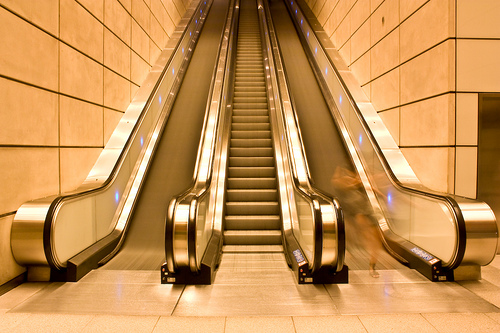
There are tiny competitions in life that nobody announces, nobody scores, and nobody admits caring about. Taking the stairs beside somebody taking the escalator is absolutely one of them.
The Secret Sport Happening in Every Mall, Airport, and Subway Station
You know the scene. You and another person reach the same vertical transportation crossroads at exactly the same time. They glide toward the escalator, choosing the slow mechanical river of convenience. You, for reasons that may include fitness, impatience, pride, or a sudden desire to become an action hero in business casual shoes, choose the stairs.
Now the race begins.
Nobody says “go.” Nobody stretches. Nobody checks a stopwatch. But the second your foot hits the first step and their shoe lands on the escalator tread, a full Olympic event has begun in your mind. You are now competing against a person who may not know they are competing, which is both unfair and deeply satisfying.
This is the everyday magic behind #685 Taking the stairs beside somebody taking the escalator – 1000 Awesome Things. It is not just about stairs. It is about momentum, micro-victories, healthy movement, ridiculous human psychology, and that goofy little burst of triumph when you reach the top first and pretend you are not breathing like a leaf blower.
Why This Tiny Moment Feels So Good
Part of the pleasure comes from contrast. The escalator passenger is moving upward without effort, carried by machinery like royalty entering a department-store palace. Meanwhile, you are using your own legs, lungs, balance, and mild stubbornness. It is primitive versus modern. Muscle versus motor. Human calves versus industrial engineering.
And somehow, the old-school method can win.
That is the delicious surprise. Stairs look like the harder option, but escalators are often slower than we expect. They are designed for safety and steady flow, not dramatic personal excellence. If the staircase is short, open, and not packed with people, a brisk stair climber can easily beat someone standing still on the escalator. Suddenly, your choice feels clever. You did not simply move between floors. You solved a tiny urban puzzle.
The Joy of Winning a Race No One Else Entered
Humans love progress. We like seeing ourselves move forward, upward, faster, better. This is why crossing items off a to-do list feels like receiving a tiny trophy from your own brain. Taking the stairs beside an escalator gives that same satisfaction in physical form. You can literally see the comparison beside you: step, step, step, glide, glide, glide.
When you reach the top before the escalator rider, your brain lights up with an absurd little celebration. You may not cheer out loud, because society has rules. But inside? Confetti cannon. Marching band. Slow-motion movie shot. A bald eagle appears for no reason.
The Health Bonus Hiding in Plain Sight
The funniest part is that this tiny victory is also good for you. Stair climbing is one of the easiest ways to sneak physical activity into a normal day. You do not need a gym membership, a playlist called “Beast Mode,” or athletic wear so advanced it looks designed by NASA. You just need stairs and a willingness to be mildly inconvenienced for thirty seconds.
Health experts consistently recommend adding more movement into daily routines. Walking, climbing stairs, stretching, and taking short movement breaks all count as physical activity. Adults are generally encouraged to aim for regular moderate-intensity activity during the week, and even short bursts can contribute to better fitness over time.
Stairs are especially powerful because they ask more from the body than flat walking. Your quadriceps, hamstrings, glutes, calves, core, heart, and lungs all join the meeting. Unlike many exercises, stair climbing is both cardio and strength work. It raises your heart rate while also making your lower body do the ancient work of lifting you against gravity. Gravity, as usual, remains undefeated, but stairs let you argue with it politely.
Why Stairs Feel Hard So Quickly
If you have ever climbed three flights and wondered whether your lungs filed a complaint, you are not alone. Stairs feel intense because every step requires vertical effort. You are not just moving forward; you are moving upward. That means your body has to lift its weight repeatedly, which increases demand on the cardiovascular system and leg muscles.
This is why a short stair climb can feel more challenging than a longer walk down a hallway. It is not because you are secretly out of shape, although your group chat does not need to know that. It is because stairs are efficient. They compress effort into a small space and a short time.
That makes the staircase-escalator moment so satisfying. You are doing something practical, playful, and physically meaningful all at once. It is not a workout with a clipboard. It is a tiny adventure between Floor 1 and Floor 2.
Why the Escalator Still Deserves Respect
Before we crown stairs as the undisputed champion of civilization, let us be fair: escalators are wonderful. They help people move through busy buildings. They reduce effort for people carrying luggage, managing children, recovering from fatigue, or simply not interested in turning every errand into a cardio sampler.
More importantly, stairs are not accessible or safe for everyone. People with mobility disabilities, injuries, balance concerns, chronic pain, heart or lung conditions, pregnancy-related discomfort, heavy bags, or temporary exhaustion may need elevators, escalators, ramps, or other accessible routes. A good public space should offer choices, not shame.
So the awesomeness of taking the stairs beside someone on the escalator is not about judging the person on the escalator. It is about enjoying your own choice. Their ride is valid. Your climb is valid. The escalator is not laziness; it is infrastructure. The stairs are not moral superiority; they are an opportunity for a tiny personal win.
The Best Version of the Moment Is Playful, Not Smug
The charm disappears if the stair climber turns into a smug mountain goat. Nobody likes a person who reaches the top, looks back, and gives the escalator crowd a face that says, “I have conquered modern weakness.” Please do not become that person. That person probably also says “actually” before correcting cereal box trivia.
The better version is private, silly, and self-aware. You take the stairs, you race the escalator in your head, you win or lose, and you move on with your day. Maybe you smile. Maybe you pretend you are not winded. Maybe you silently thank your knees for showing up to work. That is enough.
The Psychology of Micro-Victories
One reason this moment feels so memorable is that it creates a micro-victory. A micro-victory is a small success that gives your day a little lift. It does not change your life, but it changes the next five minutes. You feel more awake, more capable, and more engaged with the world around you.
These small wins matter because daily life is full of neutral moments: waiting, walking, commuting, standing in line, searching for keys, wondering why your phone battery drops from 24 percent to 9 percent in the time it takes to blink. When an ordinary moment suddenly becomes playful, it breaks the gray routine.
Taking the stairs beside someone on the escalator turns architecture into entertainment. It transforms a building feature into a tiny personal challenge. Instead of passively moving through space, you participate in it.
The “Main Character” Feeling, Without the Drama
There is also a tiny main-character feeling. Not the exhausting kind where every coffee order becomes a cinematic crisis, but the healthy kind where you feel present in your own day. You notice your body. You notice your surroundings. You notice the escalator rider rising beside you like a calm villain in a very low-budget action movie.
That awareness is part of the magic. The moment is funny because it is so ordinary and yet so strangely dramatic. You are not saving the world. You are not outrunning a volcano. You are just trying to reach the mezzanine before a stranger in loafers. Still, for seven glorious seconds, it matters.
How Stair Moments Build Better Daily Habits
Big health goals can feel intimidating. “Get in shape” sounds like a massive project involving meal plans, expensive shoes, and a suspicious amount of steamed broccoli. But “take the stairs this time” feels doable. That is the beauty of small habits. They are specific, repeatable, and easy to attach to a daily cue.
Habit research often emphasizes the importance of context, repetition, enjoyment, and simple action. Taking the stairs works because the cue is obvious: you see stairs. The behavior is clear: climb them. The reward is immediate: you arrive, your heart wakes up, and sometimes you defeat the escalator without anyone knowing a competition occurred.
Over time, choosing stairs can become automatic. You stop negotiating with yourself. You stop holding a courtroom debate every time you see an escalator. You simply take the stairs when it makes sense. This is how many healthy routines begin: not with a dramatic identity transformation, but with one small choice repeated often enough to become normal.
When to Take the Stairsand When Not To
Of course, common sense gets a vote. Take the stairs when they are safe, well-lit, not overcrowded, and appropriate for your body that day. Skip them when you are injured, dizzy, overloaded with luggage, wearing shoes designed by someone who hates feet, or dealing with a health condition that makes stair climbing risky.
The goal is not to turn stairs into a punishment. The goal is to make movement feel available. Some days the awesome thing is taking the stairs. Other days the awesome thing is choosing the escalator because your ankle hurts and you are listening to your body like a responsible adult. Growth comes in many forms, including not being ridiculous.
Escalator Etiquette: A Quick Survival Guide
Since this topic involves escalators, we must address the great social contract of vertical transportation: stand on one side, walk on the other, and do not become a human cork in a moving bottle. In many U.S. cities, the informal rule is to stand on the right and pass on the left. In crowded spaces, rules may shift depending on signs, safety guidance, or local habits.
If you are on the escalator, hold the rail when needed, keep bags from blocking others, and pay attention at the top so you do not create a sudden traffic jam. If you are on the stairs, avoid sprinting past people like you are late for a movie explosion. Everyone is just trying to get somewhere.
The perfect staircase-escalator race is respectful. You are not cutting people off, shoving through crowds, or making strangers feel judged. You are simply choosing the stairs and letting the tiny drama unfold in your own head, where it belongs.
Why “1000 Awesome Things” Still Works
The enduring appeal of the “1000 Awesome Things” idea is that it celebrates small pleasures most people overlook. Life is not only made of weddings, promotions, vacations, and giant milestones. It is also made of tiny sparks: peeling a sticker cleanly, finding money in an old coat, hearing a favorite song in a store, or beating an escalator to the top of the stairs while pretending you did not try.
These moments matter because they help us notice the ordinary. They remind us that happiness is not always hiding behind a major achievement. Sometimes it is standing beside a brushed-metal handrail, wearing a backpack, and realizing your legs are faster than a machine today.
That is the genius of this particular awesome thing. It is universal, visual, and funny. Almost everyone has seen stairs beside an escalator. Almost everyone understands the temptation to compare speeds. Almost everyone knows the strange pride of reaching the top first and immediately acting casual, as if your soul is not wearing a gold medal.
Real-Life Examples of This Tiny Awesome Thing
The Mall Sprint That Pretends to Be a Walk
You are at the mall with a friend. They take the escalator because they are holding a smoothie the size of a houseplant. You take the stairs. At first, you are relaxed. Then you notice you are exactly even. Suddenly, your pace increases by 12 percent. Your friend looks over. You look away, pretending the ceiling is fascinating. You reach the top first and say, “What took you so long?” This is friendship, apparently.
The Subway Station Comeback
You exit a subway platform and see the escalator packed with commuters. The stairs look open. You take them, not because you are athletic, but because you have places to be and patience is currently unavailable. Halfway up, you regret your confidence. Three-quarters up, you question your life choices. At the top, you pass the same people still rising on the escalator. Regret turns into glory.
The Airport Carry-On Challenge
Airports are full of escalators, moving walkways, and people dragging suitcases with the intensity of medieval knights. Taking the stairs beside an escalator while carrying a bag feels like bonus difficulty. If you reach the top smoothly, you feel efficient and powerful. If you arrive wheezing, you still get points for effort and maybe a reminder to pack fewer “just in case” outfits next time.
How to Make the Most of the Moment
If you want to enjoy this tiny awesome thing more often, keep it simple. Choose the stairs when the climb is short and safe. Use the handrail when needed. Take a comfortable pace. Let the escalator person be your silent pacing partner, not your enemy. If you win, enjoy it privately. If you lose, blame physics, footwear, or the suspiciously fast escalator settings.
You can also use stair moments as mini energy resets. Feeling sleepy after lunch? Take one flight. Waiting for an elevator that seems to be visiting every floor in geological time? Take the stairs. Need to shake off a stressful meeting? A short climb can help your body move out some tension. Stairs are not therapy, but sometimes they are a decent opening act.
Make It a Game, Not a Guilt Trip
The key is playfulness. The second stairs become a guilt machine, the joy disappears. You are not required to take them every time. You are not failing if you choose the escalator. You are simply giving yourself an option: a little movement, a little challenge, and maybe a tiny moment of victory in a day that could use one.
of Experience: What It Feels Like to Take the Stairs Beside the Escalator
The experience usually begins with false confidence. You see the stairs, you see the escalator, and your brain says, “We can do this.” This is the same brain that once convinced you one grocery basket was enough for a full weekly shop, so its judgment is not flawless. Still, you believe. You step onto the first stair with a casual rhythm, the kind that says, “I am not competing. I am merely a person who enjoys architecture.”
Then you glance sideways. Big mistake. The escalator rider is moving at a steady, royal pace. They are relaxed. They are not lifting a knee. They may even be checking their phone. Meanwhile, your legs have begun filing paperwork. You are only five steps in, but the staircase suddenly looks longer than it did from the bottom. Was it always this tall? Did the building add extra stairs while you were not looking?
You speed up anyway.
Now the race is real. You are no longer a casual stair user. You are a vertical athlete in jeans. Your breathing changes from “normal human” to “motivational documentary.” You try to keep your face calm because the escalator rider might look over, and nothing is more embarrassing than being caught losing a race you invented against someone who is thinking about tacos.
Halfway up, the drama peaks. If you are ahead, you feel heroic but nervous. Can you hold the lead? If you are behind, you start negotiating. Maybe you can take two steps at a time. Maybe the escalator will pause. Maybe the person will get distracted by a sale sign and lose momentum, despite being transported by machinery. Hope is not always logical.
Near the top, everything becomes slow motion. The escalator rider approaches the landing. You approach the final steps. Your calves are awake now, perhaps too awake. You reach the top first by half a second, and a ridiculous wave of satisfaction washes over you. You do not celebrate openly. You simply adjust your shirt, pretend to read a sign, and walk away with the quiet dignity of someone who has just defeated electricity.
But sometimes you lose. The escalator wins. The other person floats to the top while you arrive two seconds later, breathing like you just carried a piano through a swamp. Strangely, even that can feel good. You still moved. You still tried. You still turned a boring transition into a small story. And honestly, losing to a machine is not shameful. Machines have been training for this.
The best part is that the moment disappears almost instantly. Nobody records it. Nobody posts results. No leaderboard appears above the stairwell. Yet you carry the feeling with you: a little more awake, a little more amused, a little more connected to the funny theater of everyday life. That is why this tiny experience belongs on any list of awesome things. It proves that joy does not always need planning. Sometimes joy is just choosing the stairs and seeing what happens.
Conclusion: The Small Climb That Makes the Day Better
Taking the stairs beside somebody taking the escalator is awesome because it turns an ordinary choice into a tiny adventure. It gives you movement, humor, competition, and a private victory all at once. It asks nothing complicated from youjust a few steps, a bit of energy, and the willingness to enjoy a moment that most people would ignore.
In a world obsessed with giant achievements, this little stairway race reminds us that daily life is full of small wins. You do not need a medal to feel triumphant. You do not need an audience to enjoy progress. You do not even need the other person to know they were involved.
Sometimes the awesome thing is simple: you took the stairs, the escalator took them, and for one brief, breathless moment, you were faster than convenience.
SEO Tags
Note: This HTML body is written as original, publish-ready content in standard American English and is based on real health, habit, accessibility, and everyday-life research without inserting source links into the article body.